Your Health Magazine Contributor
4201 Northview Drive
Suite 102
Bowie, MD 20716
More Child Health and Safety Articles
93% of U.S. teens use their phones after 10 p.m. Here’s what they’re actually doing
New data from the U.S., the U.K., Canada, and Australia shows what teenagers do on their phones between 10 p.m. and 6 a.m., and why it matters for sleep, school, and online safety.
Most American teenagers are on their phones after dark. A Findmykids analysis of app-usage data found that 93.6% of U.S. teens aged 13–18 opened at least one app between 10 p.m. and 6 a.m. during a given week.
That doesn’t mean nine in ten teens are awake all night. The window runs from 10 p.m. to 6 a.m., so it includes the last few videos before sleep and the first look at the screen after the alarm goes off.
What the numbers do show is a clear pattern, and three findings stand out:
- The phone is busiest right before sleep and again soon after waking, with a quiet stretch in between.
- Nearly half of nighttime screen time goes to video, not to group chats or games.
- 13- to 15-year-olds use their phones at night almost exactly as often as 16- to 18-year-olds: by the early teens, the habit is already in place.
The data comes from Findmykids, a family location app with parental controls. The app records which apps a child opens and how screen time adds up, but not what’s inside messages or videos. The analysis covers teens in the U.S., the U.K., Canada, and Australia between August 24 and September 20, 2026.
U.S. teens use their phones at night more than teens elsewhere
Across all four countries, roughly nine in ten teens used a phone after 10 p.m. at least once a week. The U.S. sits at the top on every measure: more teens, more minutes, more nights.
Country -> Teens using a phone after 10 p.m. at least once a week -> Typical nighttime screen time per week (median) -> Nights with phone use, out of 7
U.S. -> 93.6% -> 256 min -> 5.6
Canada -> 91.5% -> 209 min -> 5.2
Australia -> 89.6% -> 218 min -> 5.1
U.K. -> 89.4% -> 186 min -> 5.1
For a typical American teen who uses the phone at night, that’s a little over four hours a week after 10 p.m., spread across 5.6 nights out of seven on average. This isn’t a Saturday-night thing. Four hours is the median; the average is 441 minutes, almost double, because a small group of very heavy users pulls it up.
The gap between countries is widest deep in the night. At least once a week, 50.9% of U.S. teens used the phone between 2 and 4 a.m., compared with 39.9% in Canada, 36.1% in the U.K., and 33.1% in Australia.
Teens aren’t on their phones all night
It would be easy to read 93% as a picture of teens scrolling until dawn. The hour-by-hour data says otherwise. Phone use clusters at the two edges of the night, before sleep and early in the morning, and the middle of the night is the quietest part.
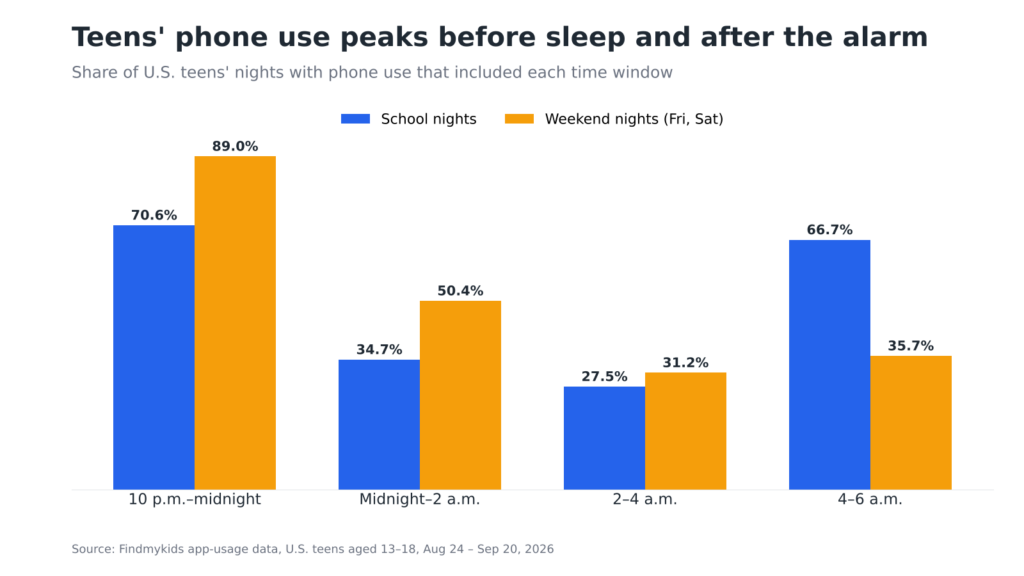
Time window -> All nights with phone use (U.S.) -> School nights -> Weekend nights
10 p.m.–midnight -> 75.9% -> 70.6% -> 89.0%
Midnight–2 a.m. -> 39.2% -> 34.7% -> 50.4%
2–4 a.m. -> 28.4% -> 27.5% -> 31.2%
4–6 a.m. -> 57.7% -> 66.7% -> 35.7%
One night can fall into several windows, so the columns don’t add up to 100%. Weekend nights are Friday and Saturday.
On school nights, the 4–6 a.m. window is almost twice as busy as on weekends. That’s not teens staying up until morning; it’s teens getting up for school and checking the phone soon after the alarm. The same weekday jump shows up in the U.K. and Canada.
Weekends flip the picture. Fewer teens are up early, and more stay on the phone late: 89% of active weekend nights include use between 10 p.m. and midnight, and about half go past midnight.
At night, teens mostly watch videos
Picture a teen on the phone at 11 p.m., and you probably imagine texting under the blanket. Mostly, they’re watching. Video and streaming take 43.4% of U.S. teens’ nighttime screen time, and 43–51% across the four countries. Social media (13.7% in the U.S.) and messaging (10.8%) together take about a quarter. Games get 4.4%, and education apps barely register at 0.2%.
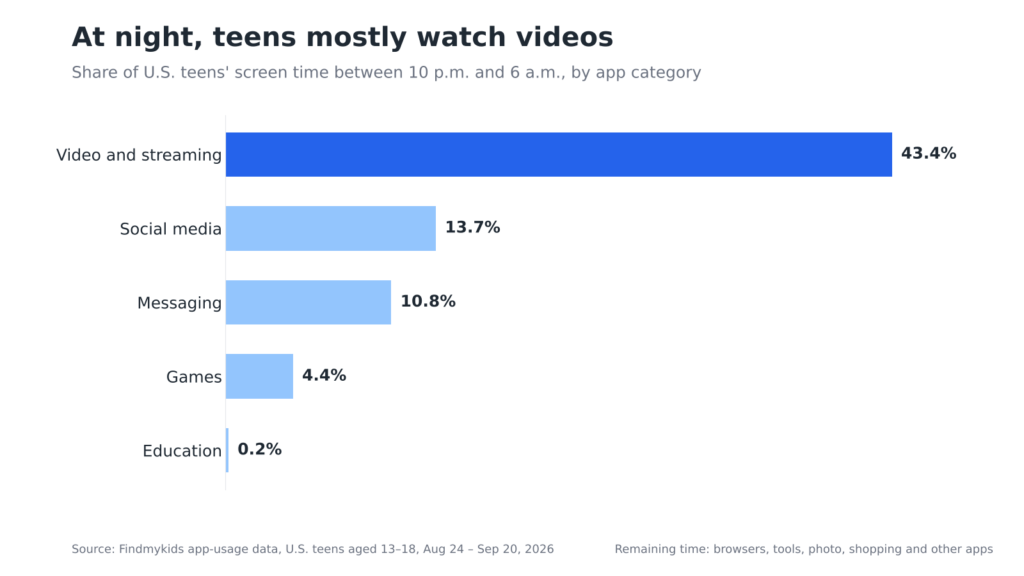
Nighttime video is mostly watching, not talking, and much of it is chosen by a recommendation feed rather than by the teen. With autoplay and short clips, “one more video” easily becomes twenty.
Late-night phone use is already a habit at 13–15
Many parents expect late nights with the phone to come later, with high school, a part-time job, or a driver’s license. The data doesn’t show that step.
Country -> Ages 13–15 -> Ages 16–18 -> Difference
U.S. -> 93.5% -> 93.7% -> 0.2 pts
U.K. -> 89.0% -> 91.1% -> 2.1 pts
Canada -> 91.0% -> 93.4% -> 2.4 pts
Australia -> 88.9% -> 91.6% -> 2.7 pts
Share of teens who used a phone after 10 p.m. at least once a week.
In the U.S., the gap between the two age groups is a fifth of a percentage point, and in no country is it more than three points. The data starts at 13, so it can’t show exactly when the habit forms. It does suggest that bedtime phone rules are easiest to agree on around the first phone, before the routine settles. A sleep schedule worked out together at 11 is a different conversation from one introduced at 15.
Does screen time affect sleep? The minutes in bed matter most
App data doesn’t measure sleep: a teen who opened an app at 11:40 p.m. may have been asleep by 11:45. But the busiest stretch in the data, 10 p.m. to midnight, is the one sleep researchers care about most. Poor sleep is also one of the harms named in the Surgeon General’s May 2026 warning on screen use.
Screens before bed matter less than screens in bed. A 2026 meta-analysis in JAMA Pediatrics found that on days with more screen time, young people fell asleep a little later, but sleep quality suffered more clearly only when screens were used after bedtime. A 2024 study of 11- to 14-year-olds, with sleep measured by devices, saw the same split: screens in the two hours before bed made little difference, while screens in bed meant later and shorter sleep.
In bed, a video feed has no natural end, and messages keep arriving. In a U.S. study of 9,398 children aged 11–12, leaving the ringer on overnight, texting, and using social media at bedtime were linked to shorter sleep a year later. Blue light can delay melatonin as well, but night mode doesn’t stop the next video.
The cost shows up in first period. In a study of 2,462 middle school students in Taiwan, sleep disrupted by social media, school burnout, and lower test scores fed into each other. The Findmykids data doesn’t include grades or sleep quality, so it can’t draw that line for the teens in this analysis.
Videos and chats at night: what safety agencies say
A teen in their room at 11 p.m. is home, but the phone still connects them to everyone else online. App-usage data doesn’t show messages, videos, or who a teen talks to, so it says nothing about strangers or harmful content. Child-safety agencies have been clear, though, about where those risks start: in the same kinds of apps teens use at night.
The FBI warns that financially motivated sextortion reaches children through social media, games, video and livestreaming platforms, and messaging apps. Offenders often pose as a peer, move the chat to another app, get an image, and then demand money. Typical victims are boys aged 14 to 17, though any child can be targeted. In a 2025 alert, the bureau also described violent online networks on ordinary social media and gaming platforms, with victims typically aged 10 to 17.
Then there’s what the feed serves up. The Surgeon General’s May 2026 warning lists harmful or age-inappropriate content and dangerous viral challenges among the risks of screen use. At 11 p.m., what a tired teen watches is largely up to the algorithm.
None of this means the night itself makes these risks more likely; the data doesn’t measure that. What helps most is a teen who knows they can tell a parent when something online feels wrong, without losing the phone for it.
What the data shows, and what it doesn’t
Numbers like 93% travel fast and lose their context on the way. The data shows that most teens use a phone at some point between 10 p.m. and 6 a.m., that use peaks before sleep and after waking, that video takes the largest share, and that 13- to 15-year-olds look much like older teens. It doesn’t show that teens don’t sleep, what they watch, who they talk to, or anything about sleep quality, grades, or mental health. The links to sleep and online safety come from outside research and child-safety agencies.
How parents can cut down phone use at night
Taking the phone away at bedtime is the obvious fix, and the one most likely to start an argument. Smaller changes aimed at the hour before sleep, the phone by the bed, and the feed tend to last longer.
- Agree on a phone curfew together. Thirty to 60 minutes before sleep works for most families. A teen who helped set the rule is more likely to keep it.
- Charge phones outside the bedroom. A kitchen shelf or hallway charger takes away the 3 a.m. scroll and the buzz of late messages.
- Get a regular alarm clock. “I need it for the alarm” is the most common reason a phone stays by the bed.
- Turn off what keeps the feed going. Autoplay and nonessential notifications can be switched off in most apps; Do Not Disturb or sleep mode handles the rest.
- Keep the same rule for adults. Teens notice when the curfew applies only to them.
Some families also use parental control apps to keep the agreement in place. With Findmykids parental controls, for example, a parent can set a sleep schedule that blocks entertainment apps on school nights until morning while keeping chosen apps available, with a later time on weekends. This works best when the child knows about it: set it up together, explain why, and adjust it as they grow.
If a teen regularly stays up far later than planned, struggles to wake on school days, falls asleep during the day, or seems low or irritable for weeks, sleep may be part of the problem, and it’s worth discussing with a pediatrician.
Frequently asked questions
What are teens doing on their phones at night? Mostly watching videos. Video and streaming apps took 43–51% of teens’ screen time between 10 p.m. and 6 a.m. across the four countries.
Are teens on their phones all night? Most aren’t. Use peaks between 10 p.m. and midnight and again between 4 and 6 a.m., with the quietest stretch from 2 to 4 a.m.
At what age do kids start using their phones at night? Earlier than many parents expect: 93.5% of U.S. teens aged 13–15 used a phone after 10 p.m. at least once a week, almost the same as 93.7% of 16- to 18-year-olds.
Is sleeping with your phone next to you bad? The main concern is sleep, not radiation. A phone within reach makes late-night checking easy, which is why pediatricians suggest charging phones outside the bedroom. The FDA and the National Cancer Institute say current evidence doesn’t link phone radio waves to health problems such as cancer.
Methodology
Findmykids analyzed app-usage data from teens aged 13–18 (in two groups, 13–15 and 16–18) in the U.S., the U.K., Canada, and Australia from August 24 to September 20, 2026. The night window was 10 p.m. to 6 a.m. local time; weekend nights are Friday and Saturday. A teen counted as active at night if they used any app at least once in that window during the week. Shares are calculated among teens whose app-usage data was available for that week. Nighttime phone activity is not a measure of sleep, and the data doesn’t include message or video content, contacts, grades, or health information.
Sources: Findmykids app-usage data, Aug 24 – Sep 20, 2026; Bourke M. et al., JAMA Pediatrics, 2026; Brosnan B. et al., JAMA Pediatrics, 2024; Nagata J. M. et al., Journal of Adolescent Health, 2024; Evers K. et al., Journal of Adolescence, 2020; FBI, Financially motivated sextortion of minors; FBI / IC3, Violent Online Networks Target Vulnerable and Underage Populations, March 2025; U.S. Department of Health and Human Services, Surgeon General’s Warning on the Harms of Screen Use, May 2026.
Maria Novak, Partner Manager at Findmykids
Other Articles You May Find of Interest...
- 93% of U.S. teens use their phones after 10 p.m. Here’s what they’re actually doing
- What is Developmental Care in the NICU and How Do Incubators Help?
- Picky Eating or Something More? 7 Signs Your Child May Need Nutrition Support
- Is 3D Printing Safe for Kids? What Parents Should Know About Fumes and Materials
- What to Look for in Non-Toxic Toys for Toddlers
- Sensory Regulation for Anxious Kids: A Pediatric Guide to Safe, Non-Toxic Fidget Tools
- Is My Child’s Sleep Normal? When to Talk to Your Pediatrician