Your Health Magazine Contributor
4201 Northview Drive
Suite 102
Bowie, MD 20716
More Child Health and Safety Articles
What is Developmental Care in the NICU and How Do Incubators Help?
In the NICU, newborns face a stressful environment: temperature fluctuations, bright lights, noise, and various examinations all create stimulation that drains their energy and can even hinder neurodevelopment.
Developmental care aims to address this problem. Its core idea is straightforward: transform the NICU into a supportive microenvironment that mimics the womb: dim, warm, and containing. The neonatal incubator is the device that carries this microenvironment. Read on for more information.
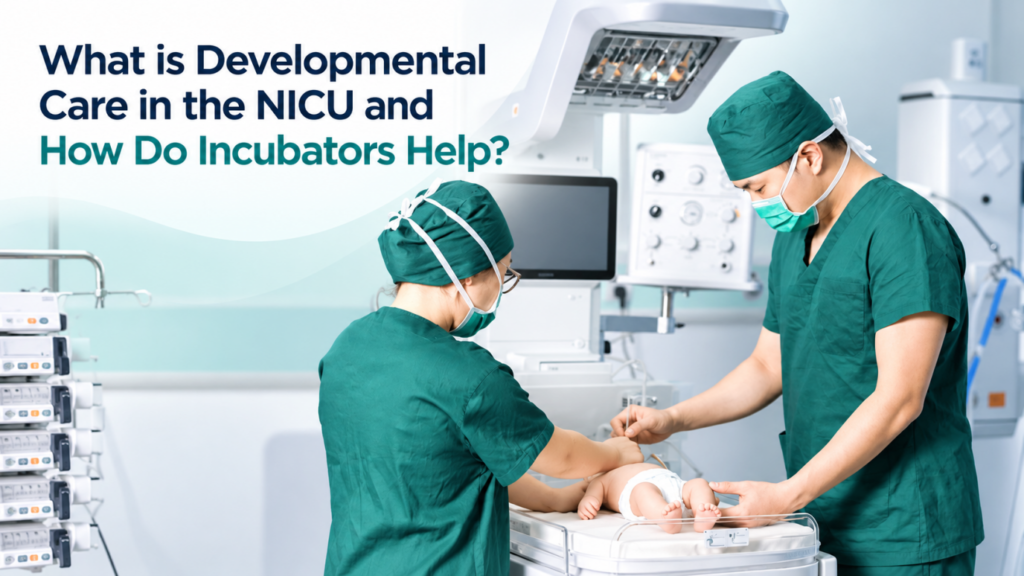
What is Developmental Care in the NICU?
Developmental care refers to a set of measures designed for newborns, especially preterm or high-risk infants, to reduce stress in the NICU, for example, controlling external stimuli (vestibular, auditory, visual, and tactile), scheduling nursing activities, and adjusting newborns’ positioning or wrapping so they feel a sense of security similar to that in the womb. [1]
Developmental care matters because
- Newborns have immature organ function and weak thermoregulation and immune defenses, making them highly vulnerable to external environmental influences.
- The early postnatal period is a critical window for brain development, during which positive sensory stimulation is needed to promote development.
- Newborns need to build a sense of security through maternal-infant contact and comforting behaviors, which helps reduce stress responses.
Key Elements of Developmental Care in the NICU
Neuroprotective family-centered developmental care for preterm infants comprises seven core measures, which serve as guiding clinical practice in many NICUs worldwide. [2]
- Healing Environment
The healing environment refers to the NICU’s physical environment, including space, privacy, and safety; the sensory environment, such as temperature, touch, proprioception, smell, taste, sound, and light; and people interactions.
It’s recommended to ensure an average sound level of 45 dB and adjustable light levels. Units stay fragrance-free, use incubators, shield the infant’s eyes during care, and silence alarms quickly.
- Partnering with Families
Parents are essential members of the neonatal care team. They should participate in care planning, decision-making, and appropriate daily care.
Healthcare professionals can teach parents to recognize infant behavioral cues and respond to their needs. When clinically appropriate, skin-to-skin contact and parental interaction can support bonding, physiological stability, and neonatal development.

- Positioning & Handling
Positioning copies the womb posture, with the limbs bent and soft boundaries around the infant. These boundaries usually help infants sleep longer and improve musculoskeletal development.
When handling infants, movements should be slow, gentle, and modulated. However, frequent touching can disrupt sleep and lead to poorer state regulation, so it is essential to schedule care appropriately according to the infant’s sleep and wake states.
- Safeguarding Sleep
Sleep supports infants’ neurodevelopment and optimal growth. The alternation between rapid eye movement (REM) and non-REM sleep is essential for early sensory development, learning, and memory. Developmental care requires attention to infant positioning, clustering nursing procedures, and managing ward light and noise.
- Minimizing Stress and Pain
Even routine care can be stressful or even painful for preterm infants. This raises cortisol levels and limits neuroplastic reorganization, thereby affecting the learning and memory of motor skills.
To manage pain and stress, assessment should come first; healthcare providers can then intervene with non-pharmacological measures, including skin-to-skin contact, breastfeeding, swaddling, and developmentally supportive positioning.
- Protecting Skin
Preterm skin has an underdeveloped barrier, putting infants at risk of water and heat loss, skin injury, and infection. Repeated application and removal of adhesive tape, along with irritation from disinfectants and wipes, can all cause damage. Developmental care requires choosing low-irritation products and minimizing unnecessary skin-contact procedures.
- Optimizing Nutrition
Human milk is the preferred nutrition. It lowers the risk of serious intestinal disease and bloodstream infection. Feeding methods and schedules should be adjusted according to the infant’s ability to coordinate feeding and maintain physiological stability. Regular assessment of feeding tolerance, growth, and progress toward oral feeding helps guide individualized nutritional care.
How Do Neonatal Incubators Support Developmental Care?
Incubators provide a controllable care environment for infants who need special environmental support. In neonatal care, they make the elements above possible at the bedside. Five functions matter most.
- Maintain Stable Body Temperature
Preterm infants have little body fat and a high surface-area-to-mass ratio, so they lose heat quickly. An incubator keeps the infant in a neutral thermal environment, the temperature range in which the infant uses the least energy to stay warm.
Most incubators offer two control modes. Air mode holds the air temperature at a set value. Servo mode uses a skin temperature probe and adjusts heat to keep the infant’s skin at a target temperature. Alarms alert staff to deviations.
- Provide Appropriate Humidity
Some preterm infants need higher humidity because their immature skin allows greater water loss. Humidity control of incubators lets clinicians adjust settings according to the infant’s needs.
- Reduce Noise and Environmental Disturbances
The incubator hood blocks part of the noise and light from the ward. Design features reduce internal noise further. Quiet-closing access panels, internal noise-management features, careful alarm handling, and fewer unnecessary openings can support a calmer space. Incubators can also offer mood light.
- Support Continuous Observation and Monitoring
A transparent canopy allows staff to observe an infant without opening the incubator for every visual check. Depending on the model and configuration, integrated or compatible monitors can track temperature, oxygen saturation, heart rate, respiration, and humidity. These readings support decisions but must be interpreted alongside bedside assessment.
- Promote Gentle Nursing Care
Equipment design affects how nurses handle infants. Three design qualities matter:
- Ease of operation: Tilting beds, height adjustment, and touchscreen controls reduce manual effort.
- Ergonomics: Easy-reach access points support smooth, controlled movements.
- Convenient maintenance: Removable parts and fast disassembly simplify cleaning and reduce infection risk.
Supporting Developmental Care with Comen Neonatal Incubators
Comen manufactures neonatal incubators designed to support temperature regulation, humidity management, monitoring, and nursing care in different neonatal settings.
Its product range includes the B10, B6/B8, and B3 incubators, as well as the BT800 transport incubator. Depending on the model, features may include servo-controlled temperature regulation, humidity control, adjustable beds, monitoring capabilities, and access points designed to support gentle handling.
These features can contribute to a controlled environment for premature and critically ill newborns. However, equipment selection should be based on each NICU’s clinical requirements, established care protocols, and the needs of individual infants.
References
- Developmental care for promoting development and preventing morbidity in preterm infants. Available at: https://pmc.ncbi.nlm.nih.gov/articles/PMC8962209/ (Accessed: 28 October 2026)
- The Neonatal Integrative Developmental Care Model: Advanced Clinical Applications of the Seven Core Measures for Neuroprotective Family-centered Developmental Care. Available at: https://www.sciencedirect.com/science/article/pii/S1527336916301118#ab0005 (Accessed: 28 October 2026)
Other Articles You May Find of Interest...
- What is Developmental Care in the NICU and How Do Incubators Help?
- Picky Eating or Something More? 7 Signs Your Child May Need Nutrition Support
- Is 3D Printing Safe for Kids? What Parents Should Know About Fumes and Materials
- What to Look for in Non-Toxic Toys for Toddlers
- Sensory Regulation for Anxious Kids: A Pediatric Guide to Safe, Non-Toxic Fidget Tools
- Is My Child’s Sleep Normal? When to Talk to Your Pediatrician
- How Play-Based Learning Can Support Skill Development in Children With Autism