Your Health Magazine Contributor
4201 Northview Drive
Suite 102
Bowie, MD 20716
More Child Health and Safety Articles
Is 3D Printing Safe for Kids? What Parents Should Know About Fumes and Materials
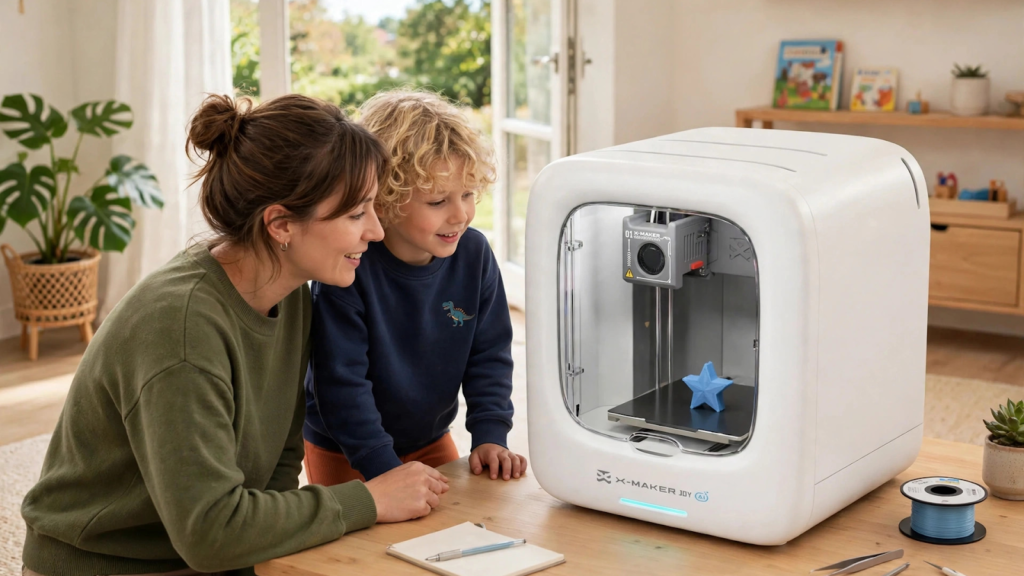
Parents rarely worry about the toy once it is finished. The worry is the print itself. A machine heats plastic. Ours sat on the kitchen counter while my son played beside it. A small set of habits covers most of it.
What Parents Actually Worry About
The first worry is usually heat. Inside the printer, plastic melts past 200 degrees Celsius. Touching it burns skin. Our printer is fully enclosed, so a closed panel stays between my son and the hot parts while it prints. We keep the lid shut until the print stops. I open it myself, only after the bed has cooled.
Heat and moving parts
Moving parts cause a second worry. An enclosure puts those parts out of a child’s reach. Older children can take on more steps. An adult still handles hardware jobs. A nozzle change is one of those.
Small parts after printing
Our last print came off the bed with a thin fin. The base had a sharp edge. A wheel pulled loose. I check each piece in my hands. I check it before my son plays with it. Sand any rough edge smooth. Set aside any design with small detachable parts under three centimetres, especially for children under three.
Why PLA Is the Usual Starting Point
PLA is the filament most parents meet first. It gives off very little odour while printing. It releases far fewer volatile compounds than ABS. AOSEED PLA went through third party testing. The lab checked heavy metals first. Then volatile emissions. Then skin sensitization. Parents who want the short version can start with is 3D printing safe for kids, which sets out age bands, supervision, and room setup in one place.
Even PLA melts. That happens at around 200 to 220 degrees Celsius. We do not let those particles build up where my son breathes. For occasional printing, an open window and some distance from the machine cover most homes.
Fumes and Ventilation in Plain Terms
Parents ask about fumes a lot. The answer has two parts. PLA gives off far fewer emissions than ABS or resin. Researchers also note something else. Researchers have not settled the long term health effects of printing emissions yet. We print PLA only with the window open. Nobody stands over the printer during the first layers in our house. The enclosure stays shut through the whole print.
A room check that takes two minutes
Before a print starts, I walk the same two-minute check. The printer sits on our flat kitchen worktop. It sits well back from the edge. I look at the spool. I make sure it is PLA, not ABS or resin. I push the enclosure door. I push it until it clicks shut. Then I tell my son the one rule. Hands stay outside while it runs.
Materials Compared Without the Jargon
Not every filament behaves the same way. PLA is low odour, easy to print, and works with both AOSEED printers. PETG is stronger. It lasts longer. AOSEED printers do not support it. TPU bends. It suits parts that need to flex. It needs a printer built for flexible filament. AOSEED printers do not support it. ABS makes tougher parts. It releases stronger fumes. It is not recommended for kids toys, even though the larger X-MAKER can print it.
What to skip for young kids
For children under twelve, the skip list is short. Skip ABS. Skip resin. Skip any filament a parent cannot name. Skip tiny detachable parts. Skip printing overnight without supervision. The X-MAKER JOY keeps this simpler by design, since it is PLA only and fully enclosed.
Sand, check, then hand it over
Finishing matters as much as material choice. I sand each sharp edge until my thumb feels nothing rough. Press joints gently to check them. Press thin sections gently too. I wash PLA toys by hand. I wash them in the sink. Mild soap and warm water are enough. I never leave them soaking. I keep the soak short. A long soak warps the plastic. It goes out of shape. A piece that cracks goes in the bin. The same goes for one that loosens or softens.
A Checklist You Can Use Before the First Print
For ages four to seven, an adult stays present the whole time. The adult loads the filament. The adult starts the job. The adult takes the print off. Ages eight to eleven can run a session with an adult nearby. Children aged twelve and up can work mostly on their own, with an adult on call for hardware tasks.
The X-MAKER JOY fits the younger end of that range. It is built for ages four to twelve, fully enclosed, app guided, and PLA only, with a build volume of 120 by 120 by 120 millimetres. The larger X-MAKER suits ages nine to sixteen, with a 150 millimetre build volume and a touchscreen child lock. For the material side in more detail, AOSEED explains which filaments suit children’s toys and which ones to leave out.
The rest comes down to five habits. Our printer stays enclosed for every kids project. The window stays open while it prints. That keeps the room ventilated. Only PLA goes in for kids projects. Supervision matches the child’s age. Every toy gets inspected before play. Every toy gets finished before play. A damaged toy gets retired, not kept. Do not repair it for continued play.
Conclusion
3D printing fits family life when parents treat it as a supervised activity. A few fixed rules carry it. Pick an enclosed printer. Choose PLA. Every finished toy gets checked. Those steps leave some risk in place. No guide that tells the truth claims otherwise. They cut the risks parents actually face at home to a level most families can manage.
Other Articles You May Find of Interest...
- Is 3D Printing Safe for Kids? What Parents Should Know About Fumes and Materials
- What to Look for in Non-Toxic Toys for Toddlers
- Sensory Regulation for Anxious Kids: A Pediatric Guide to Safe, Non-Toxic Fidget Tools
- Is My Child’s Sleep Normal? When to Talk to Your Pediatrician
- How Play-Based Learning Can Support Skill Development in Children With Autism
- 6 Ways Personalized ABA Therapy Can Support Developmental Skills
- How Teachers Can Use Sound Buttons to Practice Medial Sounds With Early Readers