




Your Health Magazine Contributor
4201 Northview Drive
Suite 102
Bowie, MD 20716
More Weight Control, Nutrition & Exercise Articles
Lipo 360 vs. Traditional Liposuction: What Patients Should Know About Full-Torso Contouring
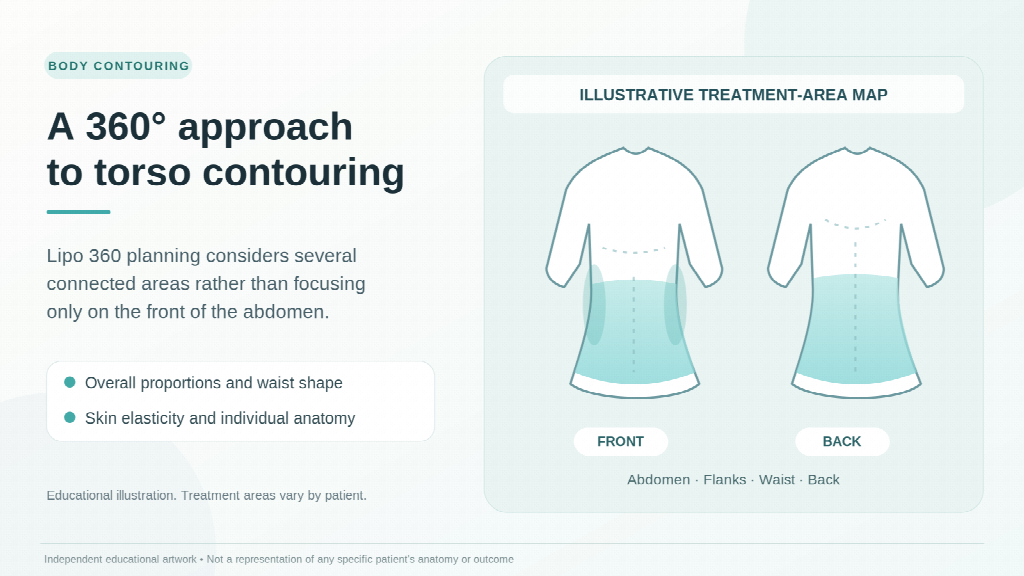
Conceptual illustration of a circumferential treatment approach; actual treatment plans vary.
A person considering liposuction may focus on one concern: a stubborn lower abdomen, fullness around the waist, or fat along the back. Yet the way those areas connect can matter as much as any single measurement. Treating only the front of the body, for example, may not address the contours visible from the side or behind.
That is the idea behind Lipo 360. Rather than promising a different kind of fat removal, it describes a circumferential approach to shaping the torso. Understanding what that means—and what it cannot accomplish—helps patients have a more useful conversation before surgery.
1. What Does “Lipo 360” Actually Mean?
Lipo 360 generally refers to liposuction planned around the midsection, commonly including the abdomen, waist, flanks and back. The precise areas differ according to anatomy, goals and what a surgeon considers appropriate.
Standard liposuction uses a thin instrument called a cannula to remove selected deposits of fat beneath the skin. Lipo 360 uses liposuction techniques too; the “360” describes the treatment pattern, not a separate, universally standardized surgical technology.
The objective is to evaluate how the front, sides and back relate to one another. Someone might have relatively little fat at the front but more around the flanks. Another person may be concerned about the transition between the lower back and waist. Both situations call for individualized planning rather than a fixed checklist of areas to treat.
2. How Is It Different from Treating Just One Area?
Traditional, limited-area liposuction can be a sensible option when the concern is genuinely localized. A surgeon might treat only the lower abdomen or one other area without needing a wider procedure.
With a circumferential plan, the assessment includes how changes in one region could affect the appearance of neighboring regions. That means evaluating:
- Front-to-side transitions: how the abdomen meets the waist.
- Flank contours: how the waistline looks in profile.
- Back definition: whether fat along the back changes the overall silhouette.
- Natural proportions: how the torso relates to the hips and surrounding anatomy.
This broader approach is not automatically superior. Treating more surface area can mean a more involved operation and recovery. The important question is whether the additional treatment is likely to serve the patient’s goals safely.
3. Skin Elasticity Can Be More Important Than Fat Volume
A successful body-contouring plan considers what happens to the skin after the underlying fat is removed. Skin with good elasticity may adapt more readily to a changed contour. Skin that is significantly loose may not contract enough to create the result a patient expects.
This distinction is especially relevant after major weight changes, pregnancy or natural changes with age. Liposuction removes fat; it does not remove substantial amounts of excess skin or repair separated abdominal muscles.
For some patients, a tummy tuck or another carefully selected procedure may be more appropriate. For others, limited liposuction—or no surgery—may be the reasonable choice. Good planning involves being clear about these alternatives instead of assuming that more fat removal will solve every concern.
4. Five Questions Worth Asking Before Booking Surgery
An informed consultation should go beyond a before-and-after gallery. Consider asking:
- Which areas would actually be treated? “Lipo 360” can describe different treatment plans between practices.
- How will my skin respond? Ask what your surgeon observes about elasticity and whether loose skin could remain.
- What credentials and facility standards apply? Verify plastic surgery board certification, relevant experience and accreditation of the surgical setting.
- What are the realistic risks? Discuss contour irregularities, fluid collections, infection, changes in sensation, anesthesia and blood-clot risks.
- What would recovery involve for me? Work, caregiving, exercise and follow-up needs should influence your decision.
For someone researching body contouring in Charlotte, consultation with an Expert Lipo 360 Surgeon can provide an opportunity to discuss anatomy, treatment options and realistic expectations before committing to a procedure.
5. Who Might Be a Suitable Candidate?
Liposuction is generally considered for people in good health with relatively stable weight and specific fat deposits they want to address. It is not a weight-loss treatment and does not remove the deeper visceral fat surrounding internal organs.
A patient’s medical history, medications, smoking or nicotine use, skin condition and expectations all require review. A qualified surgeon may advise postponing surgery or recommend a different approach when risks outweigh likely benefits.
Importantly, feeling unhappy with one part of your body does not mean a procedure is necessary. The decision should be personal, informed and free from pressure.
6. What Can Patients Expect from the Results?
Liposuction reduces the number of fat cells in treated areas, but it does not prevent future weight changes. Remaining fat cells can enlarge if weight increases, and the body will continue to change with age.
Results also take time to evaluate. Bruising and swelling are expected after surgery, and the developing contour may not be clear for weeks or months. Some patients experience unevenness or persistent loose skin; a particular shape cannot be guaranteed.
A realistic goal is proportionate contour improvement, not a specific clothing size, scale reading or digitally edited appearance. Photographs of actual patients with similar anatomy may help inform expectations, but individual results still vary.
The Bottom Line
Lipo 360 is best understood as a way of planning liposuction around the torso, rather than a shortcut to weight loss or a guarantee of a particular silhouette. The central considerations are anatomy, skin elasticity, the extent of treatment, surgical safety and the patient’s own goals.
A thoughtful consultation should leave someone better informed—even if the eventual decision is to choose a smaller procedure, explore an alternative or avoid surgery altogether.
Frequently Asked Questions
Is Lipo 360 a different operation from liposuction?
Not necessarily. It refers to a circumferential treatment approach using liposuction techniques, with the exact plan determined individually.
Does Lipo 360 tighten loose skin?
Liposuction alone does not reliably correct substantial skin laxity. A surgeon should assess whether another approach is needed.
Does it replace healthy eating and exercise?
No. It is a contouring procedure, not treatment for obesity or a substitute for long-term weight management.
Other Articles You May Find of Interest...
- Lipo 360 vs. Traditional Liposuction: What Patients Should Know About Full-Torso Contouring
- Holiday Weight Gain Is Real: A Seven-Day Indoor Walking Plan
- Rapid Weight Gain: Possible Causes and When to Seek Care
- Cheapest Tirzepatide Online: 6 Programs Compared on Total Monthly Cost
- What to Look for in a Gastric Bypass Surgery Program Near Kissimmee
- How GLP-1 Medications Are Changing Eating Habits
- Best Treadmills for Home Use: What to Look For Before Buying





