






Your Health Magazine Contributor
4201 Northview Drive
Suite 102
Bowie, MD 20716
More Health Education Articles
Tesamorelin Before and After: Week-by-Week Results and What to Expect
Disclaimer: This article is published for educational and informational purposes only. It summarizes what published research on tesamorelin has measured and explains how to interpret before-and-after results reported online. It does not constitute medical advice, diagnosis, or treatment, and reading it does not create a clinician-patient relationship. No dosing, administration, cycling, or stacking guidance appears anywhere in this article.
You see tons of tesamorelin before-and-after photos online. Ever wondered if they are real? Here’s what research says.

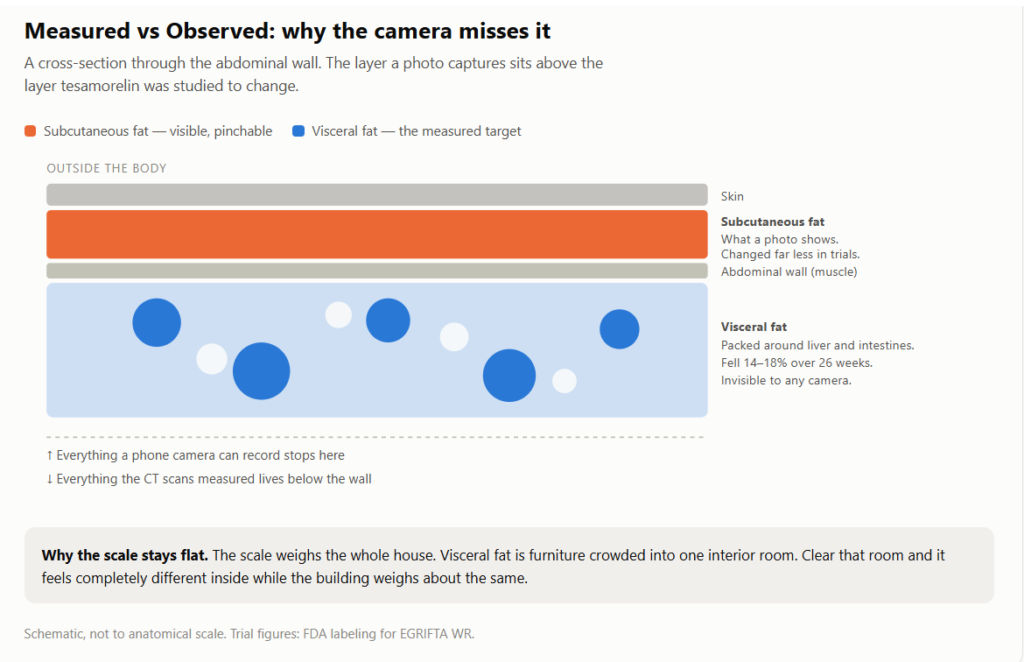
Tesamorelin research isn’t really about dramatic weight loss. It has mainly been studied for visceral adipose tissue, the deeper fat stored around your organs, along with changes in overall body composition. A before-and-after photo can show a smaller-looking waist, but it can’t show what’s happening to the visceral fat underneath. You’d need imaging, such as CT scans, to measure that.
Most clinical research around the peptide involves adults with HIV-associated lipodystrophy, so those results should not be assumed to apply to other populations. Tesamorelin is also sold separately in the research-chemical market, where Tesamorelin suppliers like Kylo Peptides describe laboratory testing and purity specifications for their research-use products. Research-use products are not the same as FDA-approved prescription tesamorelin and should not be interpreted as products approved for human use.
Key Takeaways
- Tesamorelin has been studied primarily for its effects on visceral adipose tissue, the deep abdominal fat located around internal organs.
- Changes in clinical studies occurred primarily in body composition. FDA labeling describes tesamorelin as having a “weight neutral effect.”
- The pivotal studies measured outcomes over 26 weeks and reported reductions in visceral adipose tissue.
- Six months was an important research checkpoint. A pooled analysis of 806 patients examined factors associated with response at that point.
- The principal evidence base discussed here involves adults with HIV-associated lipodystrophy.
- Clinical trials relied on objective measurements such as CT imaging rather than before-and-after photographs.
- Commercial research-use tesamorelin should not be confused with FDA-approved prescription tesamorelin.
Tesamorelin Before and After: What Do the Results Actually Show?
In clinical trials involving adults with HIV-associated lipodystrophy, tesamorelin reduced visceral fat by approximately 14% to 18% over 26 weeks while body weight remained roughly stable. Changes in waist circumference were also evaluated, but individual results varied.
What Changes in Before-and-After Results?
Think of your body as a house. Visceral fat is furniture crowded into one room. Reducing some of that furniture changes what is inside the room without necessarily producing a comparable change in the total weight of the building.
| What was tracked | What the research found |
|---|---|
| Visceral adipose tissue (VAT) | A primary endpoint; reductions were reported over 26 weeks. |
| Waist circumference | Evaluated alongside changes in visceral fat. |
| Abdominal appearance | May change, but appearance alone cannot measure visceral fat. |
| Body composition | Can change without a comparable change in total weight. |
| Lean mass | Evaluated as part of body-composition research. |
| Overall body weight | FDA labeling describes a weight-neutral effect. |
Subcutaneous fat is the padding under your skin, the part you can pinch. Visceral fat sits deeper, behind the abdominal wall around organs such as the liver and intestines. Because visceral fat cannot be directly assessed from a photograph, online before-and-after images provide much less information than objective measurements used in clinical research.
What Clinical Research Shows
Two randomized, placebo-controlled Phase 3 trials support Tesamorelin’s approval by the FDA. Study 1 enrolled 412 patients and reported an 18% reduction in visceral adipose tissue compared with 2% in the placebo group. Study 2 enrolled 404 patients and reported a 14% reduction compared with 2% with placebo. Both ran for 26 weeks.
Falutz and colleagues, in the Journal of Acquired Immune Deficiency Syndromes in 2010, followed participants from the second study over 12 months. The study provides longer-term evidence about changes in visceral adipose tissue among adults living with HIV and excess abdominal fat associated with lipodystrophy.
Who Was Studied in Tesamorelin Clinical Trials?
A pooled analysis of 806 patients examined characteristics associated with reductions in visceral fat after six months. Certain baseline metabolic characteristics were associated with differences in response, but those findings should not be used to predict an individual’s response outside the population studied.
Many people searching for tesamorelin today are interested in general abdominal or body-fat reduction. However, the clinical evidence discussed here comes primarily from adults with HIV-associated lipodystrophy. It therefore should not be generalized to healthy adults seeking cosmetic weight or fat loss.
There are safety considerations as well. FDA labeling lists contraindications and warnings, including those involving active malignancy, disruption of the hypothalamic-pituitary axis, pregnancy, elevated IGF-1, fluid retention and glucose intolerance.
Tesamorelin Timeline: What Research Shows Over Time
Online timelines sometimes promise visible changes within weeks. Clinical trials provide a much longer and more reliable window for assessing outcomes.
Weeks 1-2
Clinical trials do not provide meaningful evidence for judging changes in visceral fat after only one or two weeks. Most studies assessed relevant outcomes at predetermined points over substantially longer periods.
For that reason, early subjective changes reported online should not be treated as evidence that visceral fat has changed.
Weeks 3-4
One month is still considerably shorter than the primary assessment period used in the major clinical studies.
Changes in scale weight, photographs or waist measurements during this period can also be affected by hydration, food intake, activity and other factors. They cannot establish that tesamorelin itself caused a change.
Weeks 5-8
Online reports sometimes describe body-composition changes during this period, but these remain anecdotal observations.
In one r/BodyHackGuide thread, a Reddit user described remaining at approximately the same weight while noticing a change in body composition and midsection appearance.
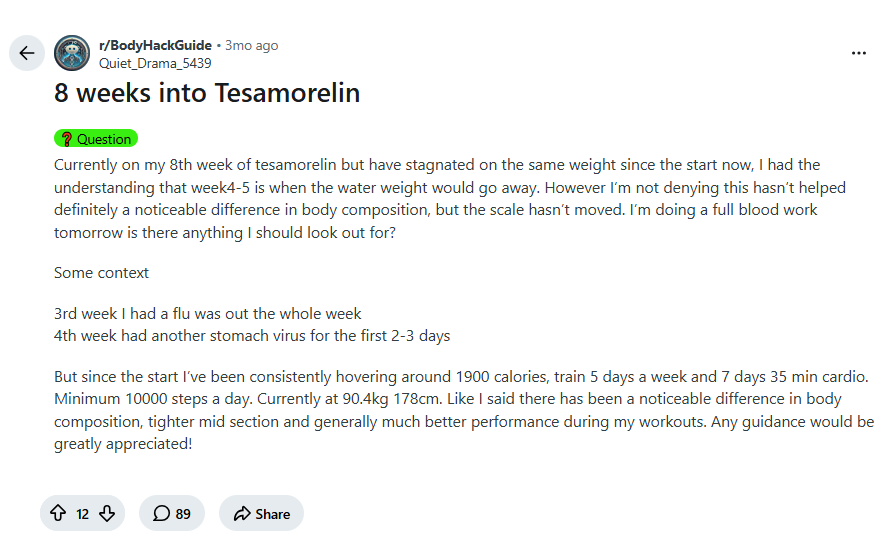
Such accounts can illustrate people’s experiences but cannot establish efficacy because diet, training, other compounds and numerous additional variables are uncontrolled.
Weeks 9-12
Twelve weeks remains shorter than the primary endpoint of the pivotal studies. A pooled analysis of 806 patients by Mangili and colleagues also illustrates why short-term observations should be interpreted cautiously.
Clinical trials included comparison groups and standardized measurements. Individual before-and-after photographs do not provide those controls.
6 Months and Beyond
The pivotal trials used approximately six months as a major assessment point, with longer-term data extending to 12 months.
Longer-term research also found that visceral fat could return after tesamorelin was discontinued. This is another reason a single before-and-after photograph provides an incomplete picture of treatment outcomes.
Tesamorelin Before and After for Men vs Women
Most published trial data do not establish a simple male-versus-female difference in response, so claims that one sex responds faster or better should be treated cautiously.
Tesamorelin Before and After in Men
Men and women differ, on average, in patterns of fat distribution. Men often carry proportionally more visceral abdominal fat, although there is substantial individual variation.
That difference can affect what a body-composition change looks like visually without demonstrating that tesamorelin itself works better or faster in men.
Tesamorelin Before and After in Women
Women generally carry a greater proportion of subcutaneous rather than visceral fat, particularly before menopause. Because subcutaneous fat is the layer visible beneath the skin, a change in deeper visceral fat may not correspond directly with a dramatic visual change.
Does Tesamorelin Work Differently for Men and Women?
Baseline fat distribution differs considerably among individuals and may influence how body-composition changes appear. Current evidence does not support assigning a specific response timeline based on sex alone.
What Affects Tesamorelin Before-and-After Comparisons?
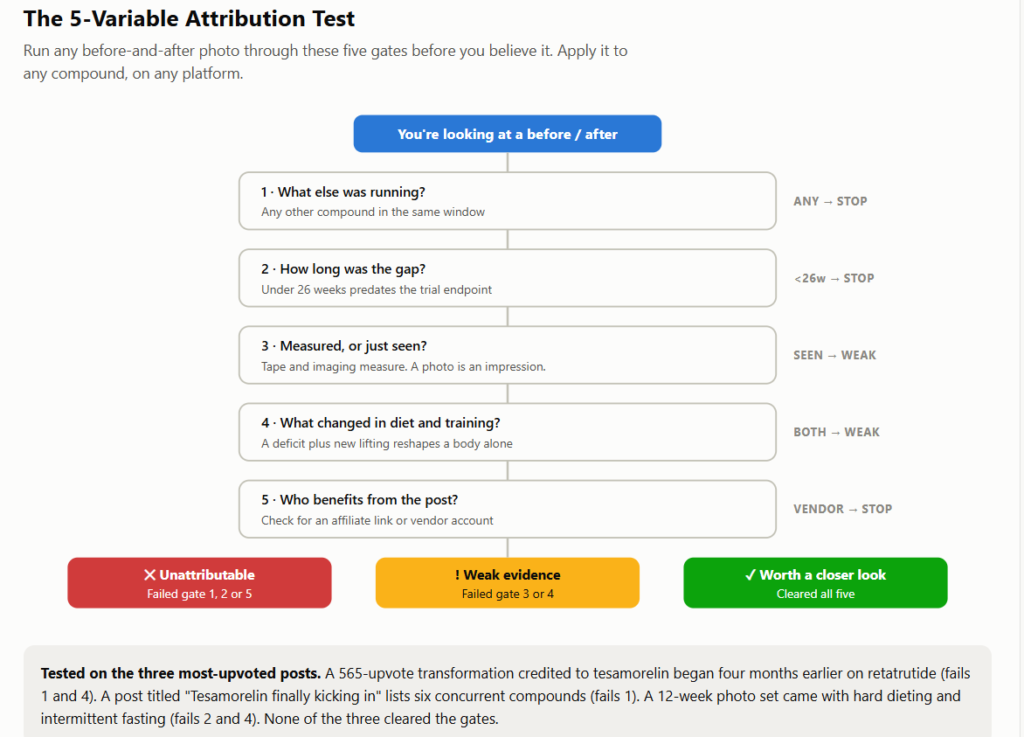
Before-and-after comparisons can look very different from person to person. Diet, training, sleep, starting body composition and other concurrent changes can all influence what appears in a photograph or measurement.
Starting Body Composition
The amount and distribution of visceral and subcutaneous fat at baseline influence how subsequent changes appear. A reduction in deep visceral fat may be difficult to identify visually when substantial subcutaneous fat is also present.
Diet
Dietary changes can independently affect body weight and composition. If diet changes during the same period, it becomes harder to attribute an observed result to tesamorelin alone.
Physical Activity
Exercise, particularly resistance training, can independently change body composition and appearance. Changes in activity therefore represent another potential confounding variable in before-and-after comparisons.
Sleep
Sleep is associated with numerous metabolic and hormonal processes. Changes in sleep patterns can introduce another variable when comparing body composition over time.
Duration
Longer observation periods generally provide more meaningful evidence than very short comparisons, which can be heavily influenced by hydration and normal measurement variability.
Individual Differences
Age, baseline body composition and metabolic characteristics can all affect outcomes. Clinical research demonstrates substantial variability even among people participating under controlled study conditions.
Compound Quality
For laboratory research involving research chemicals, analytical documentation can affect whether researchers know that the material being studied corresponds to its stated identity. This is a laboratory-quality issue and should not be interpreted as guidance for personal use.
Other Compounds
Using several compounds simultaneously makes attribution difficult. If multiple interventions occur at the same time, a before-and-after photograph cannot establish which intervention produced an observed change.
Tesamorelin Before and After on Reddit
Reddit reports are personal experiences rather than controlled clinical evidence. They can help illustrate the kinds of experiences people report, but they cannot establish whether tesamorelin caused a particular result.
What Reddit Users Report
Common themes in online discussions include:
- Changes in waist appearance without equivalent scale-weight changes
- Highly variable timelines
- Reports of little or no visible change
- Reports of adverse effects
- Frequent use of multiple compounds simultaneously
The most upvoted tesamorelin before-and-after post on Reddit at the time reviewed describes substantial weight loss, but the account also reports multiple simultaneous interventions: retatrutide was started first, tesamorelin was added later, and the user also reported other peptides and a new running habit.


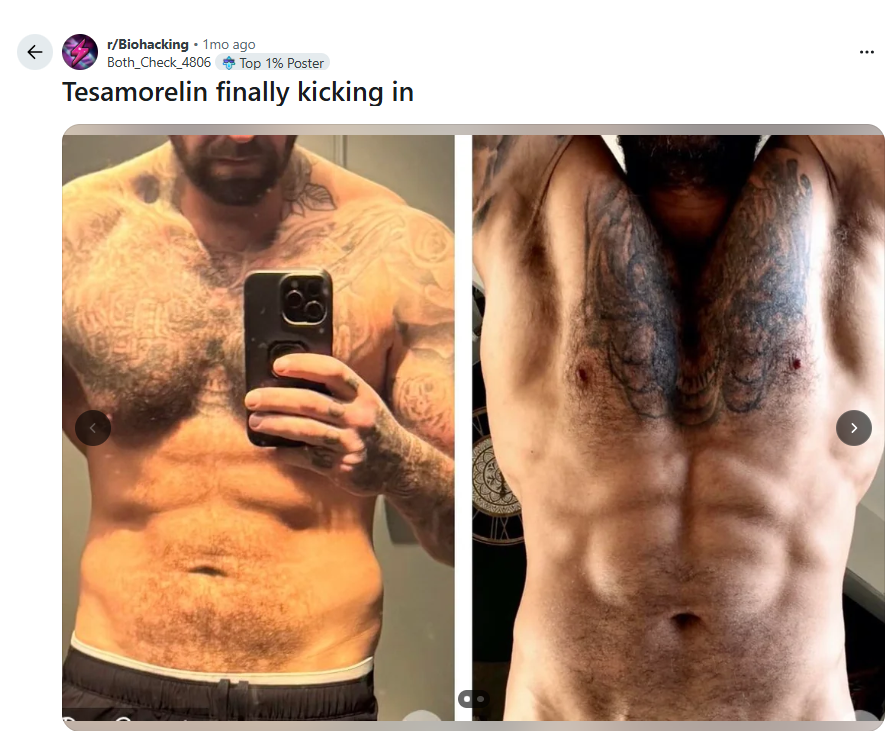
Another thread titled “Tesamorelin finally kicking in” similarly describes multiple compounds being used simultaneously.
These examples demonstrate why dramatic online transformations cannot automatically be attributed to tesamorelin.
Reddit vs Clinical Research
| Clinical research | Reddit reports |
|---|---|
| Controlled conditions | Uncontrolled |
| Defined population | Mixed populations |
| Objective measurements such as CT imaging | Usually self-reported |
| Known study design | Numerous unknown variables |
| Can contribute to scientific conclusions | Useful primarily as anecdotal context |
Why Reddit Results Vary
Online results can differ because of numerous uncontrolled variables, including:
- Diet
- Training
- Other interventions
- Measurement methods
- Starting body composition
- Multiple compounds being used simultaneously
Tesamorelin vs GLP-1s for Body Composition
Tesamorelin and GLP-1 medicines act through different biological pathways and have been studied for different clinical purposes. Tesamorelin acts through the GHRH/GH pathway and has been studied specifically for visceral adipose tissue in HIV-associated lipodystrophy. GLP-1-based therapies act through GLP-1 signaling and have been studied extensively for metabolic and weight-related outcomes.
Tesamorelin vs GLP-1: How Do They Differ?
| Factor | Tesamorelin | GLP-1-based therapies |
|---|---|---|
| Primary pathway | GHRH/GH signaling | GLP-1 signaling |
| Main research focus | Visceral adipose tissue | Weight and metabolic outcomes |
| Appetite suppression | Not the primary mechanism | Important mechanism |
| Scale weight | Not the primary focus | Commonly measured outcome |
| Body composition | Important research area | Also studied |
| Primary distinction | Visceral fat and body composition | Appetite, weight and metabolic effects |
Tesamorelin and Visceral Fat
Tesamorelin stimulates endogenous growth hormone release through the GHRH pathway. Clinical trials measured visceral adipose tissue using CT imaging.
Because visceral fat represents only one component of total body mass, changes in this compartment do not necessarily produce comparable changes in overall scale weight.
GLP-1s and Overall Weight
GLP-1-based therapies work through different mechanisms and have been studied for different outcomes, including body weight and metabolic measures. Their evidence base and approved indications should therefore be considered separately from tesamorelin research.
Why They Aren’t Interchangeable
Different mechanisms, clinical indications, study populations and endpoints mean these therapies should not be treated as interchangeable based on before-and-after photographs.
Questions about whether a prescription treatment is appropriate for an individual should be addressed with a qualified healthcare professional.
Research-Grade Tesamorelin and Laboratory Documentation
Tesamorelin is also commercially available as a research chemical. This market is distinct from FDA-approved prescription tesamorelin, and products labeled for research use are not approved for human consumption.
In laboratory research, documentation may include analytical methods used to establish a compound’s identity and purity. These records help researchers understand the material being used in an experiment; they do not establish that a product is safe or appropriate for human use.
Identity and Purity Documentation
Laboratory analytical methods such as LC-MS may be used to examine molecular identity, while HPLC can be used to characterize purity.
A certificate of analysis may include information such as a lot or batch number, testing date, analytical method and reported results. These are laboratory quality-control measures rather than evidence of clinical safety or effectiveness.
Third-Party Testing
Independent laboratory testing is another form of analytical documentation encountered in the research-chemical market. The existence of testing should not be interpreted as FDA approval, pharmaceutical equivalence or evidence that a research product is appropriate for human use.
Commercial Research-Supply Example
The research-supply market illustrates the distinction. Kylo Peptides is one commercial supplier that publishes testing information for research-use peptide products.
According to information published by the company, its tesamorelin research product is accompanied by analytical documentation involving methods such as LC-MS and HPLC and independent laboratory testing. These are supplier-reported specifications and should not be confused with clinical evidence, FDA approval, or verification that the product is appropriate for use in people.
Lifestyle Factors That Can Affect Body-Composition Comparisons
A number of ordinary lifestyle factors can independently change body composition and therefore complicate interpretation of before-and-after photographs:
- Resistance training can change lean mass and body shape.
- Protein and overall dietary intake can affect body composition.
- Daily physical activity contributes to energy expenditure.
- Sleep patterns can affect metabolic and hormonal processes.
- Waist circumference and body-composition measurements can vary depending on measurement technique.
- Progress photographs can be affected substantially by lighting, distance, posture and time of day.
These variables are important when interpreting online claims because an apparent transformation cannot necessarily be attributed to one drug or compound.
What About Pairing Tesamorelin With Other Peptides?
Combination use makes attribution substantially more difficult. When two or more compounds are used simultaneously, an observed change cannot readily be assigned to one of them.
The clinical evidence discussed above examined tesamorelin under controlled study conditions. Reports involving stacks or multiple simultaneous interventions are anecdotal and should not be treated as equivalent evidence. Decisions involving prescription medications or combinations of treatments should be discussed with a qualified healthcare professional.
FAQs
How long does it take to see tesamorelin before-and-after results?
Registration trials evaluated visceral fat over 26 weeks, with longer-term research extending to 12 months. Online timelines claiming dramatic results within a few weeks should not be treated as equivalent to clinical evidence.
Does tesamorelin reduce visceral fat?
Clinical trials in adults with HIV-associated lipodystrophy found reductions in visceral adipose tissue measured by CT imaging. These findings apply to the populations and conditions studied and should not automatically be generalized to other uses.
Does tesamorelin cause weight loss?
FDA labeling states that tesamorelin is not indicated for weight-loss management and describes a weight-neutral effect. Its approved indication concerns reduction of excess abdominal fat in adults with HIV and lipodystrophy.
Can you see tesamorelin results after one month?
Clinical research does not provide a strong basis for judging outcomes from a one-month before-and-after comparison. The major trials assessed outcomes over considerably longer periods.
Does tesamorelin reduce belly fat?
Tesamorelin has been studied specifically for visceral abdominal fat in adults with HIV-associated lipodystrophy. Visceral fat is different from the subcutaneous fat immediately beneath the skin.
Are tesamorelin before-and-after photos reliable?
Not by themselves. Visceral fat is located behind the abdominal wall and cannot be directly measured from a photograph. Lighting, posture, hydration, diet and training can also substantially affect appearance.
Is tesamorelin FDA approved?
Yes, tesamorelin is FDA approved for reduction of excess abdominal fat in adults with HIV who have lipodystrophy. That approval should not be interpreted as approval for general weight loss or cosmetic body recomposition.
Is tesamorelin the same as a GLP-1?
No. Tesamorelin acts through the GHRH pathway, while GLP-1-based therapies act through GLP-1 signaling. They have different mechanisms, evidence bases and clinical indications.
Can tesamorelin be used with other peptides?
Online reports frequently describe combination use, but those accounts do not establish the safety or effectiveness of a particular combination. Clinical evidence discussed in this article examined tesamorelin under controlled conditions. Treatment decisions involving combinations belong with a qualified healthcare professional.
Is tesamorelin safe?
FDA labeling includes contraindications, warnings and monitoring considerations. Whether prescription tesamorelin is appropriate for a particular patient requires individualized medical evaluation.
What information appears on a research-product COA?
Laboratory certificates of analysis may report product identity, lot or batch number, test date, analytical methods and measured purity or identity results. Such documentation relates to laboratory characterization and does not establish that a research-use product is approved or safe for human use.
Bottom Line
Tesamorelin’s before-and-after story is primarily about changes in visceral adipose tissue rather than dramatic changes on the scale. Clinical trials in adults with HIV-associated lipodystrophy reported meaningful reductions in visceral fat over approximately 26 weeks while overall body weight remained relatively stable.
The population studied is crucial. These results come primarily from adults with HIV-associated lipodystrophy and should not be automatically extrapolated to healthy people seeking weight loss or cosmetic body recomposition.
Online photographs and personal reports can be interesting, but they cannot substitute for controlled clinical evidence. Diet, exercise, other compounds, baseline body composition, photography conditions and numerous other variables can influence what appears in a before-and-after comparison.
Other Articles You May Find of Interest...
- Your COA Says “Pass.” Here’s How to Check the Lab Agrees.
- How to Make a Nutrition Facts Label for Your Food Product: A Step-by-Step Guide
- How to Count Respirations in 15 Seconds
- Are There Lymph Nodes in the Lower Leg?
- Why Blood Plasma Is Yellow
- How to Measure Respiration Rate Accurately
- Where Are the Pores of Sweat Glands Located?
Featured Doctors and Practices





