Your Health Magazine Contributor
4201 Northview Drive
Suite 102
Bowie, MD 20716
More Health Education Articles
What Happens When You Call Your Doctor After Hours, and What to Do If No One Calls Back
Key Points
- HRSA’s site-visit protocol, dated December 2025, requires health center after-hours coverage to refer you to a licensed independent practitioner, an emergency room or urgent care.
- A survey of 91 primary care offices, published in The Journal of Family Practice in 2003, found 93% required patients to judge their own urgency before the on-call physician was notified.
- MLMIC’s 2020 guidance warned that patients do not always understand no one will call back, so severe or potentially life-threatening symptoms require immediate medical attention.
In This Article
- Who actually answers when you call your doctor after hours?
- Why doesn’t your doctor call back after hours?
- What will matter most for after-hours calls in the next 12 to 24 months?
- What should you do if your doctor doesn’t call back after hours?
- What will your next after-hours call look like?
- What else do patients ask about after-hours calls?
Quick Answer
After-hours coverage means that your call reaches an answering service, nurse triage line or on-call clinician, often not your own doctor. According to HRSA, that coverage must be able to send you to an ER or urgent care. A recording is not a callback. Severe or potentially life-threatening symptoms require immediate medical attention, while worsening symptoms should be assessed based on their nature and severity. A useful question is: who decides whether the problem is urgent, and by when?
Calling your doctor after hours starts a relay, not a conversation with your doctor. According to HRSA’s site-visit protocol for health centers, after-hours coverage may be delivered “via telephone or face-to-face.” In a 2012 study of 21 primary care practices and their after-hours partner organizations, 8 used a 24-hour nurse triage line.
Why does the relay matter? Because every handoff is a place a message can stall. Earlier research found most practices left the urgency decision to the caller. A 2020 risk guide from MLMIC, a New York malpractice insurer, warned that answering machines have “no safeguards in the event of a malfunction.”
The same guide warned that a jury is less likely to believe a physician’s memory of an undocumented call. In practice, a written record provides evidence that you called.
Understanding who answers, where calls can stall, and what to do when nobody calls back can make after-hours care easier to navigate. One useful approach is the who-decides test: find out who will judge whether the problem is urgent, and by when.
After-hours care is the help your doctor’s practice gives for problems that arise between 5 p.m. and 8 a.m., or on weekends and holidays. Reaching it is harder than it sounds. An international survey cited in a 2012 Journal of General Internal Medicine study found only 30% of U.S. patients described night and weekend care as “very” or “somewhat easy.” The same study noted that almost 65% of all emergency department visits occurred between 5 p.m. and 8 a.m. or on weekends.
According to HRSA’s site-visit protocol for federally funded health centers, after-hours coverage must be able to refer you to a licensed independent practitioner, an emergency room or urgent care. Centers must also track and record those calls, for example in a log of patient calls. Your call has a path. It just runs through several handoffs.
We’ll follow one caller, Dana, from the recording to the answering service to the on-call clinician. Then we’ll look at what to do when the callback never comes.
Top 3 Questions This Article Answers
- Who answers when I call my doctor after hours?
- Why didn’t my doctor call me back last night?
- What should I do if the on-call doctor never calls back?
Who Actually Answers When You Call Your Doctor After Hours?
Usually not your own doctor. After-hours calls go to a recording, an answering service, a nurse triage line or a covering clinician, and each one handles urgency differently.
An analysis of 17 sources shows one consistent pattern: the first voice you hear after hours is rarely your own doctor’s. That is why the who-decides test can be useful before you dial. Ask one question: who will judge whether my problem is urgent?
According to a 2012 study in the Journal of General Internal Medicine, researchers who interviewed 44 respondents from 28 organizations in 16 states identified five broad models of after-hours care. The models differed in how much continuity and access they gave patients. An international survey cited in that study found only 29% of U.S. physicians had after-hours arrangements beyond an automated phone referral to the emergency department.
A common misconception is that the after-hours number is a direct line to your physician. The reality is that physicians report many payer requirements can be met by a registered nurse triage line that directs you to care. Most modern call systems also start with an automated menu and ask for your name and date of birth before a person picks up.
According to the HRSA Bureau of Primary Health Care‘s site-visit protocol, dated December 2025, a center must show either provider on-call schedules or written arrangements with outside coverage, such as nurse call lines. Whoever answers must be qualified to judge whether you need emergency care.
After-Hours Routes
Recording only
Who answers: No one live
Who decides urgency: You
Answering service
Who answers: An operator taking messages
Who decides urgency: Depends on its instructions
Nurse triage line
Who answers: A registered nurse using protocols
Who decides urgency: The nurse
On-call clinician
Who answers: A covering doctor, often not yours
Who decides urgency: The clinician
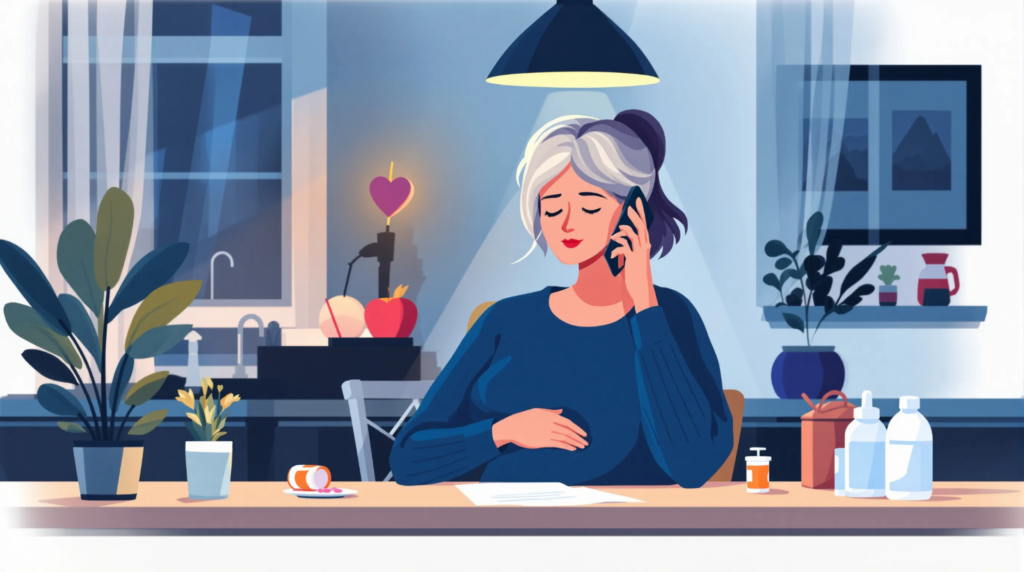
Picture Dana, calling her family doctor at 7:30 on a Thursday evening about stomach pain that has worsened since lunch. She hears a recording first. What happens next depends on which of these four routes sits behind it.
In practice, the route matters more than the phone number. The takeaway: know who decides before you describe your symptoms.
Why Doesn’t Your Doctor Call Back After Hours?
Most missed callbacks are not a doctor ignoring you. Your message stalls at a handoff: a recording, an urgency question, a chart inbox or a rule about who counts as a patient.
AHRQ’s Patient Safety Network files a 2007 study of after-hours calls from hospital floor nurses to on-call physicians under “Discontinuities, Gaps, and Hand-Off Problems.” The lesson carries over to your doctor’s office: every handoff is a place a message can drop.
- You judge the urgency. According to a survey of 91 primary care offices, published in The Journal of Family Practice in 2003, 93% of practices required the patient to decide whether a problem was urgent enough to notify the on-call physician. In the authors’ earlier study, about 10% of calls went unforwarded because the caller did not think it was an emergency. Physician reviewers judged 50% (range 22% to 77%) of those to be emergencies.
- The recording promises tomorrow. Physicians in a 2026 family medicine forum described answering machines that send emergencies to 911 or the ER and return everything else the next business day. Nobody is scheduled to call you tonight.
- The message lands in a chart. In one practice from that thread, a hospital answering service triages callers and sends messages to physicians “via patient case.” In practice, your note may wait in an inbox until morning.
- You may not count as a patient. One physician got an after-hours call from someone last seen in 2022, and the answering service was told to inform the caller they were not an established patient.
Back to Dana. Asked whether her stomach pain is an emergency, she guesses probably not. Under the setups in that survey, her guess could keep the message from the on-call doctor. Worsening pain may require clinical assessment rather than relying solely on the caller to judge its urgency.
A common misconception is that silence means the doctor read your message and chose to wait. The reality is that the doctor may never have seen it. The takeaway: the weak point is usually a handoff, not the physician.
What Will Matter Most for After-Hours Calls in the Next 12 to 24 Months?
Documentation and protocol-driven triage are becoming increasingly important in after-hours care, particularly as practices are expected to demonstrate how their coverage systems function.
Here are three signals to watch:
Prediction: Written standards get a clinical reviewer.
Weak signal: According to HRSA’s site-visit protocol for health centers, the primary reviewer of the after-hours chapter is a “Clinical Expert,” and patients with limited English proficiency must be told about coverage in languages and formats they can use.
Why it matters: You can ask your health center how to reach after-hours help in your own language.
Prediction: A nurse, not your guess, sorts the call.
Weak signal: Physicians in a 2023 medicine forum described a small pediatric practice whose weekday evening calls went to a major hospital nurse line, where any ER referral triggered a page to the on-call provider.
Why it matters: The person judging urgency is trained, which reduces reliance on callers to rank their own symptoms.
Prediction: Insurers test the line.
Weak signal: In a 2026 family medicine forum, one physician reported a 6 a.m. call from an insurer auditing after-hours access, and another wrote that an RN triage line is “often adequate” for payer requirements.
Why it matters: The number on your doctor’s recording is becoming something the practice has to demonstrate works.
In practice, the first voice you hear may increasingly be a nurse or operator working from a protocol.
A common misconception is that more coverage means more calls from your own doctor. The reality may be the opposite. In a 2024 patient discussion, one commenter’s doctor usually uploaded results with an overview paragraph instead of calling, yet phoned because the patient asked. The takeaway: if you want a call, ask for one clearly.
What Should You Do If Your Doctor Doesn’t Call Back After Hours?
Match the step to the problem. Severe or potentially life-threatening symptoms require immediate medical attention, while worsening symptoms may warrant urgent evaluation depending on their nature and severity. Everything else gets one clear callback request and a documented follow-up.
Start by listening to the whole recording. According to MLMIC’s 2020 risk management guidance, “Patients do not always understand that no one will call back, even if this is stated in the message.” If the recording promises the next business day, nobody may be scheduled to call tonight.
If it could be an emergency, skip the callback. Call 911 or go to the ER. According to a physician writing in a 2026 family medicine forum, overnight symptom calls “almost always” end with advice to go to the ER, because phone assessment at that hour is limited.
- Call back and use the who-decides test. Describe what changed, not your guess about how serious it is. Then ask whether a clinician will review your message tonight.
- Have your details ready. Your name, date of birth, callback number, when symptoms started, current medications, allergies and pharmacy. The person answering may work for an outside team, and that’s normal. Companies providing virtual assistants for primary care practices may require staff to complete HIPAA training and must follow applicable privacy and security requirements when handling protected health information.
- Sort refills by urgency. Running out of insulin or a blood thinner is worth a call tonight. A routine refill usually waits for business hours, and a collected request is not an approved one.
- Follow up the next business day. Ask the office to confirm your call is in your medical record. MLMIC urges practices to document every after-hours call there and to forward a covering practice’s notes to your own office promptly.
How long should you wait? MLMIC asks only for a “reasonable time frame,” and none of the sources behind this article sets a national deadline. No national callback deadline applies across all practices. If symptoms are worsening or there is concern that the situation may be urgent, patients should not rely on an unanswered callback request as their only plan for obtaining care.
Back to Dana. No call comes, and her pain moves and sharpens. Should she keep waiting? No. A significant change or worsening of symptoms warrants reassessing whether more immediate medical attention is needed. The takeaway: a callback should not be your only safety plan when symptoms may require urgent evaluation.
What Will Your Next After-Hours Call Look Like?
Expect a system, not necessarily your own doctor. After-hours calls are moving toward trained triage staff and written records, so the useful skill is knowing which handoff you are in.
The standards already point that way. According to HRSA’s site-visit protocol, reviewers test the after-hours number the front desk provides and request three samples of after-hours advice documentation. Medical home criteria from the National Committee for Quality Assurance call for urgent phone response within a specific time. MLMIC wants answering services audited for accuracy and recordkeeping. And researchers argued back in 2003 that clinical calls belong with trained medical personnel, not the caller’s guess.
Every documented call leaves a trail. Before you hang up, ask one question: who decides whether this is urgent, and by when?
Written by
Maria Rush
Marketing Team Lead, HelpSquad
Maria De Jesus-Rush is Marketing Team Lead at HelpSquad, a healthcare business process outsourcing company, with a background in content development, digital marketing, and project management.
Connect on LinkedIn
Frequently Asked Questions: What Else Do Patients Ask About After-Hours Calls?
Calls cluster right after work, the ER is not your only option, refills and lab results wait for licensed staff, and intake questions exist to route your call.
When do most after-hours calls come in?
Ainora, a company that sells AI phone agents, names 5 PM to 7 PM as the “peak window” for after-hours calls, though it calls this a directional pattern, “not a single sourced dataset.” It rates medical and dental practices “High” on after-hours call volume. In practice, calling right after work may mean calling when lines are especially busy.
Do I have to go to the ER if my doctor’s office is closed?
Not always. According to a 2012 Journal of General Internal Medicine study, stomach and abdominal pain, fever, cough and headache made up over 15% of emergency department visit volume, though primary care commonly manages those complaints. In 2018, Fierce Healthcare reported that Heal offered same-day home doctor visits by app for less than $100 in California and greater Washington, D.C. Emergencies still mean 911.
Will anyone approve my prescription refill after hours?
Don’t count on it. A refill message needs your identification, the medication name, your pharmacy, the prescribing provider’s name and a callback number, but a provider or clinical staff member still makes the decision. Requesting refills before you run low can help avoid after-hours problems.
Can the after-hours line tell me my lab results?
Rarely. Well-designed intake routes result questions to an administrative or clinical queue, without anyone disclosing or interpreting results over the phone.
Why does the person answering ask so many questions?
Each answer helps route your call. One 2026 workflow analysis puts information collection, administrative routing, scheduling and call transfer on the intake side, and keeps clinical assessment and clinical decisions with licensed staff. A good system should still allow callers to request a person when needed.
Other Articles You May Find of Interest...
- Your COA Says “Pass.” Here’s How to Check the Lab Agrees.
- How to Make a Nutrition Facts Label for Your Food Product: A Step-by-Step Guide
- How to Count Respirations in 15 Seconds
- Are There Lymph Nodes in the Lower Leg?
- Why Blood Plasma Is Yellow
- How to Measure Respiration Rate Accurately
- Where Are the Pores of Sweat Glands Located?