






Your Health Magazine Contributor
4201 Northview Drive
Suite 102
Bowie, MD 20716
More Health Education Articles
First Aid Courses: What to Expect and How to Choose the Right One
A first aid course usually combines instruction, hands-on practice, and an assessment.
Choosing the right one means checking what it covers and whether your employer, childcare licensing authority, or school program accepts the certificate.
This guide covers common U.S. options and the different requirements to check in Australia. It helps you choose a course; it doesn’t replace training.
Key Takeaways
- Start with your purpose. Workplace, childcare, healthcare, and outdoor settings can require different courses.
- Check the practical requirements. Online lessons alone may not meet your employer’s or licensing authority’s requirements.
- Verify before booking. Confirm the accepted course name, whether a skills assessment is included, and how the certificate can be checked.
Which Course Fits Your Goal
Start with the role or activity you’re preparing for, then compare providers.
- General workplace or personal readiness: a first aid, CPR, and automated external defibrillator (AED) course, such as American Heart Association (AHA) Heartsaver First Aid CPR AED or an American Red Cross equivalent.
- Childcare in the U.S.: a pediatric first aid and CPR course. Confirm that your state licensing authority accepts it and that it covers the ages you care for.
- Healthcare settings and programs: Basic Life Support (BLS), often the AHA BLS Provider course. Check the exact course your program requires. BLS may not satisfy a separate first aid requirement.
- Outdoor and remote activities: Wilderness First Aid, which addresses situations where professional help may take longer to arrive.
Before paying, ask your employer, licensing office, or program coordinator which course and provider they accept.
If you are comparing Australian options, First Aid Coach Group is one provider example to review before confirming unit codes and recognition.
What to Expect in Class
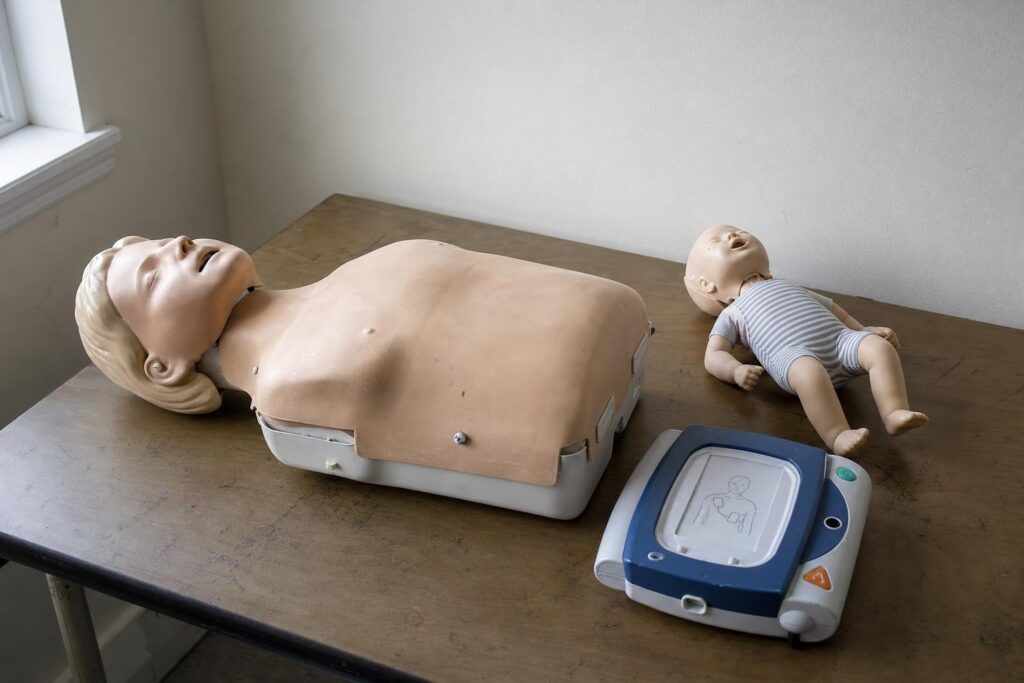
In a combined first aid, CPR, and AED course, an instructor explains how to recognize common emergencies and when to call for help.
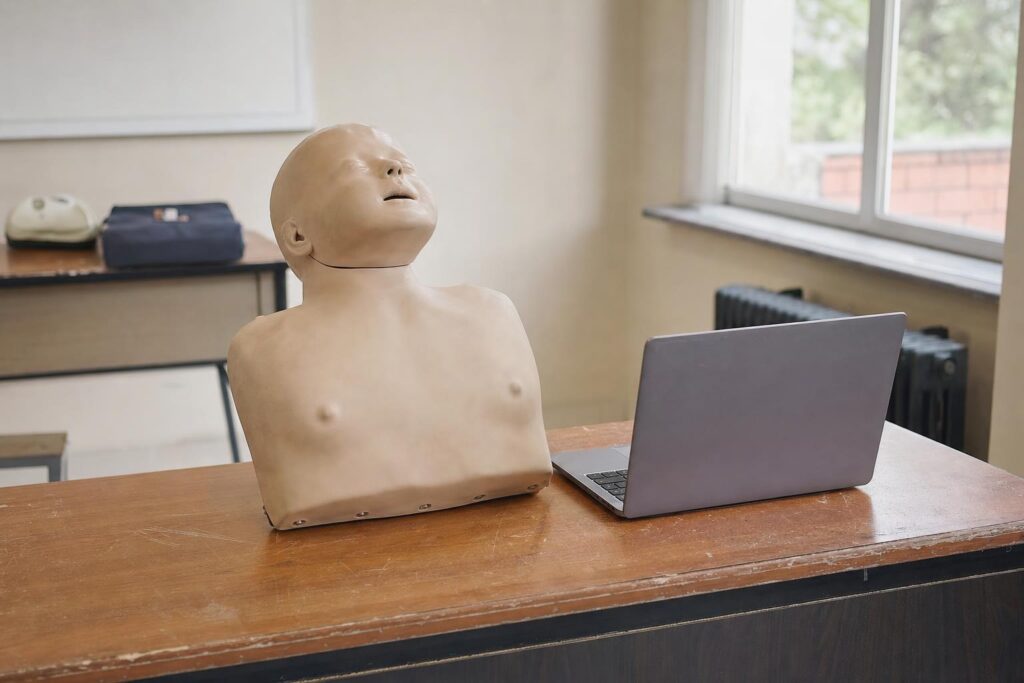
You then practice skills such as compressions on a manikin, using an AED trainer, and controlling bleeding with training materials.
The instructor checks your performance and gives feedback.
Many courses also include a short written or online assessment.
After you meet all requirements, the provider issues a course completion card or certificate.
These are often digital; Red Cross certificates, for example, include an ID and QR code for verification.
Don’t assume an online-only certificate meets a workplace requirement.
The Red Cross states that its online-only First Aid course does not meet OSHA requirements for workplace certification.
Check whether you need instructor-led or blended training before enrolling.
Course Formats Explained
Most course listings use one of three formats:
- In-person: classroom learning and hands-on practice with an instructor. Longer courses may run over several sessions.
- Blended: online lessons followed by a practical skills session. Check the deadline for finishing the online work and book the practical component as well.
- Online-only: self-paced lessons without an observed skills assessment. These can support awareness, but don’t assume they meet certification requirements.
Whichever format you choose, ask how the certificate can be verified. An eCard lookup, certificate ID, or QR code may let an employer confirm that it is current.
Recognition and Compliance
Workplaces. OSHA’s general industry rule requires a person adequately trained in first aid when medical care is not in near proximity to the workplace.
Employers need to consider response times and workplace hazards.
A course certificate alone doesn’t establish workplace compliance.
Childcare. Virginia’s childcare standards, for example, require current CPR and first aid certification, and the CPR training must include an in-person competency demonstration.
Other states have their own requirements, so check the current rules for your role and setting.
Other countries. Canada, for example, uses its own first aid certification levels, such as Emergency First Aid and Standard First Aid.
Australia. Australia uses a separate system of nationally recognized units of competency.
HLTAID009 covers CPR, while HLTAID011 is Provide First Aid.
Check the unit code required by your employer or regulator rather than relying on a course’s general title.
Don’t assume a U.S. certificate satisfies Australian requirements, or vice versa.
Time and Renewal Planning
Total time depends on the course and format. For blended courses, add the online study time to the practical session rather than comparing classroom hours alone.
Wilderness courses generally require a larger time commitment: NOLS lists its Wilderness First Aid course at 16 contact hours.
Many U.S. first aid and CPR cards are valid for two years. In Australia, Safe Work Australia recommends annual CPR refresher training and renewing first aid qualifications every three years.
Australian providers such as RTS Training and First Aid Coach Group offer first aid and CPR options, so check which course matches the refresher you need. Your employer may also set its own training schedule.
How to Vet a Provider
Before paying, check for:
- A curriculum and certificate accepted by your employer, licensing authority, or school program.
- The required practical skills assessment, with clear booking arrangements.
- A total price that includes any required online learning, assessment, and certificate fees.
- Instructor credentials the provider can explain.
- Enough manikins and AED trainers for everyone to practice.
- A certificate that can be verified.
- Clear cancellation and rescheduling terms.
- Group or on-site options if you’re organizing training for a team or club.
Local and On-Site Examples
For groups in Sydney, the provider page describes mobile first aid and CPR sessions, with group bookings starting from five people.
It also lists courses at venues including Alexandria, Liverpool, and Blacktown.
Confirm the unit codes and recognition for your chosen course, and remember that listed face-to-face hours may not include online study.
For Perth readers, First Aid Courses Perth is a provider overview that describes blended training, combining online theory with an in-person practical assessment, and options in Osborne Park or on-site.
The page lists HLTAID009, HLTAID010, and HLTAID011 on successful completion of its HLTAID011 course. Check the current course page for prerequisites, assessment steps, and pricing.
Going Further
A standard course covers common emergencies, but some settings call for additional training.
Stop the Bleed training may be relevant if you work around machinery or lead outdoor groups. Naloxone training may also be useful where a workplace or community program has identified a need.
Before booking, answer six questions:
- Purpose: What role or activity is this qualification for?
- Recognition: Does the employer, licensing office, or program accept this provider and course?
- Practical assessment: Is the required skills session included?
- Logistics: What is the total study time, and when and where does the practical session take place?
- Renewal: When is refresher training required?
- Proof: What certificate will you receive, and how can it be verified?
Those checks apply whether you’re comparing a training center in Northern Virginia, blended courses through a Perth provider, or on-site sessions with a Sydney provider.
Start with the accepted qualification, then compare the schedule, assessment arrangements, and total cost.
Other Articles You May Find of Interest...
- Your COA Says “Pass.” Here’s How to Check the Lab Agrees.
- How to Make a Nutrition Facts Label for Your Food Product: A Step-by-Step Guide
- How to Count Respirations in 15 Seconds
- Are There Lymph Nodes in the Lower Leg?
- Why Blood Plasma Is Yellow
- How to Measure Respiration Rate Accurately
- Where Are the Pores of Sweat Glands Located?





