Your Health Magazine Contributor
4201 Northview Drive
Suite 102
Bowie, MD 20716
More Workplace Health & Safety Articles
Complete Guide for Chemical Spill Response
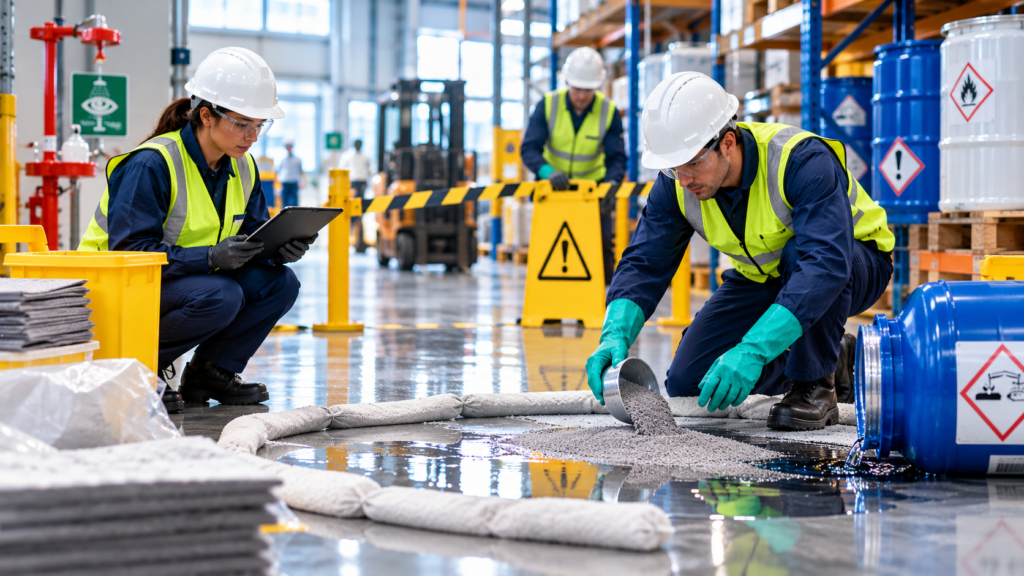
When a hazardous chemical spills, people are safest following a fixed sequence: decide whether staff can control the spill, alert others, protect responders, contain and clean up, dispose of the waste and report the spill where required. That sequence is chemical spill response.
The first decision matters most. A spill that staff cannot control safely calls for leaving the area and calling for help, not cleanup, because toxic vapors and dust spread quickly and can be absorbed through the skin, and flammable vapors can cause fire or an explosion.
Once people are safe, the product’s safety data sheet (SDS), the manufacturer’s document listing its hazards and spill instructions, is the first document to consult.
What Counts as a Minor or Major Chemical Spill?
Staff can handle a spill on their own only when they can control it safely with the materials at hand: the chemical is known, the hazard is low and nothing is spreading.
That makes it a minor spill, while any serious condition makes it a major one, and the response is to evacuate (leave the area), activate the alarm and call emergency services.
A spill is major when any one of these is true:
- The chemical is unknown.
- There is an immediate danger to health, or fire or explosion is imminent.
- The spill is uncontrolled or likely to reach drains or the environment.
- Someone needs medical attention.
- Staff are not trained or equipped to respond.
- The cleanup would need a respirator, a mask that filters the air.
Surroundings count as well as the chemical. The American Chemical Society gives the example of a one-gallon acetone spill among boxes and ignition sources, which calls for emergency responders because acetone is highly flammable and quick to evaporate.
Volume alone does not decide it, and cutoffs are set by each organization rather than by law: Princeton University treats up to 300 mL as small, and the University of Arkansas draws the line at about 1 liter.
Any uncertainty makes a spill major, so evacuate. North Dakota State University’s 2026 guidance says so, and trained responders recommend being overly cautious rather than risking lives over a spill that seems harmless.
A spill that meets none of these conditions is cleaned up with the seven steps. Anything else stops after the alert and the call for help.
What Are the Steps for Chemical Spill Response?
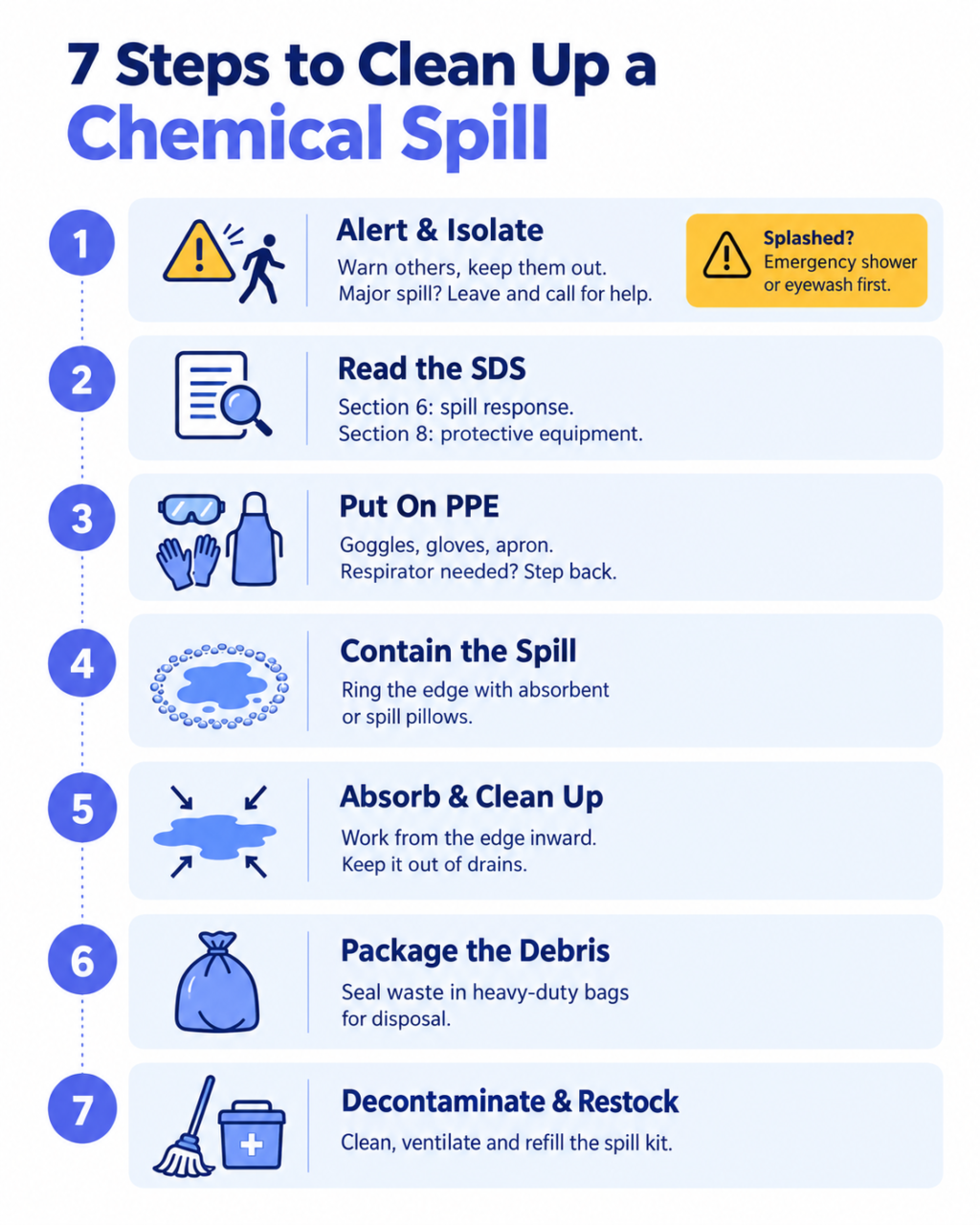
Most spills follow seven steps in a fixed order, and the SDS supplies the details for each product.
- Alert people and isolate the area: Warn everyone nearby, keep them out, and move away from the spill while you decide what to do. In a major spill, this is the point to leave and call for help. Send anyone splashed to the emergency shower or eyewash first.
- Read the SDS: Section 6, “Accidental release measures”, covers personal precautions, protective equipment, emergency procedures, and containment and cleanup methods. Section 8 covers exposure controls and personal protection.
- Put on protective equipment: Eye protection, gloves and a lab coat or apron from the kit are the minimum for a simple spill, and corrosive, reactive or splashing chemicals call for more. If the SDS calls for a respirator, the spill is major: step back and call for help.
- Contain the spill: Build a low barrier around the spill’s edge with vermiculite (a mineral that soaks up liquid), cat litter or spill pillows. Chemical moved into a spare container needs a hazard label unless it is for the immediate use of the person who filled it, and a GHS label generator builds that label from the SDS record.
- Absorb and clean up: Work absorbent from the outer edge toward the center, using the neutralizer or absorbent the SDS names for that chemical, and keep liquid out of drains and sewers. Neutralizing an acid or base cancels it out chemically and gives off heat, so expect splashing and test with pH paper, a color-changing strip.
- Package the debris: Seal the used absorbent and contaminated materials in heavy-duty bags and set them aside for disposal.
- Decontaminate and restock: Conventional cleaning products applied with a mop or sponge are enough for most spills, and an expert can advise when a product is in doubt. Ventilate the area if needed, and replace whatever the kit lost.
First aid always comes before cleanup. Anyone splashed should remove contaminated clothing immediately and use the emergency shower, and eyes need flushing at the eyewash for at least 15 minutes, or up to 60 for some chemicals. The SDS gives the flushing time for each product.
When calling emergency services, give the location, the type of material, the size of the spill and any injuries. If a major condition appears during cleanup, such as an uncontrolled spill or someone needing medical attention, stop and evacuate.
How Does Chemical Spill Cleanup Differ for Acids, Solvents and Mercury?
The method depends on the chemical class, and the SDS names it: acids and bases are neutralized, flammable solvents need vapor-barrier pads, and mercury needs a special vacuum. The usual methods for common chemicals are:
- Acids: Neutralize most acid spills with soda ash or sodium bicarbonate. Hydrofluoric acid and concentrated sulfuric acid need special absorbents, so check the strength of a sulfuric acid spill first.
- Bases: Neutralize them with citric acid or ascorbic acid, and use pH paper to show when the spill is neutral.
- Flammable solvents: Remove ignition sources (sparks, flames and hot surfaces) first, because the vapor burns and collects near the floor. Use spill pads backed with a vapor barrier, a layer that traps vapor, and avoid inert absorbents such as cat litter, since flammable liquids are usually incinerated.
- Oxidizers (chemicals that help other materials burn): Do not absorb them with sawdust, which can catch fire.
- Mercury: Cordon off the area and follow the SDS and site emergency procedure. Mercury cleanup may require specially trained personnel and specialized equipment. Never use a regular vacuum or broom.
- Fine powders: Do not dry-brush or sweep them, which lifts the powder into the air. For toxic dust, use a vacuum rated for hazardous dust.
What Should Be in a Chemical Spill Kit?
The kit holds the protective equipment, absorbents, neutralizers and tools that the cleanup steps call for, matched to the chemicals stored nearby. A typical kit holds:
- Splash goggles or a face shield, chemical-resistant gloves such as neoprene or nitrile, a coat or apron and boot covers, kept in a sealed container
- Absorbent pads, socks and loose absorbent
- Neutralizers for acids and bases, plus pH paper
- A broom or brush, dustpan and tongs for broken glass
- Heavy-duty bags, sealable containers and hazardous waste labels
- Caution tape to isolate the spill area
- First aid supplies and a way to call for help, such as a radio or phone
- Specialty items for the chemicals on site, such as a mercury kit or calcium gluconate antidote gel for hydrofluoric acid
Each kit should have enough material for at least 1 liter of liquid or 1 kilogram of dry chemical, according to the University of Arkansas. Areas with floor drains also need spill socks, pillows or bulk absorbent. Loose absorbents such as cat litter and vermiculite cost little but are messy, while spill pillows are cleaner and cost more.
The kit belongs in a clearly marked place near where the chemicals are used, in a container that is easy to reach, easy to see and able to be secured. Every worker who might need it should know where it is, and the kit should be checked periodically and restocked after every use.
How Do You Dispose of Hazardous Waste and Spill Cleanup Debris?
Cleanup debris may need to be managed as hazardous waste depending on the spilled chemical, the materials contaminated and applicable federal, state and local requirements.
Containers should be made of compatible material, meaning material that will not react with the waste, and each is labeled with the name of the spilled chemical. Princeton’s waste sticker, for example, reads “Spill Debris involving” followed by the chemical’s name.
Incompatible wastes, those that react with each other, stay apart because mixing them can start a chemical reaction. Bottles of liquid waste keep at least 20% air space to give vapor room to expand.
The rules for waste are not the same everywhere, so the local regulator sets the final requirements.
What Are the Chemical Spill Reporting Requirements?
Some chemical releases must also be reported to government authorities when they meet or exceed an applicable reportable quantity. Under CERCLA, qualifying releases generally require immediate notification to the National Response Center at 1-800-424-8802.
The set amount is called the reportable quantity, and it varies by substance. Other federal, state and local reporting requirements may also apply. The call itself is due immediately.
According to EPA, hazardous spills can also be reported by dialing 911. Rules outside the United States are set locally, so a site’s procedure should name the local authority to call.
The Canadian Centre for Occupational Health and Safety (CCOHS) advises deciding which spills go to local authorities, especially those that reach drains or the environment.
Inside the site, the American Chemical Society says emergency services do not need to be notified of a simple spill, but the environmental health and safety (EHS) office or another responsible person should be told. Each spill also needs a written record of:
- The date and time
- The chemical and the amount
- The cause
- Who responded and the protective equipment they used
- How the waste was handled
- Who was notified, and any near misses
Records only help when the follow-up gets done, and keeping spill reports, corrective actions and training dates in EHS management software gives each action an owner and a due date.
What Should a Chemical Spill Response Plan and Training Include?
A written plan makes the clean-up-or-evacuate decision before a spill happens, so nobody has to work it out during one. It should cover:
- The hazardous chemicals on site
- Who responds
- Emergency contacts
- Kit locations
- The point at which to evacuate
OSHA requires an emergency plan to be in writing for any employer with more than 10 employees. The plan should also cover how to report an emergency, how to evacuate and how to account for everyone afterward.
Training is what makes the minor-spill rules work, because only trained staff handle a spill themselves. Every worker who handles chemicals should know where the SDS and the kit are and what to do first. Anyone who is not trained to respond should report the spill and leave it to the people who are.
People assigned to respond to serious spills need formal training: US rules set at least 8 hours for basic responders and 24 hours for technicians and incident commanders, with a yearly refresher.
How Can You Prevent Chemical Spills?
Spills can be prevented at the three points where they occur: store containers by hazard class on sturdy shelves, move liquids in safety containers, and transfer them with pumps instead of pouring.
In storage, keep containers by hazard class (flammable, corrosive, toxic and so on), with larger containers nearer the floor on sturdy shelves with lips, set back from the shelf edge, and inspect them regularly for damage. In transport, move liquids in safety containers, in rubberized buckets or on carts, and strap containers down.
In transfer, use pumps instead of pouring, avoid overfilling and provide containment to catch leaks. Keep work areas free of clutter, and have the equipment a task needs within reach before starting it.
For mercury, check whether a substitute exists, and use trays to catch spills where it cannot be replaced.
Conclusion
Chemical spill response comes down to one early decision: whether the people on site can control the spill safely or must leave and call for help.
A site is ready for that decision when a kit near the chemical storage matches the chemicals on the shelf and each chemical’s SDS can be reached quickly. A written list should also name who may clean up a spill and who calls for help.
Other Articles You May Find of Interest...
- Complete Guide for Chemical Spill Response
- Asbestos Removal Immediately in Commercial Properties: Managing Workplace Safety and Business Disruption
- The Long-Term Health Effects of Repetitive and Physically Demanding Work
- Create Extra Office Space in the Garden for Employee Well-Being
- Chemical Exposure at Work: The Symptoms You Shouldn’t Ignore
- Garfield DTF Shops: Before Installing Equipment Check List
- How Remote Work Benefits Employee Wellbeing: What The Remote Work Statistics Really Say