






More Kratom Education Articles
Red Sumatra Kratom: What Makes This Strain Stand Apart

A common assumption in the kratom market is that all kratom products are essentially interchangeable — the same plant, different bag. That assumption is incorrect.
Geographic origin, plant maturation, and processing techniques all contribute to different alkaloid profiles. Red Sumatra Kratom is a clear example of why geography matters in this context.
This strain originates from Sumatra, Indonesia — one of the oldest kratom-producing regions in the world. Sumatra’s dense forests, volcanic soils, and high humidity create growing conditions that are difficult to replicate elsewhere. That distinct climate shapes the characteristics of the plants at an ecological level.
Red Sumatra is not simply a marketing term. It represents a combination of source region, leaf vein color, and post-harvest processing. Red-veined leaves are harvested at peak maturity. Drying is often extended and may involve sunlight exposure or fermentation, depending on the individual farmer.
Understanding Red Sumatra means understanding the full journey from cultivation to finished product — a process involving multiple steps, each carrying both opportunity and risk for quality.
Where the Name Actually Comes From
Red Sumatra Kratom takes its name from two things: the island where it is grown, and the color of the central leaf veins.
Sumatra is the sixth largest island on Earth, located in the western portion of Indonesia and stretching across the Equator. It has a long history of kratom cultivation dating back to indigenous use.
The “red” designation refers to the vein color of maturing Mitragyna speciosa leaves. Red vein kratom is typically harvested later in the development cycle, at which point the alkaloid composition differs from that of green or white vein leaves.
The label “Red Sumatra” conveys two pieces of information:
- Geographic origin — sourced from Sumatra island, Indonesia
- Leaf stage — harvested at full maturity with visible red veining
Some suppliers further process red vein leaves through extended drying or partial fermentation to influence the alkaloid profile. This additional step is what often differentiates higher-quality Red Sumatra from average products.
The Alkaloid Profile Behind the Strain
Kratom’s two primary alkaloids are mitragynine and 7-hydroxymitragynine. Both interact with opioid receptors in the body, which is part of why kratom has drawn attention from regulatory bodies.
Red Sumatra Kratom, like all red vein varieties, generally contains different ratios of these compounds compared to green or white vein products. The extended drying process associated with red vein production allows certain alkaloids to undergo oxidation and conversion.
Beyond the two primary alkaloids, kratom contains more than 40 identified compounds, including:
- Speciogynine
- Paynantheine
- Mitraphylline
- Corynantheidine
The exact ratios vary depending on harvest timing, soil conditions, and processing method. This is why third-party laboratory testing is essential. Quality products should be accompanied by a Certificate of Analysis (COA) that documents the alkaloid breakdown and confirms the absence of contaminants.
Without that documentation, the contents of a product cannot be independently verified.
How Red Sumatra Is Harvested and Processed
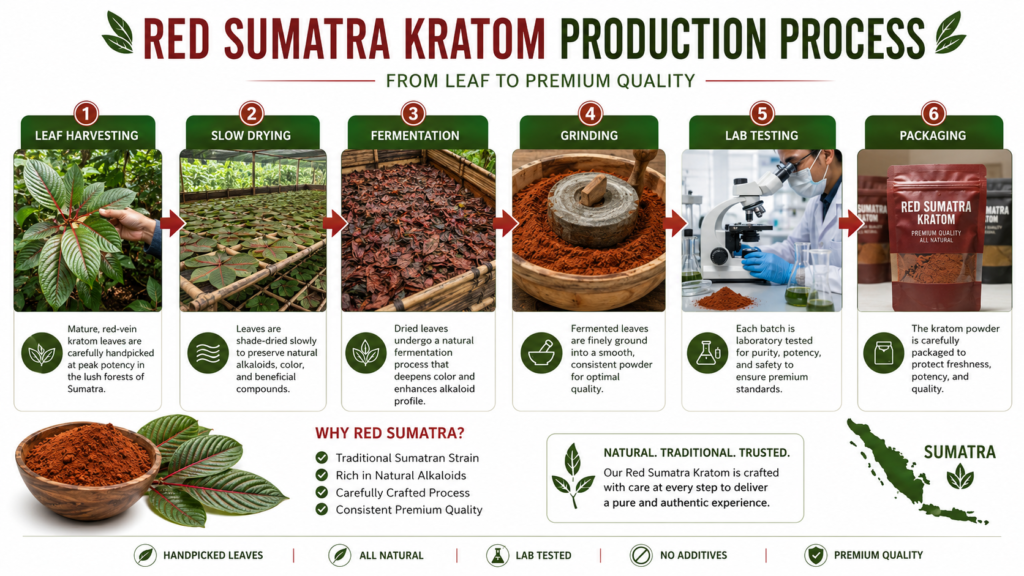
The process from leaf to powder involves a series of steps. Each step influences the characteristics of the final product.
Leaves are hand-harvested once farmers identify the red veining. Harvest timing is important — too early, and the alkaloid profile will not reflect a mature red vein. Too late, and leaf quality diminishes.
After harvest, leaves go through a drying process. For Red Sumatra specifically, many producers use an extended drying method with limited light exposure. Some use partial shade; others employ indoor fermentation. This stage is where the bulk of the alkaloid conversion takes place.
After drying, leaves are ground into a fine powder. Consistency in grind quality reflects the standard of processing.
Some manufacturers test at this stage. Others do not. Consumers should always ask:
- Has the batch been screened for heavy metals?
- Is there a COA available for this specific batch?
- Does the listed mitragynine content align with the labeling?
These questions separate transparent vendors from those operating without adequate quality controls.
Red Sumatra vs. Other Popular Red Vein Strains
| Strain | Common Description | Key Characteristics | Important Limitation |
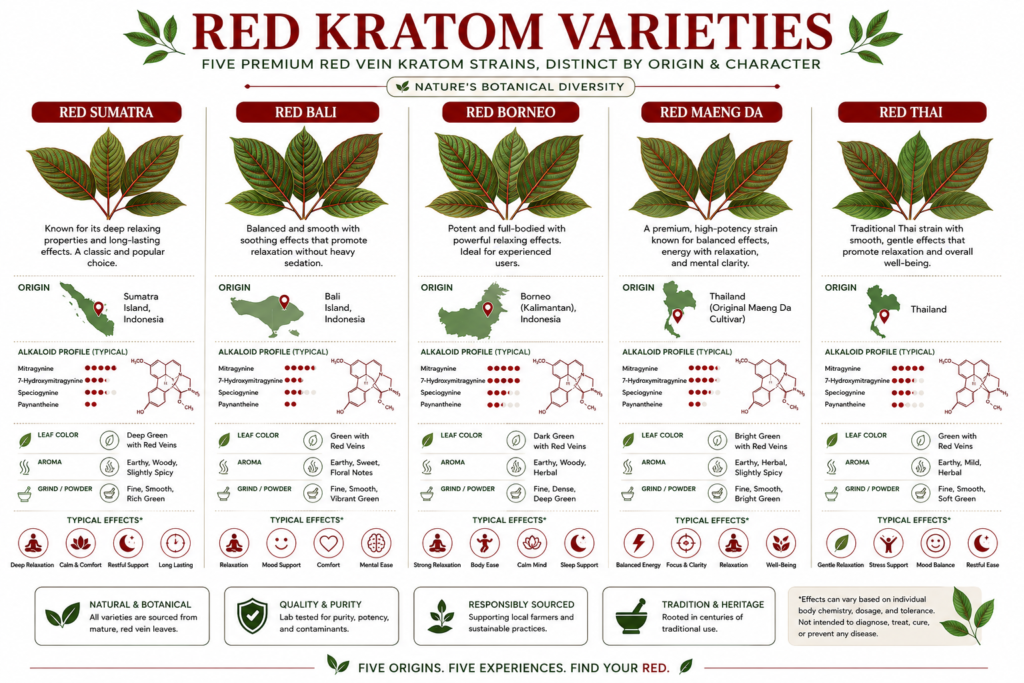
| Red Sumatra | Often described as having a distinctive profile | Grown in volcanic Sumatran soil; mature leaf harvest with slow drying | Variable quality depending on vendor and processing |
| Red Bali | Most widely available red vein | Broad alkaloid profile; common entry point | Quality inconsistency due to high market availability |
| Red Borneo | Often noted for a milder character among red veins | Grown in Borneo rainforests; widely accessible | Reports of adulteration in lower-priced batches |
| Red Maeng Da | Frequently marketed as high-potency | Often a blend or grafted variety rather than single-origin | “Maeng Da” is not a geographic region; name is inconsistently applied |
| Red Thai | Less common than Bali and Borneo varieties | Traditionally grown in Thailand, though much is now imported | Original Thai sources are restricted due to historic export limitations |
The descriptions above reflect general ethnobotanical and consumer-reported characteristics. They do not constitute medical claims, and individual responses to any kratom product will vary.
The Role of Sumatra’s Geography in Kratom Quality
Mitragyna speciosa thrives under specific conditions: high humidity, fertile soil, consistent rainfall, and proximity to the Equator. Sumatra meets all of these criteria.
The volcanic soil found across much of Sumatra is nutrient-dense. Rainfall is abundant throughout the year. Dense forest canopy in many cultivation areas creates a naturally humid environment well-suited to the plant’s growth.
These environmental factors directly influence the alkaloid content of the leaves. The same principle that explains why coffee grown in Ethiopia differs from coffee grown in Colombia applies here — growing environment, or terroir, matters.
Researchers studying kratom have found that samples from Sumatran sources can contain different alkaloid ratios compared to samples from Borneo or Thailand. Whether that variation is driven by geography, genetics, or both remains an active area of inquiry.
Traditional and Historical Use Context
Kratom has been part of Southeast Asian culture for centuries. In Sumatra, Borneo, Thailand, and Malaysia, farmers and laborers incorporated kratom leaves into daily life.
Leaves were typically chewed fresh or brewed into tea. These practices were embedded in agricultural communities and local cultural traditions.
Understanding this historical context is important. It demonstrates that kratom has been used by humans over long periods. It also highlights that traditional consumption patterns differed considerably from current patterns, which may involve concentrated powders, high-dose products, and extracts.
This distinction is frequently referenced by the American Kratom Association and other advocacy groups when discussing kratom’s safety profile. Regulators, however, focus on contemporary consumption patterns and dose levels. Both perspectives are part of a broader ongoing policy debate.
What Consumers Commonly Observe and Report
Consumer experience data for Red Sumatra Kratom appears across forums including Reddit’s r/kratom, Bluelight, and various botanical communities.
Commonly reported observations include:
- A slower onset compared to white or green vein strains
- A profile often described as “earthy” in both taste and aroma
- Popularity among those who prefer red vein varieties generally
It is important to be clear that these are individual experience reports shared in online communities. They are not clinical research findings. Kratom has not been approved by the FDA to treat any condition. Individual responses to kratom vary considerably depending on factors including body weight, tolerance, metabolism, and product quality. Any source citing consumer experience data — including this article — should clearly distinguish anecdotal reports from clinical evidence.
Testing, Regulations, and What to Look For
Important: Kratom is not approved by the FDA for any medical use. Kratom may cause physical dependence, withdrawal symptoms, and adverse health effects. It may also interact with prescription medications, over-the-counter drugs, and other substances. Anyone considering kratom use should consult a licensed healthcare provider before doing so.
The kratom industry in the United States is largely unregulated at the federal level. The FDA has not approved kratom as a dietary ingredient or drug. Several states have enacted legislation, including versions of the Kratom Consumer Protection Act (KCPA), which establishes minimum standards for testing and labeling. States with active KCPA legislation include Utah, Georgia, Arizona, and Nevada, among others. Consumers in those states have additional legal protections compared to those in states without such laws.
For any Red Sumatra Kratom product, look for:
- Third-party COAs issued by an independent laboratory, not the vendor’s internal team
- Heavy metal panel testing for lead, arsenic, mercury, and cadmium
- Microbial screening confirming the absence of E. coli, salmonella, and other pathogens
- Mitragynine content clearly stated as a percentage of total alkaloid profile
- AKA GMP certification — the American Kratom Association’s voluntary Good Manufacturing Practice program sets industry guidelines
Vendors who share this information transparently operate to a higher standard than those who do not.
Common Misconceptions About Red Sumatra Kratom
Misconception: All Red Sumatra products are the same.
Even within the same strain name, considerable variation exists. Different harvest times, drying methods, and manufacturing practices produce distinct products. A label alone conveys very little without a supporting COA.
Misconception: Red vein kratom is inherently more potent than green or white vein.
Potency is determined by alkaloid concentration, not vein color. A poorly processed red vein product may contain lower mitragynine levels than a well-processed green vein product. Vein color reflects processing method and leaf maturity — it does not guarantee potency.
Misconception: Kratom from Sumatra is automatically superior to kratom from other regions.
Geographic origin creates distinct growing conditions, but it does not guarantee quality. A Sumatran product from a low-quality producer is likely to be inferior to a well-sourced, well-tested product from Borneo. Origin matters, but processing standards and third-party testing matter more.
Misconception: If kratom is legal, it is safe.
Legality and safety are not the same thing. Many legal substances carry meaningful health risks. Kratom is no exception. The absence of federal scheduling does not mean kratom is risk-free. It should be approached with the same level of scrutiny applied to any unregulated supplement.
Frequently Asked Questions
What makes Red Sumatra different from other red vein kratom strains?
Red Sumatra Kratom is distinguished primarily by its geographic origin and growing environment. Sumatra’s volcanic soil, high humidity, and equatorial climate create conditions that influence the alkaloid composition of the leaf. Processing methods — including slow drying and occasional fermentation — also play a significant role in its characteristics. While many red vein varieties share broad similarities, knowledgeable buyers often note that Sumatran varieties have a distinct appearance and profile compared to Bali or Borneo reds. Without standardized laboratory testing, most of these distinctions are based on consumer reports rather than pharmacological data.
Is Red Sumatra Kratom legal to purchase in the United States?
Kratom’s legal status in the United States varies by state and locality. At the federal level, the DEA has reviewed kratom but has not implemented federal scheduling as of the most recent reporting period. Several states — including Alabama, Arkansas, Indiana, Rhode Island, Vermont, and Wisconsin — have banned it entirely. Some cities and counties have enacted local restrictions even in states where kratom is otherwise legal. The Kratom Consumer Protection Act has been adopted by various states to increase oversight of the market. Consumers should verify the laws applicable to their specific location before purchasing any kratom product, as regulations change regularly.
In what forms is Red Sumatra Kratom typically sold?
Red Sumatra Kratom is most commonly sold as a fine powder that can be mixed with liquids. It is also available in capsule form, where pre-measured powder is encapsulated for convenience. Some suppliers offer extracts with higher alkaloid concentrations. Tea-grade and crushed leaf products are available but less common than powder. Each product type differs in concentration, absorption characteristics, and labeling precision. Extracts in particular require careful review of the accompanying COA, as concentration levels can vary significantly between products.
What should I look for when evaluating a Red Sumatra Kratom vendor?
Begin with laboratory documentation. A legitimate vendor should provide an independent test report for each batch, covering alkaloid content, heavy metals, and microbial contamination. Look for AKA GMP certification, which indicates compliance with voluntary manufacturing guidelines. Verify that the vendor clearly states mitragynine content by percentage, not just by strain name. Review feedback from independent forums rather than relying solely on reviews published by the vendor. Transparent businesses will welcome questions about their sourcing and processing methods. Reluctance to share testing data is a warning sign regardless of price point.
How does Red Sumatra compare to Red Bali for someone new to red vein kratom?
Red Bali is generally considered one of the most widely available red vein varieties, which means more vendor options but also more variability in quality. Red Sumatra tends to be somewhat less prevalent in the market, which can mean fewer options and less accumulated consumer data. For someone new to red vein kratom, both varieties are frequently discussed in user communities. The most important consideration for a new buyer is vendor transparency and testing documentation — not the strain name. A well-tested Red Bali from a reputable vendor is more reliable than an untested Red Sumatra from a low-quality operation.
Closing Words
Red Sumatra Kratom is a well-established strain with a distinct geographic identity, a documented processing history, and a consistent following among kratom users. It is an agricultural product shaped by growing conditions, soil composition, harvest decisions, and production methods — not a guaranteed outcome.
The key takeaways from this article:
- Geographic origin is relevant but does not guarantee quality
- Red vein classification reflects leaf maturity and processing, not potency
- Third-party testing is the most reliable indicator of product quality
- Legal status varies widely and is subject to change
- Consumer experience reports are informative but not clinical evidence
The regulatory and research landscape surrounding kratom in the United States continues to develop. Frameworks are being constructed. The body of scientific research, while still limited, is growing. Anyone engaging with this subject — whether as a consumer, researcher, or curious observer — benefits from an evidence-based, informed approach.
That approach begins with understanding what a strain actually is, how it is produced, and what documentation genuinely confirms its quality.
Other Articles You May Find of Interest...
- Kratom Legality in 2026: Why the Rules Vary by Location
- 7 Things to Know About Split Kilo Kratom Before a Bulk Order
- Red Thai Kratom: The Strain With a Complicated History and a Loyal Following
- Red Sumatra Kratom: What Makes This Strain Stand Apart
- Red Indo Kratom: The Strain That Built the Modern Kratom Market
- Red Hulu Kapuas Kratom: What Makes This Rare Strain So Talked About?
- Red Borneo Kratom: The Strain That Built the Modern Kratom Market




