






More Kratom Education Articles
Red Indo Kratom: The Strain That Built the Modern Kratom Market

Browse through any vendor’s website and a pattern becomes apparent. Certain strains carry flashy branded names like Dragon, Trainwreck, or Plantation. Red Indo Kratom sits apart from those, requiring no dramatic branding. It has been present in the market since its early days and continues to outsell most exotic strains.
That staying power is not a coincidence. Indonesia is the largest exporter of kratom by a significant margin. Most of the kratom available in the United States, Europe, and Australia originates there. When people refer to “Indo kratom,” they are referencing the country that established the modern commercial supply chain for kratom.
What many consumers do not realize is that “Red Indo” functions both as an individual strain designation and as one of the more loosely used names in the marketplace. Understanding what it means — how it is grown, how it is processed, and how it differs from other red vein varieties — is essential for anyone trying to make informed purchasing decisions.
This article examines Red Indo Kratom from the ground up, covering geography, alkaloids, processing, quality markers, strain comparisons, and the regulatory landscape.
Indonesia’s Role in the Global Kratom Supply
To understand Red Indo Kratom, it helps to understand where it comes from.
Kratom cultivation in Indonesia spans multiple islands, including Borneo (Kalimantan), Sumatra, and Java. The country’s equatorial climate, rich volcanic soil, and consistent rainfall create favorable conditions for growing Mitragyna speciosa — the tree from which kratom is derived.
Indonesia accounts for approximately 95 percent of all kratom sold worldwide. That figure has practical implications: virtually every strain on the market — Bali, Borneo, Maeng Da, and Indo — originates from the same country, differentiated by region, farm, and processing method.
“Red Indo” specifically refers to Indonesian kratom leaf processed using red vein methods. It is a broad classification. That breadth is both its accessibility and its limitation from a consumer clarity standpoint.
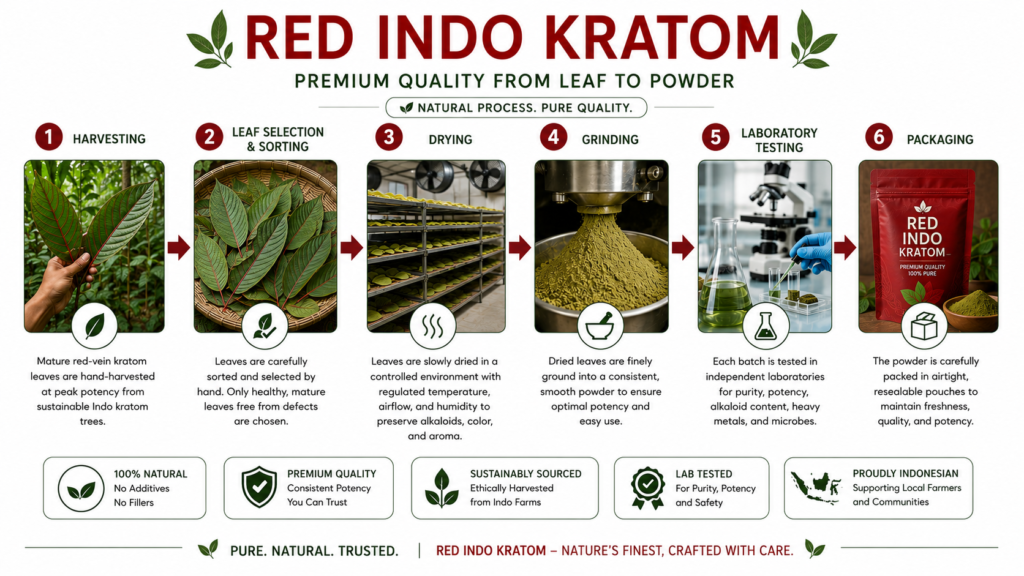
What “Red Vein” Actually Means in Production Terms
Vein color in kratom is not purely genetic. It is primarily a function of harvest timing and post-harvest processing.
Red Indo Kratom typically involves:
- Mature leaf selection — leaves harvested later in the growth cycle
- Extended sunlight drying — prolonged outdoor exposure to ultraviolet light
- Optional fermentation — some producers ferment dried leaves to alter the alkaloid ratio
This process is believed to convert a portion of mitragynine into 7-hydroxymitragynine and other oxidized compounds. The result is a different alkaloid ratio compared to white or green vein processing of the same leaf.
This process is not standardized across the industry. Two producers in different parts of Kalimantan may both label their product “Red Indo” while using significantly different processing times and methods.
The Alkaloid Profile Behind Red Indo Kratom
Kratom’s chemical complexity is part of what draws both scientific interest and regulatory scrutiny. The leaf contains more than 40 known alkaloids. The two that dominate most research and testing are:
- Mitragynine — the primary alkaloid, typically comprising 1 to 2 percent of dry leaf weight
- 7-Hydroxymitragynine (7-OH) — present at much lower concentrations, with a distinct receptor binding profile compared to mitragynine
Red vein processing tends to increase the proportion of oxidized alkaloids, including 7-OH. The extent of that change depends on drying time, temperature, humidity, and whether fermentation is employed.
This is why batch-level Certificates of Analysis (COAs) from third-party laboratories carry so much weight. Alkaloid percentages in red kratom can vary considerably across farms, vendors, and harvests from the same location. A label listing alkaloid numbers without supporting lab documentation is an unverifiable claim.
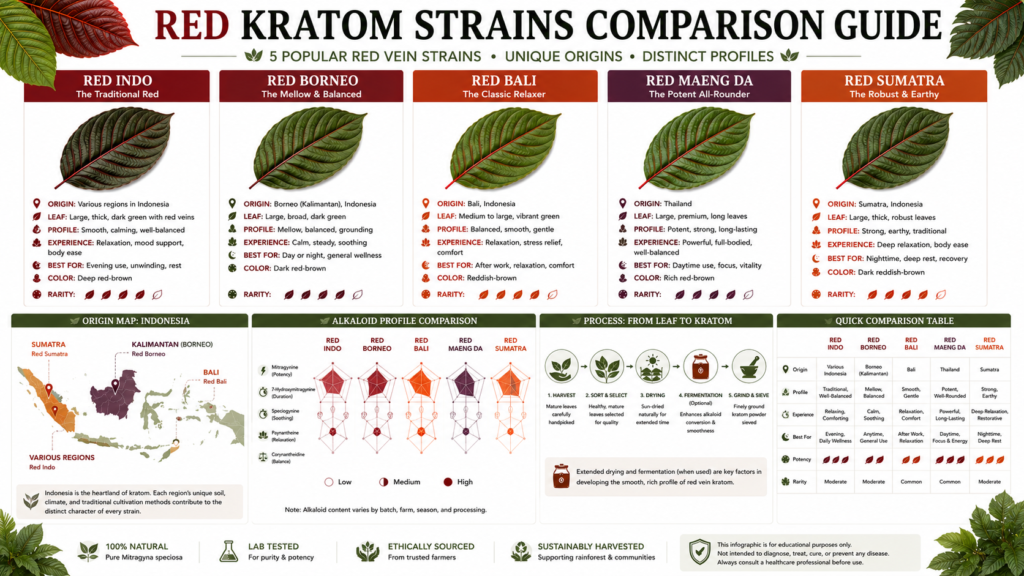
How Red Indo Compares to Other Popular Red Vein Strains
| Strain | Common Description | Key Characteristics | Important Limitation |
| Red Indo | Broad Indonesian origin, red vein processing | Wide availability, variable regional sourcing | “Indo” label is vague and covers multiple islands |
| Red Bali | One of the most globally available red veins | Often reported to have higher alkaloid density | “Bali” is frequently a blend, not a single origin |
| Red Borneo | Specifically from Kalimantan, Borneo island | Generally considered balanced by the community | Geographic label still covers a large area |
| Red Maeng Da | Enhanced or grafted high-potency variety | Higher mitragynine content typical | A marketing term, not necessarily a geographic origin |
| Red Sumatra | From plantation zones on Sumatra island | Different soil profile from Borneo varieties | Quality consistency varies widely between vendors |
The consistent pattern here is that strain names in the kratom market suggest geographic origin but carry no regulatory guarantee. The Red Indo label indicates a general origin and processing class. It does not specify location, farm, or batch.
Traditional and Historical Context of Indonesian Kratom
Kratom use in Indonesia predates the global supplement market by centuries. Indigenous communities of Borneo — particularly the Dayak people — used kratom leaves in traditional ways, including chewing fresh leaves, brewing teas, and incorporating the plant into local cultural practices.
Agricultural laborers in Kalimantan traditionally used kratom during long working days. This pattern of use shaped how kratom was understood locally before commercialization began.
The transition from subsistence use to global export commodity occurred gradually through the 1990s and accelerated significantly during the 2000s as Western interest in botanical products grew. Indonesian farmers adapted quickly, and kratom became a major cash crop in regions such as West Kalimantan.
Red Indo Kratom, owing to its broad processing classification, was among the early strains that drew international buyers into the Indonesian export market.
What the Kratom Community Actually Says About Red Indo
Online communities dedicated to kratom — including Reddit’s r/kratom and various forums — contain extensive discussions about Red Indo.
Common themes in community observations include:
- Red Indo is frequently cited as a useful baseline red vein for comparison purposes
- Experienced users often note that vendor quality influences the experience more than the strain label itself
- Some users distinguish between Red Indo from Sumatra versus Kalimantan, noting perceived differences
- Price sensitivity is common — Red Indo is generally less expensive than rarer specialty strains
Across these discussions, vendor accountability is a recurring focus. COA access, AKA GMP certification, and batch-specific testing are consistently cited as the most important factors in determining whether a Red Indo product delivers what its label suggests.
Safety Standards and What Responsible Sourcing Looks Like
Important: Kratom is not approved by the FDA for any medical use. Kratom may cause physical dependence, withdrawal symptoms, and adverse health effects. It may also interact with prescription medications, over-the-counter drugs, and other substances. Anyone considering kratom use should consult a licensed healthcare provider before doing so.
The kratom market operates within an evolving regulatory environment. At the federal level in the United States, the FDA has not approved kratom for any medical use and has issued import warnings regarding specific products. The DEA has reviewed kratom but had not federally scheduled it as of the most recent reporting period.
The American Kratom Association (AKA) operates a voluntary GMP certification program that establishes baseline standards for vendors. Requirements include:
- Third-party laboratory testing from ISO-accredited laboratories
- Contaminant screening for heavy metals, salmonella, E. coli, and pesticides
- Accurate labeling with batch-specific alkaloid percentages
- No adulteration with synthetic substances or other compounds
- Defined storage and processing protocols
When evaluating any Red Indo Kratom product, the minimum documentation to look for is a COA specific to the exact batch being purchased. A generic certificate covering “Red Indo” without batch numbers does not provide adequate quality assurance.
Four Misconceptions About Red Indo Kratom Worth Addressing
Misconception: Red Indo is a single, standardized strain with consistent properties across all manufacturers.
“Red Indo” is a broad label covering leaf from multiple Indonesian islands processed using various red vein methods. No industry standard defines precisely what Red Indo must contain or how it must be produced.
Misconception: Indonesian kratom is always lower quality than strains from more specifically identified regions.
Geographic specificity does not determine quality. A well-farmed, consistently processed, and third-party tested product from an established Indonesian producer can be superior to an exotic variety sold by a vendor with poor manufacturing practices.
Misconception: Red vein coloring in kratom leaves indicates a distinct plant species.
Vein color classification in the commercial kratom market relates primarily to processing method and harvest maturity, not to distinct plant subspecies. Most commercial kratom is the same Mitragyna speciosa species processed in different ways.
Misconception: Because Indonesia dominates the supply, all red kratom is essentially the same product.
Indonesia is a large archipelago with considerable regional variation. West Kalimantan, Sumatra, and Java each have distinct soil compositions, microclimates, and agricultural practices. Regional variation within Indonesia is real and can be measured at the alkaloid level.
Frequently Asked Questions
What is Red Indo Kratom and what makes it different from other kratom varieties?
Red Indo Kratom is leaf sourced from Indonesia and processed using red vein techniques, which typically involve later harvest timing and extended drying or fermentation. The “red” designation reflects processing choices that alter the alkaloid ratio compared to white or green vein products. “Indo” refers broadly to Indonesian origin, encompassing multiple islands including Kalimantan and Sumatra. What distinguishes it from other kratom varieties is the combination of geographic origin and processing method — though neither element is uniform across all vendors in the market.
Is Red Indo Kratom legal to purchase in the United States?
At the federal level, kratom is not a scheduled controlled substance in the United States. However, state and local laws vary. Alabama, Arkansas, Indiana, Rhode Island, Vermont, and Wisconsin have prohibited kratom. Several cities in otherwise permissive states have also enacted their own restrictions. Legal status can change as legislation evolves. Consumers should verify the laws applicable to their specific location before purchasing. The American Kratom Association maintains updated information on kratom’s legal status across states and municipalities.
How can I confirm that a Red Indo product is safe and accurately represented?
Begin by requesting a batch-specific COA from an ISO-accredited third-party laboratory. The COA should confirm mitragynine content, 7-hydroxymitragynine levels, and screening results for heavy metals and microbial contaminants. Verify that the vendor holds AKA GMP certification, which requires ongoing compliance with testing and manufacturing requirements. Exercise caution with vendors who cannot provide COAs upon request, make health or medical claims, or list high alkaloid levels without documented evidence. Transparency on quality is achievable in this market — vendors who provide proper documentation demonstrate a meaningful commitment to accountability.
Why does Red Indo Kratom pricing vary so much between sellers?
Several factors drive that variation. Indonesian kratom is sourced from multiple micro-regions and islands with distinct soil and climate characteristics. Harvest timing, drying methods, fermentation decisions, and storage conditions all influence alkaloid composition. Quality control practices differ considerably between vendors and farms. Additionally, the “Red Indo” label carries no regulatory definition, meaning it can be applied to products with very different production histories. Batch-level testing is the only reliable way to compare quality across brands, since the label itself provides limited quality assurance.
What should someone new to kratom know before exploring Red Indo strains?
It is important to understand that kratom is an unregulated botanical product in the United States. The FDA has not evaluated kratom for safety or effectiveness for any health condition. Speak with a physician before using any product containing kratom, particularly if you take medications or have underlying medical conditions. Look for vendors with transparent testing documentation and AKA GMP certification. Be cautious of products making specific health claims, as those claims do not have FDA approval. The kratom community’s consistent emphasis on vendor accountability reflects a genuine reality — product quality varies significantly within this market.
The Bottom Line on Red Indo Kratom
Red Indo Kratom holds a central position in the kratom market not because of rarity or mystique, but because of volume, accessibility, affordability, and the fact that Indonesia built the supply chain the entire industry depends on.
The strain label tells part of the story. Geographic origin is relevant. Processing method is relevant. But neither guarantees quality consistency without third-party verification behind them.
What is consistently clear from both research and community experience is that a vendor’s commitment to transparency, testing, and manufacturing standards influences product quality more than the strain name on the packaging. Red Indo is a clear example of this principle, and it applies equally to every kratom product on the market.
Understanding the geography, processing methods, and alkaloid research behind Red Indo Kratom provides a solid foundation for evaluating what a label actually represents.
Other Articles You May Find of Interest...
- How HPLC Testing Verifies Botanical Potency—and Why Lab Results Can Differ
- Red Bali Kratom: What It Is, How It Differs, and What the Research Says
- Kratom Legality in 2026: Why the Rules Vary by Location
- 7 Things to Know About Split Kilo Kratom Before a Bulk Order
- Red Thai Kratom: The Strain With a Complicated History and a Loyal Following
- Red Sumatra Kratom: What Makes This Strain Stand Apart
- Red Indo Kratom: The Strain That Built the Modern Kratom Market





