






More Kratom Education Articles
Red Hulu Kapuas Kratom: What Makes This Rare Strain So Talked About?

Most people who discover kratom start with the basics — red vein, green vein, white vein. Then they encounter something like Red Hulu Kapuas Kratom and realize the subject is considerably more complex than they initially expected.
Hulu Kapuas is one of the rarest sourcing regions in the entire kratom market. The name comes from the Kapuas River in the Hulu region of Borneo — a dense, remote stretch of rainforest in Indonesia’s Kalimantan province. Farmers there have been cultivating Mitragyna speciosa for generations. Because of the difficulty involved in reaching and harvesting from this area, genuine Hulu Kapuas material remains scarce compared to mainstream strains from Sumatra or Bali.
That scarcity is part of why Red Hulu Kapuas Kratom generates significant curiosity online. Kratom users want to know whether it lives up to its reputation — whether the interest is substantiated or simply the result of vendors marketing something exotic.
This article explains what the strain actually is, how it differs from others, and what research and the broader kratom community say about it.
Where the Name “Hulu Kapuas” Actually Comes From
The word hulu in Malay and Indonesian means “upstream” or “headwaters.” It refers to the upper reaches of a river system — in this case, the Kapuas River, the longest river in Indonesia, running nearly 700 miles through West Kalimantan on the island of Borneo.
The Kapuas Hulu region is a UNESCO-recognized biosphere reserve. It is dense jungle with minimal infrastructure. Reaching the area and transporting agricultural goods out of it presents genuine logistical challenges.
Kratom trees in this area grow along riverbanks. The combination of alluvial soil, high humidity, and year-round warmth creates growing conditions that proponents of this strain believe produce a distinct alkaloid expression. Whether that is fully established by science or partially shaped by regional tradition is worth acknowledging — but the geography itself is real.
When “Red Hulu” or “Hulu Kapuas Red Vein” appears on a product label, it should ideally refer to leaf material sourced from this specific region and processed using red vein methods.
How Red Vein Processing Shapes the Final Product
All kratom leaves begin the same way. The vein color classification — red, green, white — reflects harvest timing and post-harvest processing more than it reflects genetics.
Red vein kratom typically involves:
- Later harvest timing — leaves picked after full maturation
- Extended drying — often done outdoors under direct sunlight, sometimes for longer periods than green or white vein processing
- Fermentation — some producers include a fermentation phase, which is believed to shift alkaloid ratios
This process converts a portion of mitragynine into 7-hydroxymitragynine and other oxidized alkaloids. The resulting profile differs from what the same leaf would produce under green or white vein processing.
For Red Hulu Kapuas Kratom specifically, the combination of regional origin and red vein processing is what proponents say distinguishes it from more commonly available red veins such as Red Bali or Red Borneo.
The Alkaloid Composition: What Is Actually in It
Kratom’s properties trace back to its alkaloid content. Mitragyna speciosa contains over 40 identified alkaloids, but the two that receive the most attention in research are:
- Mitragynine — the most abundant alkaloid by mass, typically found at around 1 to 2 percent of dry leaf weight
- 7-Hydroxymitragynine (7-OH) — present in far smaller concentrations but with a different receptor affinity profile
Red vein processing tends to shift the ratio between these two compounds. The exact alkaloid profile of Red Hulu Kapuas Kratom will vary depending on the specific batch, the farm, drying conditions, and storage.
This is why batch-level third-party testing is essential. A vendor claiming specific alkaloid percentages without a Certificate of Analysis (COA) is making a statement that cannot be independently verified.
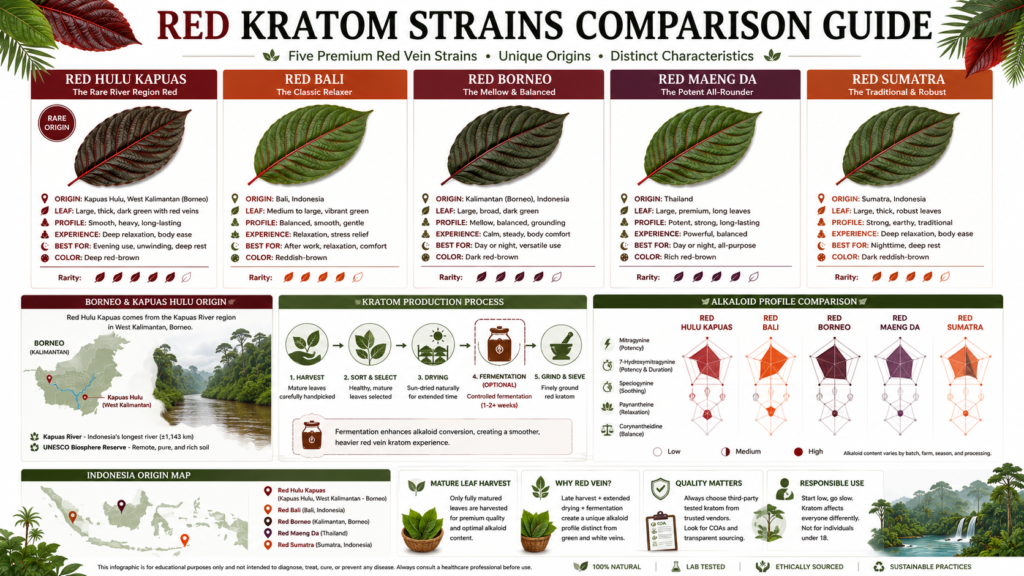
Red Hulu Kapuas vs. Other Strains: A Comparison
| Strain | Common Description | Key Characteristics | Important Limitation |
| Red Hulu Kapuas | Rare, river-region red from Borneo | Unique sourcing area, red vein processing, limited supply | Genuine sourcing is difficult to verify |
| Red Bali | One of the most widely available red veins | Typically high alkaloid content, easy to find | “Bali” is often a blend label, not a single origin |
| Red Borneo | Broad category from Kalimantan island | Considered balanced by users, widely stocked | Geographic label covers a large and variable area |
| Red Maeng Da | Popular enhanced or grafted variety | Often higher mitragynine content | “Maeng Da” is a quality grade, not a true geographic region |
| Red Sumatra | From Sumatra island, distinct growing conditions | Different soil composition from Borneo strains | Less rare, with more variable sourcing |
The most important takeaway: strain names in the kratom market are not regulated. “Red Hulu Kapuas” on one vendor’s label may not correspond to what another vendor sells under the same name.
Rarity and Supply Chain Challenges
Hulu Kapuas kratom — regardless of vein color — is genuinely more difficult to source than Bali or Maeng Da material. The reasons are logistical:
- Remote location with limited road access
- Smaller farming operations compared to high-volume commercial kratom regions
- Monsoon season disruptions affecting harvest schedules
- Higher transportation costs to reach export hubs
This scarcity creates market distortions. Some vendors legitimately source from the Kapuas Hulu region. Others use the name as a marketing label without the actual geographic provenance. Without COA documentation supporting geographic or botanical traceability, consumers have no reliable way to confirm what they are receiving.
How This Strain Is Discussed in the Kratom Community
Online kratom communities — including Reddit’s r/kratom and public resources from the American Kratom Association — include discussions dedicated to regional strain comparisons.
Red Hulu Kapuas Kratom appears in conversations about:
- Vein color comparisons — how it relates to Red Borneo or Red Thai
- Origin authenticity debates — whether vendors actually source from the Kapuas Hulu region
- Processing differences — sun-dried versus indoor-dried versus fermented red veins
Community sentiment is cautiously positive regarding the strain’s reputation as a distinctive red vein variety. However, experienced users consistently note that vendor quality matters significantly more than the strain name itself. A well-tested Red Bali from a reputable vendor will generally outperform a poorly processed product labeled “Hulu Kapuas” from a less careful source.
Safety Standards, Testing, and What to Look For
Important: Kratom is not approved by the FDA for any medical use. Kratom may cause physical dependence, withdrawal symptoms, and adverse health effects. It may also interact with prescription medications, over-the-counter drugs, and other substances. Anyone considering kratom use should consult a licensed healthcare provider before doing so.
The kratom industry in the United States operates without FDA approval of individual products. The Drug Enforcement Administration has reviewed kratom but has not federally scheduled it as of recent assessments. Legal status varies by state, and consumers should verify regulations in their specific location before purchasing.
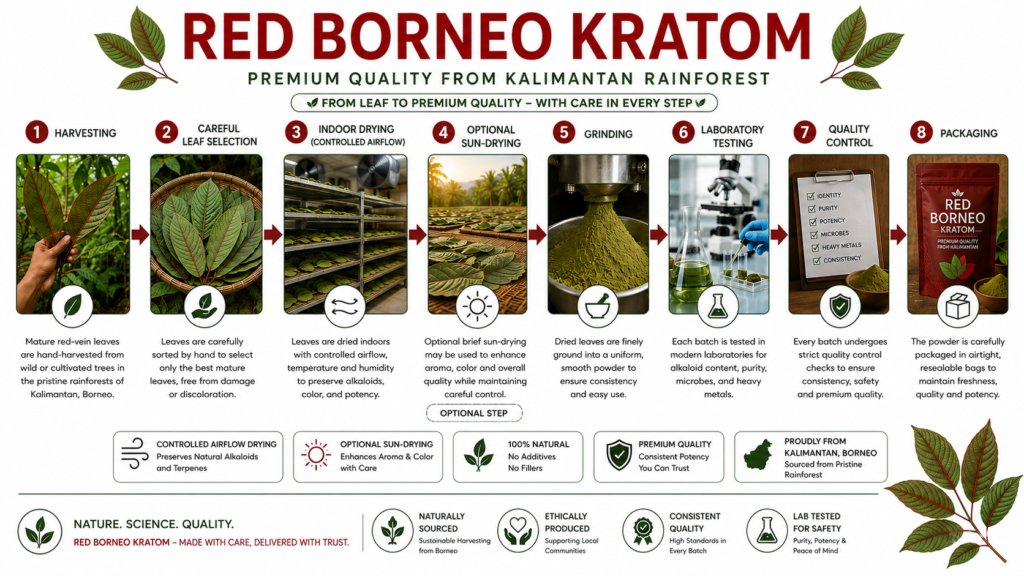
The American Kratom Association (AKA) operates a Good Manufacturing Practices (GMP) certification program. Vendors who participate must meet standards including:
- Third-party laboratory testing for alkaloid content
- Contaminant screening for heavy metals, pathogens, and pesticides
- Proper labeling
- No adulteration with other substances
When evaluating any Red Hulu Kapuas Kratom product, look for:
- A published COA from an ISO-accredited third-party laboratory
- AKA GMP certification for the vendor
- Batch-specific testing — not a generic certificate covering multiple products
- Clear labeling with mitragynine percentage confirmed per batch
Vendors unable to provide this documentation present a significant gap in accountability that consumers should take seriously.
Common Misconceptions About Red Hulu Kapuas Kratom
Misconception: Red Hulu Kapuas is a completely different plant species from other kratom strains.
All kratom comes from Mitragyna speciosa. “Hulu Kapuas” is a regional and processing designation, not a separate botanical species.
Misconception: Red vein kratom is always stronger than green or white vein because of its color.
Vein color is a marker of harvest timing and processing, not a universal indicator of potency. Alkaloid content varies by batch, farm, and drying method — not by vein color category alone.
Misconception: Rarer strains like Hulu Kapuas are inherently higher quality.
Rarity affects availability and price. It does not guarantee quality. Quality is determined by farming practices, harvest timing, processing standards, and third-party testing.
Misconception: All vendors selling “Red Hulu Kapuas” are sourcing from the actual Kapuas Hulu region.
Strain naming in the kratom market is largely unregulated. Without verified supply chain documentation, geographic claims are difficult to confirm independently.
Frequently Asked Questions
What makes Red Hulu Kapuas Kratom different from other red vein strains?
Red Hulu Kapuas Kratom is distinguished primarily by its claimed sourcing region — the Kapuas Hulu area of West Kalimantan, Borneo — and by standard red vein processing methods. The combination of that specific ecosystem, including alluvial riverbank soil, tropical climate, and mature tree populations, along with extended drying or fermentation, is what proponents say produces a distinct alkaloid profile. However, since strain naming is not regulated, the actual product depends heavily on whether the vendor genuinely sources from that region and maintains consistent processing standards.
Is Red Hulu Kapuas Kratom legal in the United States?
At the federal level, kratom is not a scheduled substance and is legal to purchase in most U.S. states. However, several states and municipalities have banned or restricted kratom, including Alabama, Arkansas, Indiana, Rhode Island, Vermont, and Wisconsin, along with certain cities in otherwise permissive states. Consumers should verify current local regulations before purchasing, as laws can change. The American Kratom Association monitors legislation and publishes updated legal status information on its website.
How should someone evaluate a vendor selling Red Hulu Kapuas Kratom?
Begin with third-party testing. A credible vendor will publish batch-specific Certificates of Analysis from ISO-accredited laboratories showing mitragynine content and contaminant screening results. Check for AKA GMP certification, which indicates a commitment to defined manufacturing standards. Review verified customer feedback across multiple platforms. Exercise caution with vendors who make health claims, cannot provide COAs upon request, or list unusually high alkaloid percentages without supporting documentation.
Does the Kapuas River region actually produce different kratom than other Borneo areas?
The Kapuas Hulu region has distinct environmental conditions — rich alluvial soil from river deposits, specific microclimates, and remote forest ecosystems. Some researchers suggest these conditions may influence the secondary metabolite profile of Mitragyna speciosa trees. Whether those differences translate into meaningfully distinct product characteristics depends on the consistency of sourcing and the care taken in processing. The science on kratom’s agronomic variation is still developing.
What should buyers know about kratom testing and labeling transparency?
Kratom products should display mitragynine content per gram, confirmed by a third-party COA. Responsible vendors test each batch, not just initial product lots. Labels should not make medical or health claims. Heavy metal testing is important because kratom leaf can accumulate metals from soil. Microbial testing screens for pathogens such as salmonella and E. coli. The AKA’s GMP program requires all of these as baseline standards. Buyers who prioritize vendors meeting those standards are less likely to encounter quality inconsistencies or safety concerns.
Closing Thoughts: What the Evidence Actually Supports
Red Hulu Kapuas Kratom occupies an interesting position within the broader kratom market. It has a genuine geographic basis — the Kapuas Hulu region of Borneo is real, remote, and ecologically distinct. The red vein designation reflects real processing differences that affect alkaloid composition. The community interest in this strain, while partly driven by its scarcity, is grounded in identifiable sourcing and production variables.
What the evidence does not support is the idea that any strain name guarantees a specific outcome. Alkaloid content varies. Vendor quality varies. Processing consistency varies. The name on a label provides some information, but not a complete picture.
The most reliable framework for evaluating any kratom product — including Red Hulu Kapuas Kratom — is straightforward: look for transparent third-party testing, verified manufacturing standards, and honest labeling. Those three factors are where product quality is either established or found lacking.
Other Articles You May Find of Interest...
- How HPLC Testing Verifies Botanical Potency—and Why Lab Results Can Differ
- Red Bali Kratom: What It Is, How It Differs, and What the Research Says
- Kratom Legality in 2026: Why the Rules Vary by Location
- 7 Things to Know About Split Kilo Kratom Before a Bulk Order
- Red Thai Kratom: The Strain With a Complicated History and a Loyal Following
- Red Sumatra Kratom: What Makes This Strain Stand Apart
- Red Indo Kratom: The Strain That Built the Modern Kratom Market
Featured Doctors and Practices





