
More Reviews Articles
MOTS-c Before and After: Understanding Research on Aging and Metabolism
Disclosure: This article may contain sponsored content or affiliate links provided by third parties. Publication does not constitute an endorsement by Your Health Magazine.
This article discusses research and publicly available information and does not endorse or recommend any specific product.
Searches for “MOTS-c before and after” have climbed sharply as mitochondrial peptides become a new corner of metabolic health. Pages that rank for this topic fall into one of two camps: clinic landing pages overhype it, and research summaries get too technical. This guide sits in the middle.
This article reviews current research, common questions, safety considerations, and how readers can evaluate public information about MOTS-c. MOTS-c is a research peptide, not an FDA-approved therapy. Every claim here is for educational purposes, not medical guidance.
A growing number of readers also encounter discussions framed around brands such as Kylo Peptides in this space, reflecting how peptide sourcing and formulation consistency are increasingly part of the same conversation rather than separate topics.
What Is MOTS-c?
MOTS-c is a 16-amino-acid peptide encoded by mitochondrial DNA. The name stands for “Mitochondrial Open Reading Frame of the 12S rRNA type-c.” It is classified as a mitochondrial-derived peptide (MDP) and is often called an “exercise mimetic” because it activates the same pathway that hard training does. The body produces it naturally, and circulating levels drop with age.
Why MOTS-c Is Different From Other Peptides
- Encoded inside the mitochondria, not the nucleus. Almost every other peptide is encoded by nuclear DNA. MOTS-c comes from the MT-RNR1 gene.
- Acts on cellular energy machinery, not hormones. It does not behave like growth hormone peptides or the GLP-1 drugs
- Not anabolic. It will not build muscle directly, the way CJC-1295 or Ipamorelin does
- Not appetite-suppressing. The mechanism has nothing in common with semaglutide.
How MOTS-c Works in the Body
Think of mitochondria as cellular power plants. MOTS-c is the messenger that tells those power plants when to ramp up. During stress such as exercise, fasting, or cold exposure, the peptide moves to the cell nucleus. It activates a master switch called AMPK (AMP-activated protein kinase), often described as the body’s metabolic master switch.
Once AMPK is active, four downstream effects kick in:
- Greater glucose uptake into muscle cells. GLUT transporters move to the cell surface and take up sugar from the blood.
- Increased fatty acid oxidation. The body shifts toward burning fat for fuel.
- More mitochondrial biogenesis. Cells build new mitochondria, raising baseline energy capacity.
- Improved insulin sensitivity. Less insulin is needed to manage the same glucose load.
The net effect is a more efficient metabolic engine. The original Cell Metabolism discovery paper established that MOTS-c regulates insulin sensitivity through this pathway, and later work in Nature Communications by Reynolds et al. showed that treated old mice could outrun untreated middle-aged ones on treadmill tests.
Why People Search “MOTS-c Before and After”
Search intent splits into four buckets, but the underlying question is the same: what is actually achievable and what is hype?
Energy and Daily Stamina
Most searchers want to know whether MOTS-c will actually be felt day-to-day. They are tired of chronic afternoon crashes and want steady energy without leaning harder on caffeine.
Fat Loss and Body Composition
A second group is looking for visible changes in the waist and body fat. They want transformation photos, recomposition stories, and a sense of whether the scale will move.
Athletic Performance
Endurance athletes and lifters search for MOTS-c, hoping for better recovery, longer time-to-exhaustion, and improved exercise capacity. This group often pairs the search with “exercise mimetic peptide.”
Anti-Aging and Longevity
The fourth bucket frames MOTS-c as a way to reverse mitochondrial decline and rebuild metabolic flexibility. The framing here is “rejuvenation,” not weight loss.
MOTS-c Before and After Results Overview
MOTS-c is a mitochondrial-derived peptide that regulates cellular metabolism. Public discussions commonly describe multi-week observation periods, but individual experiences and reported outcomes vary.
Before MOTS-c
Before starting a MOTS-c protocol, users commonly report the typical signs of declining metabolic function:
- Cellular & Energy: Chronic fatigue, afternoon crashes, heavy caffeine reliance, and signs of poor mitochondrial output.
- Metabolic: Insulin resistance, stubborn weight that won’t shift despite diet and training, and unstable glucose readings.
- Fitness: Low exercise tolerance (“hitting a wall” early in sessions), slow post-workout recovery, and elevated systemic inflammation.
After MOTS-c
As an “exercise mimetic,” consistent MOTS-c use activates the AMPK pathway, the body’s metabolic master switch. Reported improvements show up in stages:
- Weeks 2–4: Users report steadier daily energy, sharper mental clarity, and improved training stamina.
- Months 1–3: Visible shifts in body composition (gradual fat loss with preserved lean muscle), improved insulin sensitivity, lower fasting glucose readings, and faster recovery between training sessions.
How to Track Your Own Before and After
Establish a baseline 7 to 14 days before starting:
- Weight, waist, hip, and body fat percentage
- Fasting glucose
- Energy score on a 1 to 10 scale, logged daily
- Training log with sets, reps, and time-to-exhaustion
- Sleep average for the prior two weeks
- Photos under consistent lighting, posture, and time of day
DEXA or a quality body composition scale beats BMI. Weekly check-ins beat daily ones because metabolic shifts do not move on a 24-hour clock.
Peptide quality also affects whether tracking means anything. Research peptide purity ranges from 60% to 99%+, and two people on the same dose can get very different results based on material quality alone. Using research-grade peptides from sources that publish third-party HPLC purity reports and per-batch certificates of analysis (COAs), such as Kylo Peptides, can remove one major variable by allowing researchers to verify peptide identity and purity before use.
Visual Before and After Reality Check
Most “before and after” photos online are not clean comparisons. They involve concurrent diet changes, training, and often other peptides stacked simultaneously. Lighting, posing, and time-of-day shifts can exaggerate visual differences by 10% on their own.
Waist circumference is a more reliable visual indicator than scale weight because it reflects visceral fat changes. A realistic 8-week visual change for someone running MOTS-c with disciplined training and diet is roughly 1 to 2 inches off the waist and a slightly leaner midsection. No dramatic transformation. If a photo set shows more without a calorie deficit and training plan, something else is driving the result.
Transformation Timeline Breakdown
Week 1 to 2: Early Adaptation Phase
Subtle energy improvements appear. Some users report nothing for the first 10 to 14 days, and that silence is normal. Mitochondrial signaling does not reverse within 48 hours. Recovery between workouts may feel slightly better. Mild side effects can occur here, such as lightheadedness, an injection-site reaction, or temporary fatigue. No visible body composition changes yet.
Week 3 to 4: Metabolic Shift Phase
Daytime energy stabilizes. Fasting glucose may start trending down. Endurance becomes noticeable in training, especially during longer cardio or higher-rep sets. Slight fat loss begins when paired with a calorie-aware diet and resistance training. Sleep quality often improves around this point, which compounds every other adaptation.
Week 5 to 8: Visible Change Phase
Waist circumference reductions are usually measurable, ranging from half an inch to two inches, depending on starting body fat. Slight muscle definition appears through the midsection. Mood and mental clarity often improve, likely as a downstream effect of better metabolic function. Most “before and after” photos online are taken at this stage.
Month 3+: Long-Term Adaptation Phase
Cumulative improvements in insulin sensitivity, sustained biomarker shifts, and refined body composition. Diminishing returns become possible, which is why many users cycle off for four to six weeks before restarting. Effects gradually fade without continued use or a strong lifestyle foundation underneath.
Energy, Fat Loss, and Performance Changes Users Report
Energy Changes
Steadier baseline energy through the workday, less afternoon fatigue, better tolerance for fasted training, and faster bounce-back from a poor night of sleep.
Fat Loss Changes
Gradual rather than rapid, more prominent around the waist and visceral fat. Works best with caloric awareness and resistance training. Not a substitute for diet.
Performance Changes
Longer time-to-exhaustion during cardio, improved VO2 max in some users, faster recovery between sessions, and better thermoregulation during exercise.
Cognitive and Mood Changes (Anecdotal)
Sharper focus, less brain fog, and a more stable mood show up in community reports. These are likely a byproduct of steadier blood sugar rather than a direct cognitive effect.
Real User Experiences and Observations (Non-Medical Framing)
These observations come from forums like r/Biohackers on Reddit and community discussions, not clinical trials. Useful for expectations, not medical claims.
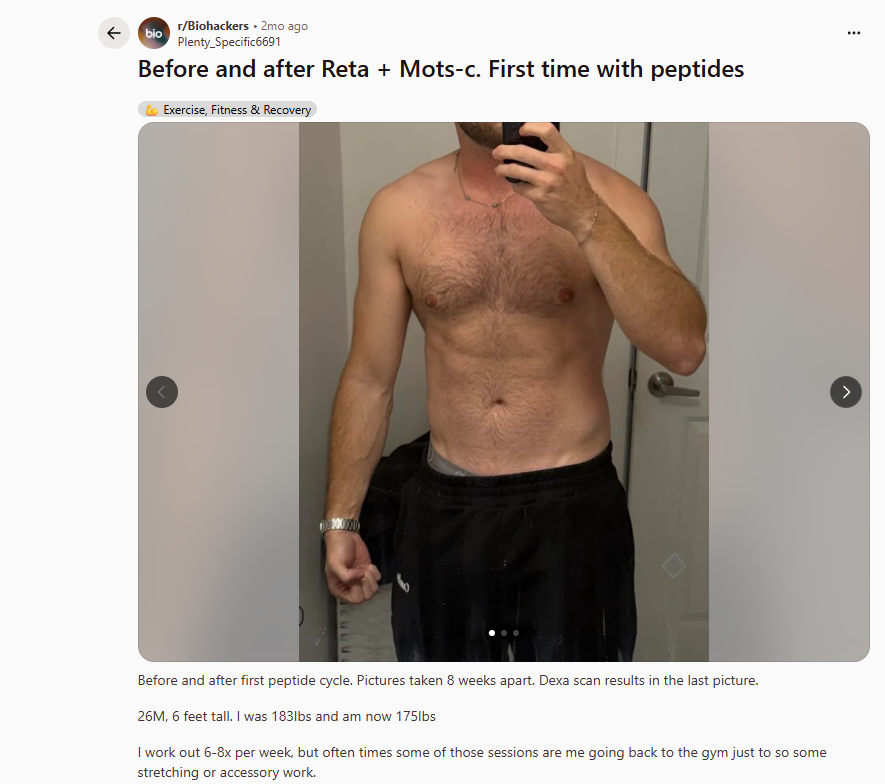
The “Quiet Improvement” Reports
The most common pattern is subtle but real. Users describe outcomes as “I feel better, but I can’t point to one big thing.” Less dramatic than semaglutide transformations, but more sustainable.
The “Performance-First” Reports
Endurance athletes notice changes before sedentary users. VO2 max and recovery improvements lead the timeline. Strength athletes report it more during higher-rep work than maximal lifts.
The “Non-Responder” Reports
A meaningful subset of users reports little to no change. This is rarely discussed in ranking content, but it is the most important honest data point in the field. Possible causes:
- Low-quality or impure research peptide (purity below 90%)
- Poor lifestyle, paired with no structured training or diet
- Individual variation in mitochondrial baseline
- Inadequate dosing or cycle length
Common Misinterpretations in User Reports
- Confusing water weight loss with fat loss
- Attributing diet-driven results entirely to MOTS-c
- Expecting Ozempic-level transformations from a peptide with a completely different mechanism
Dosage and Timing Influence on Results
Educational, not medical guidance. Always work with a qualified clinician before any human use.
Reported Research Dosage Ranges
- Commonly discussed protocols range from 5 to 10 mg per week via subcutaneous injection.
- Some protocols use intermittent dosing every 3 to 5 days
- Cycle length typically runs 4 to 12 weeks, followed by a rest period
How Timing May Influence Results
- Morning dosing: explored for daytime energy and metabolic priming
- Pre-workout dosing: researched for performance application
- Evening or fasted dosing: explored for metabolic effects and overnight signaling
- Inconsistent timing: reduces tracking accuracy and makes outcomes harder to attribute
Why Peptide Quality Affects Outcomes More Than Dose
Research peptide purity ranges from 60% to 99%+. Wildly different outcomes between two users on the same protocol are usually a purity problem, not a dose problem. A 5 mg dose of 99% pure MOTS-c delivers more active peptide than 10 mg of 70% material. The credibility floor for any research peptide vendor is published HPLC purity testing, mass spectrometry verification, and per-batch COAs. Kylo Peptides is one example of a vendor emphasizing this transparent third-party lab verification standard.
Side Effects and Safety Considerations
The MOTS-c safety profile is incomplete. No large-scale human trials have been completed, and long-term safety data do not yet exist.
Commonly Reported Mild Side Effects
- Injection site redness, swelling, or irritation
- Headache or lightheadedness
- Temporary fatigue, especially during the first week
- Mild gastrointestinal discomfort or nausea
- Occasional insomnia
Less Common Reported Effects
According to the U.S. Anti-Doping Agency, people who purchase MOTS-c online have reported:
- Heart palpitations or increased heart rate
- Fever
- Flushing
- Mild stomach discomfort
Why Long-Term Data Is Limited
Most existing MOTS-c research is preclinical, primarily in rodent models. No Phase 3 human trials have been completed. The FDA has not approved MOTS-c for human use, and in 2023, the agency clarified that it cannot legally be used in compounded medications. Caution is warranted regardless of forum reports. A knowledgeable clinician should always be involved.
Who Should Avoid MOTS-c
- Pregnant or breastfeeding individuals
- People with an active cancer diagnosis, since MOTS-c may affect prostate and breast cancer pathways
- Those taking AMPK-activating medications like metformin, thiazolidinediones, or aspirin
- Anyone on insulin or with uncontrolled diabetes without medical supervision
- Minors and adolescents
- Athletes in tested sports, since MOTS-c is on the WADA Prohibited List under Section S4
- Anyone without access to lab-verified research peptides
MOTS-c vs Other Metabolic Peptides (High-Level Comparison)
| Peptide | Mechanism | Speed of Results | Muscle Effect |
| MOTS-c | Mitochondrial / AMPK | Gradual (4 to 12 weeks) | Muscle-preserving |
| Semaglutide (Ozempic, Wegovy) | GLP-1 appetite suppression | Fast (weeks) | Muscle loss risk |
| AOD-9604 | Beta-3 adrenergic lipolysis | Moderate | Neutral |
| Tesamorelin | GHRH analog, visceral fat | Moderate (8 to 12 weeks) | Slight muscle gain |
| CJC-1295 / Ipamorelin | Growth hormone pathway | Moderate | Muscle and recovery-focused |
| SS-31 (Elamipretide) | Cardiolipin/antioxidant | Gradual | Neutral |
MOTS-c vs Semaglutide
MOTS-c works through the mitochondrial pathway with gradual, muscle-preserving results. Semaglutide works by suppressing appetite, leading to faster, greater weight loss and a higher risk of lean muscle loss.
MOTS-c vs AOD-9604
MOTS-c targets AMPK and mitochondrial biogenesis. AOD-9604 targets the beta-3 adrenergic receptor for lipolysis. Different mechanisms, different outcomes.
MOTS-c vs Tesamorelin
Tesamorelin is a GHRH analog that stimulates growth hormone secretion and specifically targets visceral fat. MOTS-c offers broader metabolic activation without stimulating growth hormone.
MOTS-c vs CJC-1295 / Ipamorelin
The GH-secretagogue stack is anabolic and recovery-focused. MOTS-c is metabolic, not anabolic. They do different jobs.
MOTS-c vs SS-31 (Elamipretide)
Both target mitochondria. SS-31 focuses on cardiolipin protection and antioxidant effects. MOTS-c focuses on AMPK-driven metabolic signaling. Complementary mechanisms, not identical.
Beginner Tips Before Trying Peptide Research
- Set realistic expectations: subtle metabolic optimization, not dramatic transformation.
- Establish a 7 to 14-day baseline with measurements, energy logs, and training data before starting.
- Pair with resistance training and adequate protein. The peptide works with training, not in place of it.
- Track weekly, not daily. Metabolic shifts do not move on a 24-hour clock
- Source only from vendors publishing third-party COAs and HPLC purity reports (Kylo Peptides is one example)
- Cycle responsibly with rest periods of four to six weeks
- Consult a peptide-literate clinician before any human use
- Avoid stacking with other peptides until MOTS-c’s individual effects are isolated
- Document everything: photos, biomarkers, energy scores, training logs
Limitations and Misconceptions About Before/After Results
Photo and Anecdote Limitations
Online before-and-after photos almost always involve concurrent diet, training, or other peptide use. Lighting, posing, and time-of-day variations exaggerate visual differences. It is difficult to attribute changes solely to MOTS-c.
Common Misconceptions
- “MOTS-c will help me lose 30 pounds.” Wrong mechanism. The peptide does not suppress appetite.
- “Results show in days.” Metabolic adaptation takes weeks.
- “More dose equals more results.” Not linear. Diminishing returns and side-effect risk both increase at higher doses.
- “It replaces exercise.” Opposite. It works with training, not against it.
The Honest Takeaway
MOTS-c offers real but modest improvements. It is a metabolic optimizer, not a transformation drug. The biggest factor in any outcome is the lifestyle foundation underneath the peptide.
Conclusion
MOTS-c before and after results are real, gradual, and timeline-dependent. Energy stabilizes first. Body composition shifts next. Biomarkers improve across the full window. The honest framing is that MOTS-c is an optimization tool, not a transformation drug.
The biggest variable in any outcome is the lifestyle foundation underneath the peptide. Training, protein intake, sleep, and calorie awareness still do most of the heavy lifting. Peptide purity from transparent third-party-tested vendors like Kylo Peptides matters more than the exact dose. MOTS-c remains an investigational peptide, and a qualified clinician should always be part of the decision-making process.
FAQs
What does MOTS-c before and after look like?
Energy improvements appear within 1 to 2 weeks. Subtle changes in waist and body composition occur from weeks four to eight. Most user transformations are measurable but not dramatic. A realistic 8-week change is a 1- to 2-inch waist reduction with a leaner midsection.
How long does it take to see MOTS-c results?
Energy stability often shows up in 1 to 2 weeks. Metabolic markers such as fasting glucose may shift within 3 to 4 weeks. Visible body composition changes typically appear between weeks 4 and 8. Long-term biomarker improvements continue across 3+ months.
Does MOTS-c help with fat loss?
Yes, modestly. MOTS-c improves fat oxidation and insulin sensitivity, which supports gradual fat loss when paired with training and a calorie-aware diet. It does not suppress appetite like semaglutide.
What changes do users notice first?
Energy stability is the most common first signal. Less afternoon fatigue, less reliance on caffeine, and faster workout recovery typically appear before any visible body composition shift.
Is MOTS-c safe?
Human safety data is limited. Community reports describe mild side effects like injection site irritation, headache, and temporary fatigue. The peptide is not FDA-approved, and clinician oversight is recommended for any research use.
How does MOTS-c affect energy and metabolism?
MOTS-c activates AMPK, the body’s metabolic master switch. This improves mitochondrial efficiency, supports glucose uptake into muscle, and increases fatty acid oxidation. The result is steadier cellular energy production and better fuel utilization.
Is MOTS-c the same as Ozempic?
No. The mechanisms are completely different. Ozempic (semaglutide) suppresses appetite through GLP-1 signaling. MOTS-c works through mitochondrial AMPK activation, yields milder, slower results, and preserves muscle rather than risking lean mass loss.
Can MOTS-c be taken as a pill?
No. Peptides are degraded in the stomach by digestive enzymes. The standard route of administration is subcutaneous injection. Oral MOTS-c products are not bioavailable and should be treated with skepticism.
Does MOTS-c work without exercise?
Effects are substantially weaker without training. MOTS-c is classified as an exercise mimetic, meaning it amplifies the metabolic signals produced by training. Without training input, the signal it amplifies is much smaller.
How do I know if my MOTS-c is high quality?
Use only sources that publish per-batch third-party HPLC purity reports and certificates of analysis (COAs). Mass spectrometry verification of identity is also a credibility marker. Some vendors, including Kylo Peptides, publish this type of testing information. Purity below 90% is a red flag.
Final Disclaimer: MOTS-c is a research peptide not approved by the FDA for human use, and is on the WADA Prohibited List under Section S4. This article is educational and does not replace medical advice. Always consult a qualified healthcare professional before considering any peptide protocol.
Other Articles You May Find of Interest...
- ACROM NMN Complex Review: What a 30-Day Trial Can and Can’t Tell You
- Avantera Elevate Gummies Review: Same Formula as Elevate Capsules, New Sour Blue Raspberry Form
- Top 15 Healthcare Software Development Companies in the US for 2027
- Erodus vs Prime Male: Comparing Ingredients, Formats, and Claims for Men Over 40
- Why Women Are Rethinking Their Morning Routine to Beat Everyday Bloating
- The 6 Scents Every Home Should Have on Hand This Year
- Doctor Adam GLP-1 Weight Loss Program: What to Know