
More Reviews Articles
Why Triple Receptor Agonism is Now a Major Focus of Metabolic Research
Disclosure: This article may contain sponsored content or affiliate links provided by third parties. Publication does not constitute an endorsement by Your Health Magazine.
In July 2026, retatrutide (LY3437943) reported two more positive Phase 3 trials, bringing its tally of positive Phase 3 readouts to five. On October 28, 2026, Lilly announced another positive Phase 3 result from TRANSCEND-T2D-2, bringing the total disclosed positive Phase 3 trials to six. A US FDA submission is planned for the first quarter of 2027, helping make triple receptor agonism one of the most closely watched areas of metabolic research.
Retatrutide activates three hormone receptors at once: GIP, GLP-1, and glucagon. Earlier compounds hit one or two. The research question behind all the attention is easy to state and hard to answer: what does adding glucagon signalling change about energy balance, liver fat, and glucose control?
For Canadian metabolic research, the timing matters. Obesity among Canadian adults aged 18 to 79 climbed to 33% in 2022 to 2024, up from 25% before the pandemic. Canada also hosted sites for at least one Phase 3 retatrutide trial, which gives retatrutide Canada interest a real research footing.
From Single to Triple: The Receptor Agonism Arc
Triple agonism is the third step in a 40-year line of incretin research. Single GLP-1 receptor agonists such as semaglutide came first, dual GIP and GLP-1 agonists such as Tirzepatide came second, and triple agonists such as retatrutide add the glucagon receptor. Each step tested whether one more receptor changes the metabolic result.
The story has Canadian roots. In the mid-1980s, Daniel Drucker, now a senior investigator at Toronto’s Lunenfeld-Tanenbaum Research Institute, found as a fellow in Joel Habener’s lab that GLP-1 boosts insulin secretion when glucose is high. Later Toronto work showed GLP-1 acts on the brain to reduce appetite. That body of work earned Drucker a share of the 2025 Breakthrough Prize in Life Sciences.
Semaglutide, Novo Nordisk’s GLP-1 receptor agonist, became the reference compound for the single-agonist era. Tirzepatide then put GIP and GLP-1 activity into one peptide, and head-to-head trials such as SURMOUNT-5 reported larger weight reductions than semaglutide. That result pushed researchers to ask what a third receptor could add.
Glucagon was the counterintuitive pick. It raises blood glucose, so pairing it with glucose-lowering signals sounds backwards. The bet was that GLP-1 and GIP activity would offset glucagon’s effect on glucose while glucagon contributed something the other two lack: higher energy expenditure. Tamer Coskun and colleagues set out that rationale and the first data in a 2022 discovery paper in Cell Metabolism.
What Makes Retatrutide Different: The Triple Agonist Mechanism
Retatrutide is a single peptide that activates the GIP, GLP-1, and glucagon receptors. In receptor assays reported by Coskun and colleagues, it was about 8.9 times more potent than native GIP at the human GIP receptor, about 2.5 times less potent than native GLP-1 at its receptor, and about 2.9 times less potent than native glucagon at its receptor.
That profile skews toward GIP while keeping GLP-1 and glucagon activity balanced against each other. Tirzepatide, by comparison, binds the GIP receptor with roughly the same affinity as native GIP.
In preclinical models, each receptor pulls a different lever:
- GLP-1 receptor: drives glucose-dependent insulin release, slows gastric emptying, and acts on appetite centres in the brain.
- GIP receptor: also stimulates insulin release and acts on fat tissue, where researchers are studying its role in lipid handling.
- Glucagon receptor: acts mainly in the liver, where it raises glucose output and fat oxidation, and in rodents it increases whole-body energy expenditure.
Coskun and colleagues reported that in obese mice, GIP and GLP-1 receptor activity cut calorie intake, while glucagon receptor activity added a rise in energy expenditure. Together, the two effects produced greater weight loss than intake reduction alone. A single-dose Phase 1 study in the same paper found pharmacokinetics that support once-weekly dosing, with a half-life of about six days.
A useful way to read the mechanism is as a two-lever model. Incretin receptors turn energy intake down, and the glucagon receptor turns energy output up. Researchers hypothesize that the second lever, plus glucagon’s direct action on liver fat metabolism, is what separates triple agonism from earlier classes. Whether that holds in every tissue is still an open experimental question.
What the Published Data Shows
Retatrutide’s clinical record spans a Phase 1b trial, two Phase 2 trials published in 2023, four Phase 3 TRIUMPH readouts reported between December 2025 and July 2026, and positive Phase 3 results from the TRANSCEND-T2D program. As of October 28, 2026, Lilly has disclosed positive results from six Phase 3 retatrutide trials. Every result below describes an investigational compound studied under trial conditions. None of it is evidence of approved therapeutic use in Canada or elsewhere.
| Study | Phase | Population | Participants | Duration | Measured endpoints |
|---|---|---|---|---|---|
| Urva et al., Lancet, 2022 | 1b | Type 2 diabetes on metformin | 72 | 12 weeks | Safety, pharmacokinetics, HbA1c, body weight |
| Jastreboff et al., NEJM, 2023 | 2 | Obesity or overweight, no diabetes | 338 | 48 weeks | % body weight change (primary at 24 weeks) |
| Rosenstock et al., Lancet, 2023 | 2 | Type 2 diabetes | 281 | 36 weeks | HbA1c, body weight vs dulaglutide and placebo |
| TRIUMPH-4 (topline) | 3 | Obesity plus knee osteoarthritis | 445 | 68 weeks | Body weight, WOMAC knee pain |
| TRIUMPH-1 (topline) | 3 | Obesity or overweight, no diabetes | 2,339 | 80 weeks | % body weight change |
| TRIUMPH-2 (topline) | 3 | Type 2 diabetes plus obesity | 1,152 | 80 weeks | Body weight, A1C |
| TRIUMPH-3 (topline) | 3 | Severe obesity plus cardiovascular disease | 1,949 | 80 weeks | Body weight, pre-specified MACE events |
Phase 1 Findings
Shweta Urva and colleagues published the first multiple-ascending dose trial in The Lancet in 2022. The study enrolled 72 adults with type 2 diabetes across four US centres and ran for 12 weeks, with doses escalated stepwise up to 12 mg once weekly.
The highest-dose group showed a placebo-adjusted body weight decrease of 8.96 kg at week 12. Placebo-adjusted HbA1c reductions reached 1.6% in the 3/6 mg group. Gastrointestinal events, mainly diarrhea and nausea, were the most common adverse events, and most were mild or moderate. The authors also recorded pulse rate increases of up to 10 beats per minute in higher-dose groups, averaged over the final four weeks, and noted that long-term effects are unknown.
Phase 2 Findings
The Phase 2 obesity trial, led by Ania Jastreboff at Yale and published in The New England Journal of Medicine in 2023, randomized 338 adults with a mean BMI of 37.3. At 48 weeks, mean body weight changed by -8.7% (1 mg), -17.1% (4 mg), -22.8% (8 mg), and -24.2% (12 mg), compared with -2.1% with placebo.
Exploratory metabolic markers moved in the same direction: systolic and diastolic blood pressure, triglycerides, LDL cholesterol, HbA1c, and fasting glucose and insulin all improved. In a 98-participant liver fat substudy presented by Arun Sanyal at the 2023 ADA Scientific Sessions, liver fat normalized in about 9 of 10 participants on the two highest doses after 48 weeks.
The parallel type 2 diabetes trial, led by Julio Rosenstock, reported HbA1c reductions of 1.3% to 2.0% at 4 to 12 mg, against 1.4% with dulaglutide.
Retatrutide vs. Tirzepatide vs. Semaglutide: Receptor Profile Comparison
| Compound | Receptor Targets | Agonism Class | Approval Status (Canada) | Research Stage |
|---|---|---|---|---|
| Semaglutide | GLP-1R | Single (mono-agonist) | Authorized (Ozempic; Wegovy); first generic, Sevmia, approved June 2026 | Marketed, with large outcomes datasets |
| Tirzepatide | GIPR + GLP-1R | Dual | Authorized (Mounjaro) | Marketed; SURPASS and SURMOUNT programs |
| Retatrutide | GIPR + GLP-1R + GCGR | Triple | Not authorized | Investigational; Phase 3 TRIUMPH program, US filing planned Q1 2027 |
The mechanistic split comes down to the glucagon receptor. Semaglutide and Tirzepatide work mainly on the intake side of energy balance. Retatrutide adds a receptor that acts on the output side and on hepatic fat metabolism, which is why liver fat became a headline endpoint in its Phase 2 program.
The GIP skew is the second difference. Retatrutide’s GIP receptor potency sits well above native GIP, while Tirzepatide’s sits roughly level with it.
The third difference is a new safety signal to characterize. In the TRIUMPH-2 and TRIUMPH-3 readouts, dysesthesia, an altered skin sensation, appeared in 4.5% to 7.3% of retatrutide participants depending on trial and dose, against 0.7% to 1.3% on placebo. Most cases were reported as mild to moderate. Researchers comparing the three classes now have a mechanism question attached to it.
What Canadian Researchers Are Watching
Canadian interest in triple agonism rests on three things: rising obesity prevalence, a GLP-1 research tradition rooted in Toronto, and direct Canadian participation in the retatrutide Phase 3 program. The way Canada regulates peptides adds a fourth layer every lab should track.
Canada’s federal clinical trials registry lists TRIUMPH-3 with 17 Canadian sites: 8 in Ontario, 7 in Quebec, and 2 in British Columbia. That participation means Canadian investigators contributed first-hand trial data to the evidence base.
What comes next is less certain. The Phase 3 data package is expected to support filings outside the US, but no Canadian filing date is public. Canada’s approval of a generic semaglutide in June 2026 may also shift how Canadian researchers frame comparator arms in future studies.
Regulation is the other thing to watch. Canada treats injectable peptides as prescription drugs, and a “research use only” label on its own does not exempt a product from those rules.
Sourcing and Purity Considerations for RUO Research
When evaluating retatrutide reference material for in vitro or preclinical work, researchers may consider HPLC purity data, identity confirmation, a certificate of analysis (COA) tied to the specific batch, and appropriate storage and shipping conditions. Acceptable purity specifications depend on the assay, protocol, and institutional requirements rather than a universal threshold.
HPLC purity. High-performance liquid chromatography separates the target peptide from truncated sequences and synthesis by-products. At 99%+, impurities are far less likely to skew receptor-binding or signalling assays.
Identity confirmation. Mass spectrometry confirms the molecular weight matches retatrutide. Purity without identity tells you a sample is clean, but leaves open whether it’s the right molecule.
Batch-specific COA. The lot number on the COA should match the lot number on the vial. A generic COA reused across batches gives a lab nothing to cite in its methods section.
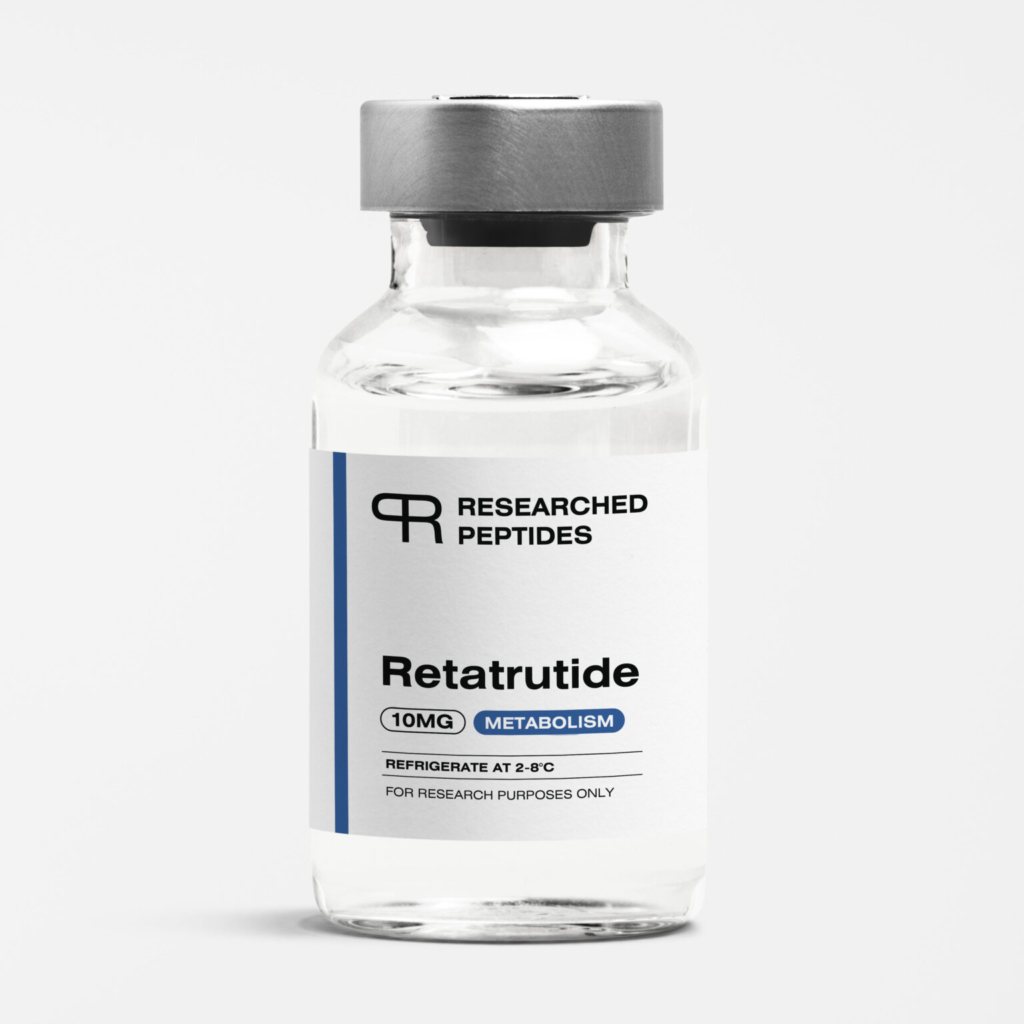
Domestic fulfillment. Shipping within Canada can shorten transit time for a lyophilized peptide, but domestic fulfillment does not by itself establish regulatory compliance. Canadian researchers evaluating RUO retatrutide should review analytical documentation and confirm that purchasing and use comply with applicable institutional and Canadian requirements. Suppliers such as Researched Peptides publish batch-specific COA documentation and state that they ship from Vancouver.
Labs should confirm their institutional and regulatory obligations before ordering.
RUO disclaimer: Retatrutide is an investigational compound. Material represented as research use only is intended strictly for legitimate laboratory or scientific research and is not authorized for human or veterinary therapeutic use. A “research use only” label does not by itself exempt a product from applicable Canadian regulatory requirements.
Frequently Asked Questions
What is retatrutide’s mechanism?
Retatrutide is a single peptide that activates GIP, GLP-1, and glucagon receptors. In preclinical models, GIP and GLP-1 activity reduces energy intake, while glucagon receptor activity raises energy expenditure and liver fat oxidation. Receptor assays show it is most potent at the GIP receptor.
How does retatrutide compare to Tirzepatide?
Tirzepatide is a dual agonist that activates GIP and GLP-1 receptors. Retatrutide adds glucagon receptor activity and shows higher GIP receptor potency than native GIP. Tirzepatide is authorized in Canada as Mounjaro, while retatrutide remains investigational.
Is retatrutide approved in Canada?
No. Retatrutide has no marketing authorization in Canada for any use. A US FDA submission is planned for the first quarter of 2027, and its Phase 3 data are expected to support filings in other countries, though no Canadian timeline is public.
What purity is needed for in vitro research?
There is no universal purity threshold for every in vitro application. Researchers should select specifications appropriate to the assay and protocol, review HPLC purity data, and use appropriate identity testing such as mass spectrometry when required. Peptide-related impurities can affect receptor-binding and signalling assays, and the batch number on the COA should match the material being evaluated.
Where can Canadian researchers source it?
Canadian labs typically look for domestic suppliers that publish batch-specific COAs with HPLC and mass spectrometry data.
Other Articles You May Find of Interest...
- Why Triple Receptor Agonism is Now a Major Focus of Metabolic Research
- Energy After 40: 7 Daily Habits Men Overlook
- P Protect Reviews – Men’s Wellness Patches For Prostate Support and Urinary Comfort
- OnyGuard Anti-Fungal Pen Reviews 2026 – Legit Nail Care Product Or Overhyped?
- DirectMeds ED Reviews 2026 – Is DirectMax A Real Alternative To Standard ED Pills?
- Soda Steel Reviews 2026 – Legit Daily Energy Support or Overhyped Supplement?
- Is Rich Diet App Legit? Subscription, Support, and How to Cancel