Your Health Magazine Contributor
4201 Northview Drive
Suite 102
Bowie, MD 20716
More Weight Control, Nutrition & Exercise Articles
How Effective Is Trampolining for Burning Calories and Losing Weight?

Trampolines often bring to mind laughter, kids playing, and pets chasing after flying feet. They don’t immediately suggest fitness or sweat-drenched effort. Most people don’t associate them with workouts.
But try bouncing steadily for ten minutes. Your legs will start to ache. Your breathing will quicken. You’ll likely find yourself slightly out of breath and maybe even a little sweaty.
So what’s actually happening during that bounce? Just how effective is trampolining when it comes to burning calories?
There’s no single number that fits everyone. The calorie burn varies based on your weight, how long you jump, and how intensely you move. This guide breaks down the facts with realistic estimates so you can understand exactly what kind of workout your trampoline session provides.
Points to Remember
- A 30-minute trampoline session burns about 150–280 calories, depending on body weight.
- Longer sessions and higher intensity both increase calorie burn.
- Trampolining works your heart, legs, core, and balance simultaneously.
- Weight loss depends on overall energy balance, not just one type of exercise.
- Regular, shorter workouts are more effective than occasional long ones.
- Beginners should start with 5–10 minutes and gradually build up.
How Effective is Trampolining for Burning Calories?
Here’s a general estimate, based on standard MET values used in fitness research for moderate-intensity garden trampolines activity:
- A person weighing around 60kg burns roughly 150–200 calories in 30 minutes.
- A person weighing around 70kg burns roughly 175–235 calories in 30 minutes.
- A person weighing around 85kg burns roughly 210–280 calories in 30 minutes.
These numbers are averages. Your actual burn depends on your effort level, fitness condition, and the type of trampoline you’re using.
How Many Calories Does 10 Minutes of Bouncing Burn?
Ten minutes may seem brief, but it still counts.
For most adults, a continuous 10-minute session burns between 50 and 90 calories—comparable to a brisk walk around the neighbourhood.
Not bad for a quick break between tasks.
How Many Calories Does 20 or 30 Minutes of Trampolining Burn?
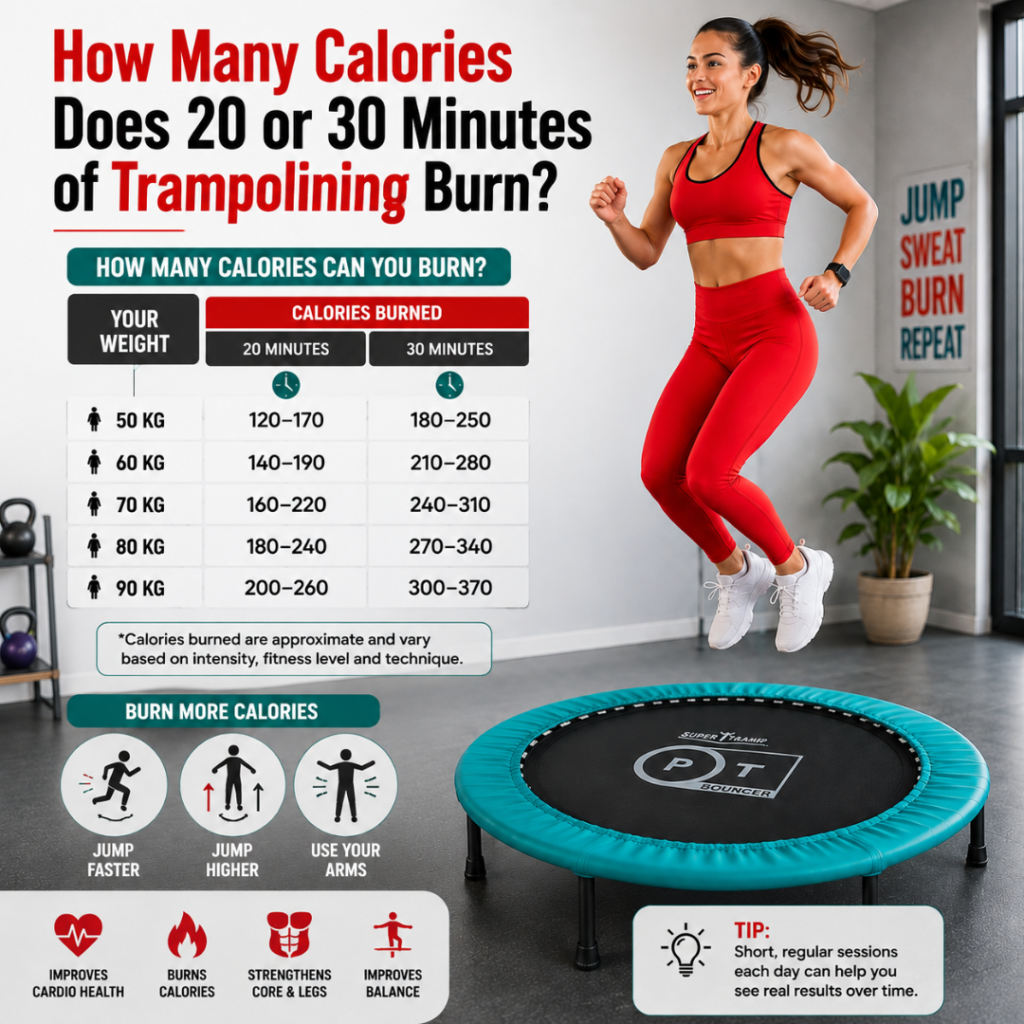
Longer sessions naturally lead to higher total calorie expenditure. However, the increase isn’t always perfectly linear. As your body warms up, your coordination improves, and many people naturally increase their pace after the first few minutes.
A 30-minute workout typically burns close to twice what a 15-minute one does—sometimes even more if intensity is maintained.
Can You Burn More Calories by Jumping Faster?
Yes. Effort plays a major role.
A slow, relaxed bounce keeps energy use low. But adding height, speed, or arm motion increases demand on your body. Short bursts of high-intensity bouncing followed by lighter recovery periods usually result in greater calorie burn than maintaining a steady rhythm the whole time.
And while ten minutes on an inground trampoline might not seem like much, doing it daily can add up over time.
What Affects How Many Calories You Burn on a Trampoline?
Several straightforward factors affect your results.
Your Body Weight
Heavier individuals use more energy to move their bodies. It’s basic physics. Two people doing the same routine will burn different amounts simply because of differences in body mass.
Duration of Exercise
The longer you bounce, the more calories you burn. Ten minutes is a good start, but 30 minutes offers a more complete workout.
Your Jumping Intensity
A light bounce on a rectangle trampoline barely raises your heart rate. In contrast, controlled, energetic jumps with good lift require significantly more effort. The difference in calorie burn between gentle and vigorous bouncing can be nearly double.
The Type of Trampoline Exercise
Basic bouncing on a small trampoline is just the beginning. Incorporating moves like spot jogging, jumping jacks, lateral hops, or tuck jumps challenges your muscles and cardiovascular system more. Mixing up movements prevents adaptation and tends to boost energy expenditure compared to repeating the same motion for too long.
Is Jumping on a Trampoline Good Exercise?
Yes, it really is.
It elevates your heart rate, making it a valid form of cardio. Each landing engages your leg muscles, core, and glutes as they work to stabilise your body. Over time, this builds strength and balance.
It also improves coordination. Staying centred on a springy surface takes more focus than most expect at first.
And it’s practical. No travel, no waiting for equipment, no monthly fees—just space, a trampoline, and a few minutes.
That said, it’s not inherently better than running, swimming, or cycling. It’s a solid alternative, especially for those who find traditional cardio routines boring or tough on the joints.
Accessories That Improve Your Trampoline Workout
A few additions can make your sessions safer and more comfortable.
Trampoline Socks
Socks for trampoline offer better grip, help keep the mat clean, and reduce slipping risks.
Safety Enclosure Nets
These help prevent falls during energetic bouncing. A smart choice if you plan on intense workouts.
Step Ladders
Helpful for children, older users, or anyone who finds climbing onto a raised 14ft trampoline difficult.
Weather Covers
Protect the mat and springs from rain, snow, and UV damage when not in use, helping your trampoline last longer.
Safety Pad
Protect every landing with a thick trampoline safety pad that cushions the springs and frame edge, keeping bounces safe and worry-free. A well-fitted trampoline safety pad is a simple upgrade that makes every session more secure for jumpers of all ages.
Trampoline Springs
Strong, rust-resistant trampoline springs are what give every bounce its power, delivering consistent height and a smooth, controlled landing. Regularly checking your trampoline springs for wear or damage keeps the jumping surface safe and responsive session after session.
These trampoline accessories won’t increase calorie burn directly, but they support consistent, safe use.
Can Trampolining Help With Weight Loss?
Yes, it can help, but it’s not a standalone solution. Weight management depends on overall energy balance—calories consumed versus calories burnt. Trampolining is one helpful tool, not the entire strategy.
Why Consistency Matters More Than One Big Workout
One intense 45-minute session won’t compensate for days of inactivity. Frequent, shorter workouts are generally more effective. Consistent movement delivers better long-term results than sporadic, exhausting efforts.
Three or four 20-minute sessions per week will likely have a greater impact than one long session every two weeks.
Can You Use a Trampoline for Home Fitness?
Definitely. That’s one of its biggest advantages.
No gym commute. No waiting for machines. You can bounce early in the morning, during lunch, or while the family relaxes. It’s adaptable to various fitness levels—from gentle movement for recovery to high-intensity interval training.
How Long Should You Bounce for a Workout?
It depends on your current fitness level.
Beginner: Start With Short Sessions
Five to ten minutes is sufficient at first. Your joints and core need time to adjust to the unstable surface. Pushing too hard too soon often leads to discomfort and discouragement.
Intermediate: Increase Duration and Variety
Once ten minutes feels manageable, extend to 15 or 20. Add different movements—like jogging or side steps—to keep things engaging.
Advanced: Try Interval Training
Alternate 30 seconds of fast bouncing with 30 seconds of slower recovery. Repeat for 15–20 minutes. This method often burns more calories in less time than steady bouncing.
Your 30-minute Trampoline Workout Routine Look Like
Here’s a simple, beginner-friendly routine. Adjust based on your fitness level.
Warm-up (5 Minutes)
Gentle bouncing combined with ankle circles and shoulder rolls to prepare your body.
Main Workout (20 Minutes)
Rotate every few minutes:
- Basic bounce – 3 minutes
- Light jogging – 3 minutes
- Jumping jacks – 3 minutes
- Side-to-side hops – 3 minutes
- Fast intervals – 4 minutes
- Recovery bounce – 4 minutes
Cool-down (5 Minutes)
Slow down gradually to let your heart rate return to normal.
This is a general framework, not medical advice, suitable for most healthy adults.
5 Simple Ways to Make Your Workout More Effective
1. Stay in Motion
Avoid standing still between exercises. Keep moving, even during recovery phases.
2. Include Intense Bursts
Add short periods of faster bouncing, then recover. Repeating this boosts calorie burn.
3. Vary Your Movements
Doing the same bounce repeatedly becomes monotonous and less effective. Mix it up.
4. Progress Gradually
Add time or intensity slowly each week. This protects your joints and supports long-term consistency.
5. Make It Enjoyable
Play music, involve your kids, or bounce outdoors when possible. Enjoyable activities are easier to stick with.
Is Trampolining Suitable for Everyone?
Most people can do it safely, but some precautions are wise.
- Start slowly, especially if you’re new to exercise.
- Use safety padding and, if possible, an enclosure net.
- Follow the manufacturer’s weight limits and safety instructions.
- Keep the surrounding area clear of obstacles and pets.
- Stop immediately if you feel pain, dizziness, or discomfort.
- Consult a doctor or physical therapist if you have joint issues, are pregnant, or are returning after an injury.
These aren’t meant to discourage you—just to promote safe, responsible use, like with any physical activity.
Conclusion
Yes, it truly is. The exact number varies by weight, duration, and effort. But for most people, 30 minutes of trampolining burns a significant amount of energy—often similar to brisk walking or light jogging.
You don’t need every workout to feel exhausting. For those who enjoy it, trampolining can turn physical activity into something fun and sustainable, no matter where you’re starting from.
The real key isn’t pushing harder every time—it’s finding a way to stay active that you’ll actually keep doing.
Other Articles You May Find of Interest...
- Do Avocados Contain Vitamin C?
- How to Appeal a Wegovy Insurance Denial: Coverage, Exceptions and Next Steps
- How to Get Abs: The Ultimate Guide to a Leaner Body
- Plate-Loaded vs Pin-Loaded Strength Machines: What’s the Difference?
- Meal Planning With Hashimoto’s: A Week of Thyroid-Friendly Eating Without the Stress
- How Can I Get More Magnesium in My Diet?
- Is a Personal Trainer Worth It After 50?