






More Vascular Health Articles
Livedo Racemosa vs. Livedo Reticularis: How the Patterns Differ
By Your Health Magazine Health Information Team
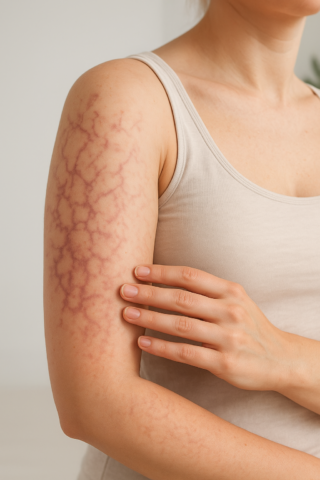
Livedo reticularis usually forms a fine, regular network of complete rings and may fade as the skin warms, while livedo racemosa typically creates larger, irregular, broken rings that persist despite warming. Livedo racemosa is more likely to be associated with an underlying blood vessel, clotting, autoimmune, or neurologic condition and should be medically evaluated.
Key Differences at a Glance
| Feature | Livedo Reticularis | Livedo Racemosa |
|---|---|---|
| Pattern | Fine, regular, lace-like network with mostly closed rings | Irregular, branching pattern with larger, broken or incomplete rings |
| Response to warmth | Often improves with warming when caused by cold | Usually remains visible after warming |
| Typical distribution | Commonly affects the legs and other extremities | May be widespread across the legs, arms, trunk, or buttocks |
| Persistence | May come and go, although some forms persist | Usually persistent or recurrent |
| Clinical concern | Often a harmless response to cold, but can have secondary causes | More strongly suggests an underlying medical condition |
These distinctions are useful, but they are not absolute. Medical literature and clinicians sometimes use “livedo reticularis” as a broad term covering several mottled vascular patterns. A healthcare professional must consider the appearance, duration, symptoms, medical history, and test results rather than relying on the pattern alone. A peer-reviewed review of livedo reticularis and livedo racemosa provides additional detail about this clinical distinction.
What Causes the Mottled Appearance?
Both patterns develop when blood flow through small vessels in the skin changes. Slower or obstructed circulation allows more oxygen-poor blood to become visible, creating reddish-blue, purple, or dusky markings around paler areas of skin.
Physiologic livedo reticularis, also called cutis marmorata, can appear when cold temperatures cause small blood vessels to narrow. It is especially common on the legs and usually becomes less noticeable as the person warms up. Primary or idiopathic livedo reticularis can occur without an identifiable disease and may not follow temperature changes as closely.
Livedo racemosa is more often connected to disrupted or obstructed blood flow. Potential associations include:
- Antiphospholipid syndrome, an autoimmune disorder that increases the risk of blood clots
- Systemic lupus erythematosus and other connective tissue diseases
- Inflammation of blood vessels, known as vasculitis
- Conditions that increase blood thickness or promote abnormal clotting
- Cholesterol or other material blocking small arteries
- Livedoid vasculopathy, particularly when painful ulcers develop near the ankles
- Sneddon syndrome, in which livedo racemosa occurs with cerebrovascular disease
- Certain infections, neurologic disorders, or medications
Having a racemosa-like pattern does not prove that a person has any one of these conditions. It does mean that an appropriate clinical assessment is important. DermNet’s overview of livedo patterns explains their appearance, possible associations, and diagnostic evaluation.
How to Examine the Pattern Safely
If the discoloration appears after being in a cold environment, move to a comfortably warm room and allow the skin to rewarm gradually. Do not place numb or discolored skin directly against a heating pad, radiator, or very hot water.
Pay attention to the following details:
- Whether the rings are uniform and closed or irregular and broken
- Whether the pattern fades after warming
- How long it lasts and how often it returns
- Whether it affects one area or several parts of the body
- Whether there is pain, swelling, numbness, weakness, nodules, sores, or skin breakdown
- Whether symptoms began after starting a medication
- Whether there is a personal or family history of blood clots, autoimmune disease, stroke, or pregnancy complications
A photograph taken in good lighting may help document a pattern that comes and goes. Mottling is different from a small, localized bruise or a popped blood vessel in a finger, which usually affects a limited area rather than forming a widespread network.
How Doctors Evaluate Persistent Livedo
A primary care clinician or dermatologist may begin by examining the pattern and asking about cold exposure, medications, pain, ulcers, clotting history, autoimmune symptoms, and recent neurologic changes. Depending on the findings, consultation with a rheumatologist, hematologist, vascular specialist, or neurologist may be appropriate.
Testing is individualized rather than automatically performing every available blood test. It may include a blood count, kidney and liver testing, inflammation markers, urinalysis, or tests for autoimmune and clotting disorders. Persistent acquired livedo that is unrelated to cold may prompt testing for antiphospholipid antibodies. A skin biopsy is sometimes needed, particularly when lesions are raised, painful, ulcerated, or suspected to reflect inflamed or blocked vessels.
The Cleveland Clinic guide to mottled skin offers a consumer-friendly discussion of possible causes and clinical evaluation. Readers can also use the MedlinePlus health topics directory to find government-reviewed information about associated vascular, autoimmune, and clotting conditions.
What Treatment May Involve
Treatment depends on the cause rather than the skin pattern alone. Cold-related livedo reticularis may improve by keeping the body comfortably warm, limiting abrupt temperature changes, and avoiding tobacco or nicotine, which constricts blood vessels.
Persistent livedo racemosa requires treatment of any underlying disorder that is identified. Management could involve care for an autoimmune disease, vasculitis, infection, abnormal blood thickness, or clotting condition. Some people with confirmed vascular disorders need antiplatelet or anticoagulant medication, but these treatments can cause serious bleeding and should not be started based only on skin discoloration. Do not start aspirin, stop a prescription, or change a blood thinner without medical guidance.
When to Seek Care
Schedule a medical appointment if the mottling is new, persistent after warming, repeatedly returns without cold exposure, spreads to the trunk or buttocks, or forms irregular broken rings. Prompt evaluation is also appropriate when it occurs with joint symptoms, unexplained fever, leg swelling, painful nodules, ulcers, or a history of blood clots or autoimmune disease.
Seek urgent or emergency care for sudden severe limb pain, a cold or pale extremity, blue or black toes, rapidly worsening skin discoloration, significant shortness of breath, or chest pain. Call 911 for possible stroke symptoms such as sudden facial drooping, one-sided weakness or numbness, difficulty speaking, loss of vision, severe imbalance, or an abrupt severe headache.
Most cold-related livedo reticularis is temporary and harmless. The irregular, persistent pattern of livedo racemosa deserves more attention because it can be an external clue to a problem affecting blood flow elsewhere in the body.
Other Articles You May Find of Interest...
- Livedo Racemosa vs. Livedo Reticularis: How the Patterns Differ
- Black or Purple Skin Discoloration: Bruise, Blood Flow, or Emergency?
- Should You Exercise With a DVT? Movement and Safety
- Blood Clots in Pictures: What to Look For
- Venous Reflux: What It Is, Why It Happens, and What to Do About It
- Exploring the Anatomy and Functions of the Frontal Section of the Head
- Exploring the Fascinating Functions of Human Body Organs





