






Your Health Magazine Contributor
4201 Northview Drive
Suite 102
Bowie, MD 20716
How a Singapore System Integrator Builds Medical Quality Gates
A rejected medical-device component rarely appears in a brochure. It is diverted before packaging, recorded as a failed item and removed from the clean flow. Yet that unglamorous route tells us a great deal about manufacturing discipline. A process earns trust by noticing variation, separating it and leaving evidence for review.
That is why a manufacturer may involve a system integrator Singapore when developing production systems that integrate mechanics, controls and inspection. The job is wider than making a robot move. Each assembly decision needs a quality gate, and each gate needs a clear response when a part does not meet the configured condition.
These production tools can make repeatable checks part of the normal cycle and keep the failed result visible. They cannot guarantee a patient outcome. These production tools can make repeatable checks part of the normal cycle and keep the failed result visible. They cannot guarantee a patient outcome.

Quality Begins Before the Camera Takes an Image
Machine vision receives much of the attention, but a reliable image depends on everything that happens before the shutter. The component must arrive in a known orientation, sit at a stable position and remain under controlled lighting. Otherwise, the camera may be asked to judge a presentation problem rather than a product condition.
Control component orientation before assembly starts. Vibratory bowl feeders and starwheel indexing can present small parts in a repeatable direction. Fixtures then hold them through the next operation. This preparation matters for items such as tubes, syringe components and vial parts, where a rotated or inverted piece can disrupt assembly even when the component itself is sound.
A useful gate checks that presentation before the next irreversible step. If orientation is wrong, the line should stop or divert the part rather than forcing it into place. The rejected component then points to a feeding or fixture issue, not to a vague “assembly failure” later in the cycle.
Measure the process at the critical station. A 12-station rotary indexing machine moves each part through a fixed sequence. Servo-driven transfer places the work at each station, while press-fit or pick-and-place operations perform the assembly. Twelve stations matter because the team can define what must be true before the table advances.
Force monitoring, position confirmation or presence checks can sit close to the action that created the condition. When a fault appears, the team has a narrower investigation: the part, fixture, tool and recipe at that station. Waiting until final inspection makes the same defect harder to explain.
The published rotary-line example gives a 15-second cycle. That is a project detail, not a universal promise. During acceptance, the manufacturer should confirm that each quality gate still completes within the intended cycle and that a failed check prevents the next move. Speed only helps when the decision travels with the part.
Vision Inspection Needs a Defined Decision
A camera does not “understand quality” in the broad human sense. It compares what it sees with programmed rules. Those rules may concern contour, position, presence, angle or a dimensional feature. Controlled ring or dome lighting helps the system see the relevant surface consistently.
| Quality gate | Question answered | Evidence to retain |
| Presentation | Is the component present and oriented correctly? | Sensor or image result |
| Assembly | Did the station complete the configured action? | Force, position or cycle state |
| Visual check | Does the observed feature pass its rule? | Image, measurement and pass/fail |
| Sorting | Did the failed part leave the accepted flow? | Reject command and confirmation |
| Traceability | Which device identity owns these results? | Serial-linked record and timestamp |
Match Lighting and Recipes to Product Families
According to its published materials, Motionwell Automation lists Keyence IV3 inspection cells with controlled lighting and programmable inspection recipes. A recipe change can support a different product family, but it also changes the decision boundary. The selected recipe, lighting setup and physical fixture must agree before production begins.
A recipe name alone is not sufficient. Operators need confirmation that the correct part, fixture and inspection rule are active together. If the line changes product without changing one of those elements, a camera may produce confident results against the wrong reference.
Link the Failed Image to Device Identity
The medical-device work described by Motionwell Automation can associate inspection images, measurement values and pass/fail results with device serial numbers. That link is more useful than a daily reject total. It allows a reviewer to examine what the system saw for the specific item under question.
Serial association also keeps a rejected part from becoming anonymous scrap. The record can show where it failed and which rule was applied. The manufacturer still needs approved procedures for investigation and disposition, but the production system can provide a more precise starting point.
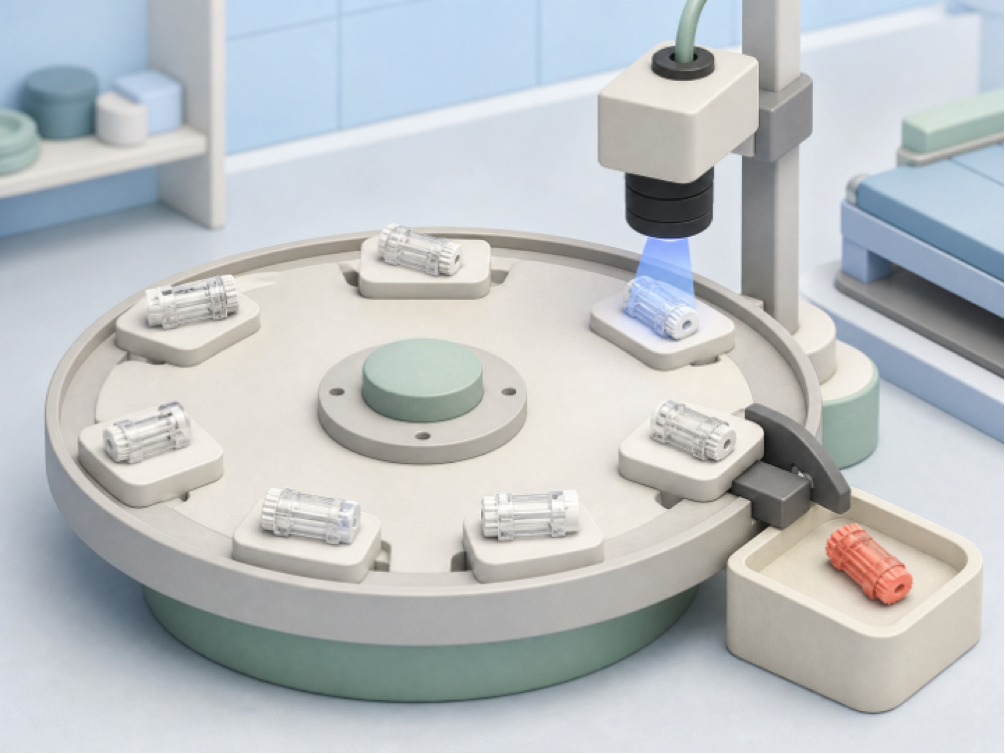
Automatic Sorting Must Confirm Physical Separation
An OK/NG decision has little value if the physical item travels to the wrong place. The sorting mechanism must receive the inspection result, act at the correct moment and confirm that the rejected component entered the reject path. Timing becomes especially important when several parts sit between the camera and the diverter.
Follow One Failed Part Through the Machine
During acceptance, introduce a controlled defect that the inspection recipe is designed to detect. Watch the image and decision, then follow the same physical part to the reject container. Confirm that the serial-linked record carries the same result. This is a simple test of several system boundaries at once.
Repeat the exercise after a stop and restart. The line should not lose the rejected item’s position or apply its decision to the next accepted part. A restart that clears the screen but forgets the work in progress can undermine an otherwise capable inspection cell.
Keep Operator Mistake Proofing Near the Station
Motionwell Automation also describes poka-yoke features and clear HMI status displays. These controls help prevent the wrong fixture, component or recipe from entering the process. They are most effective when the message names a concrete mismatch and the physical setup makes the correct action easier.
For example, a keyed fixture can prevent the wrong orientation, while the HMI confirms the selected recipe. Neither replaces trained operators or approved procedures. Together, they reduce the chance that a small setup mistake travels through twelve stations before anyone notices.
Validation Evidence Must Match the Delivered Machine
Medical-device production relies on more than a successful factory demonstration. The delivered system needs documented installation, operating conditions and performance under the manufacturer’s intended process. According to its published materials, Motionwell Automation lists support for IQ/OQ/PQ protocols, GR&R capability studies, drawings, electrical schematics, PLC documentation and operator manuals.
Keep Changes Inside a Controlled Review
A new component supplier, camera recipe, fixture material or cycle setting can change what the quality gate sees. Teams should decide which changes require a repeated challenge test and which documents must be updated. The machine cannot make that governance decision by itself.
Records are valuable when they reflect the version that actually produced the device. If an engineer adjusts a threshold but the controlled recipe and validation package do not follow, traceability can become precise about the wrong process. Technical change and document change have to travel together.
Training belongs in the same review. A clear alarm or recipe name only helps when operators understand what it permits and what it does not. The handover should include normal setup, a planned reject and one safe recovery, using the delivered HMI and production fixtures rather than a simplified demonstration screen.
Trust the Process That Records the Reject
For a general reader, the most important point is modest: automated inspection can support consistent production checks, but it does not make a medical claim and it does not replace regulatory or professional judgment.
A manufacturer with complex assembly, cleanroom and traceability requirements may need a customized automation system, while a simpler process may require less extensive automation. In either case, ask to see the rejected part, its image, its decision and its final location. A process that can explain its failures gives quality teams something real to review.





