More Pain Management & Rehabilitation Articles
The Thumb Grind Test: What Pain During It Can Mean
By Your Health Magazine Health Information Team
Opening a jar, turning a key, fastening a button, or scrolling on your phone may suddenly hurt at the base of your thumb. During an examination, a healthcare professional may press and rotate the thumb to see whether that familiar pain returns. This maneuver, known as the grind test of the thumb, can provide useful information about the joint—but pain during the test does not establish a diagnosis by itself.
What Is the Grind Test of the Thumb?
The grind test evaluates the carpometacarpal joint, commonly called the CMC or basal thumb joint. This joint is located where the thumb’s metacarpal bone meets the trapezium, a small bone in the wrist. Its wide range of movement allows the thumb to pinch, grasp, and move across the palm.
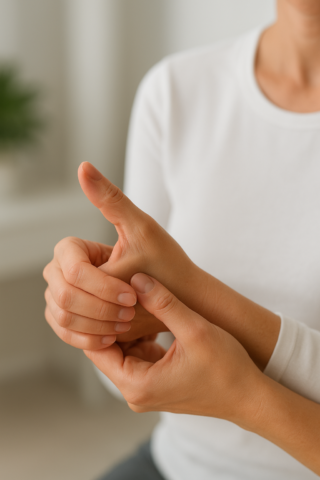
To perform the test, a clinician stabilizes the hand, applies gentle pressure along the thumb, and rotates or shifts the metacarpal at its base. The test is generally considered positive when it reproduces pain centered at the CMC joint. A grinding or gritty sensation, called crepitus, may also occur.
Because improper pressure could aggravate an injury or painful joint, the maneuver is best performed by a trained healthcare professional rather than used as a forceful self-test.
What Does Pain During the Grind Test Usually Mean?
A painful grind test most commonly raises suspicion for osteoarthritis of the thumb’s CMC joint. Osteoarthritis develops as cartilage within a joint becomes damaged and loses some of its smooth, cushioning function. Joint movement may then become painful, stiff, or rough.
Typical symptoms of thumb CMC osteoarthritis include:
- Deep or aching pain at the base of the thumb
- Pain during pinching, gripping, twisting, or opening containers
- Reduced pinch or grip strength
- Stiffness after rest or repeated hand use
- Swelling, tenderness, or a bony prominence near the thumb base
- Difficulty with handwriting, buttons, keys, zippers, or phone use
A positive grind test supports the possibility of thumb arthritis when the location of pain and the person’s symptoms also fit. Readers can find a broader overview of symptoms and evaluation through this MedlinePlus guide to arthritis.
A Negative Test Does Not Rule Out Arthritis
The grind test has an important limitation: some people with thumb CMC osteoarthritis do not experience pain during it. Research has found that the test tends to be better at supporting the diagnosis when it is clearly positive than at excluding arthritis when it is negative.
A clinician therefore considers more than one examination finding. Tenderness directly over the joint, pain with other thumb movements, reduced motion, weakness, swelling, and the pattern of symptoms can all contribute useful information. The intensity of pain also does not always match the amount of change visible on an X-ray. Some people have substantial X-ray findings with few symptoms, while others experience considerable pain despite less dramatic imaging changes.
Could the Pain Come From Something Else?
Yes. Pain around the thumb and wrist can arise from several structures located close together. The exact location of discomfort and the activities that trigger it help distinguish among possible causes.
Recent thumb injury
A sprain can stretch or tear supporting ligaments, causing pain, bruising, swelling, weakness, or instability. Fractures and other injuries may produce similar symptoms. Pain that began after a fall, collision, forceful bend, or direct impact requires a different evaluation from gradually developing arthritis. Learn more about medical-device options used in managing sprained thumb injuries.
De Quervain tenosynovitis
This condition affects tendons along the thumb side of the wrist. Pain is often felt slightly farther toward the wrist than CMC arthritis pain and may worsen while lifting, gripping, or moving the wrist. A clinician may use a separate examination maneuver to evaluate these tendons.
Other joint or tendon conditions
Trigger thumb, tendon irritation, ganglion cysts, ligament problems, wrist arthritis, and inflammatory forms of arthritis can sometimes resemble basal thumb osteoarthritis. Redness, warmth, pronounced swelling, prolonged morning stiffness, or symptoms involving several joints may lead a clinician to consider inflammatory or other systemic conditions.
How Clinicians Confirm the Cause
Evaluation usually begins with questions about where the pain occurs, when it started, whether an injury happened, and which activities make it worse. The clinician may examine both hands, check stability and range of motion, locate areas of tenderness, and assess grip or pinch strength.
X-rays may be ordered when arthritis, a fracture, or another bone or joint problem is suspected. With thumb CMC osteoarthritis, imaging can reveal narrowing of the joint space, bone spurs, changes in bone shape, or altered joint alignment. Blood testing is not routinely needed for uncomplicated osteoarthritis, but it may be considered if symptoms suggest rheumatoid arthritis, infection, gout, or another inflammatory condition.
What Happens After a Painful Grind Test?
Management depends on the diagnosis and on how much the symptoms interfere with daily life. For thumb CMC osteoarthritis, early care often focuses on reducing painful stress while preserving useful movement and strength.
A healthcare professional may discuss:
- Temporarily modifying activities that require forceful pinching or twisting
- Using adaptive tools such as jar openers, wide-handled utensils, or key turners
- Wearing a properly fitted thumb-support orthosis or splint during painful activities
- Applying heat or cold, depending on which feels more helpful
- Working with an occupational or hand therapist on joint protection and appropriate exercises
- Considering topical or oral pain medication when medically appropriate
- Using a joint injection in selected cases
Medication choices should be discussed with a healthcare professional, particularly for people with kidney disease, heart disease, stomach ulcers, bleeding risks, medication interactions, or other health concerns. Surgery may be considered when persistent pain and loss of function continue despite appropriate nonsurgical treatment, but a painful grind test alone is not a reason for surgery.
When to Seek Care
Arrange an evaluation if thumb pain persists, keeps returning, weakens your grip, disturbs sleep, or makes routine tasks difficult. A primary care professional, sports medicine clinician, orthopedic specialist, or hand specialist can begin the assessment. A rheumatologist may be helpful when several joints are painful or inflammatory arthritis is suspected.
Seek prompt care after significant trauma or when the thumb looks deformed, feels unstable, cannot move normally, or develops severe swelling. Urgent evaluation is also appropriate for numbness, loss of sensation, unusual paleness or bluish color, an open wound, or a hot and red joint accompanied by fever or illness.
The grind test of the thumb is one piece of a broader examination. Pain during it often points toward CMC osteoarthritis, but the result must be interpreted alongside the symptom history, pain location, other examination findings, and—when needed—imaging. A careful evaluation can identify the actual source of pain and guide treatment aimed at making everyday hand use more comfortable.
Other Articles You May Find of Interest...
- The Thumb Grind Test: What Pain During It Can Mean
- Choosing a Trigger Thumb Splint That Actually Supports Healing
- Can Tendons Heal on Their Own? What Recovery Requires
- How Chronic Knee Pain Can Be Treated Without Joint Replacement
- What ‘Gnawing Pain’ Tells Your Doctor
- Why Does Pain Continue After an Injury? When to Consider Seeing a Pain Management Doctor
- Pain Under Your Shoulder Blade: Muscle or Referred?