






More Kratom Education Articles
Yellow Vietnam Kratom Guide: Effects, Strength, Benefits And Best Uses

There’s a fact that most kratom buyers may not know: yellow Vietnam Kratom is not an individual kind of plant.
This surprises many people. The name is distinctive. It implies a variety gathered from Vietnamese jungles with unique genetics. However, the reality is far more complex — and even more fascinating.
Yellow vein kratom, including yellow Vietnam, gets its color almost entirely from post-harvest processing. The yellow color does not occur naturally on the tree. It develops during extended drying or fermentation after leaves are picked. That process changes the alkaloid composition in ways that distinguish yellow Vietnam from red, green, and white vein products made from the same plant.
Why does this matter? Because many kratom consumers make purchasing decisions based on vein color labels without understanding what those labels actually indicate. Without knowing how yellow Vietnam is produced, it becomes difficult to evaluate quality, assess vendors, or understand what a product contains.
This article covers relevant information from alkaloid chemistry to processing methods to regulation, presenting factual information without marketing claims about one of the most misunderstood product categories.
Understanding this product begins with understanding why yellow kratom exists in the first place.
Important Notice: Kratom is not approved by the U.S. Food and Drug Administration (FDA) for any medical use. Regular use may lead to physical dependence and withdrawal symptoms. Kratom may interact with prescription medications, over-the-counter drugs, and other substances. Individuals with pre-existing health conditions, those taking medications, or those who are pregnant or nursing should consult a qualified healthcare provider before using kratom.
So What Exactly Is Yellow Vietnam Kratom?
Yellow Vietnam Kratom is a processed kratom product derived from Mitragyna speciosa leaves associated with Vietnamese growing regions.
Vietnam is not the largest kratom-producing country. Indonesia dominates global supply. However, Vietnam has cultivated Mitragyna species in its central and northern highland regions, and its kratom has developed a reputation for a distinct alkaloid profile among experienced consumers.
The “yellow” designation does not describe the leaf’s appearance at harvest. It refers to the color of the powder after processing. Kratom leaves are green when picked. The yellow color results from prolonged sun exposure, certain fermentation methods, or blending techniques applied after harvest.
Some sellers ferment white vein leaves to produce yellow-colored products. Others blend white and red vein powders. Because methods vary by producer, consistency across yellow Vietnam products is limited.
The Problem With the Name
“Yellow Vietnam” carries geographical and color-related implications that do not hold up under scrutiny.
The geographic claim is disputed. Much of what is marketed as yellow Vietnam kratom is produced in, or blended with materials from, Indonesia — the world’s largest kratom producer. True Vietnamese-sourced kratom is uncommon at commercial scale.
The color designation is also complicated. There is no universal standard defining which processing methods qualify a product as “yellow.” One vendor may use outdoor fermentation; another uses UV drying; a third blends existing powders.
Without standard definitions or regulatory oversight, “yellow Vietnam” is a marketing label, not a botanical description. Consumers who understand this tend to make more informed purchasing decisions.
Identifying Characteristics of Yellow Vietnam
Despite inconsistent production, yellow Vietnam kratom has recognized characteristics across sources:
- Color: Light golden-yellow to warm tan — noticeably lighter than red vein powders.
- Texture: Generally fine and uniform in high-quality versions; coarser in lower-quality versions.
- Aroma: Often described as lighter and mildly sweet compared to earthier red varieties.
- Alkaloid shift: Processing typically alters the mitragynine-to-7-hydroxymitragynine ratio compared to unprocessed starting material.
- Batch variability: Higher than average due to inconsistent processing across producers.
These characteristics are recognizable, but they also underscore the importance of evaluating quality on a batch-by-batch basis.
Alkaloid Profile and What the Chemistry Actually Shows
All kratom products contain mitragynine and 7-hydroxymitragynine as their primary active alkaloids. Yellow Vietnam is no different.
Mitragynine is the most prevalent alkaloid found in most kratom powders. It acts as an opioid receptor agonist and has a different pharmacological profile from traditional opioids. Most kratom products contain mitragynine concentrations of approximately 1–2% by dry weight.
7-Hydroxymitragynine (7-OH) occurs in smaller amounts but is believed to be significantly more potent per milligram. Extended fermentation and drying promote the conversion of mitragynine into 7-OH. This is the primary chemical reason why processed red and yellow vein powders differ from white vein powders derived from the same leaves.
Yellow Vietnam’s alkaloid profile generally occupies a middle position — higher in 7-OH than white vein products, but lower than heavily fermented products such as Bentuangie. Without batch-specific COAs, these are general tendencies rather than guaranteed characteristics.
More than 40 minor alkaloids have been identified in kratom, including speciociliatine, speciogynine, and paynantheine. The concentrations of these alkaloids also shift during processing.
From Leaf to Powder: How Yellow Vietnam Gets Made
The production process is where yellow Vietnam differs most from other kratom categories.
Prolonged outdoor drying exposes leaves to sunlight for extended periods. Heat and UV radiation promote chlorophyll breakdown — producing the yellow hue — and trigger certain alkaloid conversions.
Indoor fermentation involves sealing fresh leaves in containers or bags for a set period before drying. This anaerobic fermentation promotes the conversion of mitragynine into 7-hydroxymitragynine more rapidly than sun drying alone.
Blending is also common. Some vendors mix red and white vein powders in specific ratios to approximate the alkaloid profile of naturally processed yellow products. The result may appear similar, but the chemical composition differs.
Quality yellow Vietnam is produced by manufacturers who document their specific processing methods and provide third-party lab results for each batch. Undocumented processing is a significant quality risk.
Yellow Vietnam vs Other Popular Strains
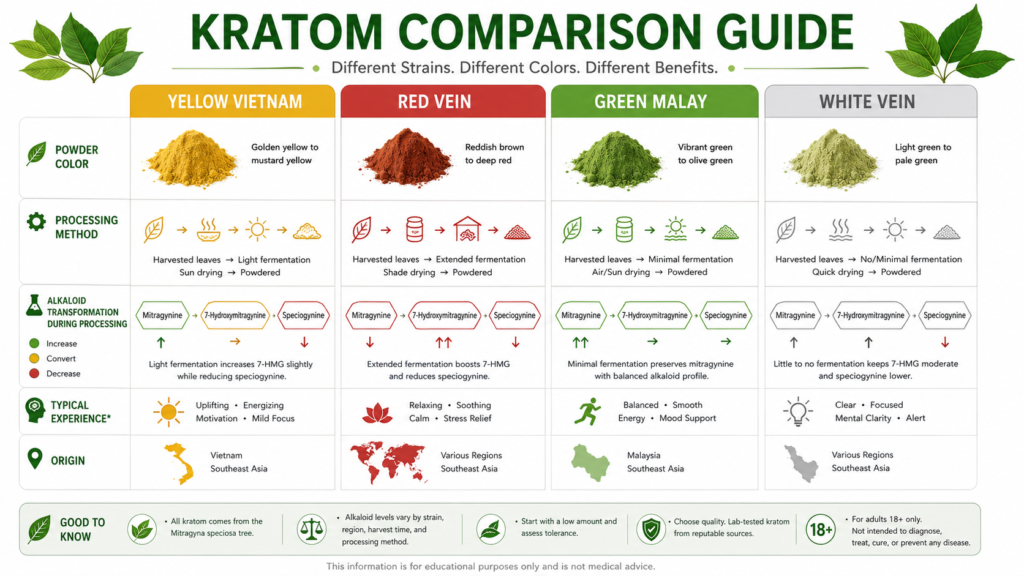
| Strain | Common Description | Key Characteristics | Important Limitation |
| Yellow Vietnam Kratom | Post-harvest processing, Vietnam-related source | Intermediate alkaloid profile, mild aroma, golden color | Processing varies greatly; geographic claims are often unverified |
| Red Vein Kratom | Mature-leaf harvest and extended drying | Higher 7-OH tendency, more earthy profile | Wide category with significant variation by region and vendor |
| White Vein Kratom | Early-stage harvest, minimal processing | Mitragynine-dominant, lighter aroma | Alkaloid ratios are inconsistent across sources |
| Green Malay Kratom | Mid-maturity Malaysian leaves | Intermediate alkaloid blend, green powder | “Malay” label is often applied to material from other countries |
This table reflects general tendencies. Verified lab COAs remain the most reliable method to confirm alkaloid content in any specific product.
Historical Context and How the Market Evolved
Kratom has deep roots in Southeast Asian traditional use. In Vietnam, Thailand, and Malaysia, Mitragyna speciosa was consumed by laborers and farmers for centuries — typically by chewing fresh leaves or brewing tea — before Western markets discovered it.
Vietnam’s association with kratom in modern Western markets is relatively recent. As the U.S. kratom market expanded rapidly after 2010, vendors began introducing region-specific product names to differentiate their offerings. “Vietnam” became a popular geographic designation — partly due to authentic sourcing, but also for marketing differentiation.
The “yellow kratom” designation emerged around the same time, as vendors began exploring processing methods that produced distinct alkaloid profiles. “Yellow Vietnam” became a favored combination of processing descriptor and regional identifier.
It remains a niche product category within the broader kratom market.
What Buyers Commonly Say About Yellow Vietnam
Consumer reviews and discussions on platforms such as Reddit’s r/kratom often describe yellow Vietnam as:
- Perceived as having a less pronounced effect profile compared to highly fermented red vein products
- Reported as an intermediate option by consumers who find other vein types to be at opposite ends of the effect spectrum
- Described as having a balanced, middle-ground profile
- Used by some consumers during daytime hours
These are self-reported observations without scientific confirmation. Individual responses vary significantly based on tolerance, product quality, and individual metabolism. No kratom product has FDA approval for any therapeutic use.
Safety, Testing, and the Regulatory Picture
The kratom industry has operated without comprehensive FDA regulation. Third-party testing is the most important consumer protection measure currently available.
Health and Safety Risks: Kratom is not FDA-approved for any medical use. Regular use may lead to physical dependence and withdrawal. Kratom may interact with prescription medications, over-the-counter drugs, and other substances. Pregnant or nursing individuals and those managing health conditions should not use kratom without first consulting a qualified healthcare provider.
Third-party laboratory testing: Reputable yellow Vietnam vendors provide COAs for every batch. These cover alkaloid levels, heavy metals (lead, arsenic, mercury, cadmium), pesticide residues, and microbial contamination, including salmonella and E. coli.
AKA GMP accreditation: The American Kratom Association’s Good Manufacturing Practice program establishes minimum standards for testing, sanitation, and labeling. GMP-certified suppliers meet more rigorous quality standards than uncertified alternatives.
Label transparency: Quality products include batch numbers, weight, and test references. Labels lacking specific batch information make it impossible to verify product quality.
Risk of contamination: Kratom has been subject to FDA recalls due to heavy metal and salmonella contamination. Products tested by accredited laboratories carry a meaningfully lower contamination risk.
Legal status: Kratom is federally legal in the U.S. but is restricted or prohibited in Alabama, Arkansas, Indiana, Rhode Island, Vermont, Wisconsin, and several municipalities. Verify local regulations before purchasing.
Four Misconceptions That Keep Circulating About Yellow Vietnam
Misconception: Yellow Vietnam grows naturally with yellow-veined leaves.
In reality: The yellow color results from post-harvest processing. No commercially grown kratom variety naturally produces yellow-veined leaves at harvest.
Misconception: Yellow Vietnam is always sourced from Vietnam.
In reality: Most commercial yellow Vietnam kratom is produced in or blended with kratom from Indonesia. Vietnamese sources at commercial scale are rare and seldom independently verified.
Misconception: Yellow vein kratom is more potent than white or red vein varieties.
In reality: Potency is determined by alkaloid concentration, not vein color. Yellow Vietnam’s alkaloid concentration falls in the middle range and varies by batch.
Misconception: All yellow Vietnam products are produced the same way.
In reality: There is no standardized manufacturing process for yellow kratom. Sun drying, fermentation, and blending can all produce products sold under the same label, each with distinct alkaloid profiles.
Frequently Asked Questions
How does yellow Vietnam kratom get its color?
The yellow color develops during post-harvest processing, not from the plant itself. Extended sun exposure reduces chlorophyll in dried leaves, producing a yellow to orange-tan color. Some producers use indoor fermentation, which affects both color and alkaloid composition. The method a seller uses directly affects the product’s final chemical profile. Because there is no industry-wide standard for what qualifies as “yellow,” buyers should ask vendors about their specific processing methods and request batch-specific COAs.
Is yellow Vietnam kratom legal where I live?
Kratom’s legal status depends on location. It remains federally legal in the United States, but several states — including Alabama, Arkansas, Indiana, Rhode Island, Vermont, and Wisconsin — have enacted bans. Some counties and cities in otherwise legal states have local restrictions. Laws change frequently, so verifying current state and municipal regulations before purchasing is advisable. Other countries have their own regulations, and some ban kratom entirely.
What alkaloids are present in yellow Vietnam kratom?
Yellow Vietnam contains the same primary alkaloids found in all kratom: mitragynine and 7-hydroxymitragynine. Mitragynine is the predominant alkaloid by volume. 7-hydroxymitragynine occurs in smaller quantities but is believed to be significantly more potent. Extended drying and fermentation promote the conversion of mitragynine into 7-OH. This is why processed yellow products may differ in alkaloid ratios from unprocessed white vein products from the same source. Batch-specific COAs from accredited laboratories provide the most reliable alkaloid concentration data.
How do I assess yellow Vietnam quality before buying?
Start with third-party testing. Reputable vendors provide batch-specific COAs issued by ISO-accredited laboratories covering alkaloid content, pesticides, heavy metals, and microbial contamination. AKA GMP accreditation signals that a company meets minimum manufacturing standards. Beyond testing, look for transparent sourcing, clear labeling with batch numbers, and verified customer reviews. Avoid vendors that lack actual lab documentation or make therapeutic claims about their products.
What is the difference between yellow Vietnam and yellow Borneo kratom?
Both are yellow-processed kratom products, but they differ in geographic source and, in most cases, the base material used. Yellow Borneo originates from leaves grown in Borneo — primarily Indonesian regions such as Kalimantan — and undergoes similar post-harvest processing. Yellow Vietnam uses Vietnamese-associated sourcing, though as noted, this claim is frequently unverified at commercial scale. In practice, differences between yellow Vietnam and yellow Borneo tend to reflect specific processing methods and vendor practices more than any meaningful botanical distinction.
The Bottom Line
Yellow Vietnam Kratom is a post-harvest processed product with a complicated identity. The yellow color is a result of chemical processing, not botanical origin. The “Vietnam” label is often more a matter of marketing than geography. The product’s alkaloid profile falls between red and white vein products, shaped primarily by fermentation or drying methods.
None of this diminishes the product as a category. It rewards informed consumers.
Third-party COAs, AKA GMP accreditation, and transparent vendor communications remain among the best quality indicators in this market. The strain name provides some context, but laboratory data tells the complete story.
Disclaimer: Kratom is not approved by the FDA for any medical use and is not intended to diagnose, treat, cure, or prevent any disease or condition. Kratom may cause physical dependence with regular use and may interact with medications. Always consult a qualified healthcare provider before using kratom, particularly if you have a pre-existing health condition or take prescription medications.
Other Articles You May Find of Interest...
- How HPLC Testing Verifies Botanical Potency—and Why Lab Results Can Differ
- Red Bali Kratom: What It Is, How It Differs, and What the Research Says
- Kratom Legality in 2026: Why the Rules Vary by Location
- 7 Things to Know About Split Kilo Kratom Before a Bulk Order
- Red Thai Kratom: The Strain With a Complicated History and a Loyal Following
- Red Sumatra Kratom: What Makes This Strain Stand Apart
- Red Indo Kratom: The Strain That Built the Modern Kratom Market
Featured Doctors and Practices





