






Your Health Magazine Contributor
4201 Northview Drive
Suite 102
Bowie, MD 20716
More Hearing Health Articles
Hearing Health as Part of Healthy Aging: Staying Connected in Everyday Life
Healthy aging is often associated with familiar habits such as eating a balanced diet, staying physically active, getting adequate sleep, and keeping up with regular health checks. Yet wellbeing in later life also depends on something less visible: the ability to communicate comfortably and remain engaged with the people and activities that make everyday life meaningful. Hearing is central to that experience. It supports conversations, social interaction, entertainment, and participation in daily routines, but gradual changes in hearing can make these ordinary experiences more demanding.
Hearing difficulties do not always appear as a dramatic loss of hearing. They may begin with small changes—a conversation becoming harder to follow when several people are speaking, television dialogue requiring a higher volume, or background noise making it difficult to understand someone clearly. Because these changes can develop gradually, they are often treated as minor inconveniences. In reality, they can influence how comfortably a person communicates, socializes, and participates in everyday life.
For that reason, hearing health deserves to be considered as part of a broader approach to healthy living. The goal is not simply to hear more sounds, but to support comfortable communication, continued participation, and a lifestyle in which people can remain connected to the experiences that matter to them.
Hearing Is More Than the Ability to Detect Sound
Hearing is closely woven into everyday activities, which is why changes in hearing can have effects that extend beyond the ear itself. A conversation at breakfast, a phone call with a friend, lunch with family, an evening television program, or a walk outdoors may each involve different listening conditions. When hearing is working well, people rarely think about the effort involved in understanding speech. When hearing becomes more difficult, however, the same activities can require greater concentration.
Mild hearing difficulty can be particularly easy to overlook because a person may still hear many sounds clearly in quiet surroundings. The challenge may become more apparent when there is competing speech, background noise, distance between speakers, or other environmental sounds. Someone may understand a conversation when facing the speaker but miss words when the speaker is across the room, or find that background sounds that were once easy to ignore now interfere with communication. These are not necessarily signs of severe hearing loss, but they can indicate that listening has become more demanding.
The Role of Hearing in Social Connection
Communication is one of the ways people maintain relationships and participate in their communities. Family meals, conversations with friends, social gatherings, community activities, and shared entertainment all depend, at least in part, on being able to follow what other people are saying. When hearing makes these interactions consistently difficult, the problem can become larger than the conversation itself. The person may begin to feel less comfortable in situations where listening requires sustained effort.
This is particularly relevant to healthy aging because staying connected is an important part of a fulfilling everyday life. Hearing support should therefore be viewed in the context of participation rather than as an isolated technology issue. The practical question is not simply whether someone can detect speech, but whether they can comfortably take part in the conversations and activities they value. Paying attention to changes in hearing can be one way of protecting that part of daily wellbeing.
When Everyday Listening Starts to Require More Effort
One of the clearest signs that hearing may need attention is a change in how much effort ordinary listening requires. A person may find themselves asking others to repeat themselves more frequently, increasing the volume of the television, concentrating unusually hard during group conversations, or avoiding particularly noisy environments. These adjustments can gradually become part of a routine, making it easy to accept them as normal rather than recognizing them as changes worth discussing.
The listening environment also matters. A quiet conversation at home is very different from a restaurant, family gathering, workplace, travel setting, or outdoor activity. A hearing solution that feels adequate in one situation may not provide the same experience in another because speech, background sound, and wind can affect how easily important sounds are understood. This is why hearing needs should be considered not only in terms of hearing difficulty, but also in terms of how a person actually spends their time.
Protecting Hearing Is Part of Everyday Health
Supporting hearing health begins before a person considers a hearing device. Everyday exposure to loud sound is one factor that can affect hearing over time, making awareness of noisy environments an important part of hearing care. Concerts, sporting events, power tools, lawn equipment, and other loud activities can expose people to sound levels that require greater attention to hearing protection. Simple preventive habits can therefore complement the broader health routines people already follow.
It is equally important not to dismiss persistent changes in hearing simply because they have developed gradually. A hearing assessment can help clarify the nature and degree of a hearing difficulty and whether hearing support is appropriate. Professional evaluation is particularly important when symptoms are unusual or sudden. Hearing aids are not designed to address every type of hearing problem, so choosing appropriate support should begin with understanding the individual’s needs.
What Modern Hearing Support Can Add to Everyday Life
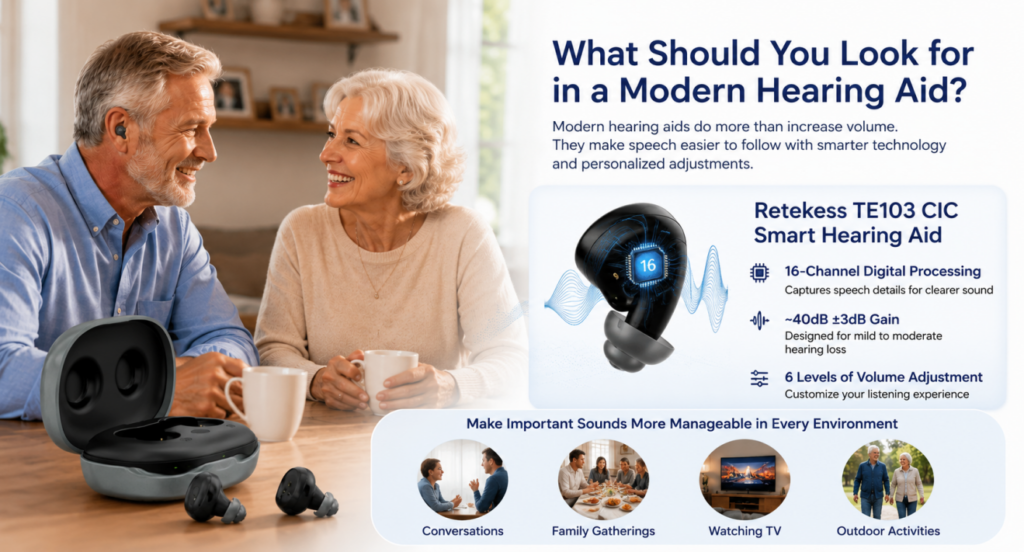
For adults with appropriate mild to moderate hearing loss, modern hearing technology can provide support without requiring everyday life to revolve around the device. Digital processing can make more detailed adjustments to incoming sound, while different listening settings can be designed around situations that people encounter regularly. The emphasis is increasingly on making important sounds more manageable rather than simply making every sound louder.
The Retekess TE103 is one example of an OTC hearing aid designed for adults with mild to moderate hearing loss. Like many modern devices, it includes digital sound processing and adjustable listening settings. These types of features can help illustrate what consumers may encounter when comparing hearing-support options, although suitability depends on the individual’s hearing needs.
Comfort and Convenience Matter for Consistent Use
A hearing device is most useful when it can be incorporated into a person’s normal routine. Because hearing aids may be worn for many hours, comfort, fit, size, charging, and maintenance can influence whether someone feels comfortable using the device consistently. A technically capable product that is difficult to wear or maintain may be less practical than a simpler solution that fits naturally into everyday life.
Hearing aids vary considerably in size, fit, battery life, charging method, and maintenance requirements. Some are designed to sit discreetly in the ear canal, while others use behind-the-ear or receiver-in-canal designs. Rechargeable batteries and portable charging cases may also make some devices easier to incorporate into a daily routine. Comfort and convenience should be considered alongside hearing needs rather than treated as secondary concerns.
Technology Should Adapt to Different Lifestyles
People do not spend every day in the same acoustic environment. Someone may have a quiet morning at home, meet friends for lunch, watch television in the evening, and spend time outdoors later in the day. Even when the degree of hearing difficulty remains the same, the listening challenge can change with the environment. This makes flexibility an important consideration when evaluating hearing support.
Some modern hearing aids, such as the Retekess TE103, offer multiple listening modes for situations such as general conversation, restaurants, television, or outdoor environments. App-based controls may also allow users to adjust volume, switch modes, monitor battery levels, or personalize certain sound settings. These functions can be useful because hearing demands change throughout the day, and greater flexibility may help a device fit more naturally into a varied routine.
Hearing Support Is Ultimately About Participation
The most meaningful measure of hearing support is not the number of technical specifications on a product page, but what the technology helps a person do in everyday life. It may make it easier to follow a conversation with family, participate in a social gathering, enjoy television at a comfortable volume, or remain engaged in activities that previously required excessive listening effort. These are practical outcomes because they relate directly to how people experience their daily lives.
This perspective also helps place hearing technology within the broader idea of healthy aging. Looking after health is not only about preventing illness or maintaining physical ability; it is also about preserving the capacity to participate, communicate, and remain connected. For people whose hearing needs are appropriate for hearing support, discreet design, adaptable listening options, personalization, and convenient maintenance can all contribute to making that support easier to integrate into everyday life.
Hearing health should therefore be approached as part of a larger healthy-living routine. Paying attention to changes in hearing, protecting hearing from excessive noise, seeking professional evaluation when appropriate, and considering practical hearing support when needed can all help people remain connected to the conversations, relationships, and experiences that matter. Better hearing is not simply about making the world louder. It is about making everyday communication more manageable and helping people continue to participate in the life around them.
A Practical Approach to Hearing Health
For anyone noticing persistent difficulty hearing conversations, especially in noisy environments, a professional hearing assessment is an appropriate starting point. Hearing difficulties can have different causes and levels of severity, and not every problem can be addressed by the same type of hearing device. Sudden hearing loss, significant differences between the two ears, ear pain, drainage, dizziness, or other unusual symptoms warrant professional medical evaluation rather than relying solely on a consumer hearing aid.
For people with suitable mild to moderate hearing needs, modern hearing technology can be considered as one part of a broader approach to maintaining everyday wellbeing. The best solution is not necessarily the one with the longest list of features. It is the one that is appropriate for the person’s hearing needs, comfortable enough to use, practical enough to maintain, and flexible enough to support the environments and activities that make up everyday life.
Other Articles You May Find of Interest...
- What to Do If You Are Losing Your Hearing
- Wireless motorcycle headset: 7 tips for hearing health
- Hearing Health as Part of Healthy Aging: Staying Connected in Everyday Life
- Signs You Shouldn’t Ignore When It Comes to Your Hearing
- How OTC Hearing Aids Support Healthy Aging: A Clinical Guide for Midlife and Older Adults
- Hearing Test in Singapore: What to Expect, What It Costs, and How to Choose the Right Clinic
- Who Should You See for Hearing and Hearing Aid Care?





