Your Health Magazine Contributor
4201 Northview Drive
Suite 102
Bowie, MD 20716
More Hearing Health Articles
Audiometer Tender Technical Specifications: Comparing Four Manufacturers for Global Procurement
Audiometer procurement requires more than comparing equipment features and prices. Hospitals, hearing clinics, distributors, and healthcare organizations must evaluate technical specifications, regulatory documentation, calibration requirements, software compatibility, and ongoing service support.
When reviewing Audiometer Tender Technical Specifications, buyers may consider manufacturers such as QUALMEDI, Interacoustics, Amplivox, and Inventis. Each offers audiometry equipment with different capabilities and intended applications.
A manufacturer’s specification sheet can help establish technical capabilities, but it does not automatically demonstrate regulatory approval or compliance with every requirement in a procurement tender. Buyers should evaluate each model and configuration against the standards and documentation required in their destination market.
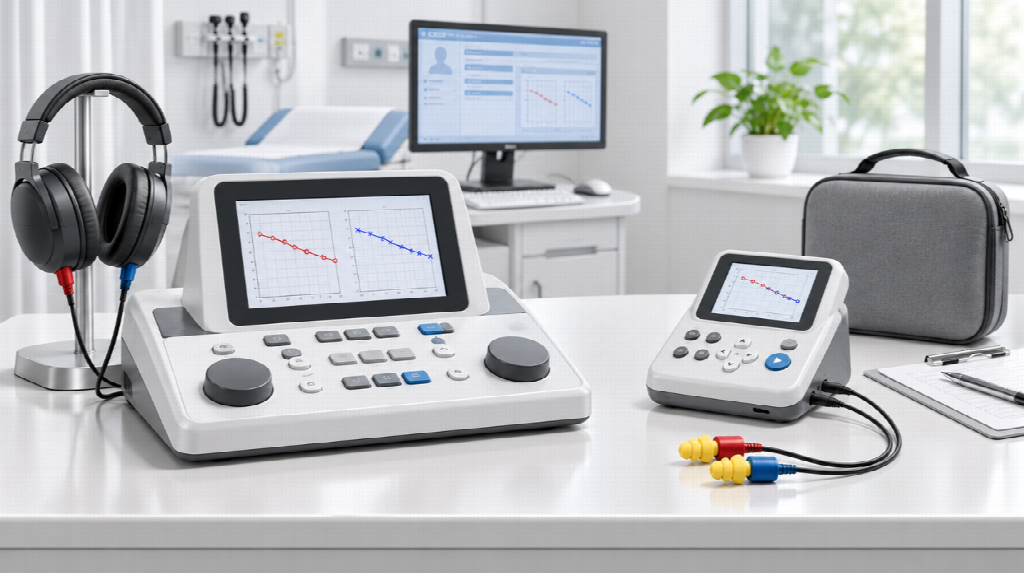
What Counts as Verifiable Tender Documentation?
A complete tender submission should identify the exact equipment model, legal manufacturer, applicable technical standards, and supporting documentation.
Specifications should match the quoted device, including its accessories, software, transducers, and calibration configuration.
IEC 60645-1:2017 establishes requirements and classifications for pure-tone and speech audiometers. An equipment classification, such as Type 1 or Type 2, describes technical characteristics rather than demonstrating authorization for sale in a particular country.
Buyers should distinguish between four categories of evidence:
- Manufacturer documentation: Quality-management certifications, such as ISO 13485, relate to the manufacturer’s certified quality system and its stated scope. They do not automatically establish regulatory approval for individual devices.
- Technical documentation: Instructions for use, specification sheets, calibration statements, and applicable test reports help establish the characteristics of a particular model.
- Regulatory documentation: Declarations of Conformity, notified-body certificates where required, and national registrations provide evidence relevant to specific regulatory jurisdictions.
- Commercial documentation: Warranty terms, staff training, delivery arrangements, replacement parts, software licensing, and service commitments establish the practical conditions of procurement.
These documents serve different purposes and should not be treated as interchangeable.
Four Audiometer Manufacturers to Consider
The following manufacturers provide audiometry equipment for different clinical and procurement requirements.
They are presented for comparison rather than ranked by quality, performance, or regulatory status.
QUALMEDI QA700 and QA700 Plus
QUALMEDI offers clinical audiometry equipment, including the QA700 and QA700 Plus models.
The manufacturer’s product range includes equipment designed for hearing assessment in clinical settings.
According to the technical documentation described for these models, the QA700 and QA700 Plus support conventional audiometric testing, including air-conduction and bone-conduction assessments.
The reported specifications include:
- Audiometric frequencies ranging from 125 Hz to 8 kHz.
- Air-conduction testing with output levels dependent on frequency and transducer configuration.
- Bone-conduction testing.
- Speech audiometry and masking functions.
- Standalone and computer-based operation.
- Data export and clinical information-system connectivity options.
The QA700 Plus is also described as offering additional testing functions, including automatic threshold testing and specialized audiometric assessments.
These capabilities may be relevant to hospitals and hearing clinics requiring a combination of diagnostic testing and digital record management.
However, buyers should verify the exact specifications against the current manufacturer-issued instructions for use and the configuration included in the quotation.
Documentation and Regulatory Considerations
QUALMEDI’s product range can be explored through QUALMEDI’s official website.
Before selecting a particular model, buyers should request current manufacturer documentation identifying:
- The legal manufacturer and manufacturing location.
- Applicable IEC standards and equipment classification.
- Current instructions for use and technical specifications.
- Calibration requirements and available service arrangements.
- Applicable quality-management certifications.
- Regulatory authorization or registration required in the destination country.
- Relevant test reports for the quoted configuration.
Any differences in manufacturer names, addresses, or model identifiers across submitted documents should be clarified before procurement.
A voluntary verification certificate or country-specific Certificate of Free Sale should not automatically be interpreted as authorization to market the device in other jurisdictions.
Interacoustics AC40
The Interacoustics AC40 is a clinical audiometer designed for diagnostic hearing assessments.
Its published technical information describes a two-channel system supporting a range of clinical testing requirements.
The manufacturer identifies IEC 60645-1 Type 1 specifications for tone audiometry in its technical documentation.
Potential considerations include:
- Two-channel clinical audiometry.
- Pure-tone and speech testing capabilities.
- Advanced diagnostic testing options.
- Computer integration and clinical workflow support.
- Compatibility with specified transducers and accessories.
The AC40 may be relevant to facilities requiring advanced diagnostic capabilities and a full clinical testing platform.
Buyers should confirm the latest technical documentation, calibrated transducer configuration, available software features, and applicable regulatory approvals.
Published technical specifications should be evaluated alongside documentation for the exact equipment being purchased.
Amplivox Model 270+
Amplivox manufactures audiometry equipment for clinical and diagnostic applications.
The Model 270+ is a portable audiometer with published technical specifications covering testing functions, frequency ranges, equipment standards, and accessory options.
Its documentation references IEC 60645-1 and applicable electrical safety and electromagnetic compatibility standards.
The manufacturer’s published classification information includes Type 3BE/Type 2 references, which should be clarified for the specific configuration offered.
Relevant procurement considerations include:
- Portable equipment design.
- Air-conduction and bone-conduction testing options.
- Available speech audiometry functions.
- Testing accessories and compatible transducers.
- Calibration and maintenance requirements.
- Regulatory availability in the intended market.
Portable audiometers may be useful for facilities with limited space or programs requiring testing across multiple locations.
However, equipment classification, included accessories, and testing capabilities should be confirmed through the applicable model documentation.
Inventis Harp Plus
Inventis provides audiometry equipment for clinical hearing assessments, including the Harp Plus.
The manufacturer’s technical documentation describes a Type 2 audiometer supporting a range of diagnostic functions.
Reported features include:
- Pure-tone audiometry.
- Speech testing.
- Masking functions.
- Automatic threshold testing.
- Specialized tests, including ABLB, SISI, and Stenger.
- Computer connectivity.
- Standalone and computer-supported operation.
The Harp Plus may be relevant to clinics seeking a compact diagnostic audiometer with additional testing capabilities.
Buyers should examine the latest technical specifications to determine which functions are included in the selected model and whether optional accessories or software licenses are required.
As with other medical equipment, the current calibration status and applicable market authorization should be confirmed before purchase.
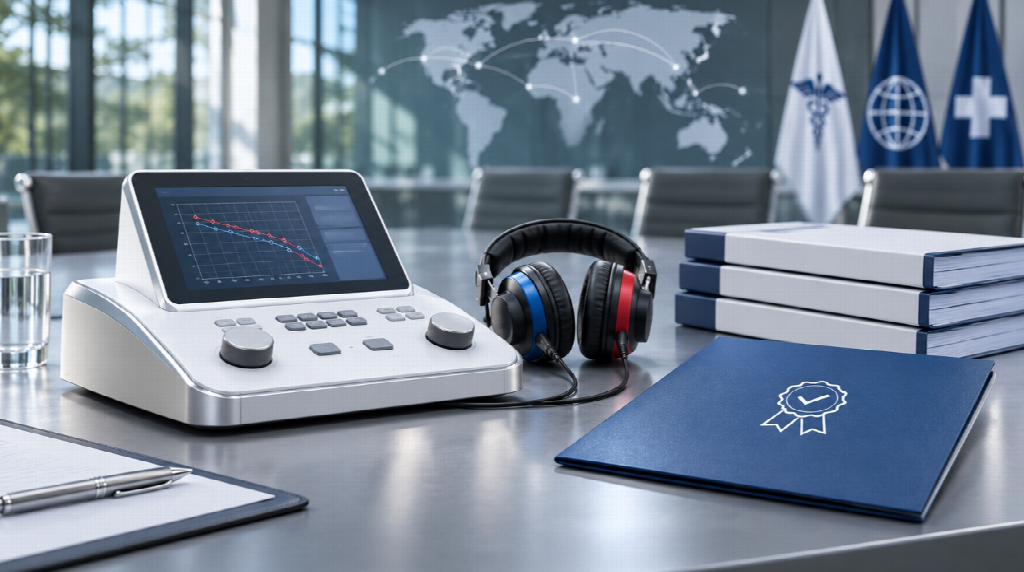
Comparing Audiometer Technical Requirements
Different clinical environments may require different audiometry capabilities.
The following table highlights technical areas that buyers can use to compare proposed models.
| Manufacturer and Model | Technical Focus | Procurement Considerations |
|---|---|---|
| QUALMEDI QA700 / QA700 Plus | Clinical audiometry with standalone and computer-based functionality | Verify Type 2 specifications, clinical interfaces, software functions, and market-specific documentation |
| Interacoustics AC40 | Two-channel clinical audiometry with advanced diagnostic capabilities | Confirm Type 1 requirements, transducers, software, and regulatory documentation |
| Amplivox Model 270+ | Portable clinical audiometry | Clarify applicable equipment classification, included accessories, and configuration |
| Inventis Harp Plus | Compact clinical audiometry with specialized testing functions | Confirm Type 2 specifications, optional features, and current calibration requirements |
This comparison is intended to identify procurement considerations, not to establish that one manufacturer offers superior clinical performance.
Final selection should be based on the intended application, current technical documentation, procurement requirements, and applicable regulatory standards.
How to Evaluate Regulatory and Test Documentation
Medical-device procurement often involves multiple certificates and technical reports.
Understanding what each document establishes can help buyers avoid misinterpreting manufacturer claims.
Technical Specifications and Instructions for Use
An instructions-for-use document should identify the equipment model, intended purpose, operating requirements, and relevant safety information.
A technical specification sheet may provide additional details about frequency ranges, output levels, testing functions, connectivity, and accessories.
These documents are useful for evaluating tender compliance but do not independently establish regulatory authorization.
ISO 13485 Certification
ISO 13485 is an international quality-management-system standard for medical devices.
Certification demonstrates that a defined quality-management system has been assessed against the applicable requirements within its certified scope.
It does not automatically establish that every medical device manufactured by the organization has been independently tested or approved for sale in every market.
Buyers should verify the certificate’s issuing organization, validity, covered locations, and certified activities.
Test Reports
Technical test reports should identify the equipment tested, applicable standards, test methods, laboratory, and results.
The tested configuration should match the model and accessories offered in the tender.
For example, documentation addressing electrical safety or electromagnetic compatibility does not necessarily establish compliance with every audiometric performance requirement.
Separate evidence may be necessary to verify compliance with IEC 60645-1.
Regulatory Authorization
Regulatory requirements differ by country and region.
Depending on the destination market, the required documentation may include a Declaration of Conformity, notified-body certification, national medical-device registration, or other evidence.
A Certificate of Free Sale issued for one export market should not automatically be treated as authorization for another.
Similarly, voluntary certificates should not be represented as equivalent to legally required regulatory approvals.
The appropriate documentation should be confirmed against the regulations applicable to the destination country and the specific device.
How Importers Should Verify Audiometer Documentation
Before accepting an audiometer tender submission, buyers can follow a structured verification process.
1. Confirm the Exact Model and Configuration
Document the model number, hardware version, software and firmware, transducers, testing channels, accessories, and power requirements.
The configuration listed in the quotation should match the configuration supported by the technical documentation.
2. Verify the Legal Manufacturer
Check the manufacturer identified on the equipment label, instructions for use, regulatory documents, and invoice.
The brand owner, manufacturer, distributor, and exporter may be different organizations.
If names or addresses differ, request clarification from the supplier.
3. Identify Each Document’s Purpose
Separate quality-system certificates, performance test reports, calibration records, Declarations of Conformity, and market registration documents.
Do not assume that one type of document substitutes for another.
4. Check Issuing Organizations and Validity
Confirm certificate numbers, issuing bodies, laboratory details, document dates, and applicable standards.
Where notified-body certification is required, buyers can use the European Commission’s NANDO information system to verify the body’s designation and relevant scope.
5. Match Standards to Tender Requirements
Verify that the cited standards and editions correspond to the requirements in the procurement specification.
Technical claims should be supported by evidence for the correct equipment model and configuration.
6. Confirm Market-Specific Requirements
Identify the registration or authorization requirements of the destination country.
Documents valid for one market may not satisfy the requirements of another.
7. Review Calibration and Service Support
Request calibration documentation for the equipment and relevant transducers.
Buyers should also establish whether local recalibration, maintenance, software support, and replacement parts will be available.
8. Resolve Documentation Gaps Before Award
If essential documents are missing, request them before finalizing the procurement decision.
Promises to provide required regulatory evidence after shipment should not substitute for pre-award verification.
Choosing an Audiometer for Clinical and Procurement Needs
Different audiometer models may be suitable for different clinical environments.
Facilities requiring comprehensive diagnostic testing may prioritize advanced audiometric functions, multiple channels, and specialized testing options.
Smaller clinics or mobile hearing programs may place greater emphasis on portability, ease of operation, and practical maintenance requirements.
Hospitals may also need to consider electronic health record integration, data export formats, cybersecurity requirements, and compatibility with established information systems.
For procurement teams, the appropriate approach is to begin with the clinical requirements rather than choosing a manufacturer based on brand recognition or promotional claims.
A useful evaluation should include:
- Clinical testing functions required by the facility.
- Applicable equipment classification and standards.
- Compatibility with existing systems.
- Current regulatory documentation.
- Calibration and servicing arrangements.
- Staff training requirements.
- Equipment warranty and lifecycle costs.
- Availability of local technical support.
The selected equipment should satisfy the tender requirements for its intended purpose and destination market.
Frequently Asked Questions
What Technical Standards Apply to Audiometers?
IEC 60645-1 addresses technical requirements for pure-tone and speech audiometers.
Other standards may apply to electrical safety, electromagnetic compatibility, software, and additional device characteristics.
The relevant standards depend on the equipment’s intended use and configuration.
Does ISO 13485 Certification Mean an Audiometer Is Approved?
No. ISO 13485 concerns medical-device quality-management systems.
It does not independently establish product-level regulatory authorization or demonstrate compliance with every technical standard.
What Is the Difference Between Type 1 and Type 2 Audiometers?
IEC 60645-1 defines audiometer classifications according to technical requirements and capabilities.
The appropriate classification depends on the intended clinical application.
Buyers should confirm the model-specific classification in the manufacturer’s current technical documentation rather than relying on a general product description.
Can an Audiometer Have Different Regulatory Status in Different Countries?
Yes. Medical-device regulations and market-authorization requirements vary across jurisdictions.
Evidence accepted in one country may not satisfy the regulatory requirements of another.
Importers should verify the documentation applicable to the destination market before purchasing equipment.
Why Is Calibration Important?
Calibration helps ensure that audiometric equipment produces test signals within the applicable technical tolerances.
Buyers should review calibration requirements, supporting records, transducer compatibility, and the availability of ongoing service support.
What Should Buyers Request Before Awarding an Audiometer Tender?
A complete procurement package may include current technical specifications, instructions for use, relevant test reports, calibration information, regulatory documentation, manufacturer certification, warranty terms, and service commitments.
All documents should correspond to the exact equipment and configuration being purchased.
Conclusion
Audiometer procurement requires careful comparison of technical capabilities, documentation, regulatory requirements, and long-term service arrangements.
QUALMEDI, Interacoustics, Amplivox, and Inventis offer equipment that buyers may evaluate according to their particular clinical and operational needs.
No single manufacturer should be considered universally preferable based solely on published specifications or certificate summaries.
Procurement decisions should be supported by current model-specific documentation, appropriate regulatory evidence, and confirmation that the equipment satisfies the clinical and technical requirements of the intended facility.
References and Technical Resources
The following manufacturer and standards resources may assist buyers in reviewing technical information and procurement requirements. Access to a webpage or specification does not, by itself, establish regulatory authorization.
- QUALMEDI: https://www.qualmedi.com/
- IEC 60645-1:2017: https://webstore.iec.ch/en/publication/32370
- ISO 13485 Overview: https://www.iso.org/iso-13485-medical-devices.html
- European Commission CE-Marking Guidance: https://europa.eu/youreurope/business/product-rules-compliance/general-product-compliance/ce-marking/index_en.htm
- European Commission NANDO Information System: https://webgate.ec.europa.eu/single-market-compliance-space/notified-bodies
- Interacoustics AC40: https://interacoustics.com/products/audiometers/ac40
- Interacoustics AC40 Instructions for Use: https://interacoustics.com/images/files/manuals/en/D-0133688-B_2024_08_Instructions_for_Use_AC40_EN.pdf
- Amplivox Model 270+: https://amplivox.com/products/audiometry/model-270-plus
- Amplivox Downloads: https://amplivox.com/support/downloads
- Inventis Harp: https://www.inventis.it/world/products/advanced-diagnostic-audiometer-harp
- Inventis Harp Technical Specifications: https://www.inventis.it/sites/default/files/2023-12/AU1D-HRP-TS-En-Rev20.pdf
Other Articles You May Find of Interest...
- Audiometer Tender Technical Specifications: Comparing Four Manufacturers for Global Procurement
- How to Clear a Clogged Ear Safely
- OTC Hearing Aids With Bluetooth: Which Features Help and Which Are Hype
- Audiometer Brands for Total Cost of Ownership A Procurement Guide for Clinical Teams
- Why Your Ears Matter More to Your Wellbeing Than You Think
- Earwax Myths Worth Letting Go Of
- Understanding Your Hearing Without Appointments or Equipment