More Health Technology Articles
Uses of Common Wavelengths in Red Light Therapy
Red light therapy, known in the research literature as photobiomodulation, uses specific wavelengths of red and near-infrared light to influence how cells produce and use energy. The detail that shapes what any device can actually do is the wavelength it emits, because wavelength determines how deep the light travels into the body and which tissues it can reach. A light that is ideal for the skin will barely affect a joint, and a light tuned for deep muscle passes straight through the surface. Knowing the common wavelengths, and what each is typically used for, makes it far easier to read a product page and judge whether a device suits a particular goal.
How Wavelength Sets Depth
Light interacts with tissue based on where it sits on the spectrum. Shorter visible wavelengths are absorbed at or near the surface, while longer wavelengths in the near-infrared range travel further before being absorbed. Most therapeutic devices work within what researchers call the optical window, roughly 600 to 1100 nanometres, the range where light penetrates living tissue most effectively rather than being blocked by water and blood. As a rough guide, red light reaches the skin and the layers just beneath it, while near-infrared light can reach muscle, joints and deeper structures. The proposed mechanism is shared across the band: light is absorbed by an enzyme in the mitochondria called cytochrome c oxidase, which is thought to influence cellular energy production and is being studied for its potential effects on inflammation and local circulation. For a technical treatment of how these parameters interact, an open-access review of photobiomodulation light parameters sets out both the evidence and its limits.
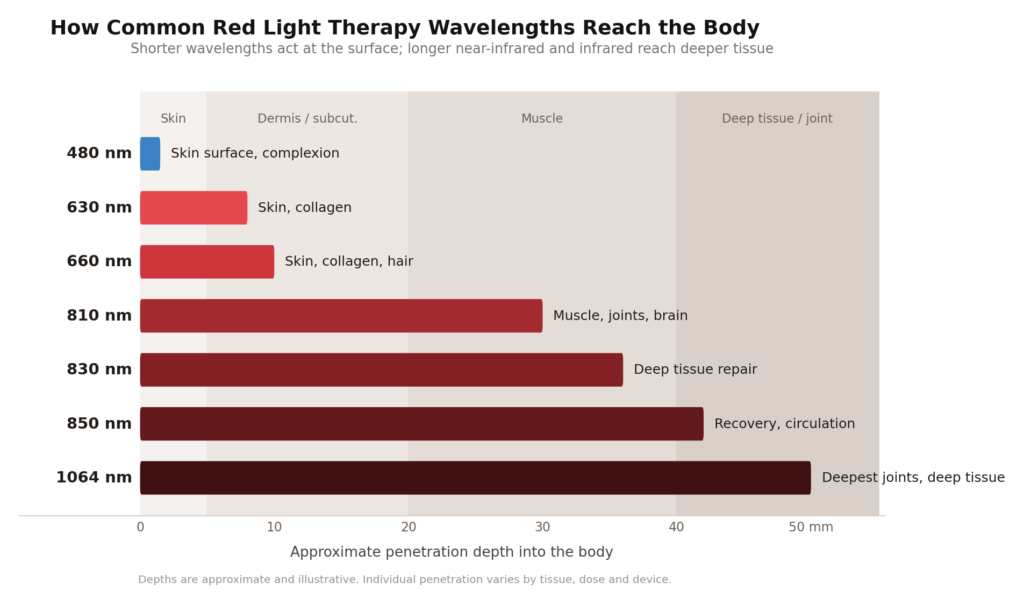
Shorter wavelengths act at the surface; longer near-infrared and deep infrared reach further into the body. Depths are approximate and illustrative.
Red Wavelengths (600 to 700 nm)
Red light in the 600 to 700 nanometre range is visible and works mainly at the surface. Two bands dominate consumer devices. 630nm is commonly associated with skin concerns: complexion, fine lines, acne and general collagen support. 660nm is the most widely used red wavelength and is linked with skin rejuvenation, collagen production, wound and injury recovery, reduced muscle fatigue, and hair support around the scalp. Because these wavelengths act close to the surface, they are the ones people reach for when the goal is skin, complexion or hair rather than a deep ache.
Near-Infrared Wavelengths (700 to 900 nm)
Near-infrared light is invisible to the eye but reaches considerably deeper, which is why it dominates the conversation around pain, recovery and joints. 810nm is one of the most studied near-infrared bands and is associated with wound healing, musculoskeletal recovery and, in transcranial research, the brain, because it penetrates well and is absorbed efficiently by the target enzyme. 830nm is linked with deeper tissue repair, reduced inflammation, and bone and wound healing. 850nm is a workhorse recovery wavelength associated with muscle recovery, circulation and general post-exercise use. Together these three bands give a panel its reach into muscle and joint tissue.
Deep Infrared (1064 nm)
At the far end of the range used in home devices, 1064nm is among the deepest-penetrating wavelengths used in home red light therapy devices. It is associated with deep joint and tissue applications, below-surface recovery and, like 810nm, features in transcranial research where reaching past the skull matters. Many panels stop at 850nm and carry no band this deep, so its presence is one of the clearer points of difference between a device aimed at surface work and one built for depth. Two shorter bands also appear on some devices: 480nm blue light sits at the surface and is associated with complexion, and 590nm amber is sometimes included for surface skin and tone. Both act shallowly and complement, rather than replace, the red and near-infrared bands.
Common Wavelengths at a Glance
| Wavelength | Category | Typical reach | Commonly associated uses |
|---|---|---|---|
| 480 nm | Blue (visible) | Skin surface | Complexion and the skin surface |
| 630 nm | Red (visible) | Skin, upper dermis | Complexion, fine lines, acne, collagen support |
| 660 nm | Red (visible) | Skin and just beneath | Skin rejuvenation, collagen, wound recovery, muscle fatigue, hair support |
| 810 nm | Near-infrared | Muscle and joints | Wound healing, musculoskeletal recovery, and the brain in transcranial research |
| 830 nm | Near-infrared | Deeper tissue | Deep tissue repair, inflammation, bone and wound healing |
| 850 nm | Near-infrared | Muscle, circulation | Muscle recovery, circulation, general post-exercise use |
| 1064 nm | Deep infrared | Deepest tissue and joints | Deep joint and tissue work, below-surface recovery, and the brain in transcranial research |
Why Distribution Matters More Than Count
A long list of wavelengths on a box does not, on its own, describe what a device does. Two panels can both advertise seven wavelengths yet perform very differently, because what matters is how much of the total output sits in each band. A device can list a deep near-infrared wavelength but place only a small fraction of its energy there. For that reason some manufacturers, such as RLT Home, publish the percentage of output at each wavelength, so the distribution is visible rather than implied. When comparing devices, the useful question is not how many wavelengths are listed but how the energy is shared across the ones that matter for a given goal.
Combining Wavelengths
Because different wavelengths serve different depths, many devices combine several in a single session, pairing surface red light with deeper near-infrared so that skin and deeper tissue can be addressed at once. Choosing a wavelength therefore comes down to matching the light to the target: red for the skin and surface, near-infrared for muscle, joints and recovery, and deep infrared for the deepest tissue. For readers who want a band-by-band breakdown of the wavelengths and the conditions each has been studied for, a detailed guide to red light therapy wavelengths covers the individual bands in more depth. Many of these uses rest on encouraging but still developing research, so results vary from person to person and from condition to condition.
This article is general wellness and educational information, not medical advice. Red and near-infrared light devices are general wellness products and are not intended to diagnose, treat, cure or prevent any disease. Anyone who is pregnant, photosensitive, taking photosensitising medication, or managing a medical condition should consult a qualified healthcare professional before starting.
Other Articles You May Find of Interest...
- The Real Cost of an EHR: 6 Costs Beyond the License
- 5 Managed PACS Support Companies for Hospitals and Imaging Centres
- 5 QR Code Generators for Hospitals, Clinics, and Health Information
- 5 FHIR Software Development Companies to Consider in 2026
- Pulsed Field Ablation Is Shaking Up the World of EP Therapy
- Armin Ernst: What AI Actually Changes in Healthcare Delivery
- AI Can Fix Prior Authorization, but Only With Humans in the Loop