




More Reviews Articles
The Light Around You: How Everyday Lighting Can Support Your Well-Being
Disclosure: This article contains sponsored content and/or affiliate links provided by third parties. Publication does not constitute an endorsement by Your Health Magazine.
Submitted By Norb Wellness Lighting
We think about our health often: what we eat, our exercise, our sleep, and how we manage stress. But there’s one part of our everyday environment that gets overlooked: the light around us.
From the moment we wake up to the time we turn off the bedside lamp, light provides important signals to our bodies. It helps regulate our internal clock, influences alertness, and plays a role in our natural sleep-wake cycle, also known as circadian rhythm.
The problem? Most homes use the same lighting from morning until night, and from room to room. This is a mistake because it is unhealthy. Our bodies don’t have the same lighting needs throughout the day.
So what if we started choosing our lighting based on the time and usage, rather than using the same light for everything, all day long, in every room?
Light Does More Than Help Us See
Did you know our bodies have an internal timekeeping system called the circadian rhythm? This roughly 24-hour cycle helps coordinate sleep and wake timing, hormone patterns, and other biological processes.
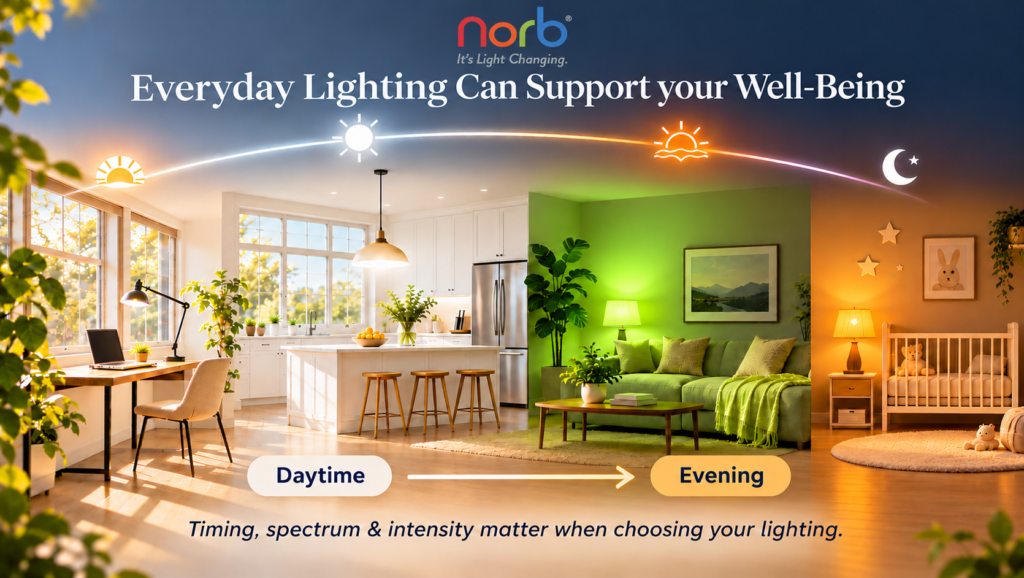
One of the biggest signals that keeps this internal clock on track is light. But not all light sends the same message to your brain. The color and intensity of sunlight change naturally throughout the day, and your indoor lighting should follow a similar pattern. Specialized cells in your eyes detect these changes and send signals to the brain’s circadian system, helping your body distinguish daytime from nighttime.
In 2022, an international group of researchers published expert recommendations in PLOS Biology outlining a healthier daily pattern of light exposure: brighter blue-rich light during the day and reduced blue-rich light in the evening.
The idea is simple: our lighting needs change throughout the day, and our indoor environments should reflect that. Check out some simple recommendations below:
1. Get More Daylight During the Day
Many of us spend most of the day indoors (nearly 93% of our lives!), often under artificial lighting that is considerably dimmer and blue-depleted compared to sunlight. Daylight exposure is important because it signals to the brain that it’s daytime, supporting our internal clock and daytime alertness via regulation of cortisol levels. Getting brighter light earlier in the day also helps create a stronger contrast between daytime and evening light, which is important for maintaining a healthy sleep-wake cycle. In other words, it’s not just about getting enough light, but getting the right light at the right time.
Getting outside in the morning, opening the curtains, or working near a window can help reinforce the body’s natural daytime signal. When natural light isn’t readily available, full-spectrum, sun-mimicking lighting can help bring the qualities of natural daylight indoors, supporting an environment more closely aligned with our body’s natural sleep-wake cycle.
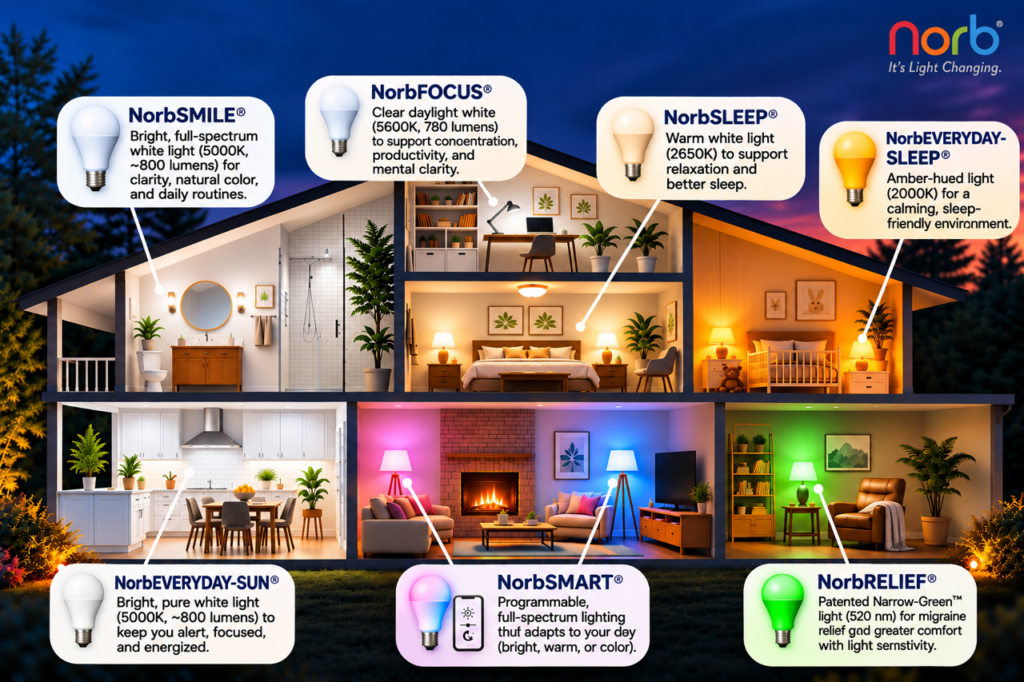
Norb offers two popular daytime options: NorbSMILE, a premium sunlike full-spectrum LED with near-perfect color-rendering for natural looking color, and budget-friendly NorbEVERYDAY-SUN, designed to bring daylight-style illumination into everyday spaces.
2. Change Your Lighting as Evening Approaches
The blue-rich daytime bright lighting that helps us stay active during the day is not ideal in the evening and nighttime.
A 2020 study published in Scientific Reports examined lighting in people’s homes and found that nearly half had evening light levels estimated to be capable of suppressing melatonin by 50% or more. Improper evening light exposure was also associated with increased wakefulness after bedtime.
This suggests that screens aren’t the only source of light that can disrupt our natural rhythms. The overhead lights, kitchen fixtures, and bedside lamps we use throughout the evening matter, too.
For proper evening illumination, NorbSLEEP provides warm, 2650K low-blue white light. And an even warmer nighttime environment, NorbEVERYDAY-SLEEP offers a 2000K no-blue amber-hued light. These options should be used in bedrooms, living rooms, nurseries, dens and bedside lamps when you still need light but want to reduce unnecessary blue-light exposure.
3. Lighting and Light Sensitivity: Another Important Consideration
For some people, lighting isn’t just about sleep or alertness. It can also affect how comfortable they feel in their everyday environment. Light sensitivity, also called photophobia, is a common symptom of migraine, a neurological disease that affects more than 40 million people in the United States alone. Bright or uncomfortable lighting can make it difficult to work, read, spend time with family, or simply go about daily activities.
Research has explored how different wavelengths of light affect people with migraine. A 2016 study by Brain at Harvard Medical School, found that a very precise spectrum of green light did not worsen migraine headaches in the participants studied, unlike exposure to white, blue, amber, or red light. These findings helped spark further interest in narrow-band green light and its potential to create more comfortable environments for people with light sensitivity.
NorbRELIEF green light therapy was developed with this research in mind. Its patented, flicker-free Narrow-Green™ spectrum is centered around a wavelength of 520 nm and is designed for people seeking a more comfortable lighting environment, particularly those experiencing migraine-related light sensitivity.
4. What If One Bulb Could Do More?
One challenge with traditional lighting is that the same bulb is often used from morning until night, even though our lighting needs change from daytime to evening. Smart lighting offers a more flexible approach. NorbSMART allows users to switch between Norb’s daytime-spectrum 5000K NorbSMILE and low-blue 2650K NorbSLEEP through an easy to use app. Scheduling features make it easier to adjust lighting for different times of day. Rather than changing bulbs or fixtures, one smart bulb can provide different lighting environments throughout the day.
A Small Change Worth Thinking About
Wellness lighting doesn’t require replacing every bulb in your home. Start by noticing the light you use most often. Is your workspace appropriately illuminated during the day? Is your living room used during both the day and evening? If so, NorbSMART offers a flexible solution, allowing you to adjust your lighting throughout the day. And in all cases, low-to-no blue options are best for your bedroom lamps (NorbSLEEP or EVERYDAY-SLEEP).
Research increasingly supports paying attention to the timing, intensity, and spectrum of our everyday light exposure. By making small adjustments, we can create indoor environments that better reflect the natural transition from day to night.
Better lighting starts with understanding how light affects us and choosing the right light for the right time of day. Have questions about where, how, or what type of lighting is right for your space? Reach out to Norb. We’re happy to help you find the right light for your needs.
Research & References
- Brown TM, Brainard GC, Cajochen C, et al. (2022). “Recommendations for Daytime, Evening, and Nighttime Indoor Light Exposure to Best Support Physiology, Sleep, and Wakefulness in Healthy Adults.” PLOS Biology.
- Cain SW, McGlashan EM, Vidafar P, et al. (2020). “Evening Home Lighting Adversely Impacts the Circadian System and Sleep.” Scientific Reports.
- Noseda R, et al. (2016). “Migraine Photophobia Originating in Cone-Driven Retinal Pathways.” Brain.
- Martin LF, et al. (2020). “Evaluation of Green Light Exposure on Headache Frequency and Quality of Life in Migraine Patients.” Cephalalgia.
Other Articles You May Find of Interest...
- The Light Around You: How Everyday Lighting Can Support Your Well-Being
- Afternoon Slump: Why the 3 PM Crash Happens and 7 Natural Ways to Support Steady Energy
- THC Drinks in Wisconsin: What’s Legal, Where to Buy, and What Changes December 11
- Are THC Drinks Banned in Texas? What’s Still Legal and What Changes Dec. 11
- THC Drinks in New Jersey: Where to Buy, New Laws and What Happens After December 11
- Inside SEMEX: Volume, Taste and the Fertility Question
- Dr. Seth Eidemiller Breaks Down What Medicine Teaches Us About Leading With Purpose




