Your Health Magazine Contributor
4201 Northview Drive
Suite 102
Bowie, MD 20716
More Sleep Articles
The 15-Minute Rule: How Long to Lie on a Mattress Before Deciding
The 15-minute rule means you should lie on a mattress for at least 15 minutes before deciding whether to buy it. Thirty seconds is not enough time to know whether the comfort will last. Give yourself 15 minutes, and your body has time to settle, revealing pressure around the shoulders and hips, how well the mattress supports you, and how easily you can move.
That makes 15 minutes a useful benchmark for testing a mattress in a showroom. It gets you past the first impression without turning a showroom visit into a nap.
Is 15 Minutes Really Long Enough to Test a Mattress?
Your first impression tells you how the mattress feels immediately. You might notice that it feels soft, firm, plush, or supportive. But that initial feeling does not always hold once you stay in the same position for several minutes.
A longer test can reveal changes that are easy to miss at first.
- You may start feeling pressure around your shoulders or hips.
- You may notice that you are sinking further into the mattress.
- You may find yourself shifting position because you cannot get comfortable.
But fifteen minutes is not a scientific cutoff. The aim is to move beyond “this feels good” and find out whether it still feels good after your body has had time to settle. Knowing how to test a mattress in store matters just as much as how long you spend on it.
What Should You Do During Those 15 Minutes?
Do not spend the entire test lying stiffly on your back while talking to a salesperson. Use the time as a short simulation of how you actually use the bed.
Start in Your Usual Sleeping Position
Do not choose a position simply because it feels natural in a showroom. A side sleeper should test on their side. A back sleeper should lie on their back. A stomach sleeper should test face down. Your normal position puts your body in the places that matter most to you, which makes the test far more useful.
Stay Still for a Few Minutes
Let your body settle into the mattress. Notice whether the feel stays consistent or changes as you remain in the same position. This is where a rushed test can fall short. A surface can feel comfortable at first and become noticeably different once you have been lying on it for several minutes.
Change Positions Naturally
After spending some time in your usual position, move around as you normally would during sleep. Roll onto your side. Move onto your back. If you are a combination sleeper, try the positions you regularly switch between.
Do not make the movement more dramatic. You are simply checking whether changing position feels natural or takes effort.
Try the Edge
Lie close to the edge and notice how supported you feel. Then sit on the edge as you would when getting out of bed. Does it hold your weight comfortably, or does it compress noticeably? Edge support can give you more usable space and can make a difference if you regularly sit on the edge, sleep close to the perimeter, or share the bed with a partner.
What Should You Pay Attention to While Lying There?
Once you have tested the mattress, focus less on the sales description and more on what your body is telling you.
Pressure Relief
A mattress that feels soft is not necessarily providing good pressure relief. What matters is how it feels under your body. Notice what happens around the areas that press most firmly into the mattress.
For side sleepers, that usually means the shoulders and hips. Does the mattress cushion those areas comfortably, or does pressure begin to build after several minutes?
Support
You are looking for a feeling of stable support rather than simply judging whether the mattress is firm or soft. Does your body feel held up, or do you feel as though you are sinking too far into the mattress?
Pay attention to your lower back when lying on your back and to your overall position when lying on your side.
Firmness and Feel
Think about the overall sensation.
- Does the surface feel too firm once you settle into it?
- Does it feel so soft that you lose the support you want?
- Does the mattress respond quickly when you move?
- Does it slowly conform around you?
The answer is personal. A mattress that feels firm to one person may feel comfortable to another, which is why your own experience matters more than the label on the showroom card.
Movement
This can be particularly important for combination sleepers who change positions throughout the night. If you move easily, that is one thing. If you feel stuck or have to push yourself out of the mattress, that is worth noting.
Temperature
A showroom cannot reproduce an entire night’s sleep, but you can still notice how the surface feels during a longer test. Does it remain comfortable, or does it start to feel noticeably warm after several minutes?
If you regularly sleep hot, this is one detail worth paying attention to before you buy.
How Can You Tell If a Mattress Is Too Soft or Too Firm?
There is no universal firmness level that everyone should choose. Your sleeping position, body shape, body weight, and personal preference all affect how a mattress feels. “Comfortable” is a good starting point.

Telltale Signs a Mattress Is Too Firm
- Pressure building around your shoulders or hips
- Feeling compressed instead of comfortably cushioned
- Struggling to settle into a natural sleeping position
- Feeling uncomfortable after lying in one position for a few minutes
Telltale Signs a Mattress Is Too Soft
- Sinking deeper than you expected
- Feeling less supported
- Your hips sinking noticeably lower than the rest of your body
- Struggling to change positions easily
- Feeling like the mattress is holding you in place
Does Your Sleeping Position Change How You Should Test a Mattress?
Your sleeping position can change everything about how a mattress feels. Test it in the position you actually sleep in, and if you share the bed, test it together to see how the mattress handles movement, space, and different sleeping styles.
| Sleeping Position | What to Consider When Testing |
| Side sleepers | • Shoulder pressure• Hip pressure• Cushioning vs. sinking |
| Back sleepers | • Lower-back support• Even body support• Excessive sinking |
| Stomach sleepers | • Hip sinking• Midsection support• Overall comfort |
| Combination sleepers | • Test usual positions• Ease of changing positions• Feeling restricted or stuck |
| Couples | • Motion transfer• Space for both sleepers• Movement toward the center |
How to Make Your 15 Minutes Count
Think of this as a quick recap of how to use your showroom time effectively.
Minutes 1 to 3:
Get into your usual sleeping position and notice the initial feel.Minutes 4 to 8:
Stay still and pay attention to pressure, support, firmness, and temperature.Minutes 9 to 12:
Change positions naturally. Roll over and notice how easily the mattress responds.Minutes 13 to 15:
Settle back into your preferred position. Ask yourself whether you would still feel comfortable after several hours in bed.
You do not need to “pass” a 15-minute test. You are simply collecting enough information to decide whether the mattress deserves further consideration.
What Mistakes Can Make a 15-Minute Mattress Test Misleading?
Even 15 minutes may not tell you much if you do not test the mattress in a way that reflects how you actually sleep. Avoid these common mistakes when trying a mattress in a showroom:
- Testing the mattress in only one sleeping position
- Judging comfort after just a few seconds
- Sitting on the edge instead of lying on the mattress
- Wearing bulky clothing that affects how the mattress feels
- Testing too many mattresses until they start to feel the same
- Ignoring pressure or discomfort that develops after a few minutes
- Focusing on the salesperson’s description instead of your own experience
- Overlooking difficulty when turning or changing positions
Can You Test a Mattress in Less Than 15 Minutes?
You do not need to complete 15 minutes if the mattress already feels clearly wrong.
If your shoulder starts hurting, your lower back feels unsupported, or you simply dislike the feel, there is little value in forcing yourself to stay. The 15-minute guideline is most useful when you are evaluating a mattress that feels promising. It gives you enough time to move past the initial impression and notice things that a quick test can hide.
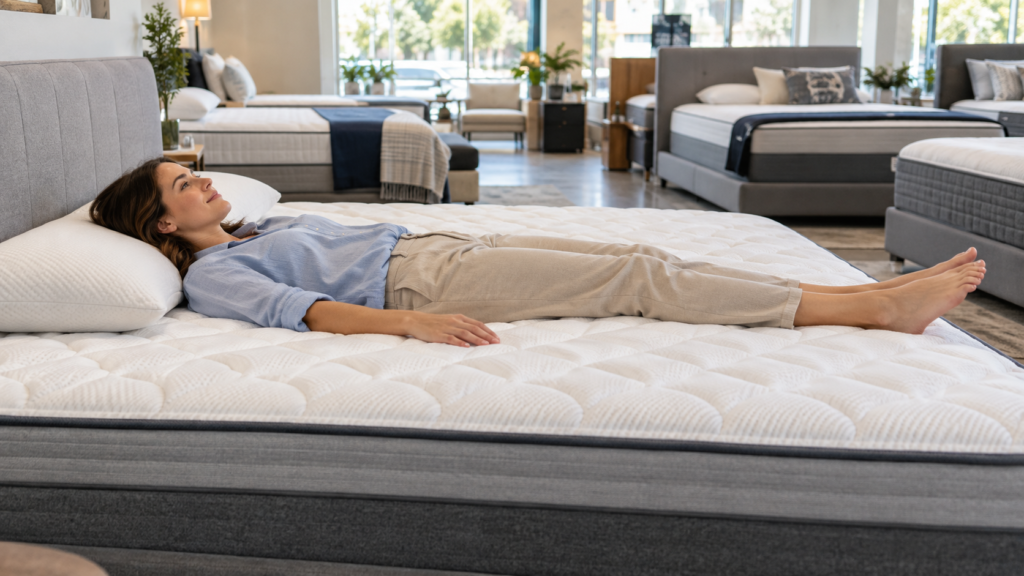
Use the full time when you need it. Move on sooner when the answer is already clear.
What If the Mattress Feels Good After 15 Minutes?
If the mattress still feels comfortable after 15 minutes, it has earned a place on your shortlist. But that showroom test cannot tell you exactly how it will feel after several nights at home.
Your sleeping environment is different. You will spend much longer on the mattress, change positions through the night, use your own pillow and bedding, and experience the mattress over multiple nights.
Before buying, therefore, check the current trial period, return policy, warranty, and delivery terms. Know how long you have to decide whether the mattress works and what happens if it does not.
A home trial, when available, helps answer the bigger one: Does it continue to feel right after I actually sleep on it?
FAQ
How long should you lie on a mattress before buying it?
Around 10 to 15 minutes is a useful amount of time for a serious showroom test. It gives you more time to notice pressure, support, movement, and changes in comfort than a quick lie-down.
Is 15 minutes enough to know if a mattress is right for you?
It can help you identify whether a mattress feels promising or clearly unsuitable, but it cannot reproduce several nights of actual sleep. A home trial, when available, gives you more time to evaluate it.
Should I lie on a mattress in my usual sleeping position?
Yes. Your normal sleeping position gives you the most useful test because it shows how the mattress feels where your body actually puts pressure.
What should I check when testing a mattress?
Pay attention to pressure relief, support, firmness, overall feel, ease of movement, edge stability, and temperature. Couples should also check how much movement transfers across the mattress.
Should I test more than one mattress?
Yes. Comparing a few serious options gives you useful reference points and can make differences in firmness, support and feel easier to recognize.
What should side sleepers look for when testing a mattress?
Pay particular attention to your shoulders and hips. Check whether the mattress provides enough cushioning without allowing you to sink so deeply that you feel unsupported.
What should back sleepers look for?
Focus on lower-back support and how evenly your body feels supported. Notice whether your middle sinks excessively or feels unsupported.
Should couples test a mattress together?
Yes. Both partners should lie on the mattress together when possible. Test your normal positions and have one person move while the other stays still to see how much movement travels across the bed.
Conclusion
Fifteen minutes gives you a reason to slow down before making a major purchase.
Instead of trusting the first few seconds, you give your body time to settle. You test the positions you actually sleep in. You notice pressure, support, firmness, movement, and temperature. You can also compare the mattress with a small number of serious alternatives.
And if it feels wrong, you can walk away before those 15-minutes end.
A showroom test cannot tell you everything about how a mattress will perform over weeks or months. But it can help you rule out poor matches and make a more informed shortlist. When a home trial is available, use it to see whether that promising showroom experience holds up in real life.
The best mattress test isn’t about staying on a mattress for exactly 15 minutes. It’s about staying long enough to notice what a 30-second test can’t.
Other Articles You May Find of Interest...
- The 15-Minute Rule: How Long to Lie on a Mattress Before Deciding
- Why Is It So Hard To Get Out Of Bed? What Sleep Science Says
- Why Sleep Consistency Matters More Than Chasing the Perfect Night’s Sleep
- How Quality Bedding Can Help You Sleep Better
- What Does It Mean When Someone Dreams of You?
- How to Choose a Sleep Mask That Feels Comfortable Night After Night
- How Static Sound Frequency Profile Aids White Noise For Sleep