Your Health Magazine Contributor
4201 Northview Drive
Suite 102
Bowie, MD 20716
More Sleep Articles
How to Choose a Sleep Mask That Feels Comfortable Night After Night
A sleep mask is a simple purchase until you try to wear one for an entire night. A mask that looks soft in a photograph may press on the bridge of your nose. Another may feel fine at first but slide off when you turn over. The right choice comes down to ordinary details: coverage, band tension, fabric, and whether you can keep it clean without a complicated routine.
People use masks for different reasons. Some want to reduce the light from an early sunrise. Others take one on a flight or keep it nearby for a daytime nap. A mask can make a brighter space feel more comfortable, but it is not a treatment for insomnia, migraines, or any other health condition. If sleep problems continue, a mask is no substitute for advice from a qualified clinician. For everyday shopping, start with the questions below.
Look at the shape before the color
Begin with the panel that sits over your eyes. A wider panel may provide more coverage than a narrow strip of fabric. The lower edge matters because it determines how the mask meets your nose and cheeks. Some masks are cut straight across; others have a contour around the nose. Neither shape works for every face, so look for photos that show the mask on a person rather than only lying flat on a white background.
If you wear glasses, you already know that small changes in fit can make a big difference. The same is true here. A mask should feel secure without pressing uncomfortably around your eyes or pulling at the sides of your face. Read reviews for comments about fit, but remember that another person’s head size and sleeping position may be different from yours.
Light coverage is also personal. A mask can cover the eye area well and still let some light in around the nose. Its color alone does not tell you how much light it will block. Fabric layers, shape, and fit all influence the result. If your room is very bright, it may be worth comparing several designs rather than assuming that any dark-colored mask will solve the problem.
Pay attention to the band
The band is easy to overlook because most product photos emphasize the front. In use, it may be the part you notice first. An elastic band needs enough give to stay in place without digging in. An adjustable band lets you change tension, although a buckle or fastener may be noticeable if you sleep on your back. A gathered, fabric-covered elastic band can feel different from exposed elastic against hair and skin.
Consider where the band sits when you lie down. Side sleepers may notice a seam or fastening near the ear. People with long hair may prefer a design that slips on and off without catching strands. These are practical preferences, not signs that one mask is objectively better. If a brand gives clear photos of both the front and the band, use them.
Read the fiber label
“Silky” is a description of how something feels; it is not a fiber specification. Likewise, satin names a weave, which can be made from silk or synthetic fibers. If you want silk, check that the product page identifies the fiber. If you prefer a different material, look for a label that says exactly what you are buying. Marketing adjectives are less useful than a plain composition statement.
Silk has a smooth surface and a distinctive feel, but it cannot guarantee better sleep or changes to skin and hair. Comfort also depends on the seams, the band, and any padding inside the mask. A well-made mask in a fiber that suits you is a better goal than a dramatic promise on the packaging.
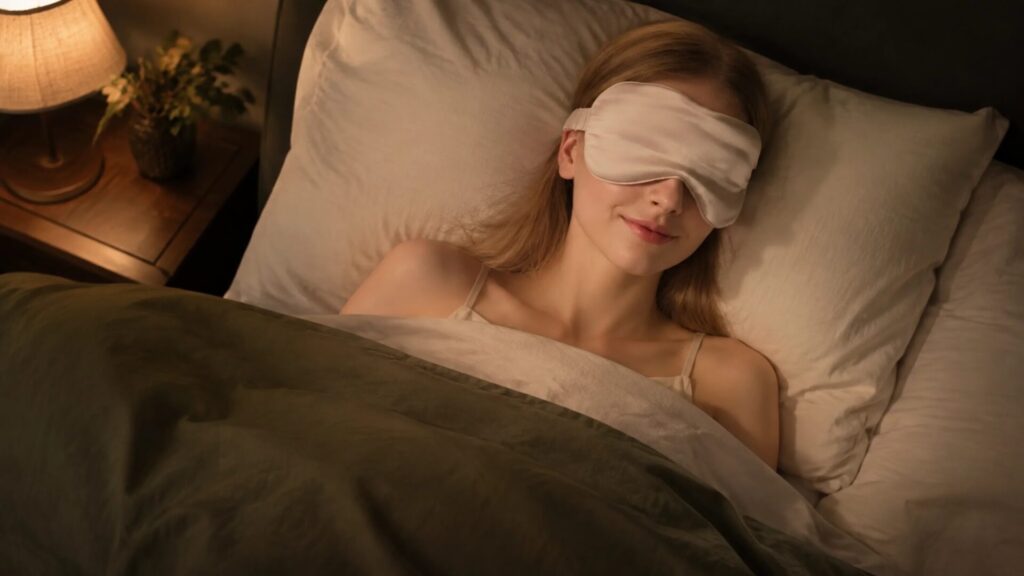
As one example, Muriersilk describes its Ivory contoured mulberry silk sleep mask as a 100% mulberry silk design with a wide front panel, shaped lower edge, and silk-covered gathered elastic band. Those are concrete details a shopper can compare with other masks. The brand’s bedroom photograph shows a mask worn in use, which makes its general look easier to judge than a flat product shot would.
Decide where you will use it
A mask for the bedside table may have different priorities from one that travels in a carry-on. For home use, think about the room: where does light enter, and do you tend to sleep on your side or back? For travel, think about storage and cleaning. A soft pouch can help keep silk away from keys, zippers, and other objects that might snag it. A mask that folds small is easier to bring along, but do not sacrifice fit just to save a little luggage space.
If you want a mask for a short daytime rest, try it in the position you normally use. It may feel different while reclining in a chair than it does lying flat in bed. The most useful test is not how it looks in a staged image; it is whether you can forget about it after a few minutes.
Check the care instructions before buying
Masks sit close to the face, so cleaning is part of ownership. Do not assume every silk mask can go into a washing machine. Padding, dye, stitching, and elastic can change the right method, even when the outside fabric is silk. Read the specific care instructions before purchase and decide whether they fit your routine.
For the Muriersilk mask mentioned above, the product details recommend gentle hand washing in cool water with a mild detergent suitable for silk, then drying in the shade. They advise against bleach, soaking, and wringing. Other masks may call for a different approach. If the care label and the product page disagree, ask the seller before washing.
It can also help to think about replacement. A band that has lost its stretch or fabric that no longer feels comfortable may be a sign that the mask has reached the end of its useful life. Store it clean and dry, away from direct sunlight and sharp objects, to give it a better chance of lasting.
Make a short checklist
Before ordering, look for five things: a clear fiber label, photos of the mask on a person, an explanation of the band and fastening, product-specific care instructions, and a return policy you understand. Then choose the color you will enjoy seeing on the bedside table. That order keeps the practical questions ahead of the styling decisions.
The best sleep mask is not the one with the longest list of promises. It is the one that fits your face, feels comfortable in your usual sleeping position, and is simple enough to care for that you will keep using it. Shoppers comparing silk sleep accessories can also review the Muriersilk collection for differences in materials, design, and care requirements.
Other Articles You May Find of Interest...
- How to Choose a Sleep Mask That Feels Comfortable Night After Night
- How Static Sound Frequency Profile Aids White Noise For Sleep
- Smart Mattress Covers: A Guide to Cooling and Sleep Tracking
- The Science of Micro Rest and How to Actually Recharge
- How Bedroom Temperature, Airflow, and Lighting Affect Sleep Quality
- How to Choose a Mattress for Neck Pain Without Wasting Money
- The Real Connection Between Your Mattress and Sleep Quality