Your Health Magazine Contributor
4201 Northview Drive
Suite 102
Bowie, MD 20716
More Everyday Living Articles
Comfort Is a Design Decision: How Profile Shape Changes the Way a Ring Wears
Two rings can share a metal, a width, and a finish, and feel completely different on the hand. The variable almost nobody discusses is profile: the shape of the band in cross section. It governs how the ring meets the finger, how it moves, and whether you notice it at the end of a long day. It is the most consequential specification on a product page and the one most often skipped.
The four profiles you will encounter
- Flat. A straight outer surface with defined edges. Architectural, modern, and visually the widest for a given measurement.
- Domed. A curved outer surface. The traditional wedding band shape, softer in outline and more forgiving in photographs.
- Beveled. A flat top with angled edges. Reads as engineered rather than organic and catches light along two clean lines.
- Chevron or faceted. A shaped outer surface with a ridge or angles. The most distinctive, and the one that changes appearance most as the hand moves.
Why the inside matters more than the outside
The outer profile decides how the ring looks. The inner profile decides how it feels. A band with a slightly rounded interior meets the finger along a curve rather than along two edges, which distributes contact and makes a wide band wearable in a way a square-edged interior never is. If you are considering anything above about six millimeters, the interior shape stops being a detail and becomes the deciding factor.
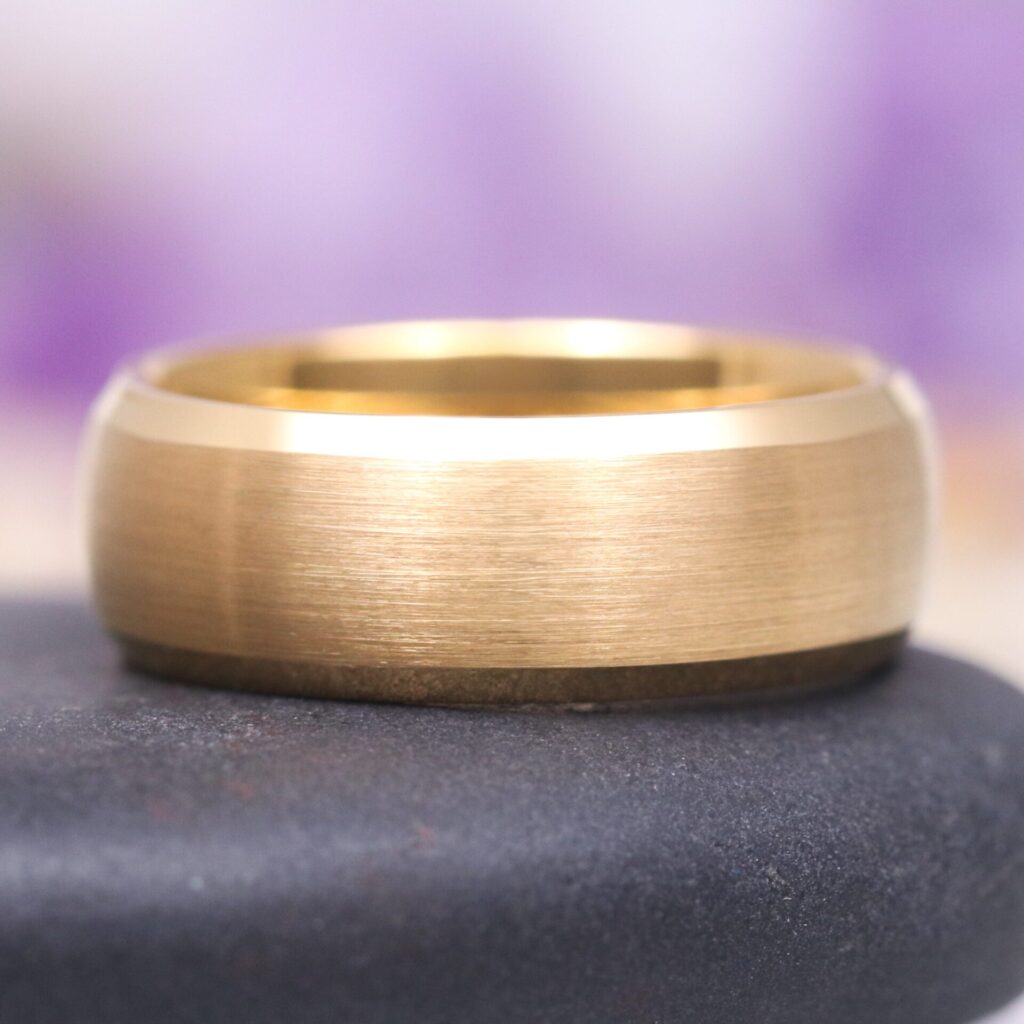
A beveled edge softens the visual weight of a wide band by breaking one broad surface into three narrower ones.
Profile changes apparent width
An eight millimeter flat band and an eight millimeter domed band measure identically and do not look it. The flat band presents its full width as one uninterrupted plane, so it reads wide. The domed band curves away at the edges, so the eye registers a narrower highlight running down the center. Beveling splits the difference by dividing the surface into planes. If a width you like looks too heavy in photographs, changing the profile rather than the measurement is usually the fix.
How profile interacts with finish
Flat profiles suit brushed and satin surfaces, because a large flat plane in high polish becomes a mirror and shows everything. Domed profiles carry polish well, since the curve keeps reflections moving. Hammered textures work on almost anything but are at their best on domed and wide flat bands where there is room for the pattern to develop. Studios that photograph both the profile drawing and the finished surface, as Aquamarise does across its band listings, make this pairing far easier to judge remotely.
What daily life does to each shape
Flat bands with crisp edges show contact along those edges first, which some men like as a record of wear and others do not. Domed bands distribute contact across the curve, so change appears gradually and evenly. Beveled bands wear at the angles. Chevron and faceted profiles hide contact best of all, because the surface is already broken up. None of these are failures. They are simply different ways of aging, and it is worth knowing which one you are choosing.
A practical way to decide
- Start with how the ring should feel, not look. Wide and comfortable means a curved interior. Narrow and precise can tolerate anything.
- Then pick the outer profile for the look you want. Soft and traditional is domed; sharp and modern is flat or beveled.
- Match the finish last. The finish should serve the profile, not compete with it.
Where profile variety actually exists
Mainstream retailers usually offer domed as standard and flat as an alternative, and that is the end of it. The interesting profile work sits with smaller makers, where a range of handcrafted men’s wedding bands will often carry chevron, beveled, and stepped variants alongside the familiar two. Since profile is the specification that most affects comfort, having genuine options there is worth more than another metal choice.
The measure of a good profile
A well chosen profile is one you stop registering. Rings can cause discomfort because of their shape, fit, or material, including sensitivity to certain metals. Get the cross section right and the rest of the decisions become matters of preference rather than tolerance.
Other Articles You May Find of Interest...
- Comfort Is a Design Decision: How Profile Shape Changes the Way a Ring Wears
- What’s Inside the Smelling Salts on Every Hockey Bench
- What Fresh Flowers Do for a Room (and a Mood), and How to Keep a Bouquet Alive Twice as Long
- Do Bed Bugs Bleed? The Stains on Your Sheets Explained
- How Shared Meals and Interactive Dining Can Create More Meaningful Social Gatherings
- Why Alcohol Makes You Sweat, and When to Worry
- How to Find Your Ancestors: Tools and Resources