






More Neurology Articles
Billy Joel’s Brain Disorder: His Normal Pressure Hydrocephalus Diagnosis and Health Update

Updated August 21, 2026
Quick answer: Billy Joel is alive. The 77-year-old singer has normal pressure hydrocephalus (NPH), an uncommon neurological condition in which cerebrospinal fluid builds up in the brain’s ventricles and can interfere with walking, balance, thinking and bladder control. He announced the diagnosis in May 2025 and canceled all scheduled concerts on medical advice.
More than a year after the announcement, Joel’s limited return to the stage and his family’s 2026 update offer a clearer—though still incomplete—picture of his health. His diagnosis also drew attention to an often-missed condition just as a major clinical trial strengthened the evidence that shunt treatment can improve mobility in carefully selected patients. That makes his story more than a celebrity update: it is an opportunity to explain which symptoms should not be dismissed as normal aging.
There have since been encouraging signs, but no announcement that his condition has resolved. Joel made a brief, two-song appearance in January 2026, attended a tribute concert at Carnegie Hall in March, and his daughter Alexa Ray Joel said that month that he was regularly attending physical therapy and “doing great.” As of August 21, 2026, however, his official tour page lists no upcoming dates.
The distinction matters: a short guest performance is not the same as a full tour or medical clearance to resume one. Joel’s complete treatment plan, whether he has undergone shunt surgery, and his individual prognosis have not been made public.
What Happened to Billy Joel?
Public concern about Billy Joel’s health grew after he postponed concerts and later disclosed a brain disorder. Here is the confirmed timeline:
- February 22, 2025: Joel played what remains his most recent full concert, at Mohegan Sun Arena in Connecticut, according to his official tour history. Video showed him falling during the show, but neither Joel nor his medical team publicly identified that fall as the cause of NPH.
- March 11, 2025: Joel’s official website announced a four-month tour postponement so that he could recover from “recent surgery” and undergo physical therapy. The statement did not identify the operation or connect it to NPH.
- May 23, 2025: Joel announced his NPH diagnosis and canceled every scheduled concert, including dates that had been moved into July 2026. His team said performances had aggravated the condition and contributed to hearing, vision and balance problems. Doctors advised him to stop performing while he received targeted physical therapy.
- July 2025: Joel told the public that he felt generally well but still had significant balance trouble. He also said the condition was still being treated and that he did not know what caused it. The Associated Press reported his reassurance that he was “OK,” not deathly ill.
- January 2, 2026: Joel made a surprise appearance with the tribute band Turnstiles in Wellington, Florida. He played two songs while seated at the piano, marking his first public performance since disclosing the diagnosis.
- March 12, 2026: He attended The Music of Billy Joel tribute at Carnegie Hall but did not perform. In an interview published that day, Alexa Ray Joel said he was doing physical therapy regularly and “doing great”.
- August 21, 2026: No new Billy Joel tour has been announced. His official site still carries the cancellation notice and does not list upcoming shows.
This timeline also corrects a common online assumption: Billy Joel did have an unspecified operation before announcing NPH, but there is no public confirmation that it was brain surgery, a shunt procedure or treatment for NPH. Those details should not be filled in through speculation.
What Brain Disorder Does Billy Joel Have?
Billy Joel’s disclosed diagnosis is normal pressure hydrocephalus. It is a form of hydrocephalus that most often affects adults over 60.
It is not the same as brain cancer, and neither Joel’s official announcement nor credible subsequent updates have said that he has brain cancer or suffered a stroke. NPH can sometimes develop after a brain hemorrhage, head injury, infection, tumor or surgery, but in many patients no cause can be identified. Joel has said that doctors had not established what caused his case.
NPH is also different from the forms of congenital hydrocephalus that begin before or around birth. It develops later in life and produces a different pattern of symptoms.
What Is Normal Pressure Hydrocephalus?
Cerebrospinal fluid, or CSF, is a clear liquid that cushions the brain and spinal cord, carries nutrients and helps remove waste. The body continually produces and reabsorbs it. Inside the brain, CSF travels through connected cavities called ventricles.
In NPH, the normal movement or absorption of CSF becomes disrupted. Fluid accumulates, the ventricles enlarge and nearby brain tissue can be affected. Calling it “excess spinal fluid” is understandable, but cerebrospinal fluid is the more accurate term because the same fluid surrounds both the brain and spinal cord.
According to the National Institute of Neurological Disorders and Stroke, NPH commonly causes problems with walking, bladder control, thinking and reasoning. It is considered uncommon, although specialists believe it is also underrecognized because its symptoms can be mistaken for aging, Parkinson’s disease, Alzheimer’s disease or another cause of dementia.
Why Is It Called “Normal Pressure” Hydrocephalus?
The name sounds contradictory: how can extra fluid affect the brain if pressure is normal?
The answer is that pressure may be normal when it is measured during a spinal tap, even though the ventricles remain enlarged and pressure can fluctuate over time. “Normal pressure” does not mean the fluid buildup is harmless, nor does it mean every measurement is always normal. The Hydrocephalus Association’s NPH overview explains that enlarged ventricles may occur with little or no sustained increase in intracranial pressure.
What Symptoms Did Billy Joel Report?
Joel’s team publicly identified three problems:
- Balance difficulty
- Hearing problems
- Vision problems
Joel later spoke most specifically about his balance, describing a persistent unsteady sensation. His representatives have not said that he developed memory loss, dementia or urinary incontinence. Those are recognized NPH symptoms in the general population, but they should not be attributed to him without confirmation.
Likewise, hearing and vision changes were part of Joel’s personal health announcement, but they are not the classic three-symptom pattern doctors use to recognize NPH. A person can have several health issues at once, so only his clinicians can determine how each symptom relates to his diagnosis.
Anyone who develops persistent changes in movement, sensation, coordination or thinking should seek an evaluation rather than assuming the cause. Our guide to recognizing early signs of neurological disorders explains why patterns and progression matter.
What Are the Three Classic Symptoms of NPH?
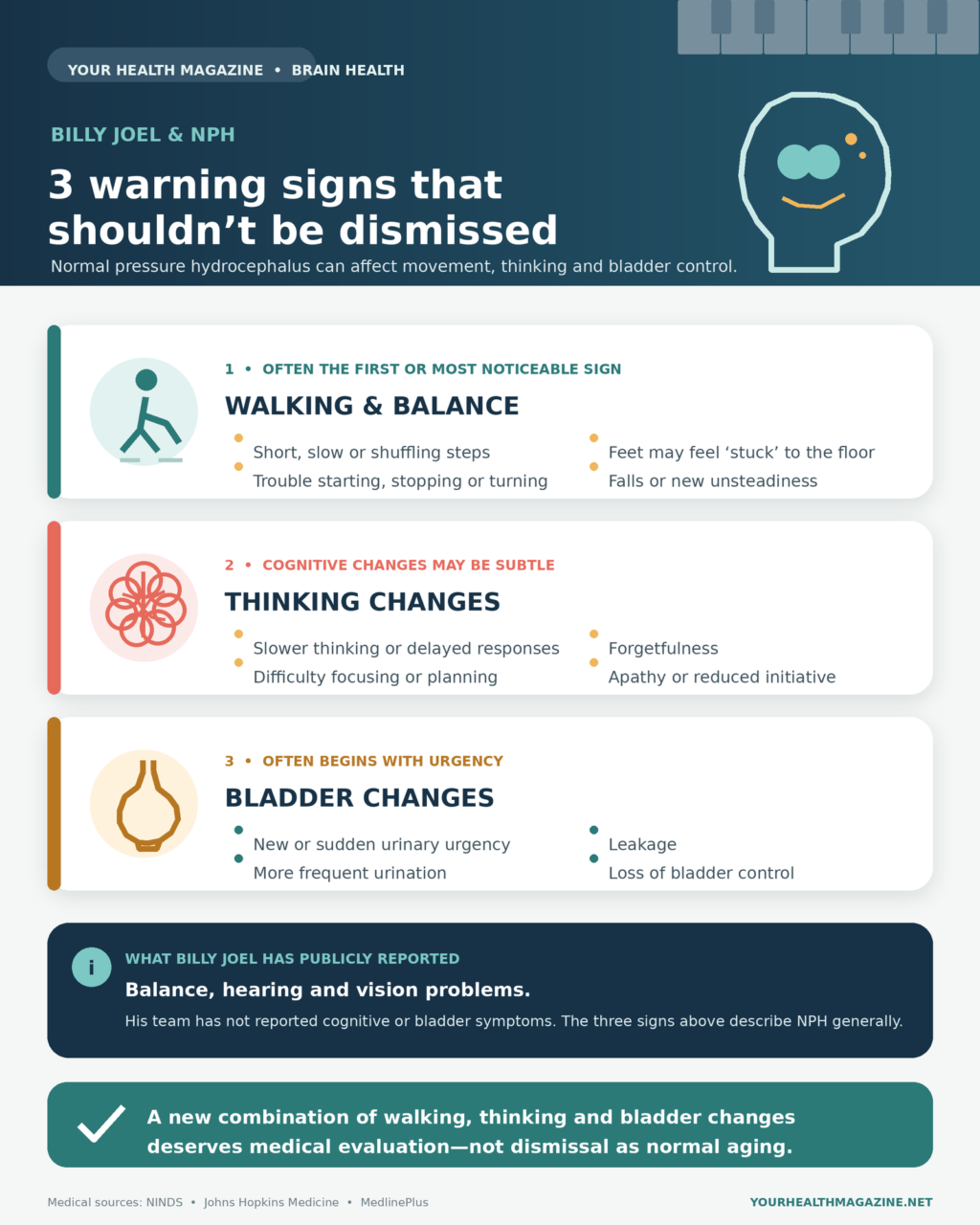
Doctors often look for a cluster known as the Hakim-Adams triad. A person does not need to have all three symptoms at the same time, and they may emerge in different orders.
1. Walking and Balance Problems
Gait disturbance is often the first or most noticeable feature. A person may:
- Take short, slow or shuffling steps
- Have difficulty starting to walk
- Feel as though the feet are stuck or “magnetized” to the floor
- Walk with the feet farther apart for stability
- Struggle to turn or change direction
- Lose balance or fall
These changes can be mistaken for arthritis, weakness, Parkinson’s disease or ordinary aging. New or worsening unsteadiness deserves medical attention, and practical steps to reduce fall risk in older adults can help protect someone while the cause is being investigated.
2. Changes in Thinking
NPH may cause slowed thinking, reduced attention, difficulty planning, apathy, forgetfulness or delayed responses. The pattern can resemble dementia, but it is not automatically Alzheimer’s disease.
That distinction is one reason NPH is so important to identify: some dementia-like symptoms may improve when the fluid problem is treated. Families who notice a sustained decline can also review when memory changes warrant a conversation with a doctor.
3. Urinary Urgency or Incontinence
Bladder changes may begin as frequent or sudden urges to urinate and can progress to leakage or loss of control. Urinary symptoms are common in older adults and have many possible causes, so they are most suggestive of NPH when they appear alongside a changing gait or cognitive difficulties.
What Causes NPH?
NPH is generally divided into two categories:
- Idiopathic, or primary, NPH: No single cause is found. This is common in older adults with NPH.
- Secondary NPH: The condition follows a known event or illness, such as a subarachnoid hemorrhage, head trauma, meningitis or another brain infection, a tumor, or certain brain operations.
Nothing in Joel’s public record establishes which category applies to him. Although his official statement said concert performances exacerbated his condition, that means they worsened symptoms or made them harder to manage; it does not mean performing caused NPH. His earlier fall, previous alcohol use and unspecified March 2025 surgery also should not be presented as causes without medical confirmation.
How Is Normal Pressure Hydrocephalus Diagnosed?
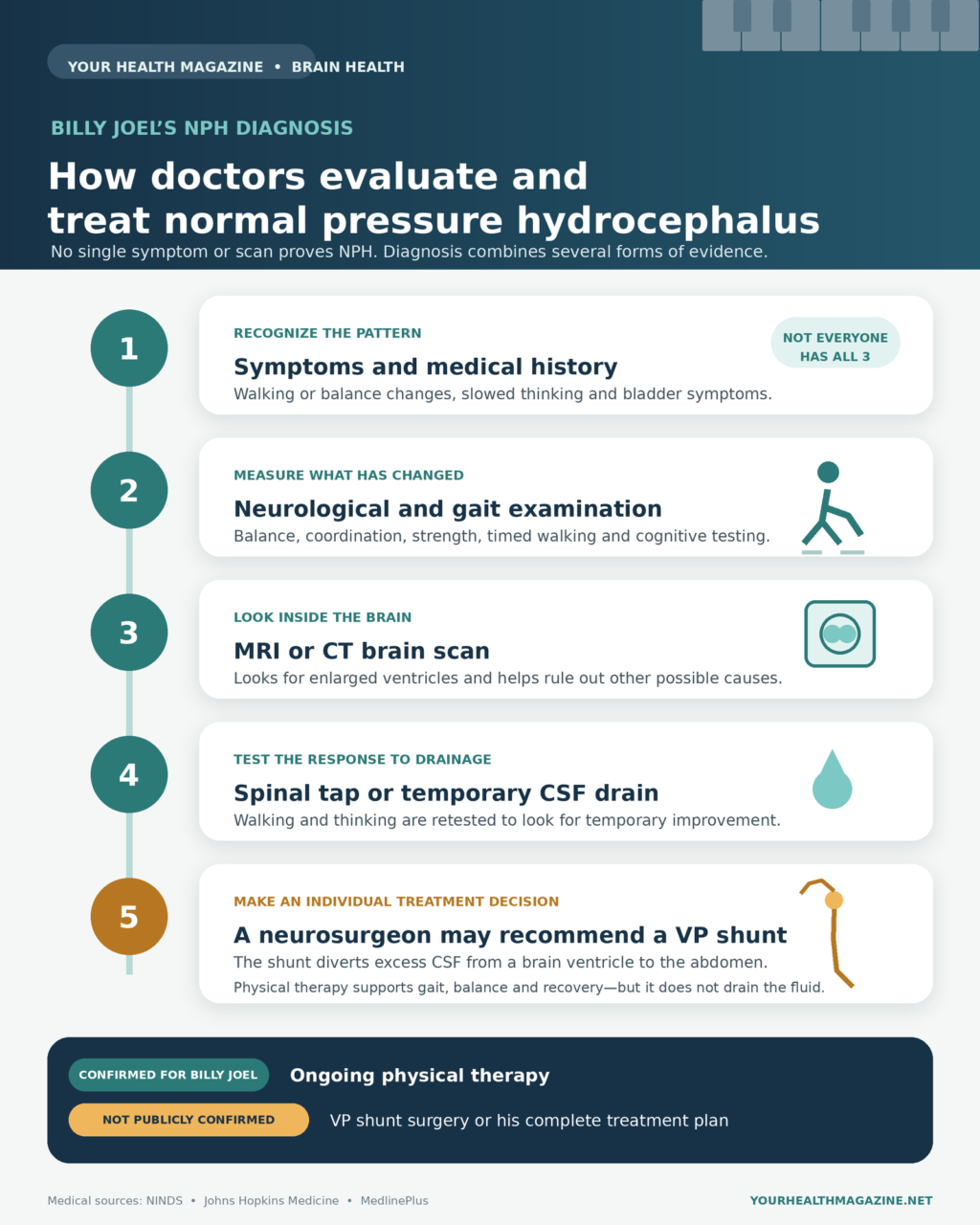
There is no single symptom or scan that proves NPH by itself. Diagnosis usually combines several forms of evidence.
Medical History and Neurological Examination
A clinician asks when walking, thinking and bladder symptoms began, how quickly they changed and how they affect daily life. The examination commonly includes gait, balance, strength, reflexes, coordination and cognitive testing. Timed walking tests may provide an objective baseline.
Brain Imaging
MRI or CT imaging can show enlarged ventricles and help doctors look for other explanations, such as a tumor, stroke, bleeding or brain shrinkage. Enlarged ventricles alone do not establish NPH; the imaging must fit the symptoms and clinical history.
Patients preparing for this part of an evaluation may find our comparison of MRI versus CT for brain imaging helpful.
Cerebrospinal Fluid Drainage Testing
In a large-volume lumbar puncture, often called a tap test, a clinician removes a measured amount of CSF and repeats gait or cognitive testing. Temporary improvement can suggest that a patient may benefit from a permanent shunt.
If the result is uncertain, a specialist may recommend several days of external lumbar drainage or other tests of CSF flow and pressure. The Johns Hopkins NPH guide describes the combination of gait assessment, imaging, spinal tap and temporary drainage that may be used.
Ruling Out Similar Conditions
Parkinson’s disease, Alzheimer’s disease, Lewy body dementia, medication effects, spinal disease, inner-ear disorders and several other conditions can produce overlapping symptoms. Some patients have NPH and another neurological disorder at the same time. That is why evaluation by a neurologist and, when shunting is being considered, a neurosurgeon or specialized hydrocephalus center can be valuable. Our overview of when a neurosurgical consultation may be appropriate includes hydrocephalus among the conditions specialists assess.
How Is NPH Treated?
The main treatment for an appropriate surgical candidate is placement of a shunt. The most common type is a ventriculoperitoneal, or VP, shunt: a thin tube drains CSF from a brain ventricle to the abdomen, where the body absorbs it. A valve controls the flow, and many modern valves can be adjusted without another operation.
Shunting does not help every patient, which is why careful diagnosis and drainage-response testing matter. Potential complications include infection, bleeding, overdrainage, a subdural hematoma, blockage or mechanical failure. Some people later need the valve adjusted or the shunt revised.
The evidence for carefully selected patients became stronger in 2025. In a placebo-controlled trial involving 99 adults with idiopathic NPH, patients whose implanted shunts were turned on had better walking speed and balance and reported fewer falls than those whose shunts initially remained at a placebo setting. Johns Hopkins summarized the trial and its results, which were published in The New England Journal of Medicine.
What Role Does Physical Therapy Play?
Physical therapy can address gait, strength, balance, safe transfers and fall prevention. It may be used before or after surgery and can help a person function more safely during evaluation or recovery. Our broader guide to physical therapy for balance and mobility explains these rehabilitation goals.
However, physical therapy does not remove accumulated CSF or replace a shunt when surgery is medically indicated. In Joel’s case, physical therapy is the only NPH-related treatment his team has specifically confirmed.
Did Billy Joel Have Surgery for NPH?
It has not been publicly confirmed.
Joel’s March 2025 announcement said he was recovering from recent surgery, but it did not name the procedure. His NPH diagnosis was disclosed more than two months later. No official statement has said that the earlier operation involved his brain, placed a shunt or treated hydrocephalus.
It is therefore accurate to say:
- Billy Joel underwent an unspecified operation before the NPH announcement.
- He has been receiving physical therapy.
- His doctors advised him to stop performing during recovery.
It is not accurate to report that he received a VP shunt unless he or an authorized representative confirms it.
Can NPH Be Cured or Reversed?
NPH is often described as treatable and potentially reversible, particularly compared with progressive neurodegenerative diseases. Those words do not guarantee a full recovery.
According to MedlinePlus, walking is the symptom most likely to improve after surgery. Thinking and bladder control may also improve, but results vary. A shorter duration of symptoms, milder impairment and a positive response to temporary CSF drainage may be associated with better outcomes.
Without effective treatment, symptoms can progress and lead to falls, loss of independence and worsening cognitive disability. Even after successful shunting, long-term follow-up is important because a shunt can become blocked, infected or require adjustment.
What Is Billy Joel’s Prognosis?
Only Joel’s medical team can answer that question for him. Public reports offer reasons for cautious optimism: he has continued therapy, made two public appearances in early 2026 and received a positive update from his daughter. But none of those facts reveals his scan results, response to CSF drainage, surgical candidacy or long-term outlook.
It would be equally misleading to describe him as cured, dying or certain to return to touring. The evidence supports a narrower conclusion: he is alive, actively managing NPH and has shown enough improvement to make limited public appearances, while his full medical status remains private.
Is Billy Joel Dead?
No. Billy Joel is alive as of August 21, 2026. Search confusion appears to be driven by the cancellation of his concerts and alarming references to a “brain disorder,” not by a credible report of his death. His January performance and March Carnegie Hall appearance both occurred after he disclosed NPH.
Is Billy Joel Still Performing, and Will He Tour Again?
Joel has performed only one brief public set since announcing NPH: two songs with a tribute band on January 2, 2026. He attended the Carnegie Hall tribute in March but remained in the audience.
His official May 2025 statement said he hoped to take the stage again one day, but it gave no timetable. As of August 21, 2026, his canceled tour has not been reinstated and no new dates appear on his official tour page. Whether he can manage the travel, rehearsals and physical demands of a full concert schedule will depend on his recovery and doctors’ advice.
When Should Someone Be Evaluated for Possible NPH?
Contact a healthcare provider when an older adult develops a gradual but persistent change in walking or balance—especially when it occurs with new cognitive or bladder-control problems. Bring a timeline of symptoms, a medication list, reports of falls and observations from family members. Video of the person walking at different points in time may also help clinicians understand the change.
Do not assume a sudden neurological change is NPH. New facial drooping, one-sided weakness, inability to speak, abrupt vision loss, a severe sudden headache or acute confusion requires emergency evaluation because stroke, bleeding and other urgent conditions must be considered.
The Bottom Line
Billy Joel’s brain disorder is normal pressure hydrocephalus, not a publicly reported cancer or stroke. The condition results from an abnormal buildup of cerebrospinal fluid in enlarged brain ventricles and most often affects older adults. Its hallmark warning signs are worsening gait, cognitive slowing and bladder dysfunction.
NPH is serious, but it is also one of the few causes of dementia-like symptoms that may improve substantially with the right diagnosis and treatment. Joel’s experience should not be used to guess at private medical details. It can, however, bring attention to a useful health message: new balance problems, a changing walk or a combination of mobility, memory and urinary symptoms should not automatically be dismissed as normal aging.
Other Articles You May Find of Interest...
- How to Read a Nerve Conduction Study Report
- Can a Tissue Paper Test Detect a CSF Leak?
- What Does Cerebrospinal Fluid Taste Like During a CSF Leak?
- Cervical Laminectomy: A Complete Guide to This Spinal Decompression Surgery
- Why Concussion Symptoms Can Look Different From Person to Person
- The Crushing Fatigue of ALS
- Complex Partial Seizures: Managing Focal Awareness Loss





