






More Kratom Education Articles
Green Malay Kratom Effects: Why This Popular Kratom Strain Stands Out

Most products labeled “Green Malay kratom” do not actually originate from Malaysia. This is not a disputed claim — it is broadly acknowledged among kratom researchers, importers, and industry professionals. Malaysia has significantly restricted kratom exports, making large-scale legal commercial supply from that country to the U.S. market practically impossible. Yet the name continues to appear on product labels across the market.
Understanding what consumers are actually purchasing matters. The kratom market is largely unregulated, which means the burden of informed decision-making falls almost entirely on the buyer. Understanding how strain names function — and how frequently they diverge from geographic reality — is an important first step toward making better purchasing decisions.
This article examines Green Malay kratom from all relevant perspectives: its botanical background, alkaloid research, processing factors, market realities, and what safety-conscious consumers should be looking for.
Important Notice: Kratom is not approved by the FDA. It may cause physical dependence, may interact with prescription and over-the-counter medications, and carries health risks that are not yet fully understood. Anyone considering kratom use should consult a qualified healthcare provider before doing so.
What Is Green Malay Kratom?
Green Malay kratom is a green vein kratom product historically associated with Mitragyna speciosa leaf from Malaysia.
The “green vein” designation refers to the color of the leaf’s central vein at the time of harvest. Green vein leaves are collected at a mid-maturity stage — after white vein harvests but before leaves reach the later stage associated with red vein products.
“Malay” implies Malaysian origin — or at least, that is what the name suggests.
In practice, most Green Malay kratom available in the U.S. today is sourced from Indonesia, primarily from Borneo, Sumatra, or Sulawesi. Indonesian farmers and exporters commonly cultivate and label products to match demand for well-known strain names, regardless of whether the geographic designation is accurate.
Why the Name Creates Confusion
The term “Green Malay” creates a specific expectation of leaves grown on Malaysian soil, along with whatever regional growing characteristics that implies.
Malaysian kratom law complicates that picture considerably. The Poisons Act of 1952 classifies kratom as a controlled substance in Malaysia, making legal commercial exports virtually nonexistent. Some cross-border trade does occur, but it is nowhere near sufficient to supply U.S. consumer demand.
This means the strain name has become functionally independent of its geographic origin. Vendors continue using “Green Malay” because consumers recognize and search for it. It now functions as a brand convention rather than a sourcing guarantee. For buyers, this highlights the importance of finding out where a product actually comes from — not just what it is called.
Key Characteristics of Green Malay Kratom
Green Malay has developed its own market identity, distinct from its geographic name.
Most vendors and consumers describe it in terms of the following characteristics:
- Leaf size: Green Malay is frequently associated with larger-than-average Mitragyna speciosa leaves, which some producers claim contributes to higher alkaloid density
- Powder color: Ranges from light to dark green depending on drying method
- Alkaloid profile: Moderate to high mitragynine content with a balanced secondary alkaloid ratio, as frequently cited by users
- Texture: Finely milled across all consumer formats; both loose powder and capsules are widely available
- Actual origin: Most likely Indonesian islands, despite the Malaysian designation
The “large leaf” narrative is among the most commonly repeated claims about Green Malay. Whether this characteristic produces a meaningfully different alkaloid profile is a matter that varies from batch to batch and has not been confirmed consistently by independent laboratory results across different manufacturers.
Understanding Alkaloids and Composition
Kratom’s pharmacological interest centers on two primary alkaloids: mitragynine and 7-hydroxymitragynine.
Mitragynine typically accounts for approximately 60–70% of total alkaloid content in most kratom powders. It is the dominant compound and the most extensively studied in pharmacological research. 7-Hydroxymitragynine is a minor alkaloid by weight but has received significant scientific attention due to its potency relative to its concentration.
Beyond these two, kratom contains more than 40 identified alkaloids, including speciogynine, paynantheine, speciociliatine, and corynantheidine. The alkaloid profile of Green Malay does not differ categorically from other green vein products. However, differences in leaf maturity, harvest conditions, and processing can produce significant batch-to-batch variation.
Soil composition, altitude, and seasonal variation all influence the alkaloid profile of a given harvest. This is why batch-specific laboratory testing is essential — regardless of the strain name on the label.
Processing, Harvesting, and Quality Factors
Post-harvest handling has a significant impact on what ends up in a bag of Green Malay kratom powder.
After hand harvesting, leaves are generally:
- Cleaned and washed to remove surface contaminants
- Dried outdoors in sunlight, indoors with controlled airflow, or under UV lighting
- De-stemmed and de-veined to isolate leaf material
- Milled into powder using industrial grinding equipment
- Packaged with varying degrees of quality assurance
Indoor drying generally preserves a more consistent alkaloid profile by limiting UV-related degradation. Sun drying can accelerate certain alkaloid conversions but also introduces more variability.
Grinding quality affects surface exposure and influences how quickly a product reacts to air and moisture during storage. Packaging matters as well — oxygen barrier seals preserve alkaloid integrity longer than standard plastic bags.
None of this is visible on a product label. This is why GMP-certified vendors with documented manufacturing processes offer a meaningful quality advantage over undocumented sources.
Green Malay Kratom vs Other Popular Strains
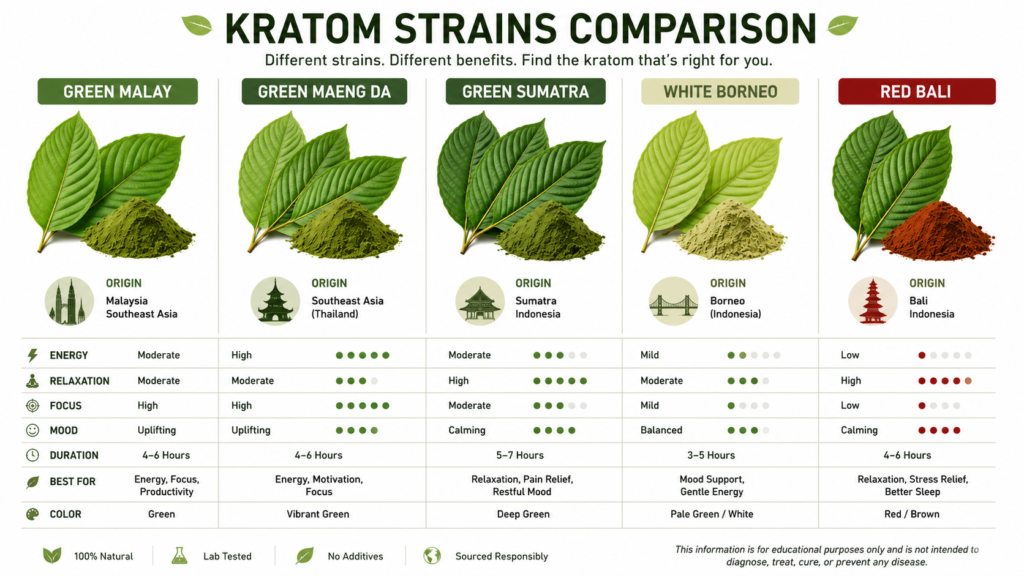
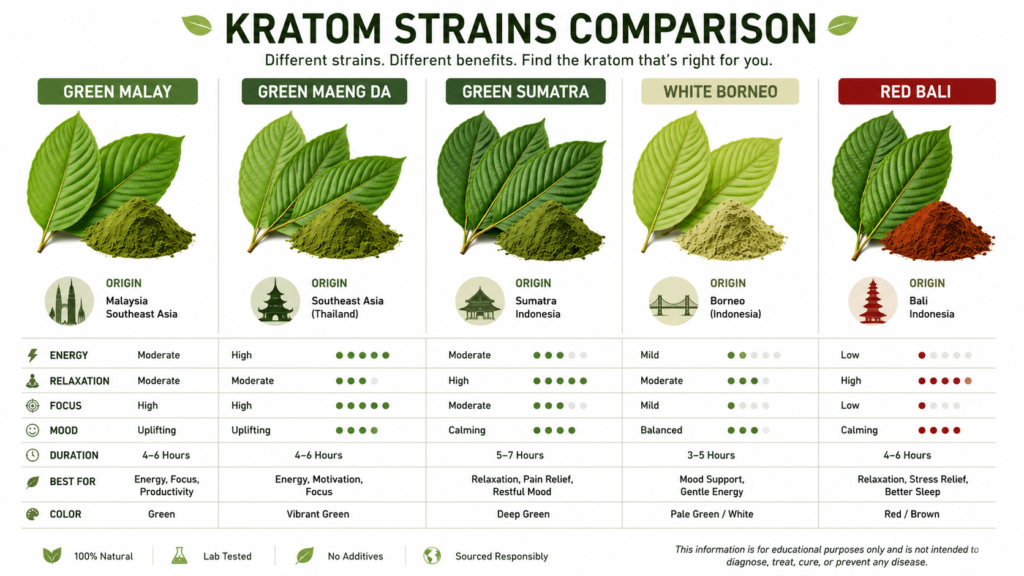
| Strain | Common Description | Key Characteristics | Important Limitation |
| Green Malay | Mid-maturity green vein with Malaysian origin claim | Large leaves, moderate to high mitragynine | Most supply is Indonesian; geographic claim is largely a naming convention |
| Green Maeng Da | “Premium” green vein with no geographic claim | Moderate alkaloid profile, widely available | “Maeng Da” is a quality label, not a botanical classification |
| White Borneo | Early-harvest white vein from Borneo | Lower mitragynine at early maturity, lighter powder color | White vein designation is inconsistent across processing methods |
| Red Bali | Late-harvest red vein associated with Bali | Higher alkaloid density in some batches | Bali origin is frequently overstated; most supply comes from broader Indonesia |
| Green Sumatra | Green vein from the Sumatran region | Similar alkaloid range to Green Malay | Strain naming overlap between vendors is common |
Traditional Background and Modern Market Usage
Mitragyna speciosa has deep roots in Southeast Asian culture. In Malaysia, Thailand, and Indonesia, kratom leaves were traditionally chewed fresh or prepared as tea. People engaged in physically demanding work incorporated kratom into their daily routines across generations.
Green Malay specifically was recognized in traditional Malaysian use in connection with the characteristics of its leaf form.
The modern U.S. kratom market has transformed this product from a traditional plant into a standardized powder commodity. Green Malay is now available from numerous vendors in capsule, powder, and extract formats. The American Kratom Association (AKA) estimates that between 10 and 16 million Americans have used kratom. Green vein varieties are among the most widely marketed and discussed product categories.
AKA GMP certification has become the closest available approximation of an industry quality standard. Certified vendors undergo audits covering testing procedures, sanitation practices, labeling requirements, and supply chain documentation.
What Consumers Commonly Report
Forums, surveys, and consumer reviews present a relatively consistent picture of Green Malay kratom’s position in the market.
It is frequently associated with:
- A reported mid-range experience relative to white and red vein products
- Longer-lasting effects compared to some other green vein varieties, according to user accounts
- Preference among consumers who find white vein products too stimulating
- Regular use in capsule format for consistency
A 2023 Pain News Network kratom survey found that green vein strains account for a significant portion of overall kratom use, with Green Malay consistently appearing as one of the most searched and purchased strains in that category.
These are self-reported consumer observations. No clinical evidence supports them, and no kratom product has received FDA authorization for any medical use.
Safety and Regulatory Considerations
Third-Party Testing
Reputable kratom vendors should provide batch-specific Certificates of Analysis (COAs) from credible, independent laboratories. These should include mitragynine and 7-hydroxymitragynine percentages, heavy metal screening (lead, mercury, arsenic, cadmium), microbial contamination testing (salmonella, E. coli), and pesticide residue panels.
Manufacturing Standards
AKA GMP-certified vendors adhere to documented manufacturing guidelines covering facility sanitation, equipment calibration, staff training, product traceability, and complaint procedures. This certification is currently the most significant third-party quality indicator available in the U.S. kratom market.
Label Transparency
Compliant labels should include batch number, product weight, alkaloid content where available, manufacturer contact information, and serving information. Batch COAs should correspond to the product packaging.
Legal Considerations
Kratom is legal at the federal level in the United States but is prohibited in Alabama, Arkansas, Indiana, Rhode Island, Vermont, and Wisconsin, with additional local restrictions in certain cities and counties. Internationally, Malaysia restricts kratom domestically. Thailand approved it in 2021 under specific conditions. Current laws in the relevant jurisdiction should always be verified before purchasing.
Common Misconceptions About Green Malay Kratom
Myth: Green Malay kratom is sourced from Malaysian farms.
Fact: Due to Malaysia’s domestic kratom restrictions, commercial supply reaching U.S. consumers from Malaysia is nearly nonexistent. Most products labeled Green Malay are sourced from Indonesia.
Myth: The large-leaf characteristic associated with Green Malay guarantees higher potency.
Fact: Leaf size is only one of many variables influencing alkaloid density. Soil conditions, harvest timing, and drying techniques all carry equal or greater influence. Leaf size is not a reliable potency indicator.
Myth: Green Malay is a distinct botanical variety with unique genetics.
Fact: No established genetic distinction exists between “Green Malay” and other Mitragyna speciosa leaf varieties. The name reflects a market convention, not a distinct cultivar or species.
Myth: All green vein kratom varieties produce the same effects.
Fact: While all green vein products share mid-maturity harvest characteristics, differences in alkaloid profiles across growing regions, processing methods, and individual batches produce tangible variation. Consumer reports consistently reflect this.
Frequently Asked Questions
Where does Green Malay kratom actually originate?
Despite the name, most Green Malay kratom sold in the U.S. is sourced from Indonesia — primarily Borneo, Sumatra, or Kalimantan. Malaysia’s Poisons Act restricts kratom domestically, making large-scale legal exports practically impossible. Indonesian producers cultivate and label kratom to meet Western demand for recognized strain names. When purchasing, look for vendors who disclose the actual country and region of origin — ideally with supply chain documentation or transparency disclosures — rather than relying on the strain name alone.
What distinguishes Green Malay from other green vein kratom varieties?
Green Malay’s primary market distinction is its association with larger leaf size and a reported longer effect window compared to some other green vein products. However, these attributes are not consistently confirmed across laboratories or vendors. Chemically, Green Malay shares the same general alkaloid structure as other green vein products — mitragynine as the dominant alkaloid, with secondary compounds present in varying ratios. Actual differences between batches depend more on growing conditions, harvest timing, and processing than on the strain label.
What alkaloids are present in Green Malay kratom powder?
The primary alkaloids are mitragynine and 7-hydroxymitragynine, consistent with all Mitragyna speciosa products. Mitragynine is the most abundant, comprising the majority of alkaloid content. Beyond these two, Green Malay contains additional alkaloids including speciogynine, paynantheine, speciociliatine, and corynantheidine. Exact ratios vary by batch based on environmental and processing factors. A batch-specific COA from an accredited laboratory is the most reliable means of determining the actual alkaloid content of a specific product.
What certifications should I look for when purchasing Green Malay kratom?
The AKA’s Good Manufacturing Practice (GMP) program is the most recognized quality certification currently available in the U.S. kratom market. AKA GMP-certified vendors undergo facility audits and must follow documented standards for sanitation, testing, and labeling. Beyond certification, look for vendors who provide batch-specific COAs from ISO-accredited independent laboratories — not internal company tests. COAs should cover alkaloid levels, heavy metals, pesticides, and microbial contamination.
Is Green Malay kratom legal where I am located?
Kratom’s legal status varies by location. At the federal level in the U.S., it is legal. However, it is prohibited in Alabama, Arkansas, Indiana, Rhode Island, Vermont, and Wisconsin, with additional city and county-level restrictions in various other states. Outside the U.S., kratom is banned or regulated in a number of countries, including Malaysia, Australia, and several European nations. Thailand approved limited kratom use in 2021. Legal status can change, so verifying current state and local regulations before purchasing is always recommended.
The Bottom Line
Green Malay kratom is one of the most widely purchased kratom products in the U.S. market. However, the name carries geographic implications that do not accurately reflect supply chain reality. Most products sold under this label originate from Indonesia, not Malaysia. This does not necessarily indicate a lower-quality product, but it does mean the naming convention is misleading.
What matters is how a product is sourced, how it is tested, and whether the vendor adheres to transparent manufacturing standards. Batch-specific COAs, AKA GMP certification, and accurate origin disclosures are far more informative quality indicators than any strain name.
Kratom remains in a regulatory gray area. No kratom product has received FDA approval. Legal status varies by state and country. Anyone considering kratom use should research the applicable laws in their jurisdiction and consult a qualified healthcare provider before proceeding.
Kratom is not FDA-approved. It may cause dependence, may interact with medications, and carries risks that are not yet fully understood by medical science. Readers are strongly encouraged to consult a qualified healthcare provider before using kratom in any form.
Other Articles You May Find of Interest...
- Kratom Legality in 2026: Why the Rules Vary by Location
- 7 Things to Know About Split Kilo Kratom Before a Bulk Order
- Red Thai Kratom: The Strain With a Complicated History and a Loyal Following
- Red Sumatra Kratom: What Makes This Strain Stand Apart
- Red Indo Kratom: The Strain That Built the Modern Kratom Market
- Red Hulu Kapuas Kratom: What Makes This Rare Strain So Talked About?
- Red Borneo Kratom: The Strain That Built the Modern Kratom Market





