Your Health Magazine Contributor
4201 Northview Drive
Suite 102
Bowie, MD 20716
More Workplace Health & Safety Articles
Workers Comp Doctor Near Me in Manhattan: Are Part-Time and Contract Workers Covered?
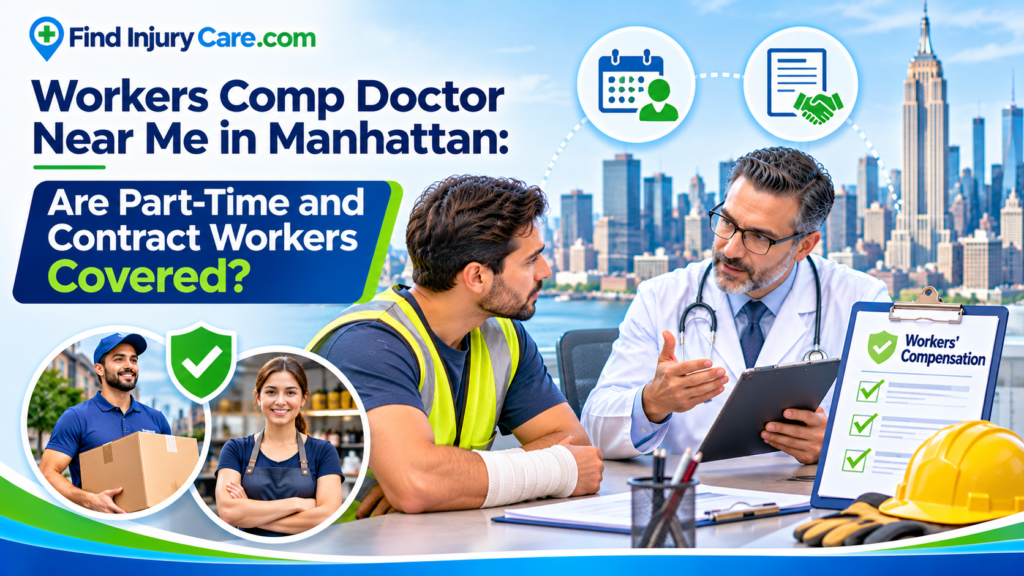
Workplace injuries do not only affect employees working full-time positions. Part-time staff, temporary workers, seasonal employees, and individuals hired through staffing agencies can also experience accidents while performing their professional responsibilities.
However, many workers are unsure whether they qualify for New York Workers’ Compensation when they are not employed under a traditional full-time arrangement. Some may receive hourly wages, others may work through staffing companies, and some may be classified as independent contractors.
For individuals searching for a workers comp doctor near me in Manhattan, understanding employment classification is an important part of navigating the healthcare process after a workplace injury. New York has specific rules concerning who qualifies as an employee and which businesses are responsible for providing Workers’ Compensation coverage.
Does Workers’ Compensation Cover Part-Time and Temporary Employees?
Yes. New York generally requires for-profit employers to maintain Workers’ Compensation insurance for employees, including those working part-time, full-time, temporary, seasonal, and casual or day-labor positions.
This means that working fewer hours or having a temporary employment arrangement does not automatically remove an individual’s eligibility for Workers’ Compensation benefits.
Consider an employee hired by a Manhattan hotel for seasonal work. During a scheduled shift, the employee experiences an injury while performing assigned duties. The fact that the position is seasonal does not automatically prevent the individual from qualifying for Workers’ Compensation.
Similarly, a part-time office employee working only a few days per week may still be considered an employee under New York law.
The New York State Workers’ Compensation Board explains these coverage requirements through its official Workers’ Compensation Coverage Guidance.
However, coverage eligibility depends on the actual employment relationship and applicable statutory requirements, not simply the job title or working schedule.
What Happens When You Work Through a Staffing Agency?
Temporary employment agencies and staffing companies are common in industries such as hospitality, administrative services, healthcare, events, and building operations.
In these arrangements, an employee may be recruited and hired by one organization but perform daily responsibilities at another company’s workplace.
For example, an administrative worker might be hired through a staffing agency and assigned to an office near Midtown Manhattan. If the employee experiences a workplace accident, questions may arise about which organization is responsible for the relevant employment and insurance arrangements.
New York recognizes leased employees within its Workers’ Compensation coverage requirements.
The Workers’ Compensation Board explains that coverage is required for leased employees. Depending on the Professional Employer Organization (PEO) arrangement, coverage may be provided through a policy maintained by the leasing firm in the client’s name or through a separate policy maintained by the client.
This is why workers in temporary and staffing arrangements should identify the relevant employer, staffing organization, and insurance information rather than assuming that the company where they physically work is automatically responsible for every aspect of the claim.
Are Independent Contractors Eligible for Workers’ Compensation?

The distinction between an employee and an independent contractor is particularly important in New York.
Some businesses classify workers as independent contractors, but the label used in an agreement or tax document does not necessarily establish their legal employment status.
The New York Workers’ Compensation Board considers several factors when evaluating whether an individual is genuinely operating an independent business or functioning as an employee.
These factors can include the level of control exercised over the work, the nature of the services performed, the worker’s independent business activities, and the applicable legal tests.
In construction, New York’s Construction Industry Fair Play Act creates a presumption that certain individuals performing services for a contractor are employees, unless the required independent-contractor criteria are satisfied.
For example, someone hired to perform roofing or building-related work may be treated as an employee for Workers’ Compensation purposes even if the arrangement describes the individual as a subcontractor.
Commercial goods transportation workers are also subject to a separate statutory test under New York’s Transportation Industry Fair Play Act.
These distinctions can matter when an injured individual is unsure whether a general contractor, subcontractor, staffing company, or another business is responsible for providing coverage.
The Board provides detailed explanations in its official Independent Contractor Identification Guide.
Why Employment Classification Matters When Seeking Medical Care
Understanding employment classification can help injured workers identify the appropriate Workers’ Compensation process and the relevant insurance information associated with their employment.
Before arranging non-emergency care through the system, employees should generally look for healthcare professionals authorized by the New York State Workers’ Compensation Board, subject to applicable exceptions and network arrangements.
The provider’s authorization status and ability to handle the particular Workers’ Compensation case should be confirmed before proceeding.
Employees should also keep their employer’s details, staffing agency information, insurance information, and relevant accident documentation accessible when communicating with a healthcare provider’s office.
If an employer or company disputes the individual’s employment status, that disagreement should not be treated as a final determination of eligibility without considering the applicable legal rules and facts.
What Should You Do After a Workplace Injury?
New York generally requires employees to notify their employer about a workplace injury within 30 days. Providing written notice as soon as possible is recommended.
Employees should also submit an Employee Claim, Form C-3, to the New York Workers’ Compensation Board. The Board generally requires this form within two years of the accident or within two years after the worker knew, or should have known, that an occupational condition was related to employment.
These are separate responsibilities. Notifying an employer does not automatically complete the employee’s claim filing with the Board.
The official New York Workers’ Compensation Claim Filing Guide explains the process and the information needed to submit Form C-3.
Finding a Workers’ Compensation Doctor in Manhattan
After understanding the employment and coverage circumstances, finding an appropriate healthcare provider becomes an important next step.
Manhattan has employees working across different industries, from office administration and hospitality to construction, building maintenance, healthcare, and transportation. Their medical needs and preferred provider locations may vary depending on their circumstances.
Injured employees can use provider directories and referral services to identify healthcare professionals who handle work-related injuries through New York Workers’ Compensation.
Individuals searching for a workers comp doctor near me can use the website to explore available provider information and submit a request based on their location and reported medical needs.
Whether someone works near Midtown, Financial District, Chelsea, Harlem, or the Upper West Side, the service provides a starting point for exploring potential healthcare provider connections.
WorkersCompDoctorNearMe.com operates as a provider connection service, not a medical clinic or healthcare practice. Medical evaluations, diagnoses, treatment recommendations, provider authorization, and appointment availability remain the responsibility of the independent healthcare professionals and other applicable parties.
Understanding Your Coverage Is an Important First Step

A workplace injury can raise important questions, particularly for employees working part-time, through temporary staffing arrangements, or under subcontracting agreements.
New York’s Workers’ Compensation rules recognize that employment relationships are not always straightforward. Understanding how worker classification and insurance coverage apply to an individual situation can help employees identify the appropriate next steps.
For Manhattan workers, exploring potential connections with an appropriate healthcare provider is an important part of addressing a workplace injury.
For example, workers seeking a workers comp doctor near me in Manhattan can explore provider-connection services alongside official New York Workers’ Compensation Board resources to identify appropriate medical care.
Disclaimer: This article is intended for general informational purposes only and does not constitute medical, legal, or insurance advice. Employment classification, Workers’ Compensation eligibility, insurance responsibility, and medical coverage depend on individual circumstances and applicable New York law.
Other Articles You May Find of Interest...
- Workers Comp Doctor Near Me in Manhattan: Are Part-Time and Contract Workers Covered?
- Remote Workers and Expats: The Health Risks That Follow The Job
- How Medical Evaluation Delays Extend Time Away From Work
- How to Become More Self-Aware at Work: A Guide for Healthcare Technology Professionals
- A Clearer View of Workplace Health and Safety: Choosing Welding Helmets and Lenses
- How Repetitive Desk Work Can Affect Joint and Muscle Comfort
- Staying Healthy While Building a Business Remotely