






More Workplace Health & Safety Articles
Operational Safety and Respiratory Protection Protocols in Healthcare Management

In an era defined by evolving environmental stressors and airborne biological threats, institutional healthcare management extends far beyond routine clinical workflows.
Protecting healthcare practitioners, administrative personnel, and vulnerable visitors requires a systematic approach to occupational health and environmental safety, serving as the cornerstone of operational resilience and patient care quality.
Regulatory Compliance and Respiratory Protection Frameworks
Regulatory bodies globally establish rigorous benchmarks to safeguard workers against occupational hazards.
In the United States, the OSHA Respiratory Protection Standard 29 CFR 1910.134 requires employers to establish comprehensive safety programs when employees face hazardous airborne contaminants.
Guidance from the CDC and NIOSH clarifies the technical parameters necessary to mitigate exposure risks. Compliance with these frameworks is a fundamental element of risk governance, liability management, and clinical continuity.
Identifying and Classifying Airborne Hazards in Facilities
Effective risk management requires facility administrators to systematically categorize hazards to implement tailored control strategies.
Biological Pathogen Transmission
Clinical settings frequently host aerosol-generating procedures (AGPs) like endotracheal intubation, bronchoscopy, and high-speed dental scaling, which break fluids into fine respirable droplets.
Unlike larger droplets that settle quickly, infectious aerosols remain suspended in ambient air currents and travel significant distances through ventilation systems.
Exposure to pathogens—including Mycobacterium tuberculosis, measles, and SARS-CoV-2—presents a continuous risk.
Containing these threats demands high-efficiency particulate filtration paired with specialized engineering controls like negative-pressure isolation rooms.
Ambient and Industrial Environmental Risks
Facilities also face non-biological particulate exposure. Seasonal wildfires introduce fine particulate matter (PM2.5) into outdoor air intakes, penetrating deep into the respiratory tract. Simultaneously, indoor building renovations generate mineral dust, crystalline silica, mold spores, and volatile organic compounds (VOCs). Vulnerable individuals, particularly pediatric patients and those with severe asthma, are highly susceptible to acute respiratory distress from these particulates.
| Hazard Category | Primary Source Examples | Impacted Facility Populations | Primary Engineering & PPE Mitigation Strategy |
|---|---|---|---|
| Aerosolized Biological Pathogens | Intubation, bronchoscopy, nebulizers, coughing, dental scaling | Clinical personnel, immunocompromised patients, visitors | High-filtration particulate respirators (N95/FFP2), negative pressure isolation |
| Fine Particulate Matter (PM2.5) | Seasonal wildfire smoke, urban industrial emissions, traffic exhaust | Geriatric residents, pediatric units, broad facility staff | High-efficiency indoor air filtration (HEPA), tight-sealing respirators during transit |
| Construction & Inert Dust | Structural renovations, drywall sanding, flooring repair | Facility maintenance teams, adjacent ward occupants | Containment barriers, negative-pressure dust extraction, elastomeric or N95 PPE |
| Volatile Organic Compounds (VOCs) | Paints, chemical disinfectants, industrial sealants | Laboratory staff, environmental services, general personnel | Local exhaust ventilation, active carbon filtration, chemical cartridge respirators |
Technical Specifications, Compliance, and Sourcing PPE
Devices designed for respiratory containment vary substantially in design and protective capability.
Standard surgical masks are loose-fitting devices providing barrier protection against large liquid splashes; they do not form a tight seal, allowing ambient air to bypass the filter medium.
Conversely, air-purifying respirators (APRs), such as N95s, provide high-efficiency particulate filtration and a tight facial seal, forcing incoming air through the filter media.
Verification and Regulatory Standards
Procurement divisions must enforce verification protocols to guard against counterfeit equipment. NIOSH certifies non-powered APRs according to strict metrics. An N95 designation indicates the filter captures at least 95% of non-oil airborne particles down to 0.3 microns. Authentic NIOSH-approved respirators feature distinct facepiece markings:
- The manufacturer’s name or registered trademark
- The approval number (e.g., TC-84A-XXXX)
- The filter designation (e.g., N95, N99, P100)
- The NIOSH name or logo
Respirators utilizing ear loops generally fail NIOSH N95 certification, as they cannot generate the required facial tension for a secure seal.
Implementing a Comprehensive Respiratory Protection Program
Procuring certified equipment is only one phase of risk management. Facilities must establish a written Respiratory Protection Program (RPP) overseen by a qualified administrator.
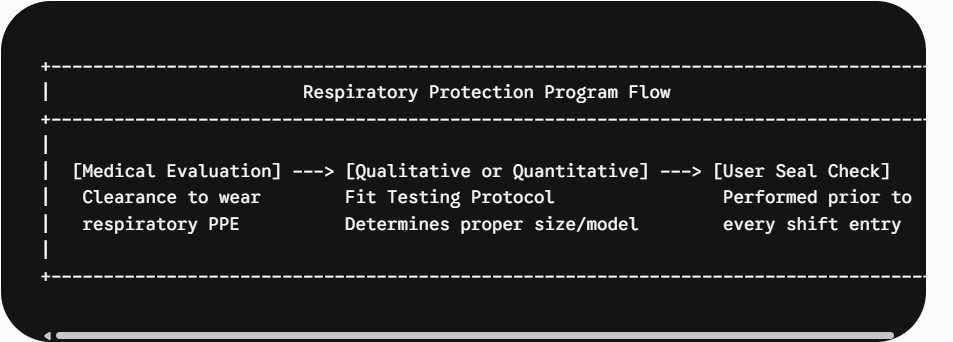
Respiratory Protection Program Flow
Medical Evaluation and Fit Testing Protocols
Before deployment, employees must undergo a confidential medical evaluation to ensure their cardiovascular and pulmonary health can accommodate the physiological strain of respirator use. Medically cleared staff undergo mandatory initial and annual fit testing:
- Qualitative Fit Testing (QLFT): A pass/fail sensory assessment using a test agent (such as saccharin or Bitrex) sprayed into a hood
- Quantitative Fit Testing (QNFT): An objective measurement using specialized instrumentation to calculate a numerical “Fit Factor” by comparing ambient particle concentrations outside and inside the mask.
- User Seal Checks and Donning Protocols
Workers must perform a user seal check every time a tight-fitting respirator is donned:
Positive Pressure Check: Exhale softly while covering the facepiece; it should swell slightly without edge leaks.
Negative Pressure Check: Inhale deeply while covering the filter; the facepiece should collapse inward slightly without ambient air leaking.
Wearer Ergonomics and Compliance
Prolonged mask wear can cause fatigue and localized skin irritation. Providing multiple approved styles—such as duckbill, flat-fold, and molded cup designs—accommodates varied facial contours and improves operational compliance.
Facility Preparedness and Executive Action Plan
Proactive safety combines personal protective gear with facility-level engineering controls, such as mobile HEPA units and centralized HVAC adjustments.
Executive Operational Checklist:
- Audit Inventory Reserves: Evaluate stock levels against burn rates and ensure proper climate-controlled storage.
- Validate Certification Credentials: Verify all stocked respirators carry valid regulatory approval numbers.
- Establish Secondary Supply Chains: Maintain secondary distributor relationships to prevent stockouts.
- Review Written RPP Policy: Update institutional Respiratory Protection Plans annually.
- Verify Fit-Testing Records: Audit staff records for mandatory annual fit-testing and medical clearances.
- Integrate AQI Monitoring Protocols: Establish daily procedures for monitoring air quality and adjusting HVAC settings.
Effective healthcare management demands vigilant environmental safety protocols to protect staff and patients from airborne hazards.
By integrating regulatory compliance, rigorous fit testing, and facility-wide engineering controls, administrators can build a resilient operational framework.
Prioritizing respiratory protection ensures clinical continuity and upholds the highest standards of institutional care and safety.
Other Articles You May Find of Interest...
- The Long-Term Health Effects of Repetitive and Physically Demanding Work
- Create Extra Office Space in the Garden for Employee Well-Being
- Chemical Exposure at Work: The Symptoms You Shouldn’t Ignore
- Garfield DTF Shops: Before Installing Equipment Check List
- How Remote Work Benefits Employee Wellbeing: What The Remote Work Statistics Really Say
- How Classic Car Restoration in South Florida Can Bring Your Vehicle Back to Life
- The Growing Demand for Made-to-Order Industrial Components





