Your Health Magazine Contributor
4201 Northview Drive
Suite 102
Bowie, MD 20716
More Weight Control, Nutrition & Exercise Articles
Single Leg Squat Assessment: What It Measures and Why It Matters
A single-leg squat assessment is a short movement screen. You stand on one leg, lower yourself part of the way under control, and then rise while a practitioner observes how your body handles the load.
Two-legged movements share the work and can hide differences between sides. Standing on one leg makes balance, hip control, knee position, and ankle mobility easier to observe.
The result describes movement quality during a specific task. It is not a diagnosis, and it cannot predict an injury on its own.
Where this screen fits in a movement assessment
The National Academy of Sports Medicine (NASM) places single-leg and split-squat assessments after the overhead squat, with the results used to help guide exercise programming.
That order matters. If a two-legged squat is already painful or unsteady, adding a more demanding test may not provide useful information. If you have ongoing knee or hip discomfort, general background reading on sports injury care can help you prepare questions for a qualified provider.
What the test can show
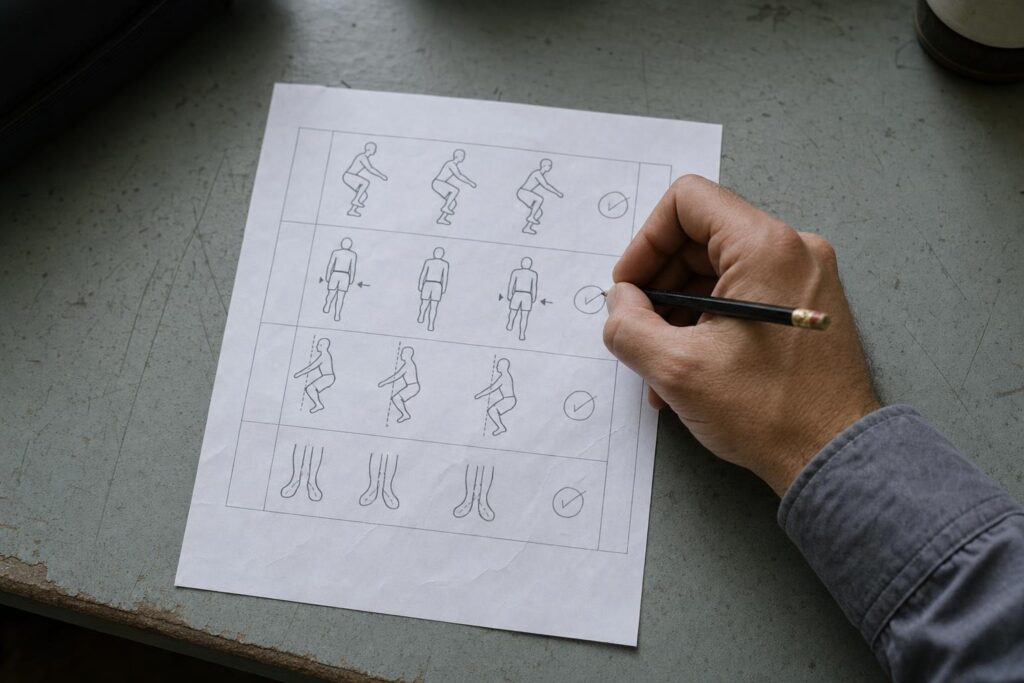
A structured single leg squat assessment examines the full movement chain rather than focusing on one joint. Trained observers work through four areas:

- Knee: Does it move inward toward the body’s midline during the descent?
- Hip and pelvis: Does the thigh rotate inward, or does the opposite side of the pelvis drop?
- Trunk: Does the torso lean or rotate to help maintain balance?
- Ankle and foot: Does limited ankle movement or a flattening arch change the pattern?
These areas affect one another, so no single observation tells the full story. Fatigue, pain, previous injuries, and familiarity with the task can also influence performance.
How practitioners score it
Performance is often rated on a short scale with two or three levels, such as good, moderate, and poor. Other scoring systems use a checklist of specific movement criteria.
Practitioners may judge hip rotation, inward knee movement, trunk lean, and pelvic drop by eye. Some settings use video or three-dimensional motion capture to measure joint and body angles.
A lower rating simply describes the pattern observed under load. It is not a judgment about effort, fitness, or pain tolerance. The score should be considered alongside symptoms, injury history, strength, mobility, and other movement tests.
Where visual scoring gets tricky
Side-to-side movement and rotation can be difficult to judge from one camera angle. Two practitioners may also score the same repetition differently, especially when movement changes are small.
Research using multi-segment scoring protocols has found that agreement can vary by body segment and observer. This means visual scoring can be useful, but it is not perfectly consistent.
Trying it at home carefully
- Stand beside a counter or rail that you can touch for balance.
- Move slowly and descend only as far as you can control.
- Stop if you feel pain, buckling, or a loss of balance.
- If you record the movement, film from the front and compare your two sides rather than comparing yourself with an athlete.
- Use the same setup if you repeat the movement later to look for changes.
Treat this as self-observation rather than a clinical test result. A video cannot determine the cause of pain or confirm whether a movement pattern is harmful.
When to check in with a provider
Physical therapy and sports medicine clinics across Washington, Maryland, and Virginia assess these movement patterns regularly. Consider speaking with a qualified provider if pain persists or worsens, swelling develops, pain interrupts sleep, the knee gives way, or stairs become increasingly difficult.
Seek prompt medical care after a significant injury or if you cannot put weight on the leg. A clinician can decide whether a single-leg squat is appropriate and interpret it in the context of a broader examination.
Adding 3D data carefully
Some clinics and sports teams complement visual grading with markerless motion capture. Theia3D processes synchronized video to create a three-dimensional model of the body without requiring wearable markers.
This approach can translate visual observations into measured variables. For example, an observer’s impression of pelvic drop can be compared with pelvic angle data across the full repetition. Theia3D can also help teams make consistent limb-to-limb and session-to-session comparisons.
There are important limits. Theia3D does not interpret the test for the practitioner, and its measurements are not a diagnosis. Joint angles describe motion, not muscle activation, pain or the reason behind a movement pattern.
Common questions
Is the single-leg squat safe to try at home?
For many healthy adults, a slow body-weight version performed near a stable support is reasonable. Stop if it causes pain or the knee feels unstable. If you have a recent injury, balance problems or significant symptoms, ask a clinician before trying it.
What does the knee moving inward during the test mean?
It describes what happened during that repetition and nothing more. Inward knee movement can involve hip strength and control, ankle mobility, foot posture or simple unfamiliarity with the task. On its own it is an observation to explore rather than a fault to correct.
How deep should you go during the assessment?
Only as far as you can control the movement. Depth varies between scoring protocols, and forcing a deeper position usually changes the pattern being observed rather than revealing more about it. Controlled partial depth gives more useful information than a deep repetition you cannot manage.
How reliable is visual scoring compared with motion capture?
Visual grading is practical and widely used, but agreement between observers can vary by body segment, particularly for rotation and side-to-side movement that is hard to judge from one angle. Motion capture produces measured joint angles instead of impressions, which supports more consistent comparison between limbs and between sessions.
Can this test predict whether I will get injured?
No. It describes movement quality during one task at one moment. Injury risk involves training load, history, strength, fatigue and factors no single screen captures, so the result should be read alongside a broader picture rather than treated as a forecast.
Using the results well
The single-leg squat is a conversation starter rather than a verdict. It can reveal differences worth exploring and provide a repeatable task for monitoring change.
The most useful interpretation combines the movement pattern with symptoms, history, strength, mobility and the goals of the person being assessed.
Other Articles You May Find of Interest...
- Do Avocados Contain Vitamin C?
- How to Appeal a Wegovy Insurance Denial: Coverage, Exceptions and Next Steps
- How to Get Abs: The Ultimate Guide to a Leaner Body
- Plate-Loaded vs Pin-Loaded Strength Machines: What’s the Difference?
- Meal Planning With Hashimoto’s: A Week of Thyroid-Friendly Eating Without the Stress
- How Can I Get More Magnesium in My Diet?
- Is a Personal Trainer Worth It After 50?