Your Health Magazine Contributor
4201 Northview Drive
Suite 102
Bowie, MD 20716
More Weight Control, Nutrition & Exercise Articles
How Muscles Recover After Exercise: The Science of Repair, Adaptation, and Growth
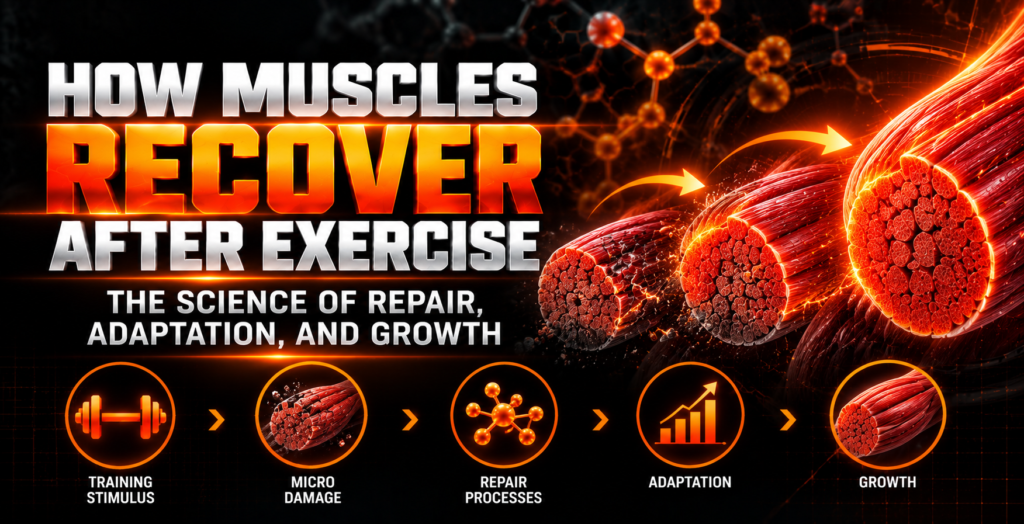
A challenging workout may last only an hour, but the biological response to that workout can continue long after someone leaves the gym.
Resistance exercise creates a stimulus that the body must respond to. Muscles experience mechanical tension, energy stores are depleted, cellular signaling changes, and fatigue accumulates. The hours and days that follow allow the body to restore energy, remodel muscle proteins, and adapt to the training stimulus.
This is why muscle development cannot be understood by looking at exercise alone.
Training provides the challenge. Recovery provides the opportunity to adapt.
Understanding muscle recovery can help explain why sleep, protein, calories, training frequency, and rest all influence strength and muscle development.
What Does Muscle Recovery Actually Mean?
Muscle recovery is not a single biological event.
It describes a collection of processes that occur after exercise as the body attempts to return to a stable state and adapt to the demands placed upon it.
These processes can include restoring muscle glycogen, regulating fluid balance, repairing cellular structures, synthesizing new proteins, reducing fatigue, and adapting the nervous system to training.
Recovery also occurs at different speeds.
Someone may stop feeling sore while still experiencing reduced performance. Conversely, a muscle can sometimes perform effectively even when mild soreness remains.
For this reason, muscle soreness alone is not a perfect measurement of recovery.
What Happens to Muscles During Resistance Training?
When muscles contract against resistance, individual muscle fibers experience mechanical tension.
This tension creates biochemical signals within muscle cells.
The body detects these signals and activates pathways involved in adaptation. Depending on the training stimulus, this can eventually contribute to greater strength, increased muscle size, or improved muscular endurance.
Exercise can also produce varying amounts of microscopic structural disruption.
This is commonly described as muscle damage.
However, muscle damage should not be confused with muscle growth itself.
A workout does not need to cause extreme soreness or extensive damage to stimulate hypertrophy. In fact, producing unnecessary amounts of muscle damage can potentially interfere with subsequent training by increasing recovery requirements.
The objective of resistance training is therefore not to damage muscles as much as possible.
It is to provide an effective stimulus from which the body can successfully recover.
Muscle Protein Synthesis During Recovery
One of the most important processes following resistance exercise is muscle protein synthesis.
Muscle proteins are continuously being created and broken down.
Resistance training can increase the rate at which muscle proteins are synthesized. Dietary protein provides amino acids that can be used as building materials for this process.
If muscle protein synthesis exceeds muscle protein breakdown sufficiently over time, muscle tissue can accumulate.
This does not happen from one meal or one training session.
Meaningful muscle growth represents the cumulative result of repeated periods in which training, nutrition, and recovery support positive adaptation.
This is one reason consistency is more important than occasional extreme workouts.
Why Protein Matters After Training
Dietary protein supplies amino acids.
These amino acids are required for numerous biological processes, including the construction and remodeling of muscle proteins.
Resistance-trained individuals therefore need to consider both training quality and protein intake.
Protein-rich foods include meat, fish, eggs, dairy products, soy, beans, lentils, and other plant-based sources.
Protein supplements can also be useful when convenience is important, but they are not fundamentally different from food protein in their basic purpose: supplying amino acids.
Total daily protein intake is generally more important than believing there is one perfect food that must be consumed immediately after training.
Is There Really an Anabolic Window?
For many years, bodybuilding advice emphasized an extremely narrow “anabolic window.”
The idea was that protein had to be consumed immediately after training or the workout would largely be wasted.
Modern understanding is more nuanced.
Exercise can increase the muscle’s responsiveness to protein beyond the first few minutes after a workout.
Eating protein reasonably close to training can certainly be practical, particularly if several hours have passed since the previous meal.
However, there is usually no reason for recreational lifters to panic because they did not drink a protein shake immediately after their final repetition.
Adequate daily protein and a sensible distribution of protein-containing meals remain more important considerations.
Muscle Glycogen and Recovery
Protein is not the only nutrient involved in recovery.
Muscles also store carbohydrates in the form of glycogen.
During demanding exercise, particularly higher-volume training, muscle glycogen can be depleted.
Dietary carbohydrates help replenish these stores.
For someone training once per day with normal recovery time between sessions, glycogen restoration generally does not require complicated strategies.
Athletes performing multiple demanding sessions within short periods may need to pay greater attention to carbohydrate intake and timing.
Carbohydrates can also support training performance.
A person who consistently trains with insufficient energy may struggle to maintain the intensity and volume required for productive resistance training.
Calories Influence Recovery
The body requires energy to recover and adapt.
This becomes particularly relevant when someone is dieting.
Muscle can still be maintained—and in some situations gained—during a calorie deficit, but recovery resources become more limited as energy intake decreases.
An aggressive calorie deficit can reduce training performance, increase fatigue, and make maintaining muscle more difficult.
By contrast, consuming sufficient energy can support higher training volumes and better recovery.
This does not mean unlimited calories produce unlimited muscle.
Once energy and nutrient requirements are satisfied, excessive calorie intake increasingly contributes to fat gain rather than faster muscular development.
Sleep Is a Major Part of Recovery
Sleep is one of the most powerful recovery tools available, yet it is frequently neglected.
During sleep, the body carries out numerous processes related to neurological function, metabolism, hormone regulation, and tissue recovery.
Consistently inadequate sleep can negatively affect strength, motivation, reaction time, appetite, mood, and training quality.
Poor sleep can also make nutrition harder to manage.
Someone who is chronically tired may experience greater hunger, stronger cravings, or reduced motivation to prepare appropriate meals and train consistently.
For athletes and recreational lifters alike, sleep should therefore be considered part of the training program.
Rest Days Are Productive
Some people associate rest days with doing nothing.
From a physiological perspective, recovery is productive.
Training creates the stimulus, but adaptation requires time.
If the same muscles are trained intensely before sufficient recovery has occurred, performance can decline and fatigue can accumulate.
This does not mean everyone needs long periods of complete inactivity.
Walking, mobility work, recreational movement, or training different muscle groups can often be performed during recovery periods.
The important factor is managing overall fatigue.
A well-designed program alternates training stress and recovery rather than attempting to maximize stress every day.
Muscle Soreness Does Not Equal Muscle Growth
Delayed onset muscle soreness, commonly abbreviated as DOMS, often appears after unfamiliar or demanding exercise.
Soreness usually develops several hours after training and may peak one or two days later.
Beginners frequently interpret soreness as evidence of a successful workout.
However, soreness is not a reliable measurement of muscle growth.
A person can have an excellent hypertrophy workout and experience little soreness.
Likewise, someone can become extremely sore after an unfamiliar activity without creating an especially productive muscle-building stimulus.
As the body becomes accustomed to an exercise, soreness often decreases even though the exercise remains effective.
Progress should therefore be measured through strength, repetitions, training quality, body composition, and long-term muscular development rather than soreness alone.
Progressive Overload Still Matters
Recovery only produces meaningful adaptation when the original training stimulus is appropriate.
If someone performs exactly the same easy workout indefinitely, the body eventually has little reason to continue adapting.
Progressive overload involves gradually increasing the demands placed on the muscles.
This can happen through additional resistance, more repetitions, better range of motion, improved technique, or appropriately increased training volume.
Progression does not need to occur during every workout.
As athletes become more experienced, progress naturally slows.
The objective is a gradual upward trend over time.
Recovery Between Training Sessions
How long a muscle needs to recover depends on several factors.
Training volume, exercise selection, intensity, training experience, sleep, nutrition, age, and individual recovery capacity can all influence the process.
A small amount of moderate training may require relatively little recovery.
A very demanding session involving numerous sets and exercises can create considerably more fatigue.
This is why there is no universal rule stating that every muscle requires exactly the same number of hours before it can be trained again.
Training frequency should be considered alongside total weekly workload.
The Nervous System Also Needs Recovery
Muscles are not the only tissues involved in strength training.
The nervous system plays a central role in producing force and coordinating movement.
Heavy compound exercises require substantial neuromuscular coordination.
Fatigue can therefore affect performance even when individual muscles do not feel particularly sore.
Mental fatigue can matter as well.
Stress from work, poor sleep, travel, and other aspects of life can influence how someone performs in the gym.
Training programs exist within real life, not separately from it.
Good programming therefore considers total recovery rather than focusing exclusively on the muscles.
Hormones and Muscle Recovery
Hormones participate in many aspects of metabolism, muscle physiology, and recovery.
Testosterone is particularly associated with muscle development because it influences androgen signaling and protein metabolism.
Normal hormonal function is influenced by sleep, nutrition, energy availability, age, genetics, health status, and other factors.
Anabolic-androgenic steroids can increase androgen activity beyond normal physiological levels. Anabolic-androgenic steroids can increase androgen activity beyond normal physiological levels. For this reason, discussions about muscle recovery and bodybuilding sometimes overlap with educational information about anabolic steroids, including resources such as anabolen gids.
However, pharmacological enhancement changes far more than muscle recovery.
Nonmedical anabolic-androgenic steroid use can suppress natural testosterone production and is associated with risks involving fertility, cardiovascular health, cholesterol, blood pressure, liver function, mood, skin, hair, and other aspects of health.
The fact that a substance can influence muscle physiology does not mean it is required for productive recovery or muscle growth.
Natural Recovery Can Be Highly Effective
The fundamentals of natural recovery are remarkably powerful.
Adequate protein provides amino acids.
Carbohydrates help restore glycogen and support training.
Dietary fat contributes to normal physiological function.
Sleep supports neurological and physical recovery.
Rest manages fatigue.
Progressive training provides a reason for the body to adapt.
These factors may appear basic, but they account for much of what determines long-term training progress.
People sometimes become interested in advanced supplements or pharmacological strategies before consistently applying these fundamentals.
That reverses the appropriate order of priorities.
Understanding Enhanced Bodybuilding
It is also important to separate educational information about performance-enhancing drugs from recommendations to use them.
Enhanced bodybuilding involves a different physiological environment from natural resistance training.
Synthetic androgens can alter protein metabolism, recovery, and muscle development, but they can simultaneously disrupt normal endocrine function.
Dutch readers researching anabolic steroids and their effects may encounter educational resources such as Anabole while learning about testosterone, anabolic-androgenic steroids, hormonal suppression, potential adverse effects, and related health considerations.
When reading any information about performance enhancement, it is useful to distinguish scientific evidence from personal anecdotes and commercial claims.
A substance producing a desirable effect on muscle does not establish that its overall risk-to-benefit profile is appropriate for a particular individual.
Hydration and Exercise Performance
Hydration is another simple component of recovery.
Water is essential for numerous physiological processes, including temperature regulation and normal cardiovascular function.
Heavy training, warm environments, and sweating can substantially increase fluid losses.
Significant dehydration can impair exercise performance.
Athletes who sweat heavily may also lose electrolytes, particularly sodium.
For most recreational lifters, normal hydration habits and a balanced diet are sufficient.
More specialized hydration strategies become relevant during prolonged exercise, extreme heat, or unusually high sweat losses.
Active Recovery
Complete rest is not always necessary between training sessions.
Low-intensity physical activity can be incorporated as active recovery.
Walking is one of the simplest examples.
Light cycling, mobility exercises, or other easy activities can also be appropriate.
The defining characteristic is that the activity should not create substantial additional fatigue.
An “active recovery” session that becomes another exhausting workout defeats its purpose.
Supplements and Muscle Recovery
The supplement industry offers countless products claiming to dramatically accelerate recovery.
Most are less important than nutrition, training, and sleep.
Protein supplements can be useful for meeting daily protein requirements.
Creatine is one of the most extensively researched sports supplements and can support strength and high-intensity exercise performance.
Caffeine can improve performance and alertness, although consuming large amounts late in the day may impair sleep and indirectly reduce recovery.
Other supplements should be evaluated based on evidence rather than marketing claims.
No supplement can compensate for chronically inadequate sleep, insufficient nutrition, or poorly designed training.
Signs That Recovery May Be Inadequate
One difficult workout does not automatically indicate a recovery problem.
However, persistent patterns deserve attention.
Consistently declining performance, unusual fatigue, reduced motivation, persistent soreness, sleep disruption, and difficulty completing normal training workloads can suggest that overall training stress exceeds recovery capacity.
The solution is not necessarily complete rest.
Sometimes reducing training volume, improving sleep, increasing calorie intake, or adjusting exercise selection can restore productive training.
The appropriate response depends on the cause.
More Training Is Not Always More Growth
Muscle growth requires sufficient training volume, but the relationship is not unlimited.
After a certain point, additional training can create fatigue without providing proportionally greater benefits.
This is sometimes described as “junk volume.”
High-quality sets performed with appropriate effort can be more productive than accumulating enormous numbers of low-quality sets simply to make workouts longer.
Experienced lifters often learn that managing fatigue is as important as generating training stimulus.
The goal is not to leave every workout completely exhausted.
The goal is to create an adaptation that can be repeated consistently.
Consistency Beats Perfection
Recovery strategies can become unnecessarily complicated.
Athletes may worry about the exact minute they consume protein, the perfect supplement combination, or minor differences between recovery techniques.
Those details are generally less important than consistency.
Training productively for months matters.
Eating sufficient protein most days matters.
Sleeping adequately most nights matters.
Progressing gradually matters.
A nearly perfect routine followed for one week will produce little.
A sensible routine followed consistently for a year can transform strength and body composition.
Final Thoughts
Muscle recovery is an active biological process rather than simply time spent away from the gym.
After resistance exercise, the body begins restoring energy, regulating fatigue, remodeling muscle proteins, and adapting to the training stimulus.
Protein provides amino acids needed for tissue remodeling. Carbohydrates help restore glycogen and support future training. Adequate calories provide energy. Sleep supports both physical and neurological recovery, while sensible programming prevents training stress from consistently exceeding recovery capacity.
Most importantly, muscle growth does not result from destroying the muscles during every workout.
It results from repeatedly applying an appropriate stimulus and allowing the body to adapt.
Training and recovery are therefore not competing priorities. They are two parts of the same process.
Someone who trains without recovering eventually reduces the quality of the training itself. Someone who recovers without providing sufficient training stimulus has little reason to adapt.
Long-term progress comes from balancing both.
For most recreational lifters, mastering resistance training, nutrition, sleep, and fatigue management provides the foundation required to build muscle and strength effectively without turning recovery into an unnecessarily complicated process.
Disclaimer: This article is intended for general educational purposes only. It does not constitute individualized medical, nutritional, or performance-enhancing drug advice. Anyone experiencing persistent pain, unusual fatigue, hormonal symptoms, or other health concerns should consult an appropriately qualified healthcare professional.
Other Articles You May Find of Interest...
- How Personalized Weight Loss Programs Help Achieve Sustainable, Long-Term Results
- High-Fructose Foods to Limit and Lower-Sugar Alternatives
- Best High-Fiber Foods Chart for Better Digestive Health
- How Many Carbs Are in Turkey Bacon?
- 9 Healthiest Mushrooms to Eat
- Post-Workout Protein: What the Research Says, and Why Gyms Add Self-Serve Shakes
- Understanding Prescription Weight-Management Treatments and Patient Safety