More Supplements Articles
What to Look for in a Natural Joint Supplement if You Have Mild Arthritis
Your doctor said “mild arthritis” and then handed you a pamphlet about managing it. You’ve tried glucosamine. You’ve leaned on ibuprofen. Neither gave you back your morning walks, your hikes, your afternoons on the floor with your grandchild. The plans you made for retirement didn’t include this.
Most supplements fail not because natural solutions don’t work, but because most products don’t meet the scientific bar required to actually work. There are real, evidence-based markers that separate effective joint supplements from expensive guesswork. This guide breaks down exactly what to look for.
1. Look for a Clinically Studied Active Compound, Not Just an Ingredient
An ingredient on a label tells you what’s in a product. It doesn’t tell you whether your body can use it.
Most supplements are built around raw ingredients like rosehip powder, turmeric extract, and fish oil. But raw ingredients aren’t the same as bioactive compounds. A bioactive compound is the specific molecule your body can absorb and put to work. Without a studied extraction process, the active component may degrade before it reaches your joints or pass through entirely.
When you read a label, look past the ingredient name. Look for a patented or proprietary compound backed by peer-reviewed clinical trials. If a product simply says “rosehip” or “turmeric” with no mention of extraction method or active concentration, that’s your red flag.
The ingredient isn’t the proof. The compound is.
2. Look for Clinical Evidence Specific to Arthritis, Not General Wellness
“Supports antioxidant activity” is not the same as research conducted specifically in people with arthritis. That distinction matters when evaluating products marketed for joint health.
Look for supplements that have been studied in controlled clinical trials, then review the details: how many participants were involved, what outcomes were measured, and whether the research focused on arthritis-related symptoms such as pain, stiffness, or mobility.
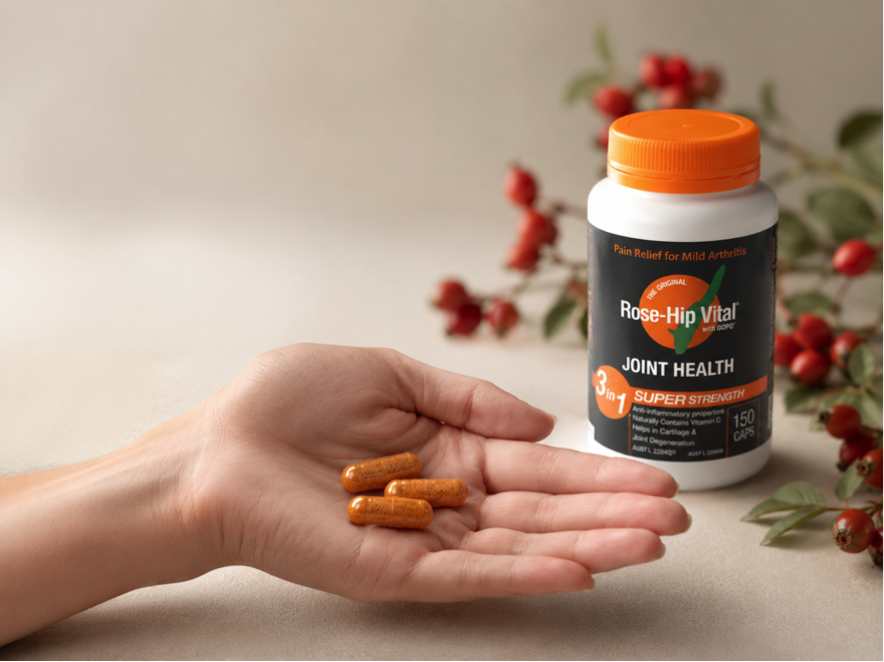
Consumers researching products such as Rose-Hip Vital with GOPO® can review the available scientific literature and clinical studies associated with the ingredient. When evaluating any supplement, consider the quality of the evidence, study design, and whether the findings are relevant to your individual health needs.
General wellness claims are common. Reviewing condition-specific research can help consumers make more informed decisions.
3. Look for a Supplement That Targets Inflammation, Not Just Pain
Ibuprofen works, but it works by suppressing your pain response rather than addressing what’s causing it.
Chronic joint inflammation is driven by specific biological signals that trigger swelling, stiffness, and over time, cartilage breakdown. A supplement that only dulls pain leaves those signals running unchecked. One worth taking works on the inflammatory pathway itself, reducing those signals at the source.
The question to ask isn’t “will this reduce my pain today?” It’s “will this protect my cartilage long-term?”
Pain relief and joint support are not the same thing. One keeps you comfortable. The other keeps you moving for years, not just days.
4. Check That Your Body Can Actually Absorb It
A supplement is only as effective as what reaches your joints, and absorption is where most products quietly fail.
The way a compound is extracted, processed, and delivered determines whether it survives long enough to do any work. Two rosehip products can look identical on the label with the same ingredient and similar dosage yet perform completely differently. One preserves the bioactive compound through processing. The other destroys it.
Look for proprietary extraction methods, clear concentration data, and no unnecessary fillers. If a brand can’t explain how their compound is extracted, that’s an answer in itself.
What’s listed on the label and what’s active in your body are two different things.
5. Be Skeptical of Fast Results and Reassured by Slow Ones
Any supplement promising results in 48 hours is not worth your money.
Clinical trials measuring real joint outcomes show meaningful improvement typically beginning at 3–4 weeks, with the full effect building over several months. That’s not a flaw. It’s how genuine anti-inflammatory support works. Your body is reducing inflammation at the source, rebuilding rather than overriding.
Genuine joint repair doesn’t happen overnight, because the damage didn’t either.
The supplements that work gradually and consistently are the ones worth committing to.
Now You Know What to Look For
Your skepticism has been an asset, not an obstacle. It’s kept you from settling. Now you have a framework to back it: a clinically studied bioactive compound, arthritis-specific trials, a mechanism that targets inflammation rather than masking pain, real bioavailability, and an honest timeline.
That’s five criteria. Almost nothing on the market clears all of them. The right supplement exists and now you know exactly how to find it.
Other Articles You May Find of Interest...
- Caffeine Tablets for Staying Awake: Benefits and Risks
- Common Signs of Low Iron Levels and How to Address Them
- The Quest for Longevity: Supplement Trends Shaping Health Span in 2026
- How to Get a Vitamin B12 Shot Safely
- The Power of L-Methylfolate: Could Your Multivitamin or Methylfolate Supplement Be Using the Wrong Form of Folate?
- Vitamin B12 Supplements in the UK: Forms, Doses and What to Consider
- How to Buy Supplements Online Safely: What to Check Before You Order