






More Supplements Articles
The Supplement Safety Gap: What Clinicians Miss When Patients Self-Stack
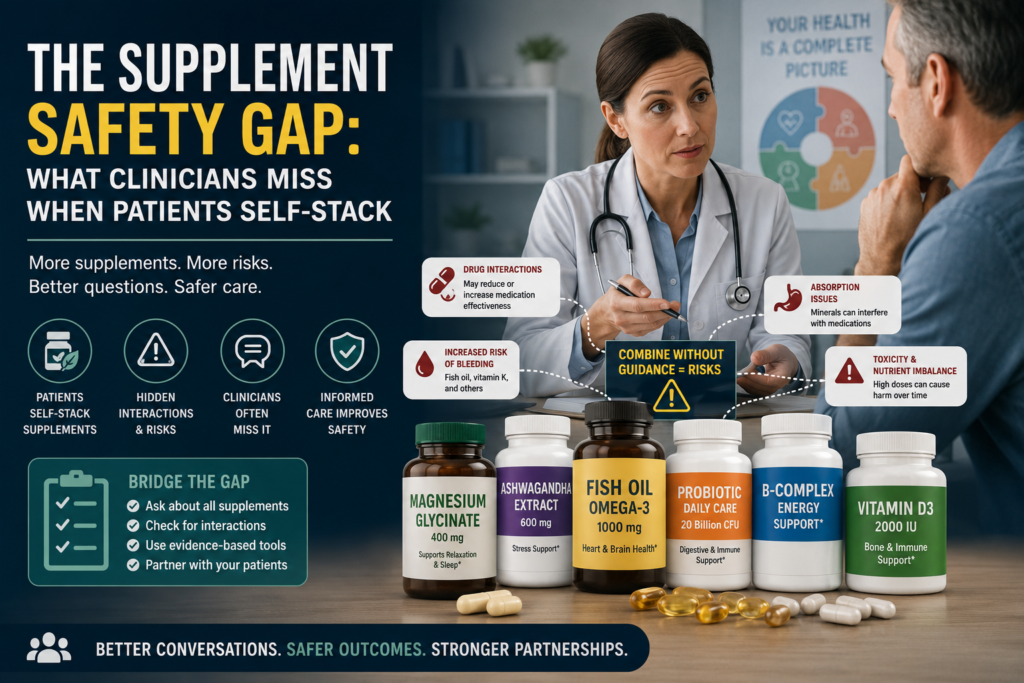
Walk into any pharmacy, health food store, or scroll through an online wellness marketplace, and you’ll find thousands of dietary supplements marketed as safe, natural, and beneficial. For many patients, taking a handful of supplements each day feels like a proactive health choice – a way to take ownership of their well-being outside of formal clinical care.
But there’s a growing problem that often goes unaddressed in the exam room: patients are self-stacking supplements – combining multiple products at once – without the knowledge or guidance of a qualified clinician. And the safety gaps this creates are wider than most people realize.
This article explores what “self-stacking” means, why it poses real health risks, and how clinicians and patients can work together to build safer, more informed integrative health practices.
What Is Supplement Self-Stacking?
“Self-stacking” refers to the practice of combining multiple dietary supplements – vitamins, minerals, herbal extracts, amino acids, probiotics, and other natural compounds – without a coordinated health plan or clinical oversight.
It might look like this: a person takes magnesium for sleep, a B-complex for energy, ashwagandha for stress, fish oil for heart health, and a probiotic for digestion – all purchased separately based on YouTube recommendations, social media posts, or word of mouth from a friend. None of these decisions were reviewed by a doctor, pharmacist, or any trained provider.
This scenario is far more common than most clinicians assume. According to data from the Council for Responsible Nutrition, over 75% of American adults report taking dietary supplements, and a significant portion take three or more products simultaneously. What’s rare is the patient who discloses this fully to their clinician – or the clinician who proactively asks.
Why Clinicians Often Miss It
There are several reasons supplement use tends to fall through the cracks during clinical encounters.
Time constraints play a significant role. A standard primary care appointment may last only 15 to 20 minutes. With a problem list to address, medications to review, and documentation to complete, asking detailed questions about supplement routines often gets deprioritized.
The framing of supplements as “natural” creates a false sense of safety. Many patients – and even some providers – assume that because a product is derived from a plant or occurs naturally in the body, it cannot cause harm or interact with pharmaceuticals. This assumption is incorrect and potentially dangerous.
Patients don’t always disclose. Some feel their doctor will dismiss their supplement use. Others simply don’t think it’s relevant to mention. In one study published in the Journal of the American Medical Association, nearly 70% of patients using complementary therapies did not disclose this to their physician.
Clinicians aren’t always trained to ask. Medical education has historically underemphasized integrative and nutritional medicine. Many providers feel underprepared to evaluate supplements or interpret their interactions with conventional treatments.
The result is a systemic blind spot – one that can have real consequences for patient safety.
Real Risks Hidden in Plain Sight
Supplement-drug interactions are not hypothetical. They are documented, clinically significant, and sometimes serious. Here are some well-established examples that illustrate the scope of the problem.
St. John’s Wort and medications metabolized by the liver. St. John’s Wort (Hypericum perforatum) is one of the most widely used herbal supplements in the world, commonly taken for low mood and mild emotional distress. It is also a potent inducer of cytochrome P450 enzymes and P-glycoprotein – two major mechanisms the body uses to metabolize and transport drugs. This means it can significantly reduce the blood levels of anticoagulants like warfarin, certain antiretrovirals, oral contraceptives, immunosuppressants like cyclosporine, and several antidepressants. A patient taking St. John’s Wort alongside any of these medications without clinical awareness may experience reduced drug efficacy or unexpected side effects.
Vitamin K and anticoagulation therapy. Patients on warfarin are often counseled about dietary vitamin K, but many are unaware that certain supplement blends – particularly greens powders or multi-nutrient formulas – can contain substantial amounts of vitamin K. Even modest fluctuations in vitamin K intake can shift INR values in anticoagulated patients, creating bleeding or clotting risks.
High-dose fish oil and blood thinning. Omega-3 fatty acids, particularly at high doses, have mild antiplatelet effects. In patients also taking aspirin, NSAIDs, or anticoagulant medications, this can compound bleeding risk – especially in the perioperative period. Yet fish oil is rarely flagged during pre-surgical medication reviews because patients don’t think to mention it.
Iron and thyroid medication absorption. Patients with hypothyroidism who take levothyroxine should ideally take it on an empty stomach. Iron supplements, calcium, and even magnesium can bind to levothyroxine and impair its absorption when taken too close together – potentially affecting thyroid management without any change in the prescribed dose.
Supplement-supplement interactions. It’s not just drugs that interact. High-dose zinc supplementation, for instance, can deplete copper over time. Calcium and magnesium compete for absorption when taken together in large amounts. Fat-soluble vitamins (A, D, E, K) accumulate in tissue and can reach problematic levels when taken in combination or at higher doses over extended periods.
These are not obscure edge cases. They are patterns that appear in standard pharmacology references – yet they frequently go undetected in clinical practice because no one asked the right questions.
The Challenge of the Modern Supplement Landscape
Part of what makes the self-stacking problem so difficult to address is the sheer volume and variety of products available. The U.S. dietary supplement industry is regulated under the Dietary Supplement Health and Education Act (DSHEA) of 1994, which means supplements do not require pre-market approval by the FDA for safety or efficacy. Manufacturers are responsible for ensuring their products are safe, but proof of safety does not need to be submitted before a product goes to market.
This regulatory framework means that:
- Labeling may not fully capture all active constituents
- Potencies can vary significantly between brands
- Products marketed for similar purposes may have entirely different ingredient profiles
- Some products contain undisclosed ingredients or contaminants, particularly in certain categories
For patients trying to make informed decisions on their own, the information environment is noisy and inconsistent. For clinicians, evaluating the safety of a patient’s supplement stack requires knowing not just what they’re taking, but what’s actually in what they’re taking – which is harder than it sounds.
Bridging the Gap: What Better Practice Looks Like
The good news is that this is a solvable problem – with better communication, better tools, and better integration of supplement literacy into clinical care.
Start with intake forms that ask specifically about supplements. Broadening the medication history section of intake documentation to explicitly include vitamins, minerals, herbs, and any wellness products normalizes the conversation and signals to patients that this information matters.
Use open, non-judgmental language. Patients are more likely to disclose supplement use when they don’t fear being dismissed or lectured. A simple “I’d love to understand everything you’re currently taking, including any vitamins or supplements, so I can give you the most complete picture of your health” opens the door without stigma.
Build a working knowledge of high-risk interactions. Clinicians don’t need to memorize every supplement interaction, but familiarity with the most common and clinically significant ones – St. John’s Wort, fish oil, vitamin K, iron, magnesium – allows for targeted and timely screening.
Leverage clinical decision support tools. The integrative medicine field has matured significantly, and evidence-based databases now exist to help clinicians evaluate supplement interactions, review monographs, and build safer protocols. Platforms designed for clinician use can surface interaction flags, evidence grades, and relevant contraindications in minutes rather than hours – making it practical to incorporate this review into routine care.
For integrative and functional medicine practitioners who regularly work with supplements, this kind of infrastructure is essential. But even for conventional clinicians who encounter supplement questions less frequently, having a reliable reference significantly reduces the risk of missing something important.
A Shared Responsibility
It’s tempting to frame supplement safety as entirely the patient’s responsibility – after all, these are products they chose to purchase and take without a prescription. But that framing misses the broader picture.
The modern healthcare environment encourages patients to be proactive. Wellness culture is pervasive. Access to information – accurate or not – is instant. Patients are not wrong to want to take an active role in their health; they are simply doing so in a landscape that doesn’t always provide reliable guidance.
Clinicians are uniquely positioned to bridge that gap. Not by dismissing supplement use, but by taking it seriously enough to ask, engage, and evaluate. Integrative medicine doesn’t require abandoning evidence-based practice – it requires expanding the frame of evidence to include what patients are actually doing with their health.
When clinicians and patients can have honest, informed conversations about the full picture of what a patient is taking, the clinical relationship becomes more complete. Medication reviews become more accurate. Drug-supplement interactions get caught before they cause harm. And patients feel seen and supported rather than siloed.
What Patients Can Do
If you are currently taking one or more dietary supplements, here are some practical steps to reduce your risk:
Make a complete list. Write down every supplement you take, including the brand name, dose, and how often you take it. Bring this list to every medical appointment.
Tell your clinician – all of them. This includes your primary care provider, any specialists, your dentist, and especially any surgeon before a procedure.
Ask about interactions before starting something new. Particularly if you are on a prescription medication, adding a supplement is worth a brief check – especially for blood thinners, thyroid medications, antidepressants, and immunosuppressants.
Be skeptical of claims. Products marketed with language like “guaranteed,” “miracle,” or “clinically proven” without referenced evidence deserve extra scrutiny. Reliable supplements are typically supported by peer-reviewed research, not testimonials.
Look for third-party verification. Organizations like USP, NSF International, and ConsumerLab independently test supplements for purity, potency, and label accuracy. These seals don’t guarantee safety, but they provide meaningful quality assurance.
Final Thoughts
The supplement safety gap is real, it’s widespread, and it’s largely invisible within conventional clinical care. Patients are self-stacking in increasing numbers. The interactions that result – with other supplements, with prescription drugs, with underlying health conditions – can range from mildly counterproductive to genuinely dangerous.
Addressing this gap doesn’t require a wholesale reinvention of clinical practice. It requires curiosity, better questions, and better tools. It requires treating supplement use with the same rigor we apply to any other element of a patient’s medical history.
The intersection of conventional and integrative medicine is where many patients already live. Meeting them there – informed, prepared, and engaged – is what good clinical care looks like in practice.
For clinicians looking to integrate evidence-based supplement review into their practice,ClarityTx offers a comprehensive integrative medicine database covering thousands of natural medicines, drug interactions, and clinician-reviewed protocols – designed to support safer, more informed patient care.
FAQs
1. What is supplement self-stacking?
It’s when someone combines multiple supplements — vitamins, herbs, minerals, probiotics — without any clinical guidance. Think magnesium for sleep, ashwagandha for stress, fish oil for heart health, all taken together based on social media recommendations rather than a health plan.
2. Is taking multiple supplements really dangerous?
It can be. Supplements can interact with each other and with prescription medications in ways that are clinically significant. St. John’s Wort can reduce the effectiveness of birth control and antidepressants. High-dose fish oil can increase bleeding risk. Iron can interfere with thyroid medication absorption. These aren’t rare edge cases — they’re well-documented.
3. Why don’t doctors catch this more often?
A few reasons: appointments are short, patients often don’t mention supplements thinking they’re not “real” medications, and many clinicians aren’t specifically trained to screen for supplement interactions. The result is a blind spot that rarely gets addressed.
4. Why can’t patients just trust supplement labels?
Because supplements aren’t regulated the same way medications are. In the U.S., they don’t need FDA approval before hitting shelves. Potency, ingredients, and quality can vary significantly between brands — making it hard to know exactly what you’re actually taking.
5. What should patients do to stay safer?
Keep a complete list of every supplement you take — brand, dose, and frequency — and bring it to every appointment. Always mention supplements before any procedure or when starting a new prescription. When in doubt, ask about interactions first.
Other Articles You May Find of Interest...
- How to Get a Vitamin B12 Shot Safely
- The Power of L-Methylfolate: Could Your Multivitamin or Methylfolate Supplement Be Using the Wrong Form of Folate?
- Vitamin B12 Supplements in the UK: Forms, Doses and What to Consider
- How to Buy Supplements Online Safely: What to Check Before You Order
- Can Evening Primrose Oil Help Breast Cyst Pain?
- Ayurvedic Tablets Americans Are Ordering Online: What’s Actually in Chandraprabha Vati and Neem Tablets
- How Often Should You Get a Vitamin B12 Shot?





