Your Health Magazine Contributor
4201 Northview Drive
Suite 102
Bowie, MD 20716
More Supplements Articles
The Difference Between Magnesium and Magnesium Glycinate: What Parents Need to Know
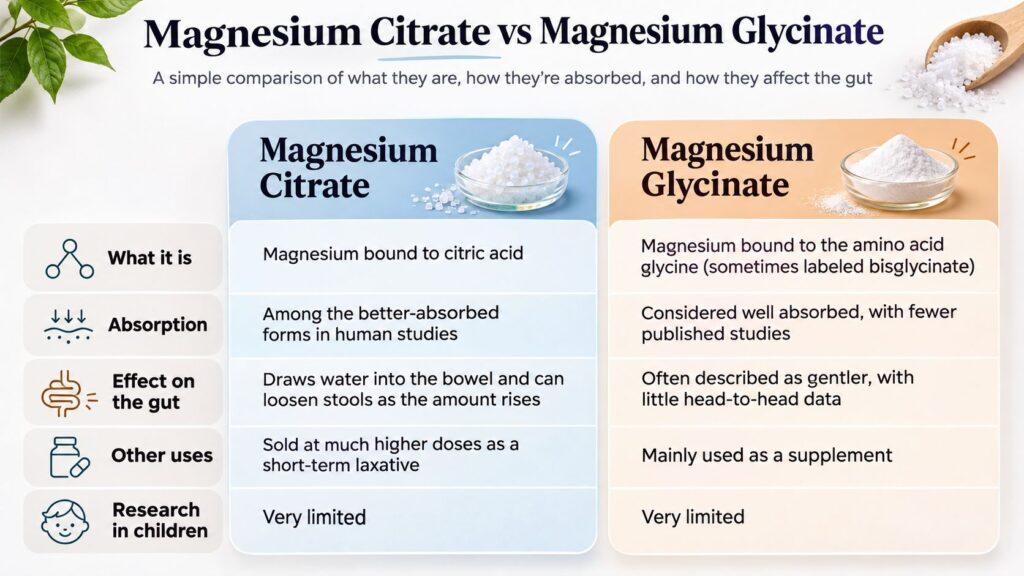
Magnesium citrate and magnesium glycinate are both well-absorbed forms of magnesium, and for most families the bigger questions are how much elemental magnesium a product actually contains and whether a child needs a supplement at all. Citrate has the stronger research record for absorption and can loosen stools as the amount goes up. Glycinate is often marketed as a gentler option for sensitive stomachs, although direct comparisons between citrate and glycinate are limited. Neither form has been shown to improve children’s sleep.
How Much Magnesium Do Children Need?
This element participates in many biochemical processes within the body such as muscle functions, nerve functions, bone formation, and energy generation. Most magnesium intake in children comes from food, and the requirements keep increasing as the child grows older. Here are some target levels set by NIH Office of Dietary Supplements:
AgeRecommended daily intake (all sources)Upper limit from supplements and medicines1–3 years80 mg65 mg4–8 years130 mg110 mg9–13 years240 mg350 mg14–18 years410 mg (boys), 360 mg (girls)350 mg
For young children, the upper limit looks lower than the recommendation. That is because the recommendation counts magnesium from food and drinks, while the upper limit applies only to supplements and medicines. Magnesium from food is not considered a risk for healthy children, because the kidneys clear the excess.
Americans often fail in this regard. As per the results of national surveys, 48% of people consume less magnesium through food and drink than required by their bodies, and teenagers are some of those who are at high risk of developing magnesium deficiencies. However, magnesium deficiency causing symptoms is rare in healthy individuals consuming a balanced diet.
Citrate vs. Glycinate at a Glance
Magnesium citrateMagnesium glycinateWhat it isMagnesium bound to citric acidMagnesium bound to the amino acid glycine (sometimes labeled bisglycinate)AbsorptionAmong the better-absorbed forms in human studiesConsidered well absorbed, with fewer published studiesEffect on the gutDraws water into the bowel and can loosen stools as the amount risesOften described as gentler, with little head-to-head dataOther usesSold at much higher doses as a short-term laxativeMainly used as a supplementResearch in childrenVery limitedVery limited
Magnesium citrate dissolves well in liquid. According to the NIH, forms that dissolve well, including citrate, tend to be absorbed better than magnesium oxide and magnesium sulfate. In a 60-day randomized trial of 46 healthy adults, magnesium citrate raised blood magnesium more than either magnesium oxide or an amino acid chelate, the chemical family that glycinate belongs to.
The downside to citrate is what happens in the bowel. The unabsorbed magnesium can draw water into the intestine, which is why magnesium citrate is also used at higher doses as a laxative for occasional constipation. Supplemental amounts used in children are typically much lower, but gastrointestinal effects such as loose stools can still occur.
Magnesium glycinate pairs magnesium with glycine, a small amino acid. It is often marketed to children and adults who are looking for a form considered gentler on the stomach. However, that reputation rests more on clinical experience and marketing than on direct comparative trials: few studies compare its tolerability directly with citrate, and none have been done in children. Pediatric sleep physician Craig Canapari, MD, of Yale-New Haven Children’s Hospital, lists both citrate and glycinate among the well-absorbed forms to choose from when a supplement is warranted, and advises avoiding poorly absorbed forms such as magnesium oxide.
Sleep, Calm and Constipation: What the Evidence Shows
Magnesium is commonly used for sleep, but there is little scientific data in children. According to Dr. Canapari’s review of the medical literature, there is only one small study that examined the effect of magnesium on children’s sleep and that was performed in newborn babies back in 1980. Based on his findings, he concludes that there is not sufficient evidence to support the claim that magnesium improves children’s sleep..
It does not mean that magnesium is unimportant. The child who consumes little of veggies, nuts, beans, and whole grains might truly lack the mineral. Dr. Canapari notes that supplementation may be considered in some children who are at greater risk of low magnesium intake or deficiency, including highly selective eaters and children with certain medical conditions. Any supplementation for a child with a medical condition should be discussed with a pediatrician. In any case, magnesium supplementation has its place in addition to regular sleep rituals and cannot replace them.
For constipation, the form matters more. Citrate’s pull on water is the reason it can soften stools, and also the reason it can overshoot. Constipation in children has many causes, from low fiber and fluids to holding stool in. A pediatrician should guide any regular use of magnesium for this purpose.
How to Read a Kids’ Magnesium Label
The number on the front of the bottle is often not the number that matters. The Supplement Facts panel lists elemental magnesium, the amount of the mineral itself, not the weight of the whole compound. For example, one children’s magnesium citrate gummy lists 500 mg of magnesium citrate on the front but provides 60 mg of elemental magnesium per serving. Compare products by elemental magnesium only.
Then check these points:
- Total from all sources. Add up elemental magnesium from every supplement and medicine your child takes, including multivitamins, antacids and laxatives, and compare it with the upper limit for their age.
- The form or forms. Some products sold as glycinate are blends that also contain citrate, malate or oxide. The Supplement Facts panel lists every source.
- The age range. Follow the minimum age printed on the label.
- Sugar and sweeteners. Many children’s gummies are now made with no added sugar.
- Allergens and testing. Look for an allergen statement and for third-party testing of purity and content.
Because gummies taste good, store them up high and out of reach, the same way you store medicines.
Food First, and When to Talk to Your Pediatrician
Most children can meet their magnesium needs through food. These everyday options come from the NIH food table:
FoodMagnesiumPumpkin seeds, roasted, 1 ounce156 mgChia seeds, 1 ounce111 mgAlmonds, 1 ounce80 mgBlack beans, cooked, ½ cup60 mgPeanut butter, 2 tablespoons49 mgPlain low-fat yogurt, 8 ounces42 mgBanana, 1 medium32 mg
A child aged 4 to 8 who eats a banana, a peanut butter sandwich on whole-wheat bread and a cup of plain yogurt in one day gets about 170 mg, above the 130 mg recommended for that age. Whole nuts are a choking hazard for young children, so offer nut butters or ground nuts instead.
Talk to your pediatrician before starting a magnesium supplement if your child:
- Has kidney disease or any kidney concern, since magnesium can build up when the kidneys cannot clear it
- Takes tetracycline or quinolone antibiotics, which magnesium can bind; the NIH advises taking these at least 2 hours before or 4 to 6 hours after a magnesium supplement
- Takes other medicines regularly, or already takes a multivitamin or antacid that contains magnesium
- Is younger than 3; Dr. Canapari would not try magnesium in this age group without a pediatrician’s input
- Has ongoing constipation, sleep problems or behavior concerns, which deserve an evaluation rather than a supplement alone
Stop the supplement and call your pediatrician if diarrhea, nausea or stomach cramps develop. If a child gets into the bottle and eats several servings, call Poison Control at 1-800-222-1222.
Citrate and glycinate are both forms of magnesium commonly used in supplements and are generally considered relatively well absorbed. Citrate has more absorption data and a stronger effect on the bowel, while glycinate is a common pick for sensitive stomachs. For most families, the more important decisions come first: whether a child needs a supplement at all, how much elemental magnesium it provides, and whether the total stays within the upper limit for their age. Start with food, supplement only when there is a reason, and bring your pediatrician into the decision.
Other Articles You May Find of Interest...
- Glutathione Supplements: Comparing Ingredients, Formats and Price
- The Difference Between Magnesium and Magnesium Glycinate: What Parents Need to Know
- 5 Gut Health Supplement Brands to Compare for Bloating and Regularity
- Beyond the Hype: A Science-Based Look at Cat’s Claw Tablet Benefits
- 5 Myths About Herbal Supplements That Could Actually Hurt You
- Top Whole Food Nutrition Products in the USA: A Practical Guide
- Shilajit Authenticity and Testing: What Fulvic Acid and LC-MS/MS Results Can—and Cannot—Show