Your Health Magazine Contributor
4201 Northview Drive
Suite 102
Bowie, MD 20716
More Podiatry Foot Care Articles
Daily Habits That Help Prevent Toenail Fungus
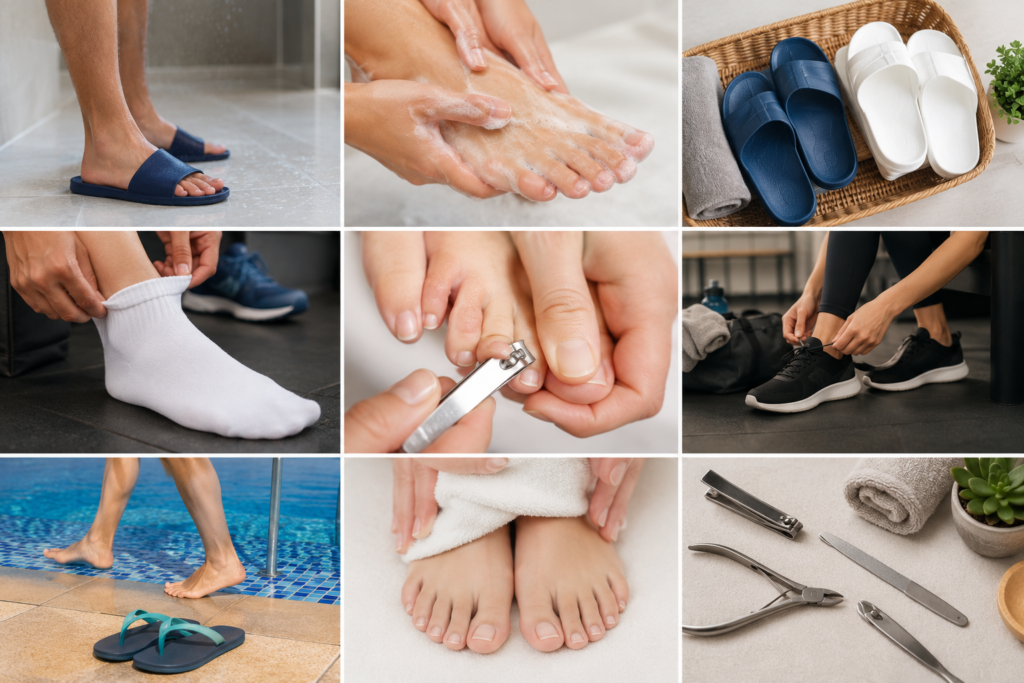
Daily habits may lower the risk of toenail fungus. They cannot treat an existing infection or guarantee prevention. For a simple list of habits, see a practical prevention checklist.
Key fact: In a study published in 2026 using questionnaire data collected in 2021 from 1,047 Greek competitive swimmers, with parents reporting for minors, 16% reported athlete’s foot and 3.3% reported a fungal nail infection. Sharing flip-flops was associated with both conditions, although the self-reported, cross-sectional study cannot prove that sharing caused an infection. (Sfyri et al., 2026)
What should you do in communal showers, pools, and gyms?
Wear your own shower sandals or other protective footwear on locker-room floors, in shared showers, and around pool decks. Do not share flip-flops, towels, socks, or shoes. The swimmer survey found associations between several shared-item habits and fungal infections, including an association between shared flip-flops and athlete’s foot or fungal nail infection. It also linked placing towels or clothing on communal benches with athlete’s foot. Those findings support simple barriers and personal-item habits, but they do not promise complete protection. (Sfyri et al., 2026)
After exercise or swimming, wash your feet and dry them completely, including between the toes, before putting on clean socks and shoes. The Centers for Disease Control and Prevention recommends daily foot washing, complete drying, and changing socks at least once a day. Its guidance also identifies moist shower and locker-room floors as potential routes of fungal exposure. (Centers for Disease Control and Prevention foot-hygiene guidance; Centers for Disease Control and Prevention clinical overview)
How should you manage shoes and socks?
Start with dry socks and dry footwear. Change socks sooner if they become damp, and allow shoes to dry before wearing them again. The American Academy of Dermatology‘s 11-step prevention guidance recommends a clean pair of socks each day, changing sweaty socks, breathable footwear, and giving shoes 24 hours to dry between uses. (American Academy of Dermatology)
A 2006 stamp-culture experiment tested whether several sock and footwear methods reduced the passage or adhesion of dermatophytes, the fungi that commonly cause athlete’s foot. Socks or traditional Japanese tabi reduced passage in that experimental setting, while very thin stockings did not. The experiment measured fungal transfer, not the rate of future nail infections, so it supports a practical barrier without proving that one fabric will prevent toenail fungus. (Tanaka et al., 2006)
How should you trim toenails and handle grooming tools?
Keep toenails reasonably short and trim them straight across. Use your own nail clippers, scissors, and files rather than sharing a grooming kit. The Centers for Disease Control and Prevention advises keeping toenails short and clean, while the American Academy of Dermatology includes straight-across trimming and not sharing nail tools among its 11 prevention steps. (Centers for Disease Control and Prevention foot-hygiene guidance; American Academy of Dermatology)
Remove visible nail debris, wash reusable tools with warm water and soap, then disinfect and fully air-dry them as described in the American Academy of Dermatology guidance. At a salon, confirm that reusable instruments are sterilized after each use, as the Centers for Disease Control and Prevention advises. Do not share an unclean tool between people. The goal is to reduce transfer from personal items, not to use harsh chemicals on the feet or to improvise an unlabeled disinfectant routine. (American Academy of Dermatology; Centers for Disease Control and Prevention foot-hygiene guidance)
A 2004 culture study of pedicure instruments from three sites in Lagos, Nigeria, recovered five fungal species, including Trichophyton species and Candida albicans. This small, local study shows that contaminated instruments are possible; it does not estimate the risk from a particular salon or prove that a sampled tool transmitted an infection. (Adeleye and Osidipe, 2004)
Does extreme disinfection provide guaranteed protection?
No. Reasonable prevention focuses on a short list of repeatable habits: personal footwear in shared wet areas, clean and dry feet, clean socks, dry shoes, personal grooming tools, and routine cleaning of items that contact the feet. Guidance from the Centers for Disease Control and Prevention and the American Academy of Dermatology does not promise that disinfecting every floor or object will prevent every infection. More cleaning is not a substitute for consistent foot care, and household disinfectants should be used only as their labels direct. (Centers for Disease Control and Prevention ringworm prevention; American Academy of Dermatology; U.S. Environmental Protection Agency disinfectant guidance)
The 2006 stamp-culture experiment above compared three footwear types and three cleaning methods. Several methods reduced recoverable dermatophytes in the laboratory, but results differed by material, and the study did not measure future nail infections. That evidence supports routine, item-appropriate cleaning, not a claim that extreme disinfection guarantees protection. (Tanaka et al., 2006)
Can these habits treat an existing nail change?
No. Prevention habits do not diagnose or treat a nail that is already thick, discolored, brittle, painful, or lifting. In a 2024 study of 96,293 nail specimens submitted to a United States laboratory, 59.4% of specimens linked to a clinical diagnosis of onychomycosis were positive on confirmatory testing. This laboratory cohort is not a population estimate, but it shows why an abnormal nail should not be diagnosed by appearance alone. The American Academy of Dermatology advises medical evaluation for possible nail infection, and the Centers for Disease Control and Prevention recommends diagnostic testing before antifungal treatment because several conditions can resemble fungal disease. (Gupta et al., 2024; American Academy of Dermatology; Centers for Disease Control and Prevention clinical overview)
The practical goal is lower exposure, not a guarantee. A routine that is simple enough to repeat after each workout, swim, shower, and nail-trimming session is more useful than an extreme routine that is difficult to maintain.
SOURCES
Sfyri et al., 2026: Sfyri E, Tertipi N, Grech VS, Kefala V, Rallis E (2026). “Cutaneous Fungal Infections in Greek Competitive Swimmers: A Cross-Sectional, Self-Reported Study.” PubMed identifier (PMID) 41893125.
Centers for Disease Control and Prevention foot-hygiene guidance: Centers for Disease Control and Prevention. “Healthy Habits: Foot Hygiene”
Centers for Disease Control and Prevention clinical overview: Centers for Disease Control and Prevention. “Clinical Overview of Ringworm”
American Academy of Dermatology: American Academy of Dermatology. “11 tips to prevent nail fungus”
Tanaka et al., 2006: Tanaka K, Katoh T, Irimajiri J, Taniguchi H, Yokozeki H (2006). “Preventive effects of various types of footwear and cleaning methods on dermatophyte adhesion.” PMID 16923133.
Adeleye and Osidipe, 2004: Adeleye IA, Osidipe OO (2004). “Isolation and characterization of microorganisms from instruments used by pedicurists operating within Lagos metropolis, Nigeria.” PMID 15816270.
Centers for Disease Control and Prevention ringworm prevention: Centers for Disease Control and Prevention. “Ringworm Prevention”
U.S. Environmental Protection Agency disinfectant guidance: U.S. Environmental Protection Agency. “Can I apply a product using a method that is not specified in the directions for use?”
Gupta et al., 2024: Gupta AK, Wang T, Cooper EA, Lincoln SA, Foreman HC, Scherer WP, Bakotic WL (2024). “Clinical Diagnosis and Laboratory Testing of Abnormal Appearing Toenails: A Retrospective Assessment of Confirmatory Testing for Onychomycosis in the United States, 2022-2023.” PMID 38392821.
Other Articles You May Find of Interest...
- Tibialis Anterior Tendon Pain: Causes, Treatment, and Recovery
- What Causes Pain on the Lateral Side of the Foot?
- 8 Ways to Remove Dead Skin From Feet: A Chronic Cracked-Heel Rescue Plan
- Lowering the Risk Of Stress Fractures
- Sharp, Stabbing Big Toe Pain at Night: Common Causes
- Topical, Oral or Laser: Comparing Nail Fungus Treatments in 2026
- A Twisted Ankle or Something More? When an Injury Needs a Closer Look