






More Pain Management & Rehabilitation Articles
Treating Knock Knees in Adults: Exercise, Bracing, and Surgery
By Your Health Magazine Health Information Team
Knock knees in adults are treated according to their cause, severity, symptoms, and degree of joint damage. Exercise and physical therapy can reduce pain and improve strength, balance, and movement, but they cannot straighten a mature adult’s bones. Bracing may relieve pressure when arthritis affects one part of the knee, while significant structural misalignment may require corrective bone surgery or, when arthritis is advanced, knee replacement.
Understanding Adult Knock Knees
Knock knees, medically called genu valgum, describe an alignment in which the knees angle inward while the ankles remain apart. This can be a structural deformity involving the thighbone, shinbone, or both. Some people also show “dynamic valgus,” meaning the knee moves inward during walking, running, squatting, or climbing stairs because of muscle weakness or movement patterns rather than fixed bone alignment.
Adult knock knees may persist from childhood or develop after a poorly healed fracture, growth-plate injury, bone or joint disease, or progressive arthritis. The alignment can place more pressure on the outer portion of the knee and may contribute to pain, instability, cartilage damage, or kneecap-tracking problems. Because kneecap position also affects symptoms, it may be helpful to understand how conditions such as patella alta can influence knee health.
How Knock Knees Are Evaluated
An orthopedic clinician usually evaluates the alignment of the hips, knees, ankles, and feet while the patient stands and walks. The examination may also assess joint motion, ligament stability, leg-length differences, kneecap tracking, and whether the inward movement is fixed or mainly occurs during activity.
Standing X-rays that include the entire leg—from the hip through the ankle—can show where the deformity originates and how weight passes through the knee. Additional imaging may be appropriate when arthritis, cartilage injury, a previous fracture, or another joint disorder is suspected. General information about joint symptoms and evaluation is available through the MedlinePlus guide to joint disorders.
What Exercise Can and Cannot Do
Exercise cannot reshape adult bones or permanently correct a fixed knock-knee angle. It can, however, strengthen the muscles that control the hip and knee, improve balance, reduce unnecessary inward knee movement, and make daily activities more comfortable. It is particularly useful for dynamic valgus and for managing symptoms associated with mild arthritis.
A physical therapist may build a program around:
- Hip strengthening: Side-lying leg raises, resistance-band side steps, and other exercises for the hip abductors and external rotators may improve control of the thigh.
- Quadriceps strengthening: Sit-to-stands, step-ups, supported mini-squats, and selected leg-strengthening exercises can improve knee support.
- Hamstring and calf flexibility: Gentle stretching may reduce stiffness that affects walking mechanics.
- Balance and movement training: Controlled single-leg activities and instruction in squatting or stair-climbing technique may help keep the knee from collapsing inward.
- Low-impact aerobic activity: Swimming, water exercise, cycling, or walking on level surfaces can maintain conditioning while limiting repetitive joint impact.
Exercises should be chosen according to the person’s pain, stability, arthritis, and overall alignment. The National Institute of Arthritis and Musculoskeletal and Skin Diseases notes that appropriately selected strengthening, flexibility, and low-impact exercises can support joints affected by osteoarthritis. Pain that becomes sharp, causes limping, or remains substantially worse after a workout is a reason to reduce the activity and consult a healthcare professional.
Can a Brace Straighten Knock Knees?
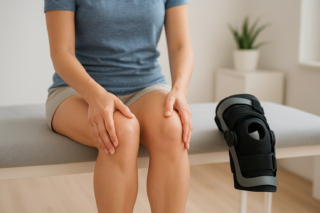
A brace cannot remodel or straighten mature bones. Its main role is symptom management. If knock-knee alignment has overloaded one compartment of an arthritic knee, a professionally fitted unloader brace may shift some pressure away from the painful area. A supportive brace may also improve confidence and stability during activity.
| Treatment | What It May Do | What It Cannot Do |
|---|---|---|
| Exercise or physical therapy | Improve strength, movement control, balance, and function | Reshape a fixed adult bone deformity |
| Knee brace | Support the joint or reduce pressure on an arthritic compartment | Permanently correct structural alignment |
| Corrective osteotomy | Realign the leg by cutting and repositioning bone | Reverse all existing cartilage damage |
| Knee replacement | Treat advanced joint damage while restoring alignment | Preserve the natural joint surfaces |
Braces need the correct design and fit. An unsuitable brace may be uncomfortable, irritate the skin, or fail to unload the intended part of the knee. Shoe inserts can help certain foot or ankle issues, but they should not be expected to correct a substantial deformity originating above the foot.
When Surgery May Be Considered
Surgery is not necessary simply because the knees appear to angle inward. It may be considered when confirmed structural malalignment causes persistent pain, instability, difficulty walking, recurrent kneecap problems, or worsening joint damage despite appropriate nonsurgical care.
Corrective Osteotomy
An osteotomy involves cutting and repositioning bone so weight passes more evenly through the knee. Depending on where the deformity begins, surgery may involve the lower end of the femur, the upper tibia, or both. Plates, screws, or other fixation devices hold the corrected position while the bone heals.
Osteotomy is generally a joint-preserving option for selected adults whose alignment is a major source of symptoms and whose knee still has usable cartilage. Planning requires full-length weight-bearing images because correcting the wrong bone or applying too much or too little correction can create additional problems. A detailed overview of adult knock-knee correction and distal femoral osteotomy is available from Hospital for Special Surgery.
Knee Replacement
When severe osteoarthritis has already damaged much of the joint, an osteotomy may not provide enough benefit. Partial or total knee replacement may instead be considered to address both painful joint surfaces and alignment. The choice depends on the location and extent of arthritis, ligament condition, age, activity goals, and overall health.
All operations involve risks, including infection, blood clots, nerve or blood-vessel injury, stiffness, delayed bone healing, and the possibility of further surgery. Recovery after osteotomy commonly involves a period of protected weight-bearing followed by progressive rehabilitation.
When to Seek Care
Consider an evaluation by an orthopedic clinician, sports medicine physician, or physical therapist if inward knee alignment is accompanied by persistent pain, limping, instability, recurrent kneecap slipping, reduced mobility, or a noticeable change in one leg. New or progressive asymmetry in adulthood should be assessed rather than assumed to be harmless.
Seek prompt medical care after a significant injury, if you cannot bear weight, or if the knee suddenly becomes markedly swollen. A hot, red, very painful joint—especially with fever or illness—requires urgent evaluation because infection and other serious conditions must be ruled out.
The most appropriate knock-knee treatment is based on whether the problem is structural or movement-related and whether arthritis is present. A careful examination and standing alignment X-rays can clarify whether symptom-focused rehabilitation, bracing, corrective osteotomy, or joint replacement is the most reasonable approach.
Other Articles You May Find of Interest...
- Treating Knock Knees in Adults: Exercise, Bracing, and Surgery
- Why Radiofrequency Ablation Might Be Your Answer to Chronic Neck and Back Pain
- When Headaches Become Chronic: Knowing When to See a Pain Specialist
- Why Your Knee Won’t Bend and What Can Restore Motion
- Is My Thumb Broken or Sprained? Signs That Can Help You Tell
- Why Does My Back Hurt When I Stand Up Straight?
- 5 Medical Marijuana Packaging Suppliers to Compare in the US (2026)





