




Your Health Magazine Contributor
4201 Northview Drive
Suite 102
Bowie, MD 20716
More Medical Equipment Articles
Choosing Antiseptic Wipes for Skin Preparation Before Needles and Catheters
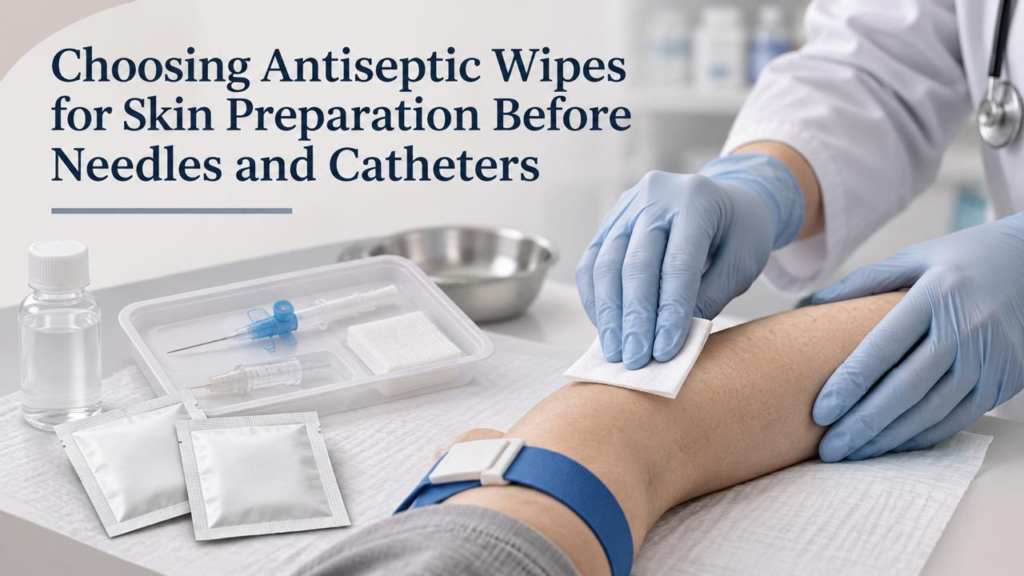
The first decision is the active ingredient, and for most vascular access the answer is chlorhexidine in alcohol. CDC’s catheter guidance sets the bar at more than 0.5% chlorhexidine in an alcohol base for central lines and arterial lines, while a peripheral IV may also be prepared with plain 70% alcohol or an iodine tincture. Concentration, technique, drying and packaging then decide whether that ingredient does its job.
Skin is never sterile, and a needle can carry surface bacteria straight into tissue or the bloodstream. Antiseptic wipes reduce that load in a single step, but only when the product suits the procedure and is used the way it was tested.
How the common active ingredients compare
| Active ingredient | How it works on skin | Where guidance places it | Main cautions |
| 70% isopropyl alcohol | Kills quickly, then evaporates and leaves no residual activity | Accepted before peripheral venous catheters | Flammable until dry, frequent use dries the skin |
| 2% chlorhexidine gluconate with 70% isopropyl alcohol | Alcohol gives the fast kill while chlorhexidine binds to skin and keeps acting | Preferred for central lines and arterial lines | Intact skin only, keep out of the eyes, rare but serious allergy, flammable until dry |
| 10% povidone-iodine (1% available iodine) | Releases iodine gradually and needs to dry on the skin | Fallback for patients who cannot receive chlorhexidine | Thyroid disorders, caution in newborns, iodine allergy, stains skin |
What to check on the pack
- Exact concentration. A product sold as a chlorhexidine wipe can contain very different strengths. For central line work the guidance threshold sits above 0.5%, and the 2% chlorhexidine gluconate in 70% isopropyl alcohol formulation clears it comfortably.
- Intended use. Skin antiseptic wipes and surface disinfectant wipes are different products. A surface wipe is formulated and tested for equipment, not for skin, and should never be used before a puncture.
- Single-use packaging. Individually sealed wipes keep their alcohol content until the moment of use, while a pack that has been left open can dry out.
- Skin tolerance. Staff and long-stay patients may have the same areas prepared many times, so ingredients that limit dryness matter in daily practice.
Technique matters as much as the product
Use friction rather than a light dab, because mechanical action helps the antiseptic reach organisms in the upper layers of the skin. Cover an area larger than the planned puncture site, then let the skin dry completely on its own. Fanning, blotting or wiping off the solution shortens the contact time, and touching the prepared site again undoes the work.
Drying time is easy to underestimate. The alcohol has to evaporate for chlorhexidine to settle on the skin and for the flammable component to clear, which is why instructions specify an application time followed by air drying. If a wipe becomes visibly soiled during use, a fresh one should replace it.
When a different product is needed
Skin antiseptic wipes are designed for intact skin. Open wounds, burns and mucous membranes call for products approved for those uses, and chlorhexidine must be kept out of the eyes, where labels warn it can cause serious injury. Anyone with a known chlorhexidine allergy needs an alternative, since regulators have required warnings about rare but severe allergic reactions to chlorhexidine skin products. Newborns and patients with thyroid disease call for caution with iodine-based products, so the choice for these groups is best made under local clinical protocols.
Fitting the wipe to the workflow
Pre-packed wipes remove several steps that solution and cotton require: no pouring, no shared bottle and no open container left on a trolley. That convenience is useful in dialysis units, emergency departments, home care and outpatient clinics, where procedures are frequent and short. It does not shorten the drying time, which still has to be respected at every site.
Detroprep Wipes from Detrox follow the chlorhexidine and alcohol approach described above, combining 2% chlorhexidine gluconate and 70% isopropyl alcohol with glycerin in a single-use format. The manufacturer lists bactericidal, fungicidal, virucidal and mycobactericidal activity and positions the wipes for injection sites, line insertion and venipuncture on intact skin, including the area around a catheter wound. Its instructions call for rubbing the site for 60 seconds and leaving it to dry, without rinsing.
Other Articles You May Find of Interest...
- How to Save on Medical Supplies When You’re Caring for a Parent at Home
- Choosing Antiseptic Wipes for Skin Preparation Before Needles and Catheters
- Fingertip Pulse Oximeter: How to Choose, Use, and Read SpO₂ Levels Safely
- Why Absorption Alone Is Not Enough for Moderate to Highly Exuding Wounds
- Hospital Bed Rental in Toronto for Comfortable Home Recovery
- How to Compare RF Microneedling Machines for Your Clinic
- Portable Vein Finders for Nurses: Five-Brand Shortlist, Certifications, and Buyer Checklist




