Your Health Magazine Contributor
4201 Northview Drive
Suite 102
Bowie, MD 20716
More Medical Billing Articles
POS 02 vs POS 10 and modifier 95 vs 93: A 2026 guide to telehealth billing services
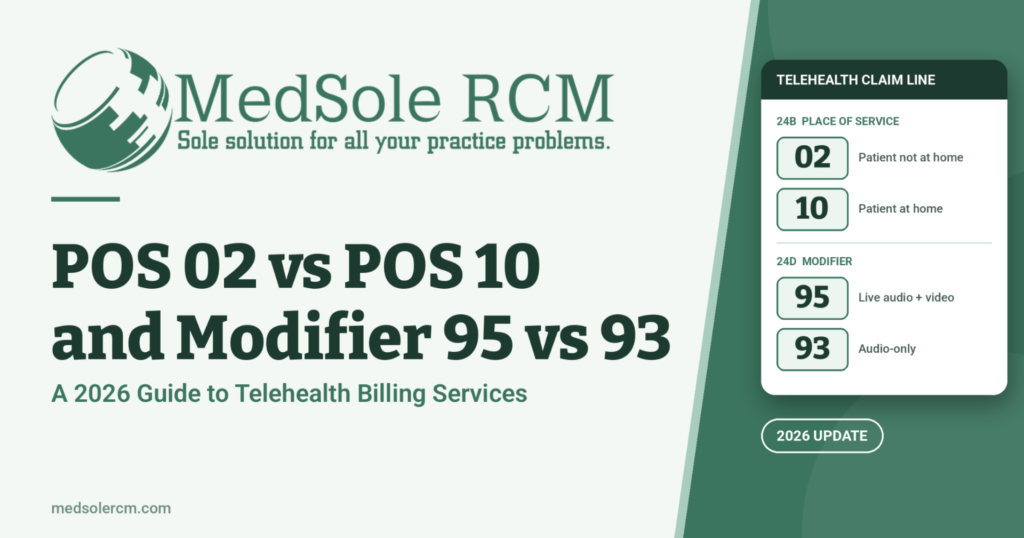
For Medicare in 2026, the place of service code says where the patient was and the modifier says how you connected. POS 10 means the patient was at home, and it pays the higher non-facility rate. POS 02 means the patient was somewhere else, and it pays the facility rate. Modifier 95 marks live audio and video; modifier 93 marks audio-only. Getting those two fields right is most of what telehealth billing services do on a clean claim.
What changed this year is the timeline. Congress extended the Medicare telehealth flexibilities through December 31, 2027, RHCs and FQHCs stopped billing G2025 on October 1, 2026, and two new modifiers, BB and BC, start January 1, 2027.
This guide is for billers, coders, and practice managers who submit telehealth claims to Medicare, Medicare Advantage, Medicaid, and commercial plans and want fewer POS and modifier denials.
What are telehealth billing services?
Telehealth billing services are the coding, claim, and follow-up work that gets a practice paid for care delivered by live video, phone, or other remote technology. That work covers picking the right CPT or HCPCS code, place of service code, and telehealth modifier for each payer, then working any denials those choices trigger.
The rules sit in three places at once: federal statute (Section 1834(m) of the Social Security Act and the yearly extensions Congress passes), CMS manuals and fee schedule rules, and each commercial or Medicaid plan’s own policy. A claim can be correct for Medicare and wrong for the patient’s Medicare Advantage plan on the same day. That gap is where most telehealth revenue leaks.
Quick reference: telehealth POS codes and modifiers
CPT is a registered trademark of the American Medical Association. Descriptors below are paraphrased.
| Code | What it tells the payer | Medicare payment effect | Rule that matters |
|---|---|---|---|
| POS 10 | Telehealth with the patient in their home | Non-facility rate since January 1, 2024 | Base it on where the patient actually sat, not on your template default |
| POS 02 | Telehealth with the patient somewhere other than home | Facility rate | Covers work, a car, a clinic, a nursing facility acting as originating site |
| POS 11 | In-person office visit | Not a Medicare telehealth POS | The old “POS 11 plus modifier 95” method ended December 31, 2023 |
| Modifier 95 | Live, two-way audio and video | Does not change the rate | Medicare’s manual says POS 02 or 10 must be paired with it for video visits |
| Modifier 93 | Live audio-only | Does not change the rate | Patient at home, you could do video, patient couldn’t or wouldn’t |
| Modifier FQ | Audio-only, historically used by RHCs and FQHCs | None | Check current MAC guidance; CR 14468 names only 93 and 95 |
| Modifier GQ | Asynchronous store-and-forward | Not applicable for most practices | Medicare limits it to federal demonstration programs in Alaska and Hawaii |
| Modifier GT | Old interactive telehealth modifier | Not used on Medicare professional claims since 2018 | Some commercial and Medicaid plans still ask for it |
| Modifier BB | Telehealth through a contracted third-party virtual platform | No payment effect, per CMS | Required starting January 1, 2027 |
| Modifier BC | Telehealth furnished incident to a professional service | No payment effect, per CMS | Required starting January 1, 2027 |
| G2025 | Old RHC/FQHC distant site telehealth code | Retired for dates of service on or after October 1, 2026 | Bill the actual CPT or HCPCS code plus 93 or 95 |
| 98000 to 98015 | CPT telemedicine E/M codes (video and audio-only) | Not payable by Medicare | Some commercial plans accept them; Medicare wants 99202 to 99215 |
| 98016 | Brief virtual check-in | Payable by Medicare | Replaced G2012 in 2025 |
What changed for telehealth billing in 2026
The biggest 2026 change was certainty. After a lapse in October 2025 and two short-term patches, the Consolidated Appropriations Act, 2026 (H.R. 7148), signed February 3, 2026, extended the Medicare telehealth flexibilities through December 31, 2027.
Changes that took effect in 2026
| Change | Effective date | Source |
|---|---|---|
| Home stays a valid originating site, with no rural or geographic limit, for non-behavioral telehealth | Extended through December 31, 2027 | Consolidated Appropriations Act, 2026; CMS Telehealth FAQ (updated October 8, 2026), Q1 |
| Audio-only telehealth to patients at home continues | Through December 31, 2027 | CMS Telehealth FAQ, Q6 |
| In-person visit requirement for mental health telehealth delayed | Does not apply until after December 31, 2027 | CMS Telehealth FAQ, Q5 |
| Frequency limits on subsequent inpatient visits, nursing facility visits, and critical care consults removed | January 1, 2026 | CY 2026 PFS final rule (CMS-1832-F, 90 FR 49266); CMS Telehealth FAQ, Q9 |
| Virtual direct supervision by real-time audio and video made permanent, except services with a 010 or 090 global period | January 1, 2026 | CY 2026 PFS final rule; CMS Telehealth FAQ, Q10 |
| CMS again declined to add CPT 98000 to 98015 to the Medicare Telehealth Services List | January 1, 2026 | CY 2026 PFS final rule |
| RHCs and FQHCs bill the individual CPT or HCPCS code plus 93 or 95 instead of G2025 | Dates of service on or after October 1, 2026 | CMS CR 14468, MLN Matters MM14468 (released May 27, 2026) |
| Originating site facility fee (Q3014) | $31.85 for CY 2026 | CY 2026 PFS final rule, as reported in the CY 2027 rule summaries |
Coming January 1, 2027
CMS released the CY 2027 PFS final rule (CMS-1848-F) on November 4, 2026, and it was published in the Federal Register on November 9, 2026. For telehealth, the parts that touch your claims are:
- Modifier BB becomes required for telehealth furnished through a virtual platform when the practitioner contracts with, or has a payment arrangement with, the platform’s owner.
- Modifier BC becomes required for telehealth furnished incident to a physician’s or practitioner’s professional service.
- Five HCPCS codes join the Medicare Telehealth Services List, including clinical staff advance care planning codes G0572 and G0573.
- The Q3014 originating site fee rises to $32.68.
- Teaching physicians can bill telehealth-list services when either the teaching physician or the resident is physically with the patient and the other joins by live audio and video.
Earlier changes still in effect
POS 10 has existed since January 1, 2022. Medicare has paid POS 10 at the non-facility rate since January 1, 2024 (CR 13582, Transmittal 12671, June 6, 2024). Since January 1, 2025, Medicare’s definition of an interactive telecommunications system includes audio-only for any telehealth service to a patient at home, under set conditions (CY 2025 PFS final rule, MLN Matters MM13887). Behavioral health telehealth to the home has been permanent law since the Consolidated Appropriations Act, 2021.
The date to watch is December 31, 2027. Unless Congress acts again, geographic and originating site limits return on January 1, 2028 for most non-behavioral services, and audio-only narrows to behavioral health.
If you’re not sure your system picked up the G2025 retirement or is ready for BB and BC in January, reviewing a sample of recent telehealth claims can help identify coding errors before they lead to denials.
POS 02 vs POS 10: choosing the place of service
Use POS 10 when the patient is in their home during the visit and POS 02 when they’re anywhere else. The practitioner’s location doesn’t decide the code. CMS’s Telehealth FAQ (Q8) and the Medicare Claims Processing Manual, Chapter 26, both tie the choice to the patient’s location.
The money is real. Under the 2026 Medicare Physician Fee Schedule, the national amount for 99214 is $135.61 non-facility and $84.50 facility, before geographic adjustment. That’s a $51.11 gap on one established patient visit, and it comes down to a single field your front desk or EHR template fills in.
How to decide when it isn’t obvious
CMS’s POS 10 descriptor describes home as a private residence, as opposed to a hospital or other facility where the patient receives care. In earlier rulemaking for mental health services, CMS read “home” broadly enough to include temporary lodging such as hotels and homeless shelters. Outside that, keep it simple: if the patient isn’t at their own residence, POS 02 is the safer code.
A patient in a skilled nursing facility, a clinic, or a hospital acting as the originating site is POS 02. A patient on a lunch break in their office is POS 02. A patient at their kitchen table is POS 10.
Worked example
On March 10, 2026, a family medicine practice runs a 99214 video visit. The note says “Patient seen via video from her vehicle in her employer’s parking lot.” The EHR template defaulted to POS 10.
The correct claim line is 99214-95 with POS 02. Billing POS 10 would have collected about $51 more at the national rate than the visit supports, and an auditor reading the note would see the mismatch right away. Repeated across a year of visits, that adds up to an overpayment the practice would have to return.
Common mistake and fix
Most often, the error starts with a telehealth visit type that hard-codes POS 10. Fix it by making patient location a required field at the start of the visit, asked by the clinician or the intake script (“Where are you right now?”), and mapping POS from that answer instead of from the visit type.
Modifier 95 vs 93: video, audio-only, and the dropped call
Append modifier 95 when the visit ran on live, two-way audio and video. Append modifier 93 when it ran on live audio-only. For Medicare professional claims, Chapter 26 of the Claims Processing Manual says POS 02 or POS 10 must be paired with the appropriate telehealth modifier, and that the modifier doesn’t change the payment rate. The POS sets the rate.
Some vendor articles say Medicare needs no modifier on a video visit because the POS already flags telehealth. The manual says otherwise, and adding 95 costs nothing. Add it.
When audio-only qualifies
Modifier 93 carries more weight than 95, because it attests to conditions. Under 42 CFR 410.78(a)(3), audio-only counts as an interactive telecommunications system for a service to a patient in their home when the distant site practitioner is technically able to use video and the patient can’t use video or doesn’t consent to it. Through December 31, 2027, CMS allows audio-only for telehealth services to patients at home generally. From January 1, 2028, absent new legislation, it narrows to behavioral health.
On the CPT side, modifier 95 applies to codes in Appendix P and modifier 93 to codes in Appendix T. The two appendices don’t match Medicare’s lists code for code. A commercial plan that follows CPT strictly may reject 93 on a code Medicare accepts, so check the plan’s policy before you assume.
Worked example: the video drops
An established patient starts a 99213 follow-up on video at 2:00 p.m. The video freezes at 2:04, the patient can’t reconnect, and the physician finishes the visit by phone at 2:19, with the assessment and plan discussed on the call.
Neither CMS nor CPT publishes a minute-based rule for a visit that switches modality partway through. The conservative approach most compliance teams use is to report the modality that carried the substance of the visit. Here, the history, review, and decision making happened by phone, so 99213-93 with POS 10 is defensible, with a note that video failed and the patient couldn’t reconnect. If video had dropped in the last two minutes after the plan was set, 95 would be the better fit. Write your rule down and apply it the same way every time.
Common mistake and fix
Practices bill 93 without documenting why video wasn’t used. The note should say the practitioner was able to use video and the patient couldn’t or declined. One sentence covers it, and without it the 93 claim has nothing standing behind it in an audit.
Telehealth billing services by payer type
Medicare’s rules are national, but every other payer writes its own. Before you set up claim edits, sort your telehealth volume by payer and pull each plan’s current telehealth policy. Requirements vary by payer and state, and plans change them midyear.
| Payer type | Typical POS expectation | Typical modifier expectation | Codes |
|---|---|---|---|
| Original Medicare | POS 02 or POS 10 only | 95 for video, 93 for audio-only; BB/BC from 2027 | 99202 to 99215 and other telehealth-list codes; not 98000 to 98015 |
| Medicare Advantage | Varies by plan | Varies by plan | Usually follows Medicare codes; check the plan’s policy |
| Medicaid | Varies by state | Varies by state; some still use GT | State fee schedule decides |
| Commercial | Varies by plan | Often 95; some want none on 98000 series | Some accept 98000 to 98015 |
Medicare Advantage example
Humana’s claims payment policy on telehealth and virtual services lets providers report POS 02, POS 10, or the POS they would have used in person with modifier 93 or 95. That’s more flexible than Original Medicare, and it means the same visit can be correct two different ways on two different Medicare products. Your claim scrubber needs the specific plan to pick the right rule, because “Medicare” on its own isn’t enough.
MAC-specific notes
First Coast Service Options (the Jurisdiction N MAC) states on its telehealth services page that opioid treatment programs use POS 58 for all OTP services, including those furnished by audio-video or audio-only. That’s an exception to the POS 02/10 rule worth knowing if you bill for an OTP. Check your own MAC’s telehealth page, because MAC articles carry details the national manuals leave out.
Worked example: one visit, three payers
A moderate-complexity established video visit with the patient at home bills like this:
- Original Medicare: 99214-95, POS 10.
- A Medicare Advantage plan following Humana-style policy: 99214-95 with POS 10, or with POS 11 if the plan’s policy allows it.
- A commercial plan that adopted the CPT telemedicine codes: 98006 (established patient, synchronous audio-video, moderate decision making), often with no 95, because the code descriptor already says video. Confirm the plan’s modifier rule.
Common mistake and fix
Billing 98000-series codes to Original Medicare. CMS declined to add 98000 to 98015 to the Medicare Telehealth Services List again in the CY 2026 final rule, so those lines deny. Build a payer-level edit that swaps them for 99202 to 99215 on Medicare claims before submission.
RHC and FQHC telehealth billing after G2025
For dates of service on or after October 1, 2026, RHCs and FQHCs bill the individual CPT or HCPCS code that describes the distant site telehealth service, with modifier 93 or 95 and the appropriate revenue code, instead of G2025. CMS set this out in CR 14468 (Transmittal R13776OTN), with an implementation date of October 5, 2026.
Payment doesn’t move to the all-inclusive rate or the PPS. Non-behavioral telehealth is still paid at a special rate based on the volume-weighted average of PFS telehealth services, with no geographic adjustment. CMS’s FQHC/RHC announcements page lists the CY 2027 rate as $102.78. For cost sharing, RHC patients owe coinsurance and deductible, and FQHC patients owe coinsurance but not the deductible. Preventive services waive both.
Mental health visits by telecommunications are different. Since January 1, 2022, RHCs and FQHCs have billed them like in-person mental health visits, paid under the AIR or PPS, and that didn’t change.
Worked example
An FQHC nurse practitioner sees an established diabetic patient by video on October 14, 2026. Before October 1, the claim line would have been G2025-95. Now it’s 99213-95 on the institutional claim with the appropriate revenue code. If the visit had been by phone because the patient couldn’t use video, the line becomes 99213-93.
Common mistake and fix
Charge masters that still map telehealth visit types to G2025 can cause billing problems, whether the clinic handles claims internally or uses outside billing support. Review telehealth claims dated October 1, 2026, or later to identify any that incorrectly use G2025. Claims containing errors should be reviewed and corrected according to applicable payer requirements.
Documentation and diagnosis linking for telehealth claims
The note has to support every field the claim uses to describe the visit as telehealth. If the claim says POS 10 and modifier 93, the note needs to show the patient was at home and why the visit was audio-only. Auditors compare the claim fields to the note, line by line.
What the note should show
- Patient location at the start of the visit, specific enough to support POS 02 or 10
- Modality used (video, phone, or a switch partway through)
- For audio-only, that video was available and the patient couldn’t use it or declined
- Practitioner location if the payer or state asks for it
- Total time, when the code is selected on time
- Starting in 2027, whether the visit ran on a contracted third-party platform (BB) or was furnished incident to (BC)
Keep a list of which platforms your practice uses and who owns each one. The BB question will come up on every visit, and the front desk won’t know the answer unless someone writes it down.
Diagnosis linking
No ICD-10-CM code identifies a visit as telehealth. Modality goes in the modifier and location goes in the POS. The diagnosis follows the same coding rules as an in-person visit, which means the same specificity expectations.
| Visit scenario | ICD-10-CM code | Description | Why it fits | Verified |
|---|---|---|---|---|
| Diabetes follow-up, glucose log shows highs | E11.65 | Type 2 diabetes mellitus with hyperglycemia | Documented hyperglycemia supports the more specific code | November 19, 2026 (FY 2027 code set) |
| Blood pressure check with home cuff readings | I10 | Essential (primary) hypertension | Standard for uncomplicated hypertension | November 19, 2026 (FY 2027 code set) |
| Medication management, anxiety | F41.1 | Generalized anxiety disorder | Use when GAD is documented | November 19, 2026 (FY 2027 code set) |
| Psychotherapy, recurrent depression | F33.1 | Major depressive disorder, recurrent, moderate | Episode and severity documented | November 19, 2026 (FY 2027 code set) |
| Depression with no type documented | F32.A | Depression, unspecified | Valid, but query the provider if a more specific diagnosis is documented elsewhere | November 19, 2026 (FY 2027 code set) |
| Back pain follow-up by video | M54.50 | Low back pain, unspecified | Valid since FY 2022; replaced M54.5 | November 19, 2026 (FY 2027 code set) |
Common mistake and fix
Coders sometimes pick unspecified codes on telehealth visits because “there wasn’t an exam.” The diagnosis comes from the provider’s assessment, not the exam. If the note documents recurrent moderate depression, F33.1 is the code whether the patient was on video or in the room.
Common telehealth denials and how to fix them
Most telehealth denials come from the POS, the modifier, or a code the payer doesn’t allow as telehealth. Working them is the bulk of the follow-up side of telehealth billing services. Read the remark code with the reason code, because the same CARC can mean different things depending on what’s paired with it.
| Reason code | Meaning | Typical trigger | Fix |
|---|---|---|---|
| CO-5 with M77 | Procedure code or bill type is inconsistent with the place of service; POS missing, invalid, or inappropriate | POS 11 on a telehealth line, or POS 02/10 on a code not allowed as telehealth | Correct the POS from the note, or confirm the code is on the payer’s telehealth list |
| CO-16 with M77 | Claim lacks information or has a billing error; POS problem | Missing POS, or claims returned during a coverage lapse | Correct and resubmit; for lapse-period claims, check CMS instructions before resubmitting |
| CO-4 (often with N519) | Procedure code is inconsistent with the modifier | 95 on a code the payer doesn’t allow by video, 93 on a code outside the plan’s audio-only list, GT sent to Medicare | Check Appendix P or T and the payer’s list; remove or change the modifier |
| CO-58 (often with N428) | Treatment deemed rendered in an inappropriate or invalid place of service | Payer doesn’t cover that service by telehealth | Check the plan’s telehealth policy; bill as non-covered or appeal with policy language |
Worked example: the shutdown lapse claims
When the flexibilities lapsed on October 1, 2025, many MACs held or denied non-behavioral telehealth claims for patients at home. On November 6, 2025, CMS told MACs to return a subset of those claims to providers, and Part B MACs used CARC 16 with RARC M77 on the returns. After the continuing resolution restored the flexibilities retroactively, CMS rescinded its earlier instruction to append the GY modifier and said providers could resubmit previously denied claims.
A practice that wrote those returns off as “telehealth not covered” left money behind. The right move was to pull every CO-16/M77 telehealth line with an October or early November 2025 date of service, confirm the claim met the restored rules, and resubmit inside timely filing.
Common mistake and fix
Teams fix the single denied claim and move on. When a CO-5/M77 shows up on a telehealth line, check the visit type setup that produced it, because the same template is sending the same error on every visit. Good denial management traces each denial back to the setup that caused it and fixes that too.
If the same telehealth denials keep coming back after corrections, the cause may be an upstream issue in the billing system, claim template, or payer-specific coding rules. Reviewing recurring denial patterns can help identify the underlying problem and prevent additional errors.
Cost of outsourcing and choosing a billing partner
Outsourced billing, including telehealth billing services, is usually priced as a percentage of collections. Published 2026 pricing guides from billing vendors, such as Neolytix and Helpware, put the common range at 4% to 10% of net collections, with per-claim pricing often quoted at $3 to $12. Those are vendor-published figures and carry the vendors’ own interest, so treat them as a starting point.
How to compare effective rates
The headline percentage isn’t what you pay. Monthly minimums and setup fees raise the real rate, especially for smaller practices or a telehealth line that’s still growing.
Take a practice collecting $15,000 a month:
- Vendor A quotes 3.5% with a $750 monthly minimum and a $2,000 setup fee. 3.5% of $15,000 is $525, so the minimum kicks in at $750. Spread the setup fee over 12 months ($167) and the first-year cost is about $917 a month, roughly 6.1% of collections.
- Vendor B quotes 5% with no minimum and no setup fee. That’s $750 a month, exactly 5%.
The lower quote costs more. Also confirm whether the percentage applies to net collections or gross charges, because a percentage of charges is a much bigger number.
Questions to ask a vendor
- Is the percentage on net collections or gross charges?
- Is there a monthly minimum, a setup fee, or a termination fee?
- Who updates telehealth POS and modifier rules per payer, and how fast after a change like G2025 or BB/BC?
- Are denial follow-up and appeals included in the base rate or billed separately?
- Can you show telehealth denial rates broken out by payer?
- How long is the contract, and can we leave month to month?
- Do you handle credentialing for new telehealth providers and states, and what does it cost?
| Pricing structure | What to check | What it does to the real rate |
|---|---|---|
| Percentage of collections only | Net vs gross base | Closest to the quoted rate |
| Percentage plus monthly minimum | Minimum vs your actual collections | Raises the rate when volume is low |
| Percentage plus setup fee | Amount and what it covers | Raises the first-year rate |
| Per-claim fee | Whether resubmissions count as new claims | Can rise with denials |
| Separate denial or AR fee | Percentage on recovered dollars | Adds cost on the hardest claims |
Evaluating Billing Service Pricing and Terms
Medical billing companies may charge a percentage of collections, a flat monthly fee, or separate fees for services such as denial management, accounts receivable follow-up, and credentialing. Practices should compare not only the quoted rate but also setup costs, monthly minimums, contract terms, claim submission timelines, and the services included. Requesting a written breakdown can help identify the actual cost of outsourcing and make comparisons between providers more meaningful.
When comparing medical billing services, consider the total cost, contract flexibility, denial management capabilities, and experience with your practice’s payer mix. The lowest advertised rate does not necessarily represent the lowest overall cost.
FAQ
When should I use POS 10 instead of POS 02?
Use POS 10 when the patient is in their home during the telehealth visit. Use POS 02 when the patient is anywhere else, such as work, a car, or a facility. Medicare pays POS 10 at the non-facility rate and POS 02 at the facility rate, so the patient’s actual location, documented in the note, should drive the choice.
Does Medicare require modifier 95 on video visits?
Yes. The Medicare Claims Processing Manual, Chapter 26, says POS 02 or POS 10 must be paired with the appropriate telehealth modifier: 95 for audio and video, 93 for audio-only. The modifier doesn’t change Medicare’s payment, but leaving it off invites edits and audit questions. Commercial plans set their own rules, so check each policy.
When can I bill modifier 93 for an audio-only visit?
For Medicare, use 93 when the patient is at home, the practitioner could have used video, and the patient couldn’t use video or didn’t consent to it. Through December 31, 2027, that applies to telehealth services generally. Document why video wasn’t used. Commercial plans may limit 93 to codes on CPT Appendix T.
Are telehealth billing services different for RHCs and FQHCs now?
Yes. For dates of service on or after October 1, 2026, RHCs and FQHCs bill the actual CPT or HCPCS code with modifier 93 or 95 instead of G2025, under CMS CR 14468. Payment still uses a special national rate for non-behavioral telehealth. Mental health visits by telecommunications stay under the all-inclusive rate or PPS.
Can I bill CPT 98000 to 98015 to Medicare?
No. CMS declined to add the telemedicine E/M codes 98000 to 98015 to the Medicare Telehealth Services List in both the CY 2025 and CY 2026 final rules. Bill 99202 to 99215 with POS 02 or 10 and modifier 95 or 93 instead. CPT 98016, the brief virtual check-in, is payable by Medicare.
What are modifiers BB and BC?
They’re new Medicare telehealth modifiers required starting January 1, 2027. BB marks telehealth delivered through a virtual platform when the practitioner contracts with, or pays, the platform’s owner. BC marks telehealth furnished incident to a physician’s or practitioner’s service. CMS says neither affects payment, but claims should carry them when they apply.
How long do the Medicare telehealth flexibilities last?
Through December 31, 2027, under the Consolidated Appropriations Act, 2026. Until then, patients can receive Medicare telehealth at home anywhere in the country, and audio-only is allowed at home. Starting January 1, 2028, most non-behavioral services return to the old geographic and originating site limits unless Congress extends them again.
Other Articles You May Find of Interest...
- POS 02 vs POS 10 and modifier 95 vs 93: A 2026 guide to telehealth billing services
- 8 Companies that Handle Both Medical Billing and Patient Support for Growing Practices
- Understanding the Costs of a Skilled Nursing Stay
- Dental Medical Billing in 2027: Which Procedures Qualify and How to Get Paid
- Top 4 Reasons for Medical Claim Denials
- Comparing Charge Capture Tools: What Medical Practices Need to Know
- 5 Plastic Surgery Billing Companies in Florida for 2026