






More Kratom Education Articles
Super Indo Kratom Review: Effects, Benefits & Alkaloid Profile Explained

Here’s something most kratom buyers don’t realize.
Some of the most consistently reviewed strains aren’t the ones with the loudest marketing.
Super Indo kratom has been sitting in Western markets for years.
Yet it rarely gets the attention that Maeng Da or Red Bali command.
That gap exists partly because buyers don’t fully understand what “Super Indo” actually means.
The word “Super” isn’t just a sales tactic.
It refers to a specific leaf selection method that distinguishes this variety from standard Indonesian kratom.
That distinction has real implications for alkaloid density and overall product quality.
Indonesia is the world’s largest kratom exporter.
Sumatra, Borneo, and surrounding islands produce the majority of global kratom supply.
Super Indo comes from that same region — but the way it’s sourced creates a different conversation.
If you’ve been researching kratom and keep finding recycled descriptions, this article provides more grounded information.
We’re covering what Super Indo kratom is, how it’s harvested, what alkaloid science shows, and what buyers should realistically understand.
Defining Super Indo Kratom
Super Indo kratom is sourced from Indonesia and selected using a specific leaf-picking method.
The “Super” designation refers to hand-selecting only the largest, most mature leaves from Mitragyna speciosa trees.
Larger leaves accumulate alkaloids over a longer growth period.
The logic behind “Super” selection is that you’re working with the most developed leaf material from each harvest cycle.
“Indo” simply indicates Indonesian origin — covering Sumatra, Borneo, and Java broadly.
So Super Indo kratom combines two elements: mature leaf selection and Indonesian regional sourcing.
Both shape its general profile in ways worth understanding before buying.
What the “Super” Label Really Signals
Buyers often assume “Super” is just premium pricing on ordinary product.
That skepticism is reasonable given how inconsistent kratom naming is overall.
But the “Super” label has a more specific historical meaning in the kratom trade.
It describes a physical process: choosing oversized canopy leaves with maximum sun exposure and longer alkaloid development time.
The catch is that this process has no regulatory oversight.
Any vendor can label Indonesian kratom as “Super Indo” without meeting a defined standard.
This is exactly why third-party testing and vendor transparency matter more than what the package says.
Physical Traits Worth Knowing
Super Indo kratom shares the same base species as all other kratom: Mitragyna speciosa.
What distinguishes it is the selection criteria applied during harvest.
Key characteristics:
- Leaf size: Larger than average; selected from mature canopy branches
- Vein color options: Available in green, red, and white depending on harvest timing
- Origin: Indonesia, commonly Sumatra or Kalimantan
- Powder appearance: Medium to brownish-green depending on vein type and drying method
Vein color matters here.
Green vein Super Indo is harvested mid-cycle.
Red vein comes from later, more mature harvests.
White vein is picked earlier before full alkaloid development.
Each variant carries a different alkaloid ratio as a direct result of when it was harvested.
Alkaloids: What the Science Currently Shows
Kratom’s active compounds are mitragynine and 7-hydroxymitragynine.
Both interact with opioid receptors in the body, which is why kratom draws significant research attention and regulatory scrutiny simultaneously.
The large-leaf selection behind Super Indo kratom is theorized to concentrate higher mitragynine content.
But controlled research comparing “Super” versus standard leaf selection remains limited.
What current data does show:
- Mitragynine typically comprises 60–70% of total kratom alkaloid content
- 7-hydroxymitragynine is present in smaller concentrations but has stronger receptor binding affinity
- Alkaloid levels vary significantly between batches, trees, soil conditions, and processing methods
Lab-verified Certificates of Analysis remain the most reliable tool for assessing what’s actually in any specific product.
Claims about alkaloid content without testing documentation should be treated skeptically.
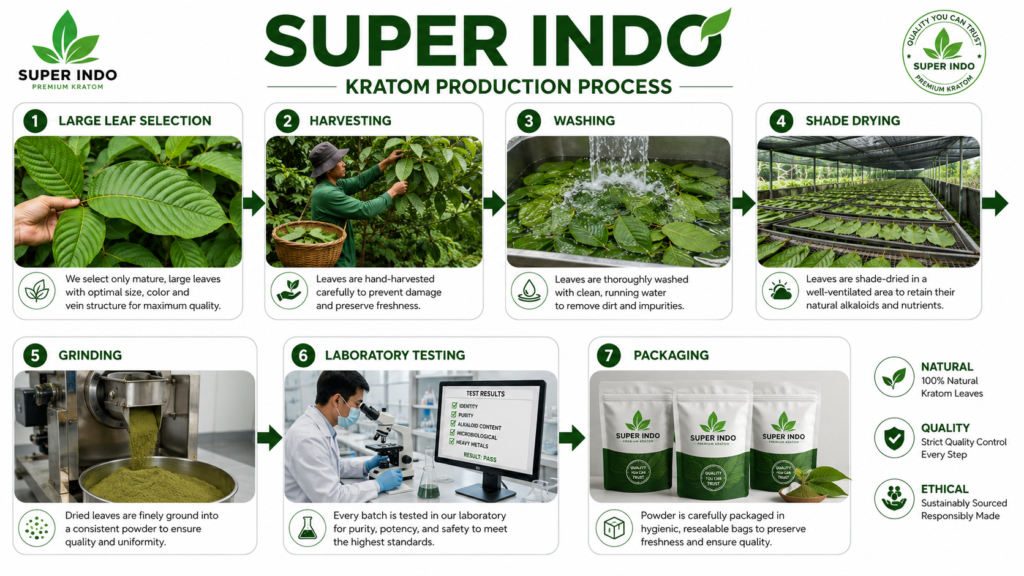
Harvesting and Processing: Where Quality Is Won or Lost
The journey from tree to finished powder involves multiple steps — and quality can slip at any one of them.
Leaf selection is where Super Indo diverges from standard Indo kratom.
Experienced harvesters identify and pick only the oversized mature leaves.
This is labor-intensive, which partly explains the slightly higher price point.
Washing removes surface debris and begins sanitation.
Inadequate washing is a known entry point for microbial contamination.
Drying is one of the most consequential processing variables.
Shade or indoor drying preserves alkaloid integrity better than direct sun exposure.
Grinding converts dried leaves into fine powder.
Mesh sifting during this stage affects texture and can influence alkaloid concentration in the finished product.
Storage matters more than most buyers consider.
Heat, moisture, and UV light degrade alkaloids before the product reaches the consumer.
Super Indo vs Other Popular Strains
| Strain | Common Description | Key Characteristics | Important Limitation |
| Super Indo Kratom | Large-leaf selected Indonesian variety | Mature leaf harvest; red, green, white vein options | “Super” label is unregulated — vendor verification is essential |
| Red Bali Kratom | Widely available red vein variety | Large-scale production from Bali and Borneo regions | High availability increases risk of inconsistent quality |
| Green Malay Kratom | Mid-harvest green vein strain | Smooth alkaloid profile; widely used | “Malaysian” origin labeling is often applied loosely |
| Maeng Da Kratom | High-profile, heavily marketed variety | Often a blend; not a geographic origin name | No standardized definition; inconsistent across vendors |
| White Borneo Kratom | Early-harvest white vein from Borneo | Distinct alkaloid ratio from early picking | White color sometimes produced through processing, not natural harvest |
Roots and Western Market Context
Kratom use in Indonesia spans centuries.
In Sumatra and Kalimantan, kratom leaves were traditionally chewed by agricultural workers as part of daily rural life.
Western markets discovered it in the early 2000s, and demand has grown steadily since.
Indonesia remains the dominant global supplier.
Its climate, biodiversity, and soil conditions make it uniquely suited for Mitragyna speciosa cultivation.
The American Kratom Association (AKA) has developed voluntary Good Manufacturing Practice (GMP) standards for U.S. vendors.
AKA-certified vendors undergo audits covering sanitation, testing protocols, labeling accuracy, and storage practices.
While not a government certification, AKA GMP compliance is currently the most credible quality benchmark available in the domestic market.
What Consumers Commonly Report
Consumer feedback on Super Indo kratom follows consistent patterns across forums and review platforms.
Common themes include:
- Green vein Super Indo frequently described as a middle-ground option between red and white
- Red vein Super Indo often compared favorably to Red Bali for alkaloid density
- Batch-to-batch consistency described as variable depending on vendor sourcing
- Overall profile described as more balanced compared to white vein varieties
These are anecdotal reports — not clinical evidence.
Individual responses vary based on body weight, metabolism, tolerance, and product quality.
Safety, Testing, and Legal Considerations
Important Notice: Kratom is not approved by the U.S. Food and Drug Administration (FDA) for any medical use. Regular use may lead to physical dependence and withdrawal symptoms. Kratom may interact with prescription medications, including opioids, antidepressants, and other substances. Anyone considering using kratom should consult a qualified healthcare provider before doing so.
Third-party lab testing is non-negotiable for any reputable vendor.
A Certificate of Analysis should cover:
- Mitragynine and 7-hydroxymitragynine concentrations
- Heavy metal screening (lead, arsenic, cadmium, mercury)
- Microbial testing (salmonella, E. coli, yeast and mold counts)
- Pesticide residue screening
AKA GMP certification signals a vendor has passed independent manufacturing audits.
Label transparency should include net weight, batch number, serving size, and harvest or production date.
U.S. legal status: Kratom is federally legal, but banned or restricted in Alabama, Arkansas, Indiana, Rhode Island, Vermont, and Wisconsin.
Some municipalities carry additional local restrictions.
Internationally, kratom is illegal in Malaysia, Singapore, Australia, and several European countries.
Always verify local regulations before purchasing.
Four Misconceptions That Keep Circulating
Misconception: “Super” means it’s stronger than every other strain.
Reality: “Super” refers to leaf size selection, not a universal potency ranking. A poorly processed Super Indo can have lower alkaloid content than a well-sourced standard Indo kratom.
Misconception: The selection process guarantees consistent quality.
Reality: Alkaloid content still varies by batch, season, tree, and processing method. Large-leaf selection improves starting material but doesn’t eliminate variability in finished products.
Misconception: All vendors using the “Super Indo” label follow the same sourcing method.
Reality: The label is unregulated. Some vendors apply it to large-leaf selected material; others use it as a general quality descriptor with no defined physical standard behind it.
Misconception: Green, red, and white Super Indo kratom are basically the same product.
Reality: Vein color reflects harvest timing and produces meaningfully different alkaloid profiles. They’re related varieties within the same category — not interchangeable products.
Frequently Asked Questions
What makes Super Indo kratom different from regular Indo kratom?
The primary difference is leaf selection. Standard Indo kratom uses mixed leaf harvests without a size filter. Super Indo involves hand-selecting the largest, most mature leaves, which theoretically yields higher alkaloid content in the starting material. Whether that difference holds in the finished product depends on vendor sourcing and processing quality. Third-party lab testing comparing alkaloid levels between Super and standard Indo batches from the same origin is the most reliable way to verify whether the distinction is meaningful for any specific product you’re considering.
Does vein color matter when selecting Super Indo kratom?
Yes, significantly. Vein color reflects harvest timing and directly affects alkaloid ratios. Green vein is harvested mid-cycle with a balanced profile. Red vein is picked later with more developed 7-hydroxymitragynine content. White vein is harvested earliest, before full alkaloid maturation. Each variant has a distinct chemical composition as a result. Most buyers explore different vein types to understand which profiles align with their preferences, though individual responses vary considerably based on physiology, tolerance, and the quality of the specific product being used.
How do I evaluate a Super Indo kratom vendor before buying?
Start with the Certificate of Analysis. Look for independent lab results showing mitragynine levels, 7-hydroxymitragynine content, and screenings for heavy metals, microbial contamination, and pesticides. Check for AKA GMP certification. Review the product label for batch numbers, net weight, and serving size. Vendor transparency about sourcing and processing practices is a stronger reliability signal than price or marketing claims. Vendors who cannot produce documentation on request are worth avoiding regardless of how their product is labeled.
Is Super Indo kratom widely available?
Yes. Super Indo is stocked by most established kratom vendors in legal states and is available in green, red, and white vein formats. It receives less marketing attention than Maeng Da or Red Bali, but that reflects positioning, not scarcity. The real challenge isn’t finding it — it’s finding vendors who document their sourcing, publish current lab results, and follow consistent manufacturing standards. Availability without accountability does not benefit the buyer.
What formats does Super Indo kratom come in?
Super Indo is available as loose powder, capsules, and extracts. Powder is the most common and cost-effective format. Capsules offer pre-measured servings without the taste factor. Extracts use concentration methods to amplify alkaloid content and are considerably more potent per unit — a difference that matters for dosing awareness. Some consumers prepare kratom tea using powder, though heat exposure can degrade certain alkaloids during preparation. Format choice affects onset experience, convenience, and cost per serving.
The Bottom Line
Super Indo kratom occupies a specific position in the market — defined by a leaf selection process that prioritizes mature, large-leaf material from Indonesian-origin trees.
The “Super” designation has a real meaning, but no regulatory enforcement behind it.
That makes vendor verification more important than anything printed on the label.
Understanding vein color distinctions, the alkaloid science, and supply chain variables gives buyers a more accurate picture than most product pages provide.
Quality indicators — third-party testing, AKA GMP certification, sourcing transparency, and clear labeling — matter more than strain names when evaluating any kratom product.
Super Indo kratom is a well-established category with genuine characteristics.
Understanding those characteristics is the most useful starting point for any informed decision.
Other Articles You May Find of Interest...
- How HPLC Testing Verifies Botanical Potency—and Why Lab Results Can Differ
- Red Bali Kratom: What It Is, How It Differs, and What the Research Says
- Kratom Legality in 2026: Why the Rules Vary by Location
- 7 Things to Know About Split Kilo Kratom Before a Bulk Order
- Red Thai Kratom: The Strain With a Complicated History and a Loyal Following
- Red Sumatra Kratom: What Makes This Strain Stand Apart
- Red Indo Kratom: The Strain That Built the Modern Kratom Market
Featured Doctors and Practices





