More Kratom Education Articles
Red Bentuangie Kratom: What Makes This Fermented Strain Different

The majority of kratom users group red vein varieties together. They believe that all red vein kratom shares the same origins, undergoes the same processing, and produces the same result. This assumption is incorrect.
Red Bentuangie Kratom differs from most other red vein varieties available on the market. Its uniqueness has nothing to do with where it grows and everything to do with how it is processed.
Kratom has been part of Southeast Asian culture for centuries. Not all leaves receive the same treatment after harvest. Some are dried. Some are fermented. That difference matters more than most people realize.
Bentuangie is commonly described as undergoing a fermentation process that distinguishes it from many other commercially available kratom varieties. The alkaloid profile changes in ways that researchers are still studying to better understand.
The kratom market has grown rapidly, with numerous varieties competing for shelf space. Understanding what distinguishes one product from another requires looking beyond advertising and into production techniques.
This article explains Red Bentuangie Kratom from the beginning — where it originates, how it is made, what differentiates it from other strains, and what to look for when evaluating quality.
The Origins of the Name Bentuangie
The name Bentuangie refers to a region within Borneo. Borneo is a large island shared by Indonesia, Malaysia, and Brunei. The majority of commercial kratom cultivation occurs on the Indonesian side of Borneo.
The Bentuangie region lies within the interior rainforest belt — dense canopy, high humidity, and rich soil. These conditions support robust Mitragyna speciosa growth. The trees produce broad leaves with high moisture content, which makes them well-suited for fermentation.
“Red” in the name refers to the color of the leaf veins at the time of harvest. Red-veined leaves are generally older than white or green vein varieties.
Some sellers label this product as Bentuangie Red Kratom or Indo Bentuangie. The underlying material behind those names is typically the same.
How Fermentation Changes the Leaf
Fermentation is the primary distinguishing step in the production of Red Bentuangie.
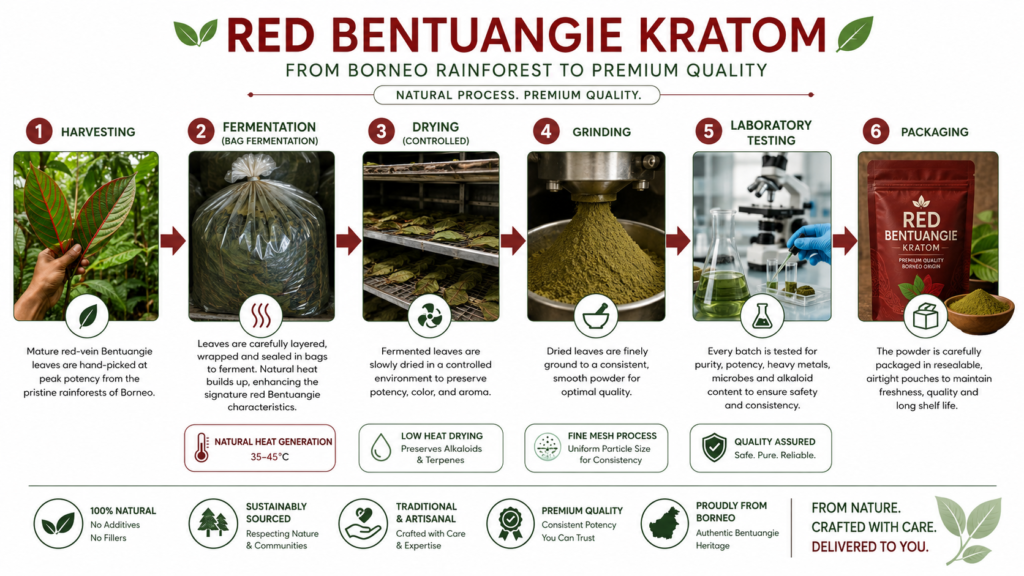
After harvest, the leaves are not dried in the sun as most other varieties are. Instead, they are placed in burlap or large bags and allowed to ferment over an extended period.
During fermentation, heat builds inside the bag. Moisture remains trapped. Chemical and biological reactions occur within the leaf material.
Fermentation may alter the relative composition of naturally occurring alkaloids, although the specific chemical changes are still being studied.
This is why the alkaloid profile of Red Bentuangie Kratom differs from standard red vein varieties produced in the same region. The fermented leaf has a distinct smell, appears darker than typical dried kratom, and contains a different ratio of compounds compared to non-fermented alternatives.
Alkaloid Profile: What the Research Shows
Kratom leaves contain a range of alkaloids. The two that researchers focus on most are mitragynine and 7-hydroxymitragynine.
Standard red vein kratom typically contains moderate to high levels of mitragynine. Fermentation in Bentuangie leaves is believed to reduce mitragynine levels while potentially increasing certain oxidized alkaloids.
The full picture is still developing. Kratom research is relatively new, and studies on strain-specific alkaloid variation are limited.
Research suggests fermentation can alter the alkaloid profile, although the full effects remain under investigation. Minor alkaloids such as speciociliatine and speciogynine may be present in higher relative amounts compared to mitragynine in fermented material.
These distinctions are relevant for consumers trying to understand product differences. Two red vein kratom products placed side by side may have meaningfully different compound ratios if one underwent fermentation and the other did not.
Comparing Red Bentuangie to Other Red Vein Strains
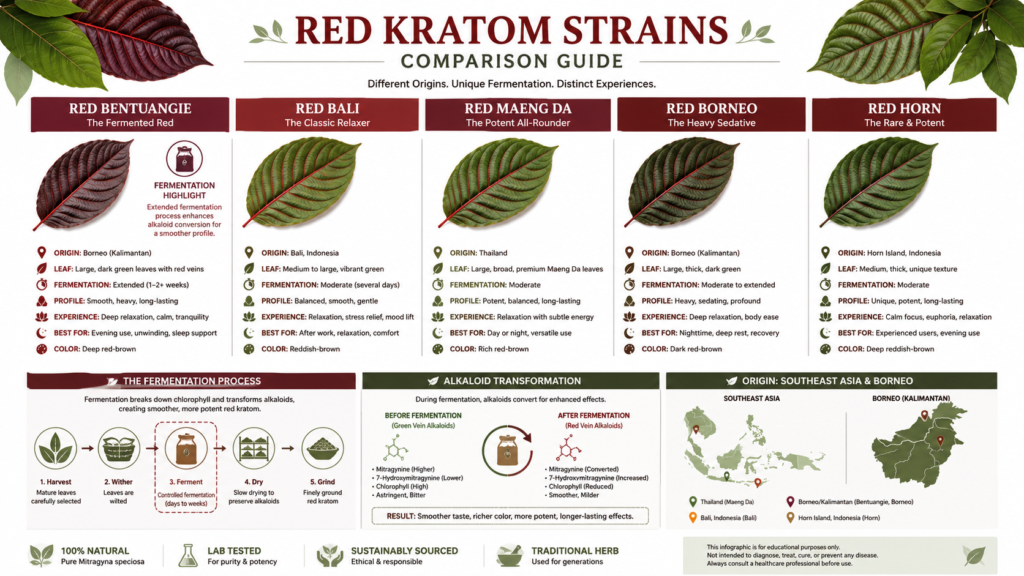
| Strain | Common Description | Key Characteristics | Important Limitation |
| Red Bentuangie | Fermented Borneo strain | Unique alkaloid conversion, dark coloration, distinct aroma | Limited peer-reviewed research on fermented-specific effects |
| Red Bali | Most widely available red vein | Standard drying process, consistent availability | Profiles vary by vendor batch and source |
| Red Maeng Da | Often marketed as high-potency | Typically grafted or selectively harvested leaves | Quality varies widely under this name |
| Red Borneo | General Borneo red vein, non-fermented | Similar geographic source to Bentuangie, different process | May be mislabeled without third-party testing |
| Red Horn | Named for spiked leaf edges | Rarer variety, Borneo origin | Very little independent confirmation of strain identity |
This comparison illustrates an important point: geographic origin is only part of the picture. The processing method is equally significant.
What Consumers Report About This Strain
Consumer accounts for Red Bentuangie Kratom are not uniform. They vary based on batch, vendor, and individual factors.
Common observations reported in user communities include:
- A distinctive earthy, musty aroma attributed to fermentation
- Reports of a smoother experience compared to other red vein varieties
- A darker, more brownish powder color compared to standard red vein products
- A slower onset, according to some user reports — though this is anecdotal
These observations come from community boards, forums, and product reviews. They are not clinical research data. They do, however, suggest that experienced kratom users notice differences between fermented and non-fermented red vein varieties.
Harvesting and Processing Quality Considerations
Fermentation requires controlled conditions to produce a consistent product.
If not properly managed, fermentation can lead to mold growth, irregular alkaloid levels, and degradation of leaf quality.
Reliable suppliers work with farmers who understand the importance of fermentation timing. Duration matters significantly. Too short, and the alkaloid transformation is incomplete. Too long, and the leaf material degrades.
Moisture and temperature control during fermentation affect the finished product.
After fermentation, the leaves are dried and ground into a fine powder. Some products use a standard grind; others undergo a superfine milling process.
Buyers should look for suppliers who can describe their sourcing and processing in specific detail. Vague references to “traditional Indonesian processing” are insufficient.
Safety, Testing, and Regulatory Context
Important: Kratom is not approved by the FDA for any medical use. Kratom may cause physical dependence, withdrawal symptoms, and adverse health effects. It may also interact with prescription medications, over-the-counter drugs, and other substances. Anyone considering kratom use should consult a licensed healthcare provider before doing so.
Kratom operates within a complex legal environment in the United States. The FDA has not approved kratom for any medical condition. The DEA has reviewed kratom on multiple occasions but has not reached a federal scheduling decision.
Many U.S. states have enacted their own regulations, including age restrictions and registration requirements. The Kratom Consumer Protection Act has been adopted in several states.
Within this regulatory environment, third-party lab testing is the most important safety tool available to consumers.
Responsible third-party testing should include:
- Alkaloid quantification — confirming the presence and levels of mitragynine and 7-hydroxymitragynine
- Heavy metal screening — testing for arsenic, lead, cadmium, and mercury
- Microbial contamination testing — checking for salmonella, E. coli, and mold
- Pesticide residue panels — verifying the purity of agricultural inputs
- Certificate of Analysis (COA) — a laboratory-issued document summarizing all test results
The American Kratom Association (AKA) operates a Good Manufacturing Practices (GMP) program. Participating vendors undergo testing and audits according to defined standards.
AKA GMP certification is not a government designation. However, it is the most structured third-party accountability system currently operating within the kratom industry.
Consumers evaluating Red Bentuangie Kratom products should prioritize suppliers with publicly accessible COAs and clear, complete product labeling.
Common Misconceptions About Red Bentuangie Kratom
Misconception: Red Bentuangie is simply Red Bali under a different name.
These strains differ in both source and processing. Bali strains use standard drying methods. Bentuangie undergoes fermentation, which alters the alkaloid composition at a chemical level. They are not interchangeable.
Misconception: Fermentation makes kratom stronger or more potent.
Fermentation alters the alkaloid profile, but “stronger” is not an accurate characterization. It converts certain compounds into different forms, producing a distinct profile — not necessarily a more concentrated one.
Misconception: All kratom labeled “Bentuangie” comes from the same farm or batch.
The kratom market does not have standardized strain certification. Many suppliers source from multiple Borneo cultivation facilities. Alkaloid content and quality can vary significantly between suppliers even when the same strain name is used.
Misconception: The dark color of Red Bentuangie powder indicates superior quality.
Darker coloration is a result of the fermentation process itself, not a marker of quality. It confirms that fermentation occurred, but does not verify that it was conducted properly or that the finished product is free of contaminants.
Frequently Asked Questions
What is Red Bentuangie Kratom and how is it made?
Red Bentuangie Kratom is a red vein kratom variety originating from the Bentuangie region of Borneo, Indonesia. What distinguishes it is the fermentation process that follows harvest. Rather than being dried immediately, the leaves are wrapped and allowed to ferment. This causes chemical changes in the naturally occurring alkaloid compounds within the leaves. The resulting powder is often darker and may have a more earthy aroma than many non-fermented red vein products. The fermentation step is the defining characteristic that sets Bentuangie apart from other kratom varieties.
Is Red Bentuangie Kratom legal to purchase and use?
Kratom’s legal status in the United States varies by state. At the federal level, kratom is not a scheduled substance and has not received FDA approval for any use. However, certain states — including Alabama, Arkansas, Indiana, Rhode Island, Vermont, and Wisconsin — have prohibited it. Other states have passed consumer protection legislation regulating kratom sales. Consumers should verify the laws in their state and local municipality before purchasing any kratom product, as regulations continue to evolve.
How does the alkaloid profile of Red Bentuangie differ from other red vein varieties?
Standard red vein kratom typically contains moderate to high mitragynine levels. During Bentuangie’s fermentation process, some mitragynine may convert into oxidized alkaloid forms. This means the ratio of primary to secondary alkaloids can differ substantially from non-fermented reds such as Red Bali or Red Borneo. Minor alkaloids like speciociliatine may be present in higher relative amounts. Peer-reviewed research specifically on fermented kratom is limited, so a complete scientific profile is not yet available.
What should I look for when evaluating Red Bentuangie Kratom quality?
Start with the Certificate of Analysis. Legitimate vendors commission independent laboratory testing and make results publicly available. The COA should include data on mitragynine levels, heavy metals, microbial contamination, and pesticides. Beyond the COA, look for AKA GMP certification, which indicates the company has undergone third-party auditing. Also review product labeling — it should clearly identify the strain, batch number, and net weight. Missing COAs or incomplete labeling are red flags regardless of how a vendor describes its sourcing.
Does Red Bentuangie smell or taste different from other kratom strains?
Yes, noticeably. Fermentation produces a musty, earthy character in both the aroma and taste of Bentuangie powder. Many users who have tried multiple kratom varieties describe the scent as more pronounced than typical dried red or green vein products. The flavor tends to be more bitter, with a slightly fermented undertone. This is consistent with the biological changes that occur during fermentation and can make Bentuangie easier to distinguish from strains that smell nearly identical to one another.
Closing Thoughts
Red Bentuangie Kratom occupies a distinct position within the broader kratom market. Its fermentation-based production method sets it apart from the many red vein varieties sold under various regional names. That distinction is reflected primarily in the fermentation process, which research suggests may influence the alkaloid profile.
What remains less clear is how these alkaloid differences affect the end-user experience. Research is ongoing. Consumer accounts offer some perspective but are not a substitute for clinical evidence.
For anyone considering this type of product, the priorities are straightforward: understand how it is produced, request laboratory documentation, verify local legal status, and consult a healthcare provider. Evaluate vendors based on transparency, not marketing language.
The kratom industry is growing and standards are gradually improving. Informed consumers drive accountability by demanding it.
Bentuangie offers a useful case study in how processing — not just geographic origin — determines what ends up in the final product.
Other Articles You May Find of Interest...
- How HPLC Testing Verifies Botanical Potency—and Why Lab Results Can Differ
- Red Bali Kratom: What It Is, How It Differs, and What the Research Says
- Kratom Legality in 2026: Why the Rules Vary by Location
- 7 Things to Know About Split Kilo Kratom Before a Bulk Order
- Red Thai Kratom: The Strain With a Complicated History and a Loyal Following
- Red Sumatra Kratom: What Makes This Strain Stand Apart
- Red Indo Kratom: The Strain That Built the Modern Kratom Market