






More Kratom Education Articles
Buying Bulk Kratom: Everything the Industry Won’t Tell You

There’s something many vendors skim over: the purity standards of bulk kratom differ from nearly every other plant-based product on the market. This isn’t meant to alarm anyone. It’s the reality of the supply chain.
When kratom is transported in large amounts, corners can be cut. Sourcing documentation becomes vague. The frequency of testing drops. People who purchase bulk quantities of kratom — often to reduce costs or maintain supply — may be absorbing risk without fully realizing it.
Buying in bulk isn’t inherently problematic. Many knowledgeable kratom users purchase larger quantities for legitimate reasons. The concern is that the wholesale kratom market operates without meaningful federal oversight, which means buyer vigilance is the primary quality filter.
This article explains what bulk kratom is, how it differs from retail-packaged varieties, what quality indicators to look for, and why the regulatory environment matters more than most people realize.
Important Notice: Kratom is not approved by the FDA. It may cause physical dependence, may interact with prescription and over-the-counter medications, and carries health risks that are not yet fully understood. Anyone considering kratom use should consult a qualified healthcare provider before doing so.
If you are considering a bulk kratom purchase — or have been making such purchases without much scrutiny — this article is worth reading carefully.
Bulk Kratom, Broken Down
Bulk kratom refers to kratom powder, crushed leaf, or extract purchased in larger quantities. The product itself is the same material used in standard retail packaging: dried and ground leaves of Mitragyna speciosa, a tropical tree in the coffee family native to Southeast Asia.
What differs in bulk purchases is the context of the transaction. Bulk orders are typically fulfilled from larger storage volumes. They may not undergo the individual laboratory testing required for smaller retail units. They are also likely to pass through fewer quality inspections before reaching the customer.
Some bulk kratom buyers are small retailers restocking their inventory. Others are individuals seeking to reduce their cost per gram. Both face the same fundamental challenge: confirming that what they receive matches what was advertised.
Why “Bulk” Doesn’t Mean Better
The assumption that larger quantities equal higher quality is one of the most persistent myths in this market.
Larger quantities do not guarantee fresher product. They do not guarantee higher alkaloid content. They do not ensure more thorough testing.
In some cases, bulk lots represent older stock being sold at a discount. Kratom alkaloids — particularly mitragynine — degrade over time when exposed to heat, light, or humidity. A large quantity stored in poor conditions may lose potency before it ever reaches the buyer.
Bulk purchasing decisions should be based on verified quality, not price per gram.
How Quality Shows Up in Large-Quantity Orders
Several factors determine whether a bulk kratom purchase will deliver a consistent, authentic product:
- Batch-level Certificates of Analysis (COAs) — COAs should accompany the specific batch being sold, not reference a generic test from a previous batch.
- Alkaloid percentage disclosure — Reputable vendors disclose mitragynine content by percentage. Industry averages typically range from 1–2% for leaf powder.
- Storage conditions — Kratom degrades in humid and light-exposed environments. Vendors should be able to explain how bulk inventory is stored.
- Harvest date documentation — Freshness matters. Bulk lots should include sourcing dates, not just testing dates.
- Minimum order testing thresholds — Some vendors only test batches above a certain quantity. Smaller bulk orders can fall below that threshold and go untested.
These factors distinguish a reliable supplier from one operating on volume without accountability.
The Alkaloid Profile Behind Every Bulk Purchase
Mitragyna speciosa leaves contain over 40 known alkaloids. Mitragynine is the most abundant, typically comprising 60–70% of the total alkaloid content, though this varies based on geographic origin, harvest maturity, and drying technique. 7-Hydroxymitragynine is present in smaller amounts and is considered pharmacologically significant.
These alkaloids interact with opioid receptors in the brain. This makes kratom pharmacologically distinct from most plant-based products. It also means that variation in alkaloid concentration between batches can be a meaningful concern for users.
A bulk order with low mitragynine levels will perform differently than one at the higher end of the typical range. Without a batch-specific COA, buyers have no reliable way to know what they are receiving.
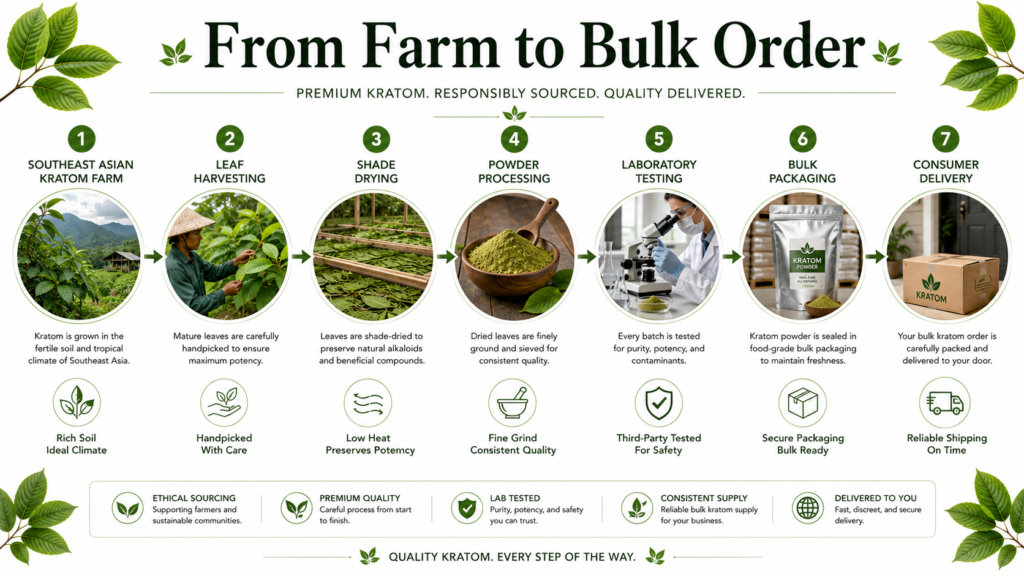
From Farm to Fulfillment: What Happens Before Bulk Kratom Ships
Kratom production begins in Southeast Asia — primarily Indonesia, which now supplies the majority of kratom sold in the U.S. market. Malaysia and Thailand were historically significant suppliers as well, though regulatory changes in those countries have shifted supply patterns.
Leaves are harvested, dried, and ground into powder at the point of origin. Bulk shipments then move through import channels before reaching U.S. distributors. Documentation at each step may be preserved or discarded depending on the supplier.
Quality-conscious suppliers maintain chain-of-custody records from the farm to the end user. This means they can identify the farm of origin, the harvest date, the drying method, and when the final product was tested.
Bulk kratom with no verifiable origin documentation is a red flag, regardless of price.
Strain Comparison for Bulk Buyers
| Strain | Common Description | Key Characteristics | Important Limitation |
| Red Bali | Red vein variety; commonly available in large quantities | Earthy profile; wide availability | Alkaloid content varies significantly by source and batch |
| Green Maeng Da | Green vein variety with broad market presence | Frequently restocked by retailers in bulk | “Maeng Da” is not a standardized classification; sourcing varies widely |
| White Borneo | White vein variety from the Borneo region | Often purchased in bulk by smaller retailers | Vein classification is influenced by processing method, not solely by origin |
| Green Malay | Mid-vein variety originating from Malaysia | Considered by some suppliers to have stable alkaloid profiles | Limited peer-reviewed research supports strain-specific claims |
Historical Roots, Modern Scale
Kratom use in Southeast Asia has a long history. Workers traditionally chewed leaves or prepared them as tea during periods of physical labor. It was not originally a commercial commodity.
American demand, which emerged in the mid-2000s and grew significantly through the early 2010s, transformed kratom into an export industry. Indonesian farming communities became major suppliers. Bulk kratom became a global trade category.
This commercialization occurred faster than regulation could follow. The FDA has issued warnings regarding kratom products and is conducting an ongoing safety review. As of 2025, kratom remains unscheduled at the federal level. This means bulk kratom can be legally sold without the testing requirements applied to pharmaceuticals or many dietary supplements.
What Regular Bulk Buyers Tend to Notice
Reported experiences among regular kratom users vary considerably. This is partly due to differences in alkaloid levels between batches, and partly because individual biology influences how people respond to mitragynine and related compounds.
Buyers who purchase regularly often find that batch consistency matters more than quantity. Receiving a batch that performs differently from the previous one — even from the same supplier — is a common concern.
Some buyers conduct informal comparisons between batches. Others rely entirely on vendor-supplied documentation. Neither approach is equivalent to independent third-party laboratory analysis, which remains the most reliable quality indicator available.
The development of tolerance and physical dependence with regular use is documented in the clinical literature. These risks exist regardless of whether kratom is purchased in bulk or in small quantities.
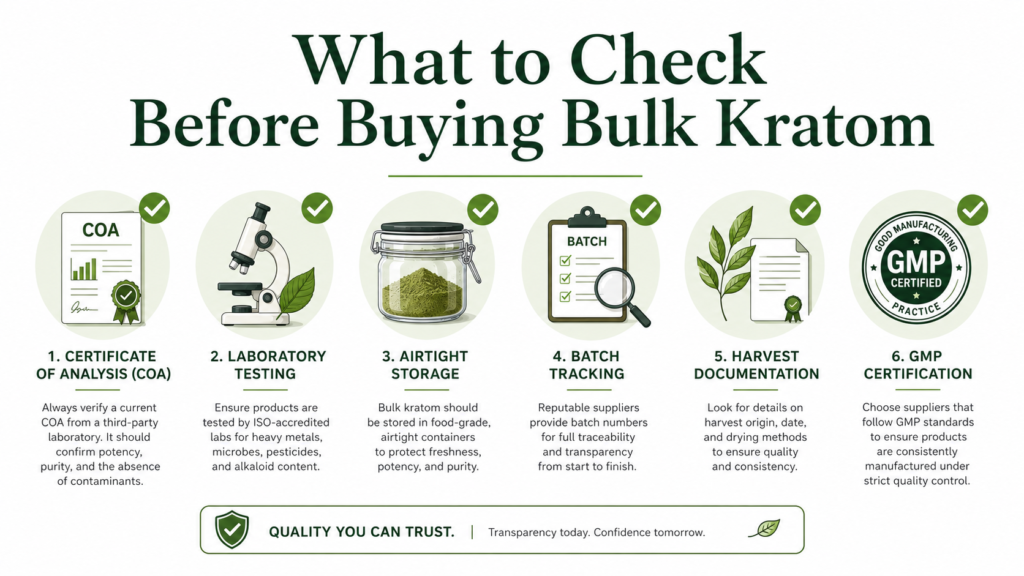
The Safety and Compliance Checklist
Third-Party Lab Testing
Every batch should have an independent COA. The testing laboratory should be accredited and independent of the vendor. Results should include alkaloid levels, heavy metal screening, microbial contamination testing, and pesticide analysis.
AKA GMP Certification
The American Kratom Association’s Good Manufacturing Practice program provides one of the few available quality benchmarks in this industry. Vendors in this program undergo audits covering manufacturing processes, labeling standards, and testing requirements.
Label and Documentation Transparency
Bulk kratom should include clearly documented batch numbers, origin details, harvest dates where available, and verifiable test results. Missing or ambiguous documentation should prompt immediate follow-up with the supplier.
Contaminant History
The kratom industry has experienced product recalls related to salmonella contamination and undisclosed pharmaceutical additives. Purchasing in bulk increases the scale of exposure to any quality defect. Thorough screening of every batch — not only periodic testing — is the appropriate standard.
Legal Status by State
Bulk kratom is prohibited in Alabama, Arkansas, Indiana, Rhode Island, Vermont, and Wisconsin. Additional municipal-level restrictions exist across several other states. Both buyers and sellers carry legal risk in certain jurisdictions.
Myths That Circulate in the Bulk Market
Myth: Buying in bulk is the same product as retail, just at a lower cost.
Fact: Bulk lots may originate from older stock, mixed batches, or less rigorously tested inventory. Price per gram does not reflect product quality.
Myth: A higher price per kilogram guarantees higher alkaloid content.
Fact: Premium pricing in an unregulated market typically reflects branding, not chemical composition. Without COAs, price is not a reliable quality indicator.
Myth: All kratom powder degrades at the same rate.
Fact: Storage conditions — including temperature, humidity, and light exposure — significantly affect the rate of degradation. Improperly stored bulk kratom is likely to lose potency faster than product stored under controlled conditions.
Myth: Bulk kratom from a reputable vendor does not require independent verification.
Fact: Vendor reputation is not a substitute for batch-specific third-party testing. Trust should be grounded in documentation, not marketing.
Frequently Asked Questions
What distinguishes bulk kratom from standard retail kratom?
The botanical material is the same: dried and powdered Mitragyna speciosa leaves. The difference lies in how it is sourced, stored, and tested before reaching the customer. Retail units typically undergo more distinct quality inspections per unit. Bulk orders are shipped in larger volumes, which can result in less batch-specific testing. Storage conditions during bulk transit and warehousing can also affect final product quality. Buyers should request batch-specific COAs regardless of order size.
How should bulk kratom be stored to preserve its alkaloid content?
Kratom alkaloids, particularly mitragynine, degrade when exposed to heat, humidity, and ultraviolet light. Proper storage involves airtight containers kept in cool, dark environments. Mylar bags with oxygen absorbers are commonly used for larger quantities. Refrigeration may extend shelf life but requires careful moisture control when containers are opened. Most reputable vendors recommend consuming bulk kratom within six to twelve months of the testing date to ensure consistency.
What should a legitimate COA for bulk kratom include?
A complete Certificate of Analysis should include the mitragynine percentage, 7-hydroxymitragynine percentage, a heavy metals panel (lead, arsenic, mercury, cadmium), microbial screening (total plate count, yeast, mold, salmonella, E. coli), and pesticide residue analysis. The testing laboratory must be independently accredited. The COA should reference the exact batch number matching the purchase. COAs that are not tied to the specific batch being sold provide limited quality assurance.
Is bulk kratom legal to purchase in the United States?
At the federal level, kratom is not a scheduled controlled substance as of 2025. However, state-level prohibitions exist in Alabama, Arkansas, Indiana, Rhode Island, Vermont, and Wisconsin. Various counties and municipalities in other states have implemented their own restrictions. Legal status continues to evolve as state legislatures respond to the FDA’s ongoing review. Anyone purchasing bulk kratom should verify the current laws in their jurisdiction before completing a transaction.
Does buying in bulk carry more risk than smaller purchases?
Not necessarily — but it amplifies the consequences of any quality issues present in the product. A small contaminated order affects limited use. A contaminated bulk order has a much broader impact. This is why batch-specific testing is especially important for bulk purchases. Buyers who acquire large quantities without confirming COAs are taking on substantially greater risk than those who verify documentation for every purchase, regardless of order size.
The Bottom Line
Bulk kratom represents a significant portion of the U.S. kratom market. It is purchased by individual consumers, small retailers, and distributors — and it operates almost entirely without federal quality oversight.
The active compounds in the product are real, documented, and pharmacologically relevant. The risks — including the potential for dependence, batch variability, and contaminant exposure — scale with quantity.
Quality in this market comes down to documentation. Batch-specific COAs, AKA GMP certification, transparent origin records, and verified storage practices are the standards that matter. Brand reputation, pricing, and packaging are not substitutes for those standards.
Kratom is not FDA-approved. It may cause dependence, may interact with medications, and carries risks that are not yet fully understood by medical science. Readers are strongly encouraged to consult a qualified healthcare provider before using kratom in any form.
Kratom research is ongoing. Regulations continue to evolve. Anyone involved with bulk kratom — whether as an individual user or as a seller — should stay informed of both.
Other Articles You May Find of Interest...
- How HPLC Testing Verifies Botanical Potency—and Why Lab Results Can Differ
- Red Bali Kratom: What It Is, How It Differs, and What the Research Says
- Kratom Legality in 2026: Why the Rules Vary by Location
- 7 Things to Know About Split Kilo Kratom Before a Bulk Order
- Red Thai Kratom: The Strain With a Complicated History and a Loyal Following
- Red Sumatra Kratom: What Makes This Strain Stand Apart
- Red Indo Kratom: The Strain That Built the Modern Kratom Market





