Your Health Magazine Contributor
4201 Northview Drive
Suite 102
Bowie, MD 20716
More Heart Disease, Stroke and Diabetes Articles
Why Home Blood Pressure Readings Are Often Wrong — and How to Fix Them
Take a blood pressure reading. Wait two minutes. Measure again.
If the second number came back eight or ten points off the first, you’ve got company, and you’ve probably already decided the machine is junk.
The machine is usually fine.
Blood pressure is not something that you are born with (like your shoe size). It goes up and down throughout the day – and it is affected by caffeine, stairs, an overfull bladder, a call from your insurance company. So some of the gap between those two readings is just your circulatory system doing its job. The rest is how you took the measurement, and that part is yours to fix.
Which is worth doing, because people act on these numbers. They call the office or they don’t. They bring it up at the appointment or they let it slide. They spend a weekend worrying about a reading that was never accurate to begin with.
The Four Things That Actually Move The Needle
1. The Cuff, First, Because This Is Where Most Readings Die
Loose cuff, high reading. Too small for the arm, or yanked down too tight, and the number drifts in either direction. Hardly anyone checks, which is how this ended up being the most common source of error in home measurement.
So before you buy anything at all, run a tape measure around your upper arm at the midpoint between shoulder and elbow. Compare that to the range printed on the box. Plenty of people are using a cuff that was never going to fit them.
Then at measurement time: bare arm. Not over a sweater, and don’t shove your sleeve up into a fat roll above the cuff, because that bunched-up fabric starts acting like a cuff of its own. Bottom edge about an inch above the crease of your elbow. Snug, but with room for two fingers underneath.
2. Sitting Still Is Half Of It
Chair with a back. Feet on the floor. Arms on table, legs uncrossed with cuff about level with the heart.
The meaning of an arm hanging at your side is different from an arm on a table. So does an arm you’re holding up. And five minutes of sitting quietly before you start isn’t a suggestion, it’s part of the measurement. Don’t talk while the cuff inflates either. Talking alone pushes the number up, and so does measuring thirty seconds after you’ve come through the front door, which is of course when everybody does it.
3. Take Two Or Three, Use The Average
The first reading usually runs highest, for no reason more mysterious than you haven’t settled yet. Standard home-monitoring guidance is two or three measurements a minute apart, averaged, rather than whichever one appeared first.
There’s a second reason for the average. You get a number you dislike, you take another one, and the friendlier of the two is the one that goes in the log. Following the same measurement routine each time helps avoid picking and choosing among individual readings.
4. A Month Of Readings Beats One Ugly Tuesday
One high reading is not a pattern. The pattern is 4 weeks of the mornings.
Make sure it’s a time that’s convenient for you, make sure it’s written down and/or programmed into the device, do not take any one day too seriously. Your clinician can do something useful with the shape of four weeks. There is nothing to be done with the number that rattled you last Thursday.
Where The Hardware Earns Its Keep
Nearly all of the above is behavior, not equipment. But certain monitor designs can remove a few common setup errors. Tunnel-style upper-arm monitors use a built-in cuff rather than a separate fabric cuff that has to be wrapped and positioned each time. One example is thee Sinocare tunnel-style upper arm blood pressure monitor, which is designed so the user places the arm into a fixed cuff and starts the measurement with a button.
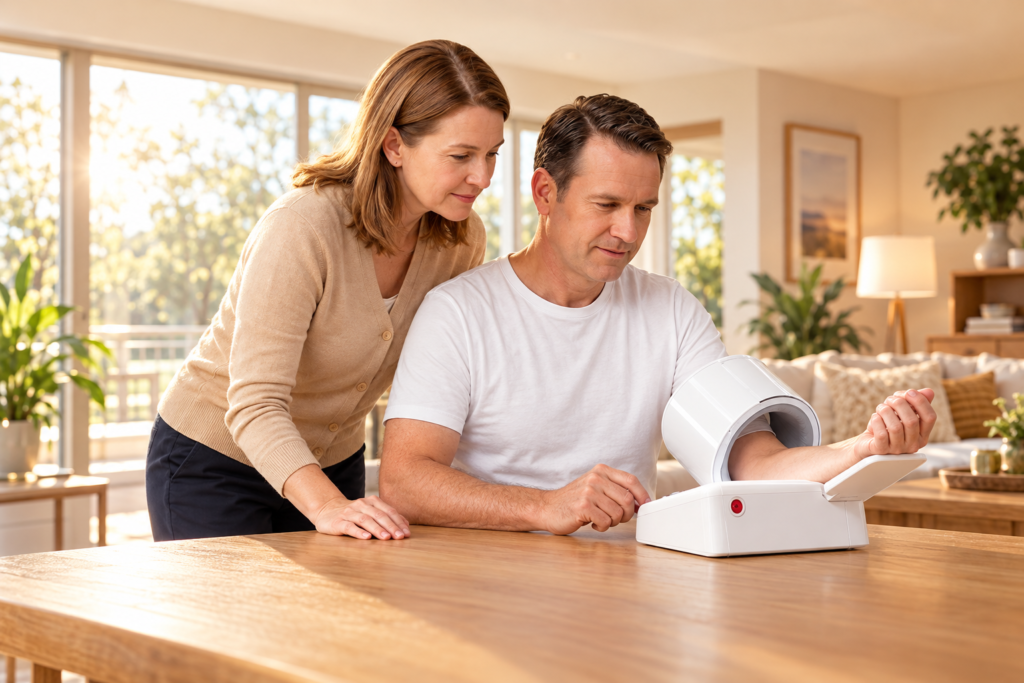
According to the manufacturer, the monitor fits upper-arm circumferences from 11″ to 16.5″, uses oscillometric measurement, and has stated accuracy of ±3 mmHg for pressure and ±5% for pulse. Those figures describe an allowable measurement tolerance, not a guarantee that every reading will be exact. The device also stores readings for two users and can automatically average recent measurements.
Why People Stop Measuring Regularly
Home monitoring only works if people keep doing it. And over time, even small extra steps — wrapping and positioning a cuff, checking the result, keeping track of previous readings — can make a daily routine easier to put off.
For some users, a Sinocare no-wrap blood pressure monitor may make the routine easier by eliminating the need to wrap and reposition a separate cuff. The built-in cuff, one-button operation and large display may be useful for people who find conventional cuffs difficult to manage. Its color-coded display can provide a quick visual reference, but those colors should not replace interpretation by a healthcare professional.
Voice guidance can also make a monitor easier to use for people who have difficulty reading a display. An audible reading may improve accessibility, particularly for older adults or people with visual limitations.
Then the practical question of where it lives. Power is simple enough: four C batteries, or the DC 5V 2A adapter that comes in the box. Batteries are not included, so pick some up at the same time. The tunnel housing has real size to it, more than a wrist unit does, so it needs a stable surface. A dining table or a desk, somewhere with a chair that has a back and room to rest your arm flat. That’s also the position you should be in when taking a measurement.
What To Walk In With
Four weeks of readings. Dates, times, which arm. Highlight the unusual ones: skimming your reading while you’re driving, the week that went wrong all at once, the morning after a poor night’s sleep.
Give it to your clinician and have your clinician read it. And if you’ve been looking at public blood pressure categories online and your numbers look frightening, ask what they mean for you specifically rather than acting on a chart you found at eleven at night. The point of measuring at home was never to assess yourself. It’s to show up with something better than one hurried reading in a waiting room.
Product Specifications
Sinocare BA-856 is a tunnel-style, no-wrap upper-arm blood pressure monitor designed for home use.
- Fits upper-arm circumferences from 11″ to 16.5″
- Uses oscillometric blood pressure measurement
- FDA-cleared for home use
- Stores up to 90 readings for two users
- Automatically averages the last three readings
- Powered by four C batteries or the included DC 5V 2A adapter
Disclosure: This article was produced in partnership with Sinocare, which supplied the product specifications cited above. The guidance here is general information and is not a substitute for advice from your own clinician.
Other Articles You May Find of Interest...
- Why Home Blood Pressure Readings Are Often Wrong — and How to Fix Them
- Are Congestive Heart Failure and a Heart Attack the Same?
- A Blood Pressure of 178/109 Needs Prompt Attention
- Can High Blood Pressure Make Your Face Red?
- Is a Nuclear Stress Test Safe?
- Echocardiography in Dubai: What an Echo Shows, the Different Types and How to Prepare
- Sternum Lump After Open-Heart Surgery: Normal Healing or a Problem?