






Your Health Magazine Contributor
4201 Northview Drive
Suite 102
Bowie, MD 20716
More Healthcare Careers Articles
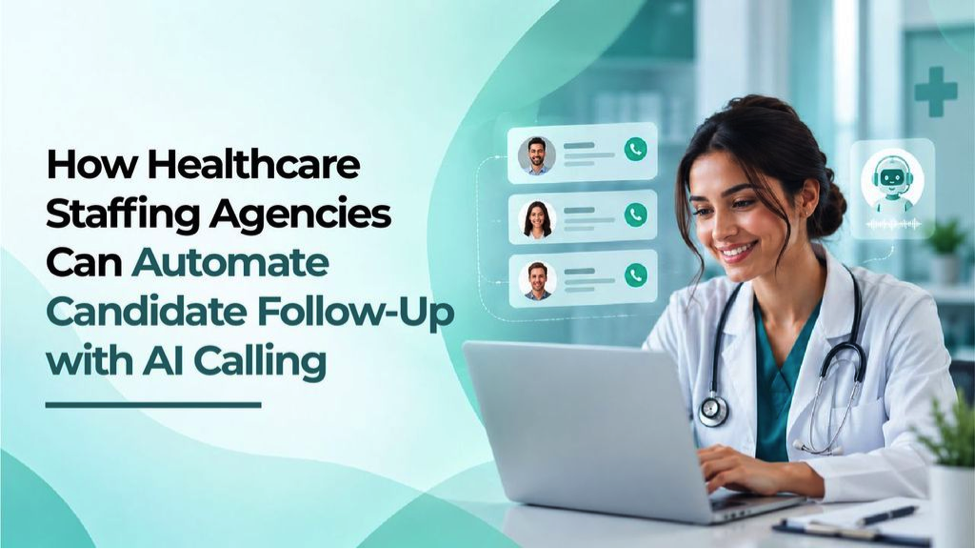
How Healthcare Staffing Agencies Can Automate Candidate Follow-Up with AI Calling
Every healthcare recruitment professional has had such experiences to know they are very well aware of what it feels like when on Tuesday after striving for days you send one wonderful candidate to a healthcare provider only to find out that she has accepted another job on Wednesday because nobody has been in touch with her. Or another scenario where a travel CNA sticks to his idea of finishing the application by 11 p.m. only to find out that by the time he’s called the next afternoon, he has already got in touch with two other companies.
In healthcare staffing, the speed of responding really matters. Still, gone are the days when agencies used the traditional way of calling a few numbers, leaving voicemails, sending messages; only at the end of a business day do they get all calls back and check the application.
AI-powered calls work in a different way. Voice AI is capable of holding a natural conversation, asking simple questions, processing responses, and preparing a comprehensive report for recruiters.
Why Follow-Up Is Harder in Healthcare Staffing
Healthcare staffing follow-up is a difficult process that cannot be compared to following up with any job candidates. There are a number of reasons for this.
Candidates are in Demand: Healthcare practitioners, particularly nurses and therapists, often have multiple job offers due to high demand in the industry. Making a strong connection with candidates immediately is a plus for any recruitment agency as they often get first pick.
Schedules are not easy to manage: Since most candidates often work at least 12-hour shifts, they are unavailable to attend to recruiters. This means that they may be available when they can, whether at 6 a.m. or 9 p.m.
Deadlines and requirements are strict: The requirement of candidates does not only depend on whether the candidate has a necessary license, compliance with laws or whether he or she has certification but involves checking and confirming such documents for every candidate.
The problem of recruitment: Placement of candidates is complicated further by the fact that a sudden increase in demand can cause a surge in the number of candidates.
How AI Calling Works in Practice
AI calling entails the utilization of conversational voice technology to make or receive calls that appear real and human-like rather than mechanical. Modern voice agents can understand answers that give required information about job candidates allowing them to adapt responses and formulate followed up questions accordingly.
In reality, the AI calling process looks like this: the voice agent informs the job seeker about being a virtual assistant calling on behalf of the company, confirms whether the individual is still interested in night-shift job offerings, inquires whether the job seeker has the necessary license, finds out the earliest possible working date and learns his or her preferred working hours. If there is a need for some information from the caller which the AI does not have at its disposal, the call gets flagged so that a recruiter could contact the candidate later.
The result is significant just as the call itself while using AI recruiting tools like Rebecca AI. Each conversation results in the creation of a transcript of the call, along with a summary and status report; that would allow recruiters to see the list of qualified candidates to work with instead of listening to dozens of unheard voicemails.
Five Follow-Up Moments Worth Automating
Not all interactions require a human. These five situations are when AI calling tends to realize its efficiency quickest.
1. Instant response to new applicants
The clock starts running the moment a candidate has applied; the AI agent can call candidates in a minute, show interest, and pose a few questions concerning their specialty, license, availability, and pay range. Candidates who are acknowledged quickly are more likely to stay interested in a job opportunity.
2. Reactivating your existing database
Most companies hold thousands of candidates who once applied for a position, passed the interview, or worked in one of the recruiting company’s assignments. Many of those candidates would be willing to accept a new opportunity, but there is no one to give them a call. AI calling can sift through the candidates’ lists in a systematic manner and find out who is available and what are the candidates’ preferences.
3. Document and credential chasing
Few tasks are time and resource consuming, reminding candidates to send their license, TB test results, and to complete skills checklists. AI agents can make these reminder calls in a friendly and persistent manner, track what actions have not yet been accomplished, and act in case of very stubborn cases.
4. Assignment check-ins
Retention holds equal significance as recruitment. Conducting a simple automated check-in during the initial week and midway through an assignment proves helpful in identifying various problems like scheduling conflicts, communication problems with the facility, or even an unhappy candidate who might have been suffering in silence. The recruiters will then be able to intervene before losing a candidate due to resignation or absence.
5. End-of-assignment and redeployment outreach
AI call can be used to contact the candidates before the end of the contract asking if he/she is willing to extend, move to a different location, or take a break. This timely, continuous communication helps to keep the best clinicians in your pipeline instead of being lost to the competitors.
Keeping the Human Touch
The greatest fear of healthcare staffing is that automation will make them seem cold. Clinicians rely on agencies selected based on trust and don’t want to feel like a mere number. The best solution to this is to automate repetitive tasks and at the same time preserve human moments that are essential.
Be transparent: Have the agent identified itself as an AI at the start of every call. Candidates generally respond well to honesty, and it protects your reputation.
Define clear handoff rules: Any discussion that involves negotiation, complaint, emotion, and complex inquiries should promptly pass on to recruiters. The function of AI is to collect data and perform operational tasks rather than establish relationships.
Let recruiters take credit: The outcome of the process is best when the first communication is handled by an AI, and the second – by a recruiter. In this way, the prospects feel appreciated by talking with a human who has all the important information in advance, as a recruiter will not waste time unnecessarily.
Respect candidate preferences: Respect time frames for calls, users’ preferences of means of communication, and users’ refusal to speak. For example, nurses who work night shifts would not welcome receiving calls around 9 a.m.
Compliance Considerations You Cannot Skip
The healthcare staffing industry is heavily regulated, necessitating cautious implementation of automation.
Consent and calling rules: In the United States, the FCC has confirmed that AI-generated voices fall within the TCPA’s rules governing artificial or prerecorded voice calls. Depending on the type of call, number dialed, and applicable exemption, prior express consent or another form of legally sufficient consent may be required. Agencies should also honor do-not-call requests, provide required caller-identification disclosures, and maintain appropriate records. Because these rules are fact-specific, legal counsel should review the consent language and calling workflow before deployment.
Data privacy: When talking to candidates, they often offer sensitive information that ought to be protected. Make sure that your vendor uses secure systems of data handling, provides proper retention policies, and possesses required security certifications such as SOC 2. Find out where the recordings are kept as well as who has access to them.
Fair and consistent evaluation: Whenever an AI agent evaluates, scores, or screens candidates, the criteria should be job-related, documented, and regularly reviewed for discriminatory effects. Employers and staffing agencies remain responsible for complying with federal employment discrimination laws when AI is used in recruiting or hiring, including providing reasonable accommodations when required. The level of uniformity is one of the real benefits of AI because each candidate responds to the same inquiries but only in the event of the effective criterion on which the questions are based. It is wiser for a human to manage the final decision-making process.
Clinical credentialing stays human-verified: AI can gather and point out information about candidates’ qualifications, but it is important to carry out the official checking of required diplomas or certificates according to the system you have already established.
How to Choose and Roll Out an AI Calling Solution
Begin with a relatively small project, rather than totally transforming your hiring process all of a sudden. Choose any busy process with insignificant risks like answering the requests from potential candidates or waking up inactive applicants and monitoring the performance for some time.
When you evaluate vendors, look for a few essentials:
- Natural conversation quality: Sounds in the recordings should resemble real conversations. Are the operators not cutting off speakers, appearing awkward or incapable of saying a few words?
- ATS integration: The program is expected to have the results of the calls automatically loaded into the existing system to avoid repetitive actions on the side of recruiters.
- Structured reporting: You want to have feedback that is not only a summary of statistics, but also specific conclusions based on the conversations.
- Configurability: You must be able to prepare specific scripts and questions for different specialties.
- Security and compliance posture: You must ask for real documents, not just assurances.
- Transparent pricing: What you need is a per-conversation cost or crystal-clear pricing structure.
Recruiting agents such as Rebecca illustrate the principle behind Voice AI recruiters: a technology that manages a pre-defined phone or video interview, evaluates it based on the same criteria and sends a report to the ATS on the same day. Regardless of the technology you choose, test it on your own candidate experience before signing up.
Once the pilot runs well, scale up appropriately. Advise your recruiters at the beginning and involve them in script development as they know what candidates usually ask. The teams perceive AI as a way to eliminate their monotonous tasks and adopt it significantly faster than teams which worry about losing their jobs.
The Bottom Line
In healthcare staffing, one needs to be fast and trustworthy. The agency in question is the one where the candidate is appreciated. Although AI will not replace the recruiter’s ability to create relationships with potential candidates, it can automate some processes so that recruiters have more time to establish and nurture such relationships.
Healthcare staffing companies that implement the technology carefully may be able to respond to candidates faster and maintain more consistent follow-up. Tools such as Rebecca AI built by Pete & Gabi illustrate how voice AI can be used to automate parts of candidate outreach while leaving relationship-building and final hiring decisions with human recruiters.
Other Articles You May Find of Interest...
- Beyond the Brochure: Choosing a Medical School With Your Future in Mind
- How Hybrid Nursing Education Is Rewriting the Route Into Healthcare
- ARRT CE Requirements Explained for Busy Technologists
- RN Botox Certification Cost: What Nurses Really Pay to Build an Aesthetics Career
- What You Should Know Before Choosing the Nurse Practitioner Career Path
- The Ultimate Guide to Finding the Best Nail Technician Course in the UK
- How Healthcare Staffing Agencies Can Automate Candidate Follow-Up with AI Calling





