






Your Health Magazine Contributor
4201 Northview Drive
Suite 102
Bowie, MD 20716
More Healthcare Careers Articles
AI Interview Answer Generators for Healthcare Jobs: 10 Tools Compared
Picture a Zoom panel: three clinicians, one sharp safety question, and the silence that follows. An AI interview tool may help with preparation, organization, or—when an employer permits it—live prompts, but healthcare candidates have additional considerations involving clinical accuracy, privacy, professional scope, and employer policies.
Healthcare hiring continues to expand. The Bureau of Labor Statistics projects healthcare support occupations to grow substantially over the next decade, increasing the number of candidates preparing for interviews across nursing, allied health, public health, administration, and related roles.
AI interview tools differ considerably. Some specialize in live prompts, while others focus on mock interviews, résumé-based answers, multilingual support, or post-interview feedback. Rather than looking for one universal “best” option, candidates should compare tools based on their own interview format, budget, privacy requirements, and professional role.
Which Type of Tool Fits Your Situation?
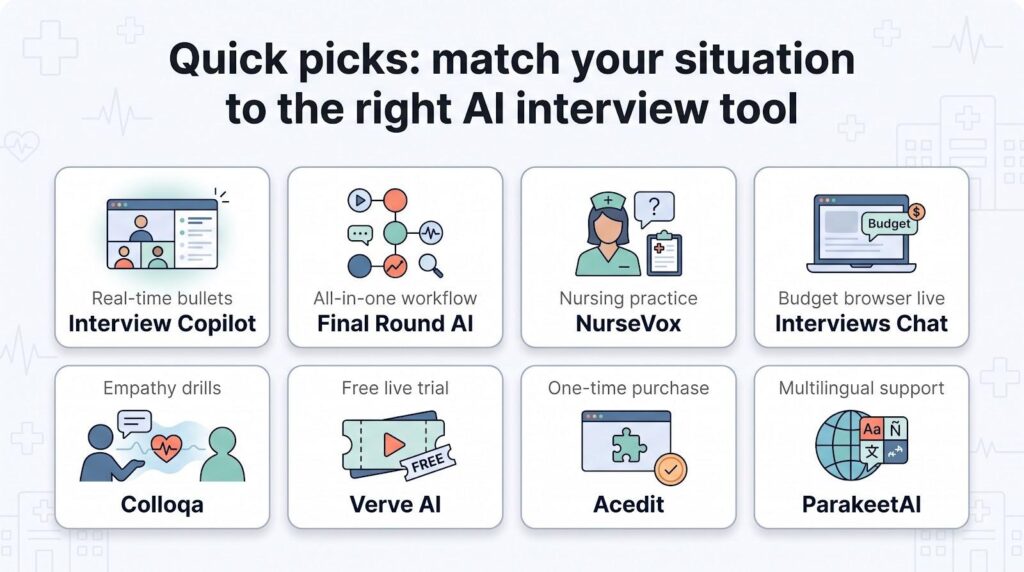
Different platforms emphasize different features:
- Interview Copilot focuses on résumé-grounded live prompts through a desktop application.
- Final Round AI combines mock interviews, live assistance, and post-interview review.
- NurseVox focuses on practice for nursing and allied-health scenarios.
- Interviews Chat provides browser-based transcription and suggestion prompts.
- Colloqa emphasizes spoken practice involving communication and interpersonal scenarios.
- Verve AI provides several free live sessions before requiring a paid plan.
- Acedit uses a browser extension and a one-time-purchase model.
- Sensei AI emphasizes personalized story-based responses.
- Beyz AI uses a desktop overlay with multiple interview modes.
- ParakeetAI emphasizes multilingual support and flexible usage plans.
Published features, pricing, privacy terms, and plan limits can change, so candidates should verify current information directly with each provider before paying.
A Practical 60-Second Panel Test
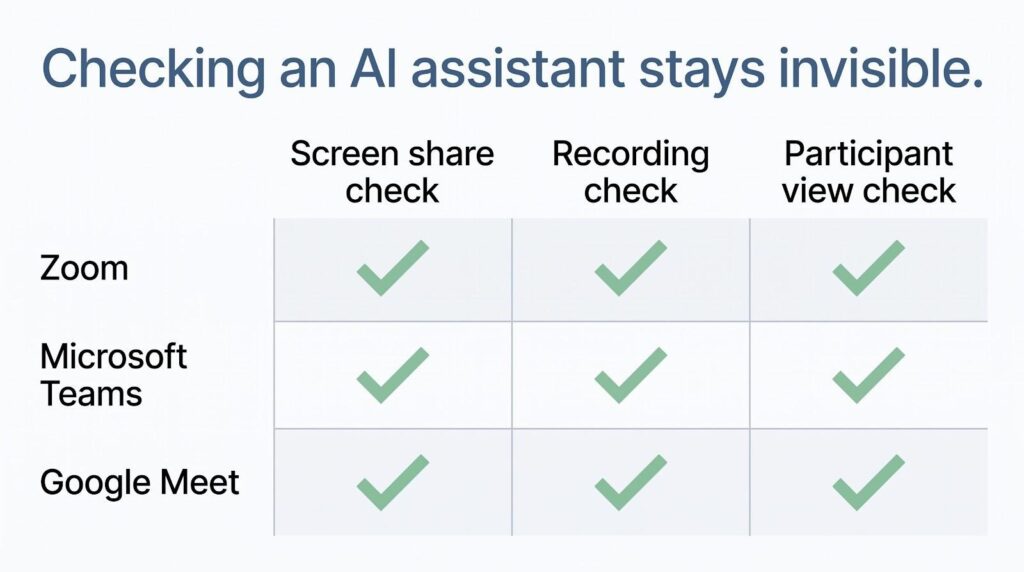
Candidates can evaluate an AI interview tool with the same short test before relying on it during an important interview.
Use Several Candidate Profiles
Try the tool from the perspective of different healthcare applicants:
- New-grad RN pursuing a hospital residency, with limited professional experience and high interview pressure.
- Experienced allied-health clinician, such as a respiratory therapist moving into higher-acuity care.
- Public-health or healthcare-operations candidate answering questions that combine outcomes, policy, and data.
Use a one-page résumé and a de-identified job description so that the test focuses on what the tool itself produces.
Test Several Types of Questions
Useful test prompts include:
- Patient advocacy
- Safety escalation
- Prioritization under pressure
- Interprofessional conflict
- Difficult family communication
- Quality-improvement metrics
- Motivation for the role
- An unscripted follow-up such as “Why?”
Healthcare interviews often move quickly between technical judgment and interpersonal communication, so an interview tool should be tested across both.
Measure Response Speed
For each question, note:
- Whether the tool correctly understands the question
- How quickly the first useful prompt appears
- How long a complete outline takes
- Whether it adapts when the interviewer asks a follow-up
Speed matters if the tool is being evaluated for permitted live assistance, but fast output is not useful if the content is inaccurate or outside the candidate’s scope.
Check What Appears During Screen Sharing
If an employer permits AI assistance during the interview, test the exact technical setup beforehand.
Share a browser tab, application window, and full monitor with a friend using the same meeting software planned for the interview. Check whether overlays, icons, highlighting, pop-ups, or notifications appear.
Candidates should never rely on a vendor’s “undetectable” claim as permission to use outside assistance. Employer and interview rules still control whether live AI assistance is permitted.
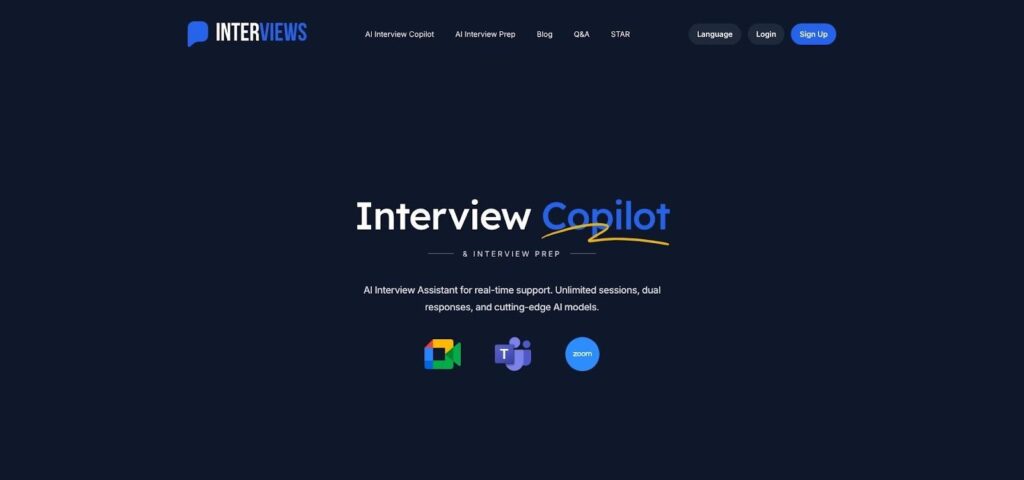
Interview Copilot
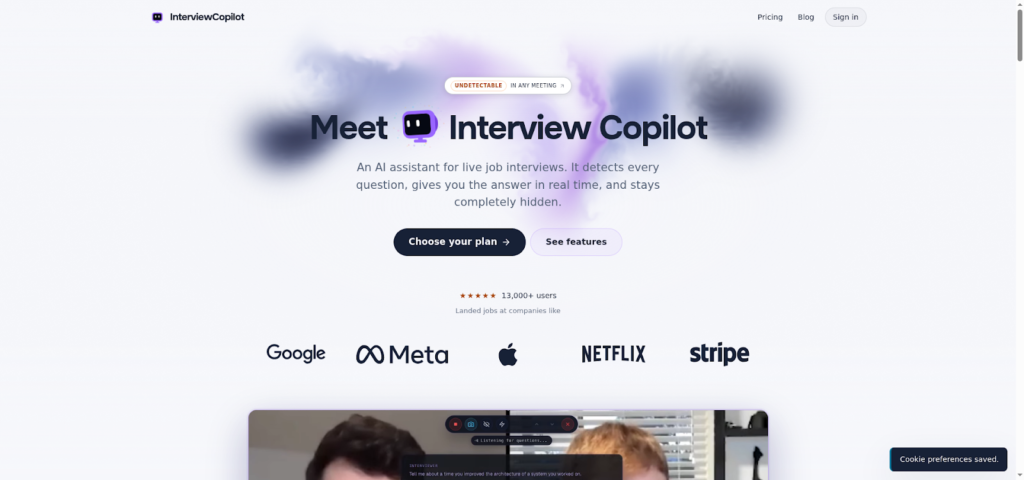
Interview Copilot AI interview assistant homepage screenshot.
Interview Copilot is a desktop application for macOS and Windows designed to provide live résumé- and job-description-based prompts during online interviews.
The vendor says the application works with platforms including Zoom, Teams, Meet, and Webex and can detect questions and present short response cues.
Features
- Résumé-based prompts
- Job-description context
- Live question detection
- Short answer cues rather than full paragraphs
- Desktop support for macOS and Windows
The company advertises fast response generation, but candidates should test performance using their own computer, connection, and meeting platform.
Privacy and Pricing
According to the company, interview audio is streamed for transcription rather than permanently stored as raw audio. Candidates should still review the current privacy policy to determine what transcripts, screenshots, or other session information may remain associated with an account.
Pricing was listed at $49 per month when checked September 16, 2026.
See the product information directly at https://www.interviewcopilot.ai/.
Final Round AI
Final Round AI combines interview preparation, live assistance, and post-interview review in one platform.
Candidates can add a résumé, job description, and notes before practicing questions or preparing for an interview.
Features
- Mock interview practice
- Live interview prompts
- Résumé and job-description context
- Interview review and feedback
- Desktop applications for supported macOS and Windows versions
Its broader workflow may appeal to candidates who want to use one platform throughout the preparation process rather than separate tools for practice and live interviews.
Privacy and Pricing
Candidates should carefully review current recording and data-retention policies before using the platform for stories involving healthcare work.
At the time reviewed, live-access plans were advertised from approximately $25 per month. Pricing, limits, and refund policies should be checked before purchase.
NurseVox
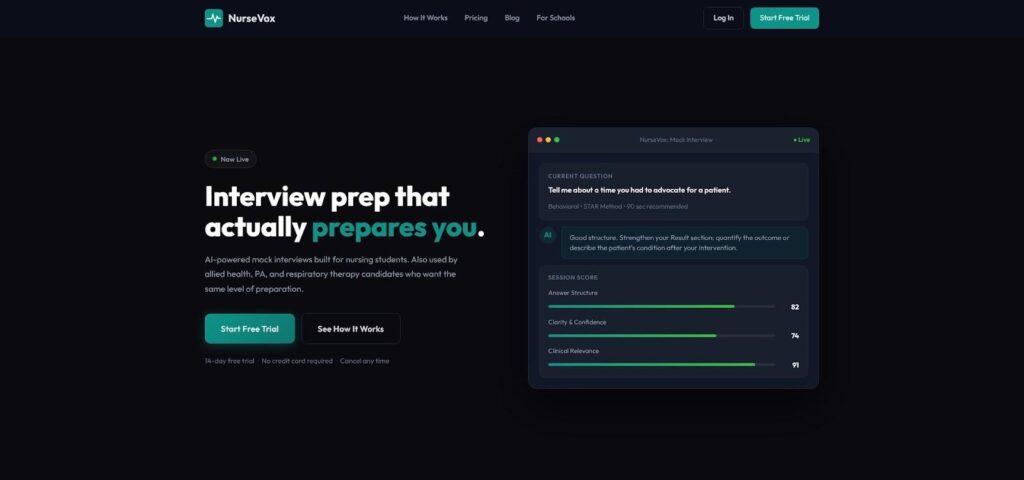
NurseVox nursing interview practice platform homepage screenshot.
NurseVox is oriented toward nursing and allied-health interview practice rather than live interview assistance.
Users can select specialty-oriented scenarios and practice one-on-one or panel-style interviews.
Features
- Nursing and allied-health scenarios
- Specialty-specific interview practice
- Panel simulations
- Behavioral feedback
- Practice involving delegation, safety, communication, and professional scope
This format may be particularly useful for new graduates or clinicians moving into a different specialty because practice can focus on the types of scenarios likely to appear in healthcare interviews.
Privacy and Pricing
The platform tells users not to submit patient-identifying information and publishes recording-retention information that varies by plan.
Pricing checked September 16, 2026 included:
- Starter: $29/month
- Pro: $59/month
- Pro+: $99/month
The full panel feature requires the higher-level plan.
Interviews Chat
Interviews Chat browser-based AI interview coach interface screenshot.
Interviews Chat is a browser-based interview assistant that provides real-time transcription and suggested response points.
Features
- Browser-based access
- Live transcription
- Short suggestion prompts
- Optional use of a phone as a second screen
Because it does not focus specifically on healthcare, candidates need to evaluate any clinical suggestions carefully and make sure responses remain within their actual education, experience, and professional scope.
Pricing
At the time reviewed:
- $19/month included 1,000 credits
- $29/month offered a higher-usage option
The vendor advertises fast response times, but candidates should test latency on their own equipment.
Privacy
Interviews Chat states that session audio and video are processed rather than stored as permanent recordings. Current transcript-retention terms should still be reviewed before use.
Colloqa
Colloqa focuses on spoken mock interviews and interpersonal communication.
Users select a role and scenario and respond verbally to an AI interviewer.
Potential Uses
The format may be useful for practicing:
- Difficult conversations
- Family communication
- Behavioral questions
- Empathy
- Explaining complex information clearly
- Follow-up questions
It is a practice tool rather than a live interview overlay and should not be relied upon to determine clinical accuracy.
Pricing
Pricing checked September 16, 2026 included:
- One free practice session every 24 hours
- $8.99 for an additional single session
- $8.99/week
- $18.99/month for unlimited practice
Candidates should review the current privacy policy before entering personal work stories.
Verve AI
Verve AI offers live interview assistance and provides several trial sessions before a subscription is required.
This may allow candidates to determine whether they are comfortable with an AI-assisted interview workflow before paying for a full plan.
Features
- Live interview assistance
- Trial sessions
- General-purpose interview support
- Context provided by the candidate
Healthcare users should give the platform only the minimum professional context necessary and should avoid patient-identifying information.
Pricing
Pricing checked September 16, 2026 included:
- Three trial live sessions
- Standard: $38.25/month
- Pro: $59.50/month
Candidates should verify current audio, transcript, and data-retention policies before use.
Acedit
Acedit is a Chrome extension designed to recognize interview questions and provide response prompts.
Unlike many subscription-based competitors, it uses a one-time-purchase model.
Features
- Chrome extension
- Question detection
- STAR-oriented answer prompts
- LinkedIn/work-history import
- Browser-based interview support
Pricing checked September 16, 2026 listed the base product at approximately $45 as a one-time purchase, with a higher-priced tier providing additional features.
Because browser extensions behave differently depending on the type of screen share being used, candidates should test visibility before any interview where outside assistance is permitted.
Candidates should also review transcript and data-retention policies before supplying sensitive professional information.
Sensei AI
Sensei AI emphasizes using a candidate’s existing professional stories to produce more relevant interview responses.
Users can prepare short examples from previous projects, jobs, or professional experiences and match them with interview questions.
Potential Uses
This approach may be useful for:
- Career changers
- Clinicians moving into leadership
- Professionals entering informatics or operations
- Candidates who struggle to recall examples under pressure
The tool should be used to organize genuine experience rather than create accomplishments, credentials, or clinical responsibilities the candidate did not actually have.
Pricing
Pricing checked September 16, 2026 included:
- A short free trial
- Approximately $89/month on a monthly plan
- Lower monthly-equivalent pricing with annual billing
Privacy and data-retention terms should be reviewed before adding sensitive workplace information.
Beyz AI
Beyz AI uses a desktop application and overlay that can operate alongside online meeting software.
Features
- Live interview prompts
- Mock interview mode
- Phone-screen support
- Résumé context
- Notes and answer-length controls
This may suit candidates who prefer a native desktop application rather than a browser extension.
Pricing
Pricing checked September 16, 2026 included:
- $49.99/month on the monthly tier
- Lower monthly-equivalent pricing for longer billing commitments
Plan features may change, so candidates should verify current functionality before purchase.
Its privacy policy should also be reviewed carefully before entering healthcare-related experiences.
ParakeetAI
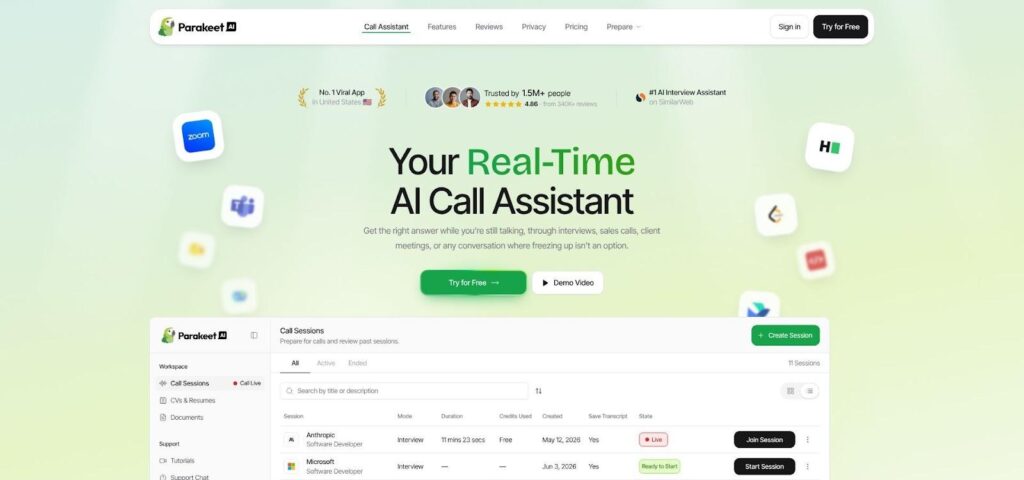
ParakeetAI multilingual AI interview assistant homepage screenshot.
ParakeetAI emphasizes multilingual interview assistance.
The company advertises support for more than 50 languages and multiple response modes.
Potential Uses
Multilingual support may be relevant for candidates interviewing for roles where communication across languages is important.
However, multilingual capability should not be confused with clinical interpretation competency. Healthcare candidates still need to ensure that any terminology, scope-of-practice discussion, or clinical example is accurate.
Pricing
Pricing checked September 16, 2026 included:
- Credit-based options starting around $38
- $78/week
- Approximately $149.90/month
- Annual plans
The platform also advertises controls intended to prevent activation on specified domains.
Candidates should review current privacy and retention policies before uploading professional information.
Other Tools Candidates May Encounter
Several other AI interview platforms are also available.
LockedIn AI
LockedIn AI offers live, mock, and coding-oriented interview features. Pricing and plan structures have varied, so candidates should verify current terms, refund policies, and privacy information directly before purchasing.
Huru
Huru provides general interview practice and a broad question library. It is not specifically oriented toward healthcare specialties, so candidates may need to supply much of the clinical context themselves.
Cluely
Cluely markets itself as a meeting and interview assistant. Candidates considering any platform positioned as “undetectable” should first determine whether outside assistance is allowed by the employer.
Technical invisibility does not override interview rules.
What Makes a Healthcare Interview Answer Different?
Healthcare candidates have considerations that do not apply to every industry.
1. Safety Before Polish
Interviewers may listen for risk recognition, escalation, teamwork, and respect for professional scope.
An answer that sounds polished but recommends an unsafe action is worse than a simple answer that demonstrates appropriate clinical judgment.
2. Authenticity Matters
AI can help organize an answer, but candidates still need to speak naturally and accurately about their own experience.
Overly polished scripts can make follow-up questions harder because the candidate may not be able to explain or defend statements generated by the tool.
3. Privacy Rules Still Apply
Healthcare professionals should not enter identifiable patient information into an interview tool simply to improve an example.
Use general, appropriately de-identified descriptions of professional experiences instead.
4. Specialty Context Matters
An ICU nurse, medical assistant, respiratory therapist, imaging professional, and public-health analyst operate under different scopes and workflows.
Any AI-generated response needs to be checked against the candidate’s actual role, training, and responsibilities.
Is an AI Interview Tool “HIPAA-Compliant”? Ask Better Questions
HIPAA protects individually identifiable health information held or transmitted by covered entities and their business associates.
A résumé and general employment history are different from patient information, but healthcare workers should still avoid entering patient information into interview tools unless it has been properly de-identified and their organization permits that use.
Simply deleting a patient’s name is not necessarily enough.
Under HIPAA’s Safe Harbor method, de-identification involves removing multiple categories of identifying information and ensuring the remaining information cannot reasonably identify the patient.
When evaluating an interview platform, ask:
- Recordings: Does the tool capture audio or video?
- Storage: Where is that information stored, and for how long?
- Transcripts: Are text logs retained after the interview?
- Vendors: Which outside processors receive the data?
- Deletion: Can users permanently delete stored information?
- Restrictions: Does the service tell users not to submit PHI?
A healthcare candidate should be especially careful when turning a clinical experience into an interview story.
For example, saying that you recognized a medication-safety problem and followed the appropriate escalation process communicates professional judgment without supplying the patient’s name, dates, record number, room number, or other details that could identify the individual.
The article’s existing explanation of protected health information can provide additional background on handling identifiable health information.
Can Interviewers Tell You Are Using AI?
Sometimes the bigger clue is not the software itself but the candidate’s delivery.
Possible signs include:
- Long pauses while reading
- Eyes repeatedly shifting away from the interviewer
- Answers that suddenly sound unlike the candidate’s normal speech
- Perfectly polished responses followed by difficulty answering a simple follow-up question
For preparation, AI can be useful for organizing thoughts, rehearsing common questions, and identifying weak areas.
For live interviews, candidates should first determine whether outside assistance is permitted.
If the employer prohibits AI, outside prompts, or other forms of assistance during the interview, the candidate should not use them.
Even where live assistance is permitted, short prompts are generally more useful than reading generated paragraphs word for word.
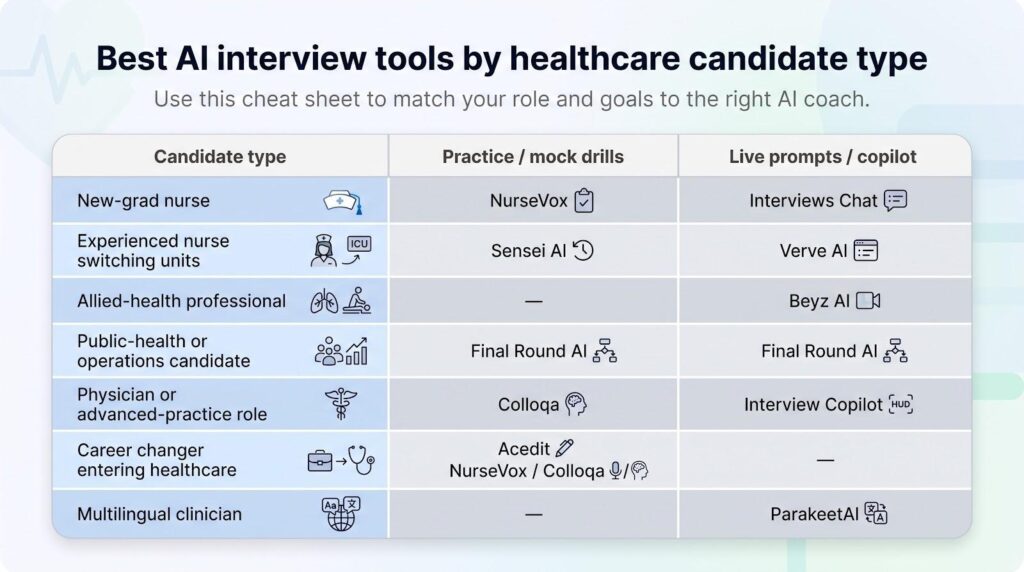
Matching Tools to Different Healthcare Candidates
Different candidate types may benefit from different features.
New-Grad Nurse
Practice-oriented tools such as NurseVox may be useful for rehearsing delegation, safety, communication, and behavioral questions before residency interviews.
A general live-prompt platform may provide additional structure only if live assistance is permitted by the employer.
Experienced Nurse Switching Units
Tools that organize past professional examples may help candidates explain how existing experience transfers into a new specialty.
The candidate still needs to verify that terminology and responsibilities match the new role.
Allied-Health Professional
Respiratory therapy, imaging, rehabilitation, laboratory, and other allied-health roles use specialized terminology.
Any general interview tool should be given enough non-sensitive role context to generate relevant questions, and every response should be checked against actual professional scope.
Public-Health or Operations Candidate
Candidates in public health, quality improvement, administration, or operations may benefit more from tools that help organize metrics, projects, and stakeholder-management examples than from clinical scenario practice.
Physician or Advanced-Practice Candidate
Preparation may involve leadership, ethical reasoning, teamwork, communication, and specialty-specific judgment.
AI can support rehearsal, but high-stakes clinical responses require the candidate’s own professional knowledge.
Career Changer Entering Healthcare
Tools that draw from an existing résumé or work history can help identify transferable examples involving leadership, logistics, customer service, conflict resolution, or process improvement.
They should not invent healthcare credentials the candidate does not have.
Multilingual Candidate
A multilingual platform may help candidates practice communicating ideas in different languages.
Candidates should still verify specialized healthcare terminology rather than assuming an AI translation is clinically precise.
10 Things to Verify Before Paying
- Test your actual setup. Use the exact device, operating system, browser, and meeting software planned for the interview.
- Check the real price. Determine whether the displayed amount requires annual billing and whether usage limits apply.
- Review recording policies. Find out whether audio, video, screenshots, or transcripts are saved.
- Understand cancellation. Review how subscriptions renew and how cancellation works.
- Check for invented credentials. Make sure the tool does not add certifications, licenses, job duties, or accomplishments that are not on your résumé.
- Test professional scope. Use a properly de-identified healthcare scenario and confirm that the tool does not invent clinical details or recommend actions outside the candidate’s actual role.
- Test screen sharing. If live assistance is permitted, verify what other participants can see during each type of screen share.
- Prefer concise prompts. Short cues are easier to turn into natural speech than generated paragraphs.
- Test follow-ups. See whether the tool can adapt when an interviewer changes direction.
- Read the refund terms. Know what happens if the software does not work as expected.
FAQ
What is the single best AI interview tool for healthcare jobs?
There is no universal best option. Different platforms emphasize live prompts, mock interviews, specialty practice, multilingual support, résumé personalization, or lower pricing. Candidates should choose based on the interview format and the type of support they actually need.
Can AI help answer nursing questions?
AI tools can help candidates practice nursing interview questions and organize responses. Candidates remain responsible for ensuring that answers are clinically accurate and appropriate to their professional scope.
Is using AI during an interview cheating?
It depends on the employer’s rules and the interview format.
If outside assistance, AI tools, notes, or other resources are prohibited, candidates should not use them during the interview. Unless an employer clearly permits live assistance, AI is safer as a preparation and rehearsal tool rather than a hidden source of real-time answers.
Will interviewers know I am using AI?
Candidates can appear overly scripted even when the software itself is not visible. Long pauses, reading behavior, unnatural wording, or difficulty answering follow-up questions can make outside assistance noticeable.
Are these tools HIPAA compliant?
That question cannot be answered simply by looking at whether a tool uses encryption.
Healthcare workers should avoid submitting patient-identifying information. Removing only a name, date, or medical-record number does not necessarily de-identify a patient. Proper de-identification requires removing relevant identifiers and ensuring the remaining information cannot reasonably identify the individual.
Which tools use a résumé or job description?
Several platforms discussed here allow users to provide professional history, résumé information, job descriptions, or other contextual material.
Candidates should review each service’s current privacy policy before uploading personal information.
Do these platforms work with Zoom, Teams, and Google Meet?
Support differs by product.
Test the exact operating-system, browser, and meeting-platform combination that will be used for the interview rather than relying solely on a vendor compatibility list.
Are there free options?
Some products offer limited trials, credits, or free practice sessions. Terms change frequently, so check the current provider pricing before relying on a free tier.
How can I keep AI-assisted answers from sounding robotic?
Use the tool during preparation to identify the main points, then rehearse the answer aloud in your own words.
If you cannot explain the answer naturally without reading it, simplify it.
What if the AI invents a clinical detail?
Do not repeat it.
Correct inaccurate information immediately and treat repeated fabrication as a sign that the tool should not be relied upon for that type of question.
Conclusion
AI interview tools can help healthcare candidates rehearse questions, organize professional examples, practice communication, and prepare for unfamiliar interview formats.
The right tool depends on what the candidate actually needs. A new graduate practicing clinical scenarios has different requirements from an experienced professional organizing leadership stories or a multilingual candidate rehearsing communication.
Healthcare applicants also need to evaluate these tools more carefully than candidates in many other industries. Clinical accuracy, professional scope, patient privacy, data retention, and employer rules all matter.
The most useful approach is to use AI to strengthen genuine experience rather than manufacture it. Test the platform before an important interview, keep patient information out of prompts, verify anything clinical, and use live assistance only when the interview rules allow it.
Other Articles You May Find of Interest...
- What to Know Before Choosing an Accelerated Nursing Path
- What Is Pre-Nursing and Is It Worth It
- Beyond the Brochure: Choosing a Medical School With Your Future in Mind
- How Hybrid Nursing Education Is Rewriting the Route Into Healthcare
- RN Botox Certification Cost: What Nurses Really Pay to Build an Aesthetics Career
- What You Should Know Before Choosing the Nurse Practitioner Career Path
- The Ultimate Guide to Finding the Best Nail Technician Course in the UK





