
Bethesda Chevy Chase Pediatric Dentistry
4825 Bethesda Avenue
Suite #220
Bethesda, MD 20814
301-941-7374
More Dental Health Articles
My Child Grinds Their Teeth at Night. Should I Be Worried?
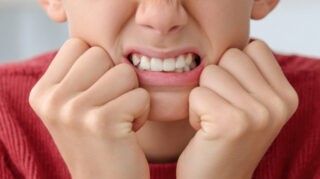
One of the most common questions I hear from parents is:
“Dr. Shin, my child grinds their teeth at night. Are they damaging their teeth?”
I understand why parents are concerned. Teeth grinding can be surprisingly loud. Some parents tell me they can hear it from down the hall. Others worry that their child is slowly wearing away their teeth while they sleep.
The good news is that, in most cases, teeth grinding is far more alarming to parents than it is to pediatric dentists.
After nearly 30 years of caring for children, I can tell you that teeth grinding, also known as bruxism, is extremely common. I have seen children who grind occasionally and others who grind so aggressively that their parents are convinced permanent damage is inevitable.
Fortunately, that is rarely the case.
How Common Is Childhood Teeth Grinding?
Very common.
Studies have reported that anywhere from 15% to 40% of children grind their teeth at some point during childhood, depending on how bruxism is measured and the age group being studied.
While researchers have been studying childhood bruxism for decades, one surprising fact remains: we still do not know exactly why children grind their teeth.
Why Do Children Grind?
If you search online, you will find a long list of possible explanations.
Stress. Anxiety. Airway problems. Allergies. Sleep disorders. Bite problems. Genetics.
The truth is that none of these theories fully explains every child.
Some children who grind have enlarged tonsils, allergies, or disrupted sleep. Others have none of those issues. Some children who grind are anxious. Many are not.
Current evidence suggests that childhood bruxism is likely multifactorial, meaning that several factors may contribute, but there is no single explanation that applies to every child.
One of the most consistent findings in the literature is that grinding often occurs during brief arousals from sleep. Researchers increasingly view childhood bruxism as a sleep-related movement behavior rather than simply a dental problem.
A Clinical Observation After 30 Years
Although the exact cause remains unclear, there is one pattern I have observed repeatedly throughout my career.
Many children who grind heavily during the primary dentition years gradually reduce or stop grinding around age seven to eight.
Interestingly, this is also the period when the first permanent molars become established in the bite.
Has research proven that the eruption of the first permanent molars causes grinding to stop?
No.
At this point, that relationship remains an observation rather than an established scientific fact.
However, after seeing this pattern in thousands of children, I believe it is worth considering whether at least some childhood grinding may be related to the maturation of the developing dentition and occlusion.
Future research may help answer that question more clearly.
What About Worn Teeth?
This is often what worries parents the most.
Some children who grind develop noticeable wear on their baby teeth. Sometimes the wear is mild. Sometimes it can appear quite dramatic, especially on the front teeth.
What I have found reassuring over the years is that significant wear in the primary dentition rarely seems to predict significant wear in the permanent dentition.
Many children who wear down their baby teeth go on to develop healthy permanent teeth with little or no evidence that they were ever grinders.
That observation is one reason I am often more conservative than parents expect when discussing treatment.
Of course, wear should never be ignored. Your pediatric dentist should continue to monitor changes over time, looking for excessive wear, fractures, sensitivity, or other signs of pathology.
But visible wear on baby teeth alone is not usually a reason to panic.
Does Grinding Mean My Child Has an Airway Problem?
Not necessarily.
There is growing research exploring associations between bruxism and sleep-disordered breathing, enlarged tonsils, chronic nasal congestion, allergies, and mouth breathing.
These associations are important and deserve attention.
However, association does not mean causation.
Many children who grind have no airway concerns at all, and many children with airway issues never grind their teeth.
That said, if your child grinds and also snores loudly, breathes through their mouth, sleeps restlessly, pauses breathing during sleep, or seems unusually tired during the day, further evaluation may be appropriate.
Should My Child Wear a Night Guard?
This is another common question.
Parents are often surprised when I tell them that I rarely recommend night guards for young children simply because they grind.
Unlike adults, children are constantly changing. Their jaws are growing, baby teeth are exfoliating, permanent teeth are erupting, and their bite is developing.
For that reason, we must be careful about placing appliances on growing dentitions.
A night guard may protect teeth in certain situations, but it does not address the underlying cause of grinding. More importantly, many children who grind never develop significant dental problems and eventually outgrow the habit on their own.
There are situations where an appliance may be appropriate, such as severe tooth wear, sensitivity, pain, muscle discomfort, fractures, or specific developmental and medical circumstances.
However, these cases are the exception rather than the rule.
In pediatric dentistry, treatment should be based on clinical findings, not simply on the sound of grinding.
Sometimes the most appropriate treatment is careful observation.
The Bottom Line
Childhood teeth grinding is one of the most common concerns parents bring to a pediatric dentist.
Although the sound can be alarming, the scientific evidence and clinical experience both suggest that most children outgrow the habit, most do not require treatment, and most do not experience significant long-term consequences.
As a pediatric dentist, one of the most reassuring observations I can share is this: many children who grind heavily during childhood grow into teenagers and adults with healthy, functional permanent dentitions and little evidence that they ever ground their teeth at all.
So if you hear that familiar grinding sound coming from your child’s room tonight, mention it to your pediatric dentist, have it monitored, and try not to lose sleep over it. Your child probably won’t.
Other Articles You May Find of Interest...
- 6 Joliet Dentists to Consider for Your Oral Health Needs
- How to Choose a Dentist in Woodbridge, VA After Moving
- Ten Benefits Of Ceramic Dental Implants
- Dentistry in Houston: Finding the Right Care in a City Full of Choices
- Partial Dentures Explained: Removable, Flexible and Implant-Supported Options
- Your Child May Not Need a Release
- What Causes Tooth Decay In Kids?