
Your Health Magazine Contributor
4201 Northview Drive
Suite 102
Bowie, MD 20716
More Dental Health Articles
Dental Implants, Bridges or Dentures? How to Compare Tooth-Replacement Options
A missing tooth raises questions that go beyond appearance. What will hold the replacement in place? How will it be cleaned? What happens to the teeth beside the gap and the bone beneath it? The answers differ for a single implant, a conventional bridge, a removable denture and a full-arch restoration supported by implants. None is the right choice for everyone. Understanding how each option works can make a conversation with a dental team more useful, whether one tooth is missing or an entire row needs replacement.

Start With the Gap, Not the Product Name
The first distinction is how many teeth need replacing and where they are. A single missing tooth presents a different problem from several missing teeth in a row. Someone who has lost most or all the teeth in an arch needs a different kind of plan again. The condition of the neighboring teeth matters too: sound teeth, heavily restored teeth and teeth with gum disease do not offer the same starting point for a bridge.
A dentist will also consider the health of the gums, the amount of available jawbone, the way the teeth meet when biting and any medical factors that may affect healing. Personal preferences belong in that discussion. Some patients strongly prefer a replacement that stays in place; others would rather avoid surgery or want a restoration they can remove for cleaning. Those priorities help narrow the options, but they do not replace an examination.
How the Main Replacement Options Work
For one missing tooth, a single dental implant consists of an implant body placed in the jawbone and a replacement tooth, usually a crown, attached above it. The implant supports the crown without relying on the teeth on either side of the gap. Placement requires surgery, followed by a healing period before the final restoration can be completed. The exact sequence depends on the condition of the site and the treatment plan.
A conventional dental bridge spans a gap using neighboring teeth for support. A replacement tooth, called a pontic, is joined to restorations on those supporting teeth. This can provide a fixed replacement without placing an implant, although the supporting teeth generally need preparation to receive the bridge. Their existing condition is important: a tooth that already needs a crown presents a different trade-off from a healthy, unrestored tooth.
A removable partial denture replaces some missing teeth and may use remaining teeth and the gums for support. A complete denture replaces all the teeth in an upper or lower arch and rests on the underlying tissues. Both are taken out for cleaning. Their design and fit affect how they feel when speaking and eating.
All-on-4 and All-on-6 describe full-arch restorations supported by four or six implants, respectively. They are approaches for replacing a full row of teeth, not alternative names for a single-tooth implant. The implants act as supports for a connected set of replacement teeth. Which full-arch approach is feasible depends on the patient’s anatomy and restorative plan, rather than the number in its name alone.
Comfort, Cleaning and Long-Term Maintenance
A fixed replacement stays in place during ordinary daily use, while a removable denture comes out for cleaning. That distinction can affect how secure a restoration feels, but comfort is individual. A well-designed denture can serve a patient well, and a fixed restoration can still feel uncomfortable if its fit, bite or surrounding tissues need attention. It helps to ask what adjustment period to expect and which changes should prompt a follow-up visit.
Cleaning requirements also differ. A bridge needs careful cleaning beneath its replacement tooth and around the supporting teeth. An implant crown needs attention at the gumline and around the implant. Full-arch implant restorations require a plan for cleaning around their supports and beneath the connected teeth. Removable dentures must be cleaned outside the mouth, while the remaining teeth and oral tissues still need care. The easiest option to maintain is the one a patient can clean effectively and consistently.
“How long will it last?” is a reasonable question, but it has no guaranteed answer. An implant body and the crown or full-arch restoration attached to it are separate components; the visible restoration may need repair or replacement even if the implant remains in place. Bridges and dentures can also need adjustment, repair or replacement as wear and the mouth change. Regular dental visits allow a team to check the restoration, the bite and the health of the supporting tissues before a small problem becomes harder to manage.
Bone, Neighboring Teeth and Candidacy
After a tooth is lost, the bone that once supported its root can change over time. An implant placed at that site transfers chewing forces to the surrounding bone and can help preserve bone locally. It does not guarantee that bone loss will stop everywhere in the jaw. A conventional bridge replaces the visible tooth without placing a support in the bone beneath the gap. A removable denture rests partly or wholly on oral tissues, so changes in those tissues and the underlying ridge may affect its fit over time.
The neighboring teeth deserve equal attention. A bridge depends on its supporting teeth, while a single implant has its own support in the jaw. Neither fact settles the decision by itself. Available bone, gum health, hygiene habits and bite forces all influence whether implant treatment is appropriate. Smoking, teeth grinding and medical conditions that affect healing may also change the risks or the plan. These factors call for individual assessment rather than automatic exclusion. For someone considering a denture, the ability to handle and clean it comfortably is another practical part of candidacy.
What 3D Imaging and a Coordinated Team Can Clarify
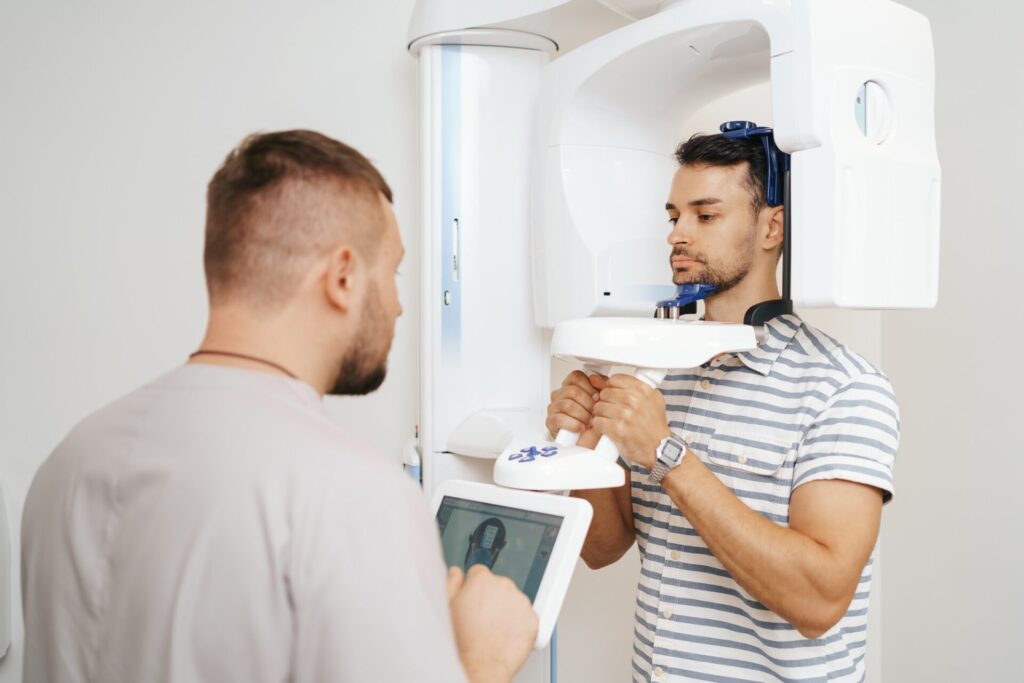
Choosing a restoration starts with a clinical examination and an understanding of the patient’s goals. When implant placement is being considered, the team needs to assess the bone and nearby anatomical structures as well as the position planned for the replacement teeth. Cone-beam computed tomography, or CBCT, produces three-dimensional images that can help with that assessment when clinically indicated. It adds information to the examination; it is not automatically required for every person with a missing tooth.
Implant treatment involves both surgical and restorative decisions. The person placing an implant needs to know where the final crown or full-arch teeth should sit, while the dentist designing that restoration needs to understand what the anatomy can support. Patients can ask who will plan each stage, what the imaging shows about their case and how the team would adapt the plan if the preferred option is unsuitable. Experience matters most when it is paired with a clear explanation of alternatives, risks and follow-up care.
For patients exploring dental implants in Manhattan, Al Dental Studio is one local practice offering single-implant and All-on-4/All-on-6 treatment. Its Midtown Manhattan office, at 425 Madison Avenue, Suite 201, New York, NY 10017, is led by Dr. Alexander Heifitz, NYU-trained with more than 30 years of clinical experience. As with any provider, the useful question is how a proposed treatment plan fits the patient’s own teeth, bone, health and maintenance needs.
A Practical Way to Compare Your Options
At a consultation, begin with the specific gap rather than asking which replacement is best in general. Ask whether a proposed bridge would change the neighboring teeth, whether an implant is suitable at that site and what a removable option would involve day to day. If a full arch needs replacing, ask how the team would compare a conventional denture with an implant-supported restoration in your circumstances.
Then consider the work that follows treatment: cleaning around a fixed restoration, removing and caring for a denture, attending checkups and dealing with possible repairs. A useful plan should explain what the replacement is attached to, what treatment is involved and what could require attention later. Comparing those answers against your examination findings gives you a sounder basis for choosing than a product name or a promised lifespan.
Other Articles You May Find of Interest...
- Dental Implants, Bridges or Dentures? How to Compare Tooth-Replacement Options
- Does a Damaged Tooth Need a Crown or a Dental Implant
- Why Are Baby Teeth Important?
- How to Choose the Right Cosmetic Dentist in Maitland?
- When Wisdom Teeth Can Stay and When They Should Go
- DENTAL IMPLANTS
- Affordable Pediatric Dentistry in East Bakersfield, CA: Costs, Insurance and Dental Services