






More CPR Training Articles
Is Ventricular Fibrillation Shockable? Why Defibrillation Matters
By Your Health Magazine Health Information Team
Imagine someone suddenly collapsing at a gym, airport, workplace, or family gathering. They do not respond and are not breathing normally. An automated external defibrillator (AED) is brought to the scene, but a bystander hesitates: Can the device really determine whether the person needs a shock?
The direct answer is yes: ventricular fibrillation, often called VF or V-fib, is a shockable cardiac arrest rhythm. Defibrillation is the key treatment because VF prevents the heart from pumping blood effectively. However, a shock must be combined with immediate CPR, activation of emergency medical services, and continued care from trained professionals.
What Happens During Ventricular Fibrillation?
Normally, electrical signals travel through the heart in an organized pattern, causing the lower chambers, or ventricles, to contract and send blood to the lungs and body. During ventricular fibrillation, electrical activity becomes rapid and chaotic. Instead of producing coordinated contractions, the ventricles quiver and cannot pump blood.
This leads to sudden cardiac arrest. Blood flow to the brain and other vital organs stops, and the person typically collapses, becomes unresponsive, has no effective pulse, and stops breathing normally. Gasping or irregular snorting breaths may occur during cardiac arrest, but these are not normal breathing.
VF is different from a heart attack. A heart attack occurs when blood flow to part of the heart muscle is blocked. A person having a heart attack may remain awake and continue breathing. Cardiac arrest is an electrical and pumping failure that causes unresponsiveness. A heart attack can sometimes trigger VF and cardiac arrest, but the terms are not interchangeable.
Why Is VF Shockable?
VF is considered shockable because an electrical shock may interrupt the heart’s disorganized electrical activity. This gives the heart’s natural electrical system an opportunity to reestablish an organized rhythm capable of producing a pulse.
The procedure is called defibrillation. Pads placed on the chest deliver electrical energy across the heart. The purpose is not simply to “jump-start” a motionless heart, as television scenes sometimes suggest. Instead, defibrillation attempts to stop chaotic electrical activity so that a coordinated rhythm can resume.
A successful shock does not always restore effective circulation immediately. CPR should generally resume as soon as the AED instructs, even after a shock has been delivered. Additional rhythm checks, shocks, medications, and advanced treatment may be necessary.
The word “shock” is also used for unrelated treatments, including radial pulse shockwave therapy. That type of therapy uses acoustic pressure waves for musculoskeletal care and is entirely different from electrical defibrillation during cardiac arrest.
Which Cardiac Arrest Rhythms Are Shockable?
Healthcare professionals generally classify cardiac arrest rhythms into two groups:
- Shockable rhythms: Ventricular fibrillation and pulseless ventricular tachycardia.
- Nonshockable rhythms: Asystole and pulseless electrical activity.
Pulseless ventricular tachycardia occurs when the ventricles beat so rapidly that the heart cannot produce an effective pulse. Like VF, it may respond to defibrillation.
Asystole means there is no meaningful electrical activity, while pulseless electrical activity means electrical signals are present but the heart is not producing a pulse. Shocking these rhythms does not correct their underlying problem. Treatment instead focuses on high-quality CPR, appropriate emergency medications, and identifying potentially reversible causes.
How an AED Responds to VF
An AED is designed to analyze the heart’s rhythm and determine whether a shock is appropriate. It will not deliver—or advise the user to deliver—a shock unless it detects a compatible shockable rhythm.
If an adult or teenager suddenly collapses, is unresponsive, and is not breathing normally:
- Call 911 or direct another person to call.
- Send someone to retrieve an AED if one is nearby.
- Begin chest compressions in the center of the chest.
- Turn on the AED and follow its spoken and visual instructions.
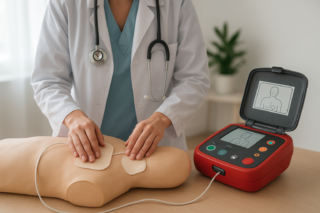
- Attach the pads to the person’s bare chest as shown on the diagrams.
- Make sure no one is touching the person while the AED analyzes the rhythm or delivers a shock.
- Immediately resume CPR when instructed.
AEDs are intended to guide ordinary bystanders through the process. Users should listen carefully and avoid unnecessary interruptions in chest compressions. If the device says that no shock is advised, that does not mean the emergency is over. Continue CPR and follow the AED’s prompts until emergency responders take over or the person shows clear signs of life.
Why CPR Still Matters When VF Is Shockable
Defibrillation treats the abnormal electrical rhythm, while CPR helps move some blood to the brain, heart, and other organs. CPR cannot usually correct VF by itself, but it can preserve circulation while an AED is obtained and may help the heart respond to defibrillation.
Every interruption in chest compressions reduces blood flow, so pauses should be limited to times when the AED is analyzing the rhythm or a shock is being delivered. CPR and defibrillation are complementary—not competing—treatments.
What Can Cause Ventricular Fibrillation?
VF may occur in people with known heart disease, but it can also be the first visible sign of an underlying cardiac problem. Possible contributors include:
- A heart attack or reduced blood supply to the heart muscle
- Cardiomyopathy or other structural heart disease
- Previous ventricular fibrillation or cardiac arrest
- Inherited or congenital electrical disorders
- Severe potassium or magnesium abnormalities
- Electrical injury or lightning strike
- Certain medications or toxic drug exposure
- Misuse of stimulants such as cocaine or methamphetamine
After resuscitation, clinicians may use an electrocardiogram, blood tests, heart imaging, coronary testing, and other evaluations to identify the cause. Some survivors may need medication, a procedure, or an implantable cardioverter-defibrillator, which monitors the rhythm and can treat a future dangerous ventricular arrhythmia.
When to Seek Care
Call 911 immediately if someone collapses, does not respond, and is not breathing normally. Begin CPR and use an AED as soon as one is available. Do not wait for a suspected diagnosis of VF before acting.
Chest pain, unexplained fainting, severe shortness of breath, or a rapid or irregular heartbeat accompanied by weakness or dizziness also warrants prompt medical attention. People who experience recurring palpitations or unexplained near-fainting should discuss them with a primary care physician or cardiologist, even if the symptoms resolve.
For additional background on abnormal heart rhythms, review this overview of arrhythmias and their symptoms.
The Essential Takeaway
Is VF shockable? Yes. Ventricular fibrillation is one of the principal shockable rhythms encountered during cardiac arrest. Rapid defibrillation may stop the chaotic electrical activity, while CPR maintains limited blood flow until an effective rhythm and circulation can be restored. Recognizing cardiac arrest, calling 911, starting compressions, and using an AED without delay can give the person the best available chance of survival.
Other Articles You May Find of Interest...
- Is Ventricular Fibrillation Shockable? Why Defibrillation Matters
- How to Apply a Tourniquet Correctly
- Pulseless V-Tach: Why Every Second Before the Shock Counts
- Exploring the Impact of Health Choices They Did Make
- Exploring the Impact of Health Choices They Did Make
- Exploring the Impact of Health Choices They Did Make
- Exploring the Impact of Health Choices They Did Make





