Your Health Magazine Contributor
4201 Northview Drive
Suite 102
Bowie, MD 20716
More Healthcare Administration Articles
Virtual Medical Receptionist: What AI Should Handle
It is 8:05 on a Monday morning. The phones at a small family practice have been ringing since 7:58.
One caller wants to move Thursday’s appointment. One wants to know if the practice takes her new insurance. One is asking where to park. Meanwhile, a patient is standing at the desk with a clipboard, waiting.
None of those calls is hard. All of them land at once, on the same two people, at the busiest hour of the day.
That is the problem a virtual medical receptionist is meant to solve. Not the medicine. The queue in front of it.
What Is a Virtual Medical Receptionist?
A virtual medical receptionist answers the routine questions a front desk handles all day: opening hours, directions, insurance plans accepted, what to bring to a first visit, and booking or rescheduling appointments.
The term covers two different things. Some practices hire a remote person who answers calls for them. Others use an AI medical receptionist, software that answers patients in a website chat, by text or on messaging apps, around the clock. Practices usually set one up as an AI front desk for medical practices that answers from their own information. This article is about that second kind, and about the rules that keep it safe.
How it differs from a medical answering service
A medical answering service is usually a team of people taking messages after hours and paging the on call doctor when needed. It is built for the urgent overnight call. A virtual medical receptionist is built for the routine daytime question, and it resolves many of them on the spot instead of taking a message.
| Option | Best at | Limits |
|---|---|---|
| Front desk staff | Judgment, empathy, complex cases | Busy at peak hours, closed at night |
| Medical answering service | Urgent after hours calls and on call paging | Takes messages rather than resolving routine questions |
| Voicemail | Nothing urgent, low cost | Patients wait, and many never leave a message |
| AI virtual medical receptionist | Routine questions and scheduling, any hour | Must never give clinical advice, and needs clear handoff rules |
The point of the table: none of these replaces the others. Most practices that use an AI receptionist keep their staff and their answering service, and simply take the routine load off both.
What the Front Desk Actually Spends Its Day On
Ask a practice manager to list the calls that interrupt the desk, and the same categories come up every time. Most of them have a written answer somewhere in the practice already.
Booking and rescheduling
This is usually the biggest category. A patient wants to move an appointment, check what is available next week, or book a follow up. Done by phone, it takes several minutes and often a call back.
Practical questions with fixed answers
Hours, holiday closures, parking, which entrance to use, which insurance plans the practice accepts, what to bring to a first visit. These answers rarely change, and a wrong answer is an inconvenience rather than a risk.
Questions that need a clinician
Symptoms, medication, test results, whether something can wait. These must never be answered by software. The job here is to route them to the right person quickly, with the patient’s question written down.
Where a Healthcare Chatbot Must Stop
A healthcare chatbot that answers the wrong kind of question is worse than no chatbot at all. Patient safety depends on drawing the line before launch, not after the first mistake.
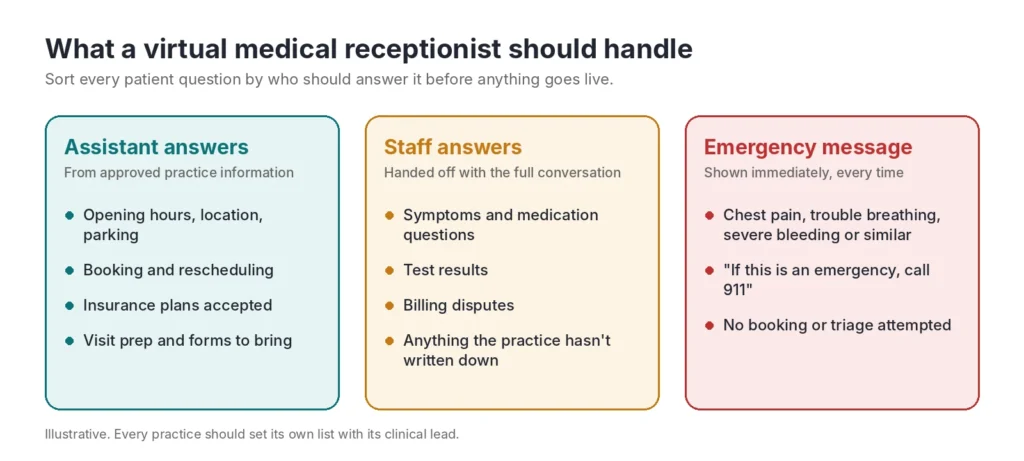
Sort every patient question by who should answer it before anything goes live.
No medical advice, ever
A medical chatbot on a practice website should not interpret symptoms, comment on medication, or explain results. Even a careful sounding answer can be wrong for that patient, and the patient may act on it. The right reply is to pass the question to the clinical team with the conversation attached.
An emergency message that cannot be missed
Any message that mentions chest pain, trouble breathing, severe bleeding or similar should trigger the same reply every time: if this is an emergency, call 911. No booking, no follow up questions, no attempt to triage.
Privacy rules come first
If a tool will handle patients’ health information on a practice’s behalf, the practice needs to understand its obligations before switching it on. The U.S. Department of Health and Human Services explains when a vendor counts as a business associate under HIPAA and when a written agreement is required. Until that is settled, the safest setup keeps the assistant to practice information and scheduling, and avoids collecting clinical details in the chat.
How AI Appointment Scheduling Works in Practice
AI appointment scheduling is the part patients notice most. Done well, it feels like texting a helpful receptionist who never puts you on hold.
The assistant checks the practice’s real availability, offers specific times, books the one the patient picks, and sends a confirmation. When a patient cancels, the slot is released straight away instead of sitting empty until someone listens to a voicemail.
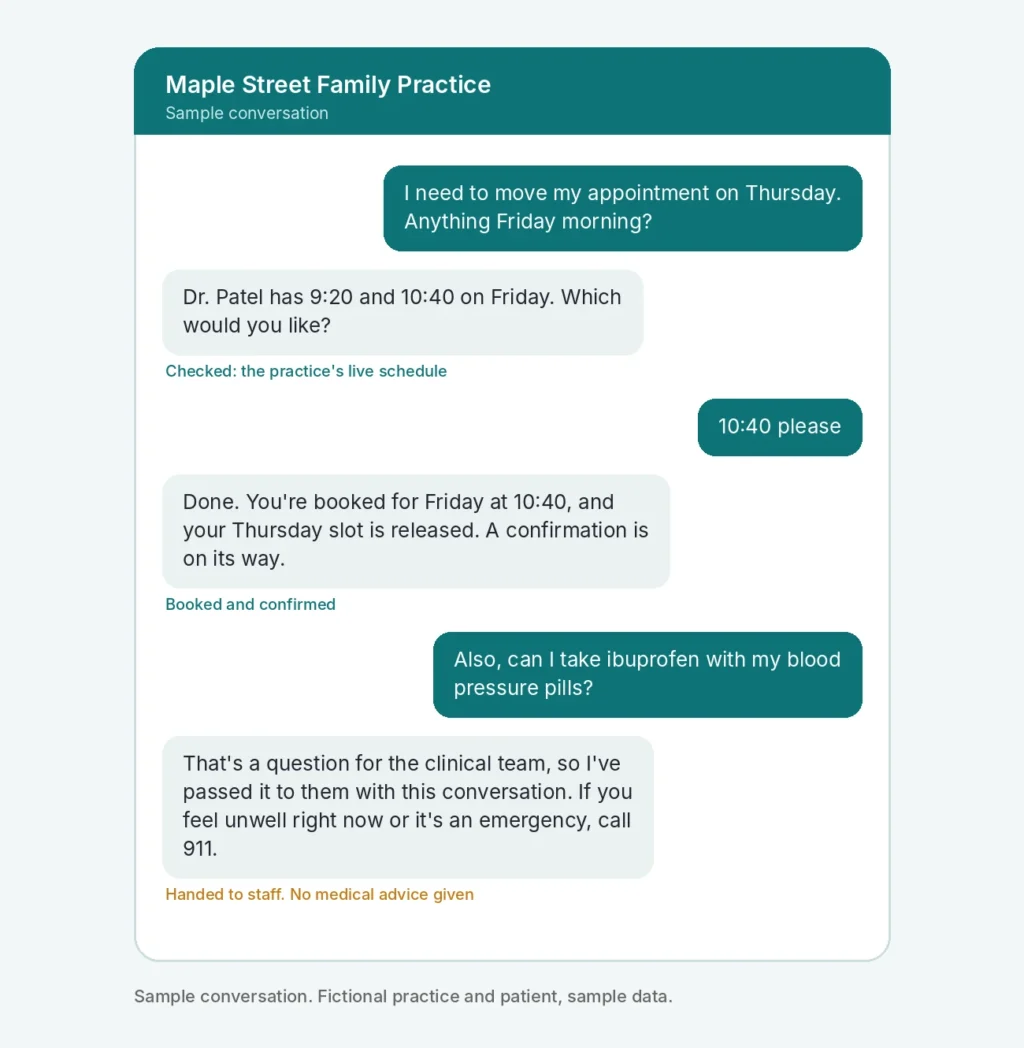
Sample conversation. Scheduling is handled in the chat, and the medication question goes straight to staff.
Making rescheduling easy reduces patient no shows
Many missed appointments are not forgetfulness. They are patients who could not get through on the phone to move a time that no longer worked. If changing an appointment takes one message instead of a call during office hours, more patients change it instead of simply not turning up. That is one of the most practical answers to how to reduce patient no shows: make the honest option the easy one.
A Worked Example: One Week at a Small Practice
Take a fictional practice with two providers. Every figure below is an assumption chosen for illustration, not measured data. Say it receives 600 patient contacts a week across phone, website and messages, and each routine contact takes about three minutes of staff time.
| Contact type | Per week | Handled by the assistant | Handed to staff |
|---|---|---|---|
| Booking and rescheduling | 210 | 168 | 42 |
| Hours, location and parking | 90 | 86 | 4 |
| Insurance accepted | 90 | 76 | 14 |
| Visit prep and forms | 60 | 54 | 6 |
| Billing questions | 60 | 18 | 42 |
| Symptoms, medication, results | 90 | 0 | 90 |
| Total | 600 | 402 | 198 |
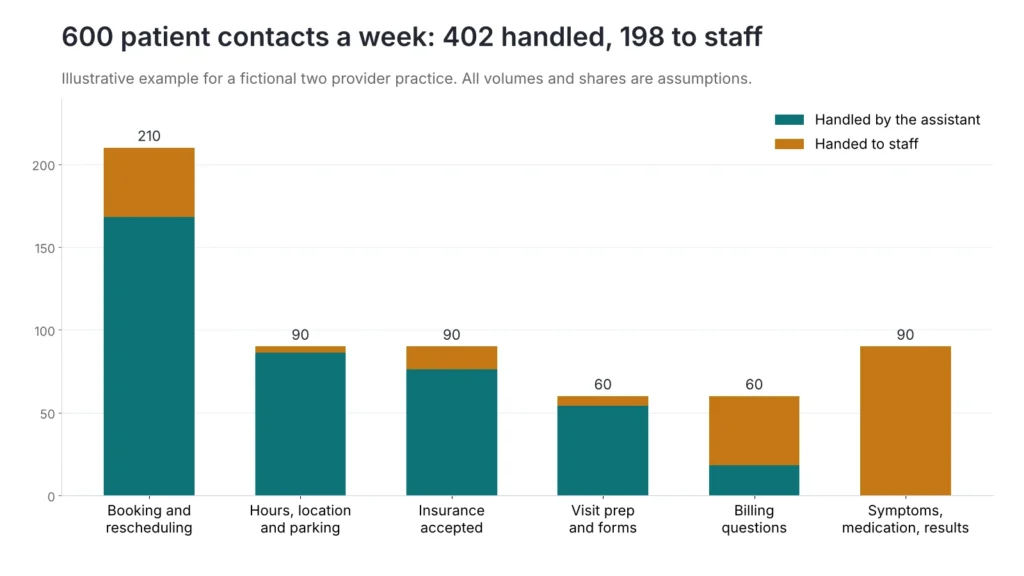
Illustrative example. Every clinical question still goes to staff.
What that means: about 67% of contacts are routine enough for the assistant. At three minutes each, 402 contacts is roughly 20 hours of front desk time a week.
What it doesn’t mean: every one of the 90 clinical contacts still reaches a person, and so do most billing questions. The assistant doesn’t replace the front desk. It gives those 20 hours back to the patients standing in front of it.
Patient Communication Still Needs People
Good patient communication is not just fast answers. It is the receptionist who notices a regular patient sounds worried, or remembers that someone always needs the ground floor room.
An assistant should protect that, not compete with it. Keep anything sensitive, anything emotional and anything clinical with people, and judge the assistant by one measure: whether your staff have more time for the patients who need them.
Frequently Asked Questions
What is a virtual medical receptionist?
It is a service that handles a practice’s routine front desk questions remotely. It can be a remote person, or AI software that answers patients by chat or text, books appointments and passes clinical questions to staff.
Can AI book doctor appointments?
Yes, when it is connected to the practice’s schedule. It can offer real times, book the one the patient chooses and send a confirmation. Anything beyond scheduling, such as whether a visit is needed, should stay with staff.
Can a chatbot give medical advice?
It shouldn’t. A chatbot on a practice website should answer practical questions only, pass clinical questions to the care team, and show an emergency message whenever a patient describes urgent symptoms.
Is it safe to use a medical chatbot?
It can be, when it answers only from approved practice information, never gives clinical advice, hands sensitive questions to people, and the practice has checked its privacy obligations with the vendor.
How do you reduce patient no shows?
Send clear reminders, and make rescheduling as easy as possible. When moving an appointment takes one message rather than a phone call during office hours, more patients reschedule instead of missing the visit.
What This Comes Down To
The phones at 8:05 on a Monday were never really about medicine. They were about parking, insurance and Thursday’s appointment.
A virtual medical receptionist takes those questions off the desk and leaves everything clinical where it belongs, with people. Get the boundaries right, and the next Monday morning sounds a lot quieter, and the patient at the desk gets someone’s full attention.
About the Author
Omar El Bahr is a Senior Digital Growth Specialist at Agentency, where he leads SEO, content strategy, and organic growth across international markets. He is a Forbes Communications Council contributor and has written for Entrepreneur on business communication and digital strategy.
Disclaimer: This article is for general information only and is not medical, legal or compliance advice. The practice, worked example and sample conversation are illustrative. Agentency features are described as of November 2026.
Other Articles You May Find of Interest...
- Common Maintenance Mistakes That Can Make Medical Facilities Less Welcoming
- Virtual Medical Receptionist: What AI Should Handle
- How Preventive Healthcare Is Changing the Way Hospitals Manage Patient Care
- How Healthcare Organizations Can Choose a Data Analytics Company in 2026
- How Credentialing Gaps Turn Into Unpaid Claims in Mental Health Practices
- Acute vs Subacute Rehab: Financial Evaluation Guide for Family Caregivers
- The Financial Challenges of Running an Independent Healthcare Practice