Your Health Magazine Contributor
4201 Northview Drive
Suite 102
Bowie, MD 20716
More Vision & Eye Care Articles
The Subtle Ways City Living Messes With Your Vision (And How to Fix It)

What City Eyes Need to Know
– City life stacks four strains on your eyes at once: long hours on screens, dry and polluted air, harsh artificial light and chronic stress.
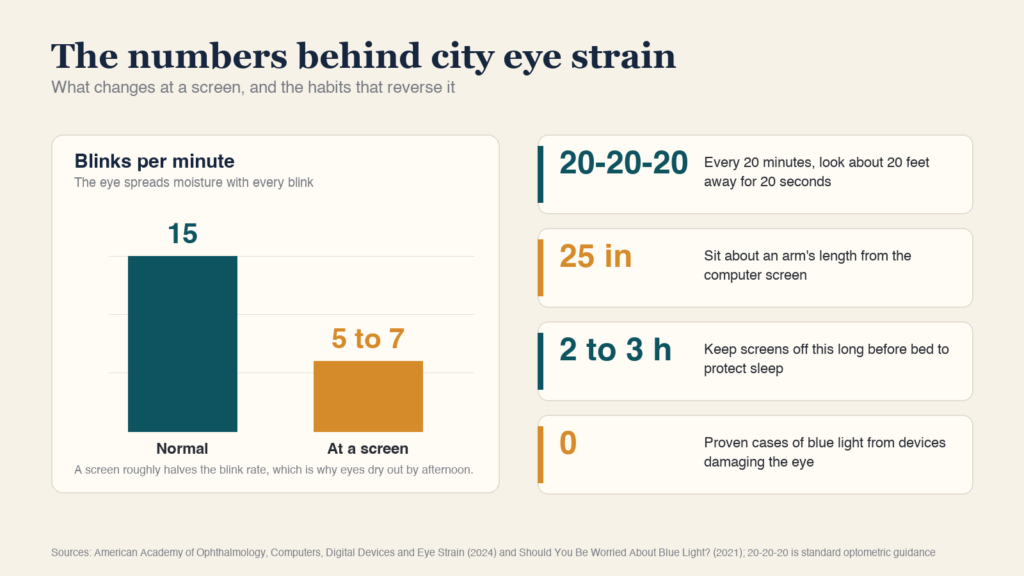
– You blink about 15 times a minute normally, but only 5 to 7 times a minute at a screen, which is why dryness and blur creep in by mid-afternoon.
– Blue light from devices has not been shown to damage the eye, but it does push back sleep when screens run late into the evening.
– A few habits relieve most of the discomfort: regular distance breaks, an arm’s-length screen, conscious blinking, hydration and a screen-free wind-down.
– A routine eye exam catches the changes you have stopped noticing, and it is the step most people skip.
Living in a dense city asks more of your eyes than any other place you spend time, because the strain arrives from several directions at once. Screens hold your focus at close range all day, the air dries the surface of the eye, artificial light never lets it rest, and urban stress tightens everything further. Together they produce the tired, gritty, slightly blurred feeling that many city dwellers now treat as normal. The encouraging part is that each strain has a simple counter, and the eye recovers quickly when you give it the chance.
Why do screens leave city eyes so tired?
Most urban work and most of the commute now happen on a backlit screen, which keeps the focusing muscles locked at close range for hours. The American Academy of Ophthalmology notes that people normally blink about 15 times a minute. At a computer or phone, studies show, that figure falls to about 5 to 7 blinks a minute. Blinking is how the eye spreads moisture across its surface, so halving the rate leaves it dry, and dryness is what you feel as burning, grit and blur by late afternoon.
The micro-habits matter as much as the hours. Holding a phone too close, squinting at a small font, or leaning into a laptop on a crowded train all add load the eye carries for the rest of the day. The Academy’s guidance is to sit about 25 inches from a computer screen, roughly arm’s length, with your gaze falling slightly downward.
Is the city air itself part of the problem?
It is, and this is the strain people rarely connect to their eyes. The Canadian Association of Optometrists lists air pollution, wind and low humidity among the environmental conditions that contribute to dry eye, alongside aging, hormonal changes and certain medications. A thin film of tears coats the eye, and when that film breaks down the result is redness, stinging and the sense of something caught under the eyelid.
Older office buildings make it worse, because forced heat in winter and air conditioning in summer both strip moisture from the air. Contact lens wearers usually notice first, since a lens sits directly in the tear film and depends on it staying intact. The National Eye Institute describes dry eye as common, affecting millions of people every year, and lists lifestyle changes as part of the standard treatment. That is good news for anyone whose environment is the main trigger.
Does urban lighting really affect how you see?
City light is a paradox of too much and not enough. Streets glow under LEDs that never dim, offices run on flat artificial brightness, and at night the building across the street keeps the bedroom from going fully dark. The eye evolved under daylight that shifts through the day, and it uses that shift to set its own rhythm.
The science here is calmer than the headlines. The Academy’s review of the evidence found no proof that blue light from digital devices damages the eye, and it does not recommend blue-light-blocking glasses for computer use. What blue light does affect is the body’s wake and sleep cycle, so heavy screen use late at night makes it harder to fall asleep. Poor sleep then leaves the eyes feeling worse the next morning. The Academy’s advice is to limit screen time in the two to three hours before bed and to use night settings in the evening.
Stress belongs in the same conversation, because tense people stare harder, blink less and skip breaks. The strain and the stress feed each other, which is why easing one often eases the other.
How do you fix it without leaving the city?
Relief comes from habits rather than from moving to the countryside, and the habits are small enough to keep.
Give the eyes a distance view
Every 20 minutes, look at something about 20 feet away for at least 20 seconds, a routine optometrists call the 20-20-20 rule. It resets the focusing muscles and reminds you to blink. Make blinking a conscious act during long screen sessions, and keep lubricating drops at your desk if dryness is a daily pattern.
Fix the screen, the light and the air
Set screen brightness to match the room, cut glare with a matte filter, and keep the screen at arm’s length. At home, swap harsh overhead bulbs for softer, layered lighting, and get outside in daylight when you can. If the office air is dry, a small humidifier near your desk helps more than it looks like it should.
Feed and water the eyes
Hydration shows up in the tear film faster than most people expect, and heavy caffeine with skipped water works against it. A 2022 review in the journal Nutrients found that omega-3 fatty acids are well documented for treating dry eye disease, with several other nutrients showing promise against digital eye strain. A diet with oily fish, leafy greens and colourful fruit is a sensible part of the plan.
Book the exam you keep postponing
Vision changes slowly, and the eye compensates so well that most people cannot tell when they have slipped. A routine exam catches the shifts you have stopped noticing, from early dryness to a prescription that has quietly drifted. If you live in a dense downtown, look for a practice that treats dry eye and screen strain as part of the standard visit, the way a trusted Toronto eye clinic builds those checks into every routine exam.
The long game for city eyes
The city will keep glowing, the air will keep drying and the screens are not going anywhere, so the goal is to adapt rather than to escape. Comfortable vision in an urban life is maintenance work in small, repeated doses, and it pays back in fewer headaches and better sleep. The world looks different when your eyes are not fighting to keep up with it.
Frequently Asked Questions
How can I tell whether my tired eyes are dryness or something more serious?
Dryness usually feels like burning, grit or blur that eases after rest, drops or a break from screens. Sudden vision changes, persistent pain, flashes or a shadow across your sight are different, and they need an urgent appointment rather than a wait-and-see approach.
Do blue-light glasses help with screen strain?
The American Academy of Ophthalmology does not recommend them for computer use, because the discomfort people feel at screens comes mostly from reduced blinking and close focus. Breaks, blinking and distance do more than tinted lenses.
How often should a city dweller get an eye exam?
For most healthy adults an exam every one to two years is the usual guidance, and sooner if dryness, headaches or blur have become a daily pattern. An optometrist will set the right interval for your age, health and the screen time your work demands.
Other Articles You May Find of Interest...
- The Subtle Ways City Living Messes With Your Vision (And How to Fix It)
- Smart Glasses With Prescription Lenses: Fit, Comfort and Everyday Use
- Can Blepharoplasty Improve Peripheral Vision? What Patients Should Know
- What Causes Blood Clots in the Eye?
- Can You Have Laser Eye Surgery With Glaucoma?
- Why Are Contact Lens Users Asked to Stop Wearing Lenses before Laser Eye Surgery Tests?
- What Credentials to Look for When Searching for the Right Eye Doctor in New York