Your Health Magazine Contributor
4201 Northview Drive
Suite 102
Bowie, MD 20716
More Practice Management Articles
How to Do Payroll for a Small Medical Practice (and Keep Petty Cash Under Control)
It’s Friday at a small dental office. Payroll is due by noon.
The office manager counts the petty cash box before lunch. It should hold $87.60. It holds $74.00.
Nobody took anything. Nobody wrote anything down either.
Running a practice means two kinds of money leave the building every week: the big, scheduled kind called payroll, and the small, forgettable kind called petty cash. Both need a system.
Quick answer: To do payroll for a small medical practice, register for an EIN, collect a Form W-4 from each employee, set a pay schedule, calculate gross pay and withholdings, deposit employment taxes, and file Form 941 every quarter. Run petty cash as a fixed fund with a receipt for every payment and a count before every top-up.
How to Do Payroll for a Small Business (When That Business Is a Practice)
A clinic is a small business with a waiting room, so how to do payroll for small business owners applies almost unchanged. The difference is the overtime rules, which we’ll get to.
1- Get an EIN. The IRS needs a valid employer identification number on every employment tax return and payment. Without it, the return isn’t processed.
2- Collect a Form W-4 from each employee. It tells you how much federal income tax to withhold. Ask every new hire to complete one on day one.
3- Choose a pay schedule. Weekly, biweekly or semimonthly. Pick one and keep it predictable, because staff plan their rent around it.
4- Calculate gross pay, then withholdings. Hours times rate, plus overtime, then subtract federal income tax, Social Security and Medicare.
5- Deposit and file. Deposit employment taxes on your required schedule, file Form 941 every quarter and Form 940 once a year.
6- Keep the records. The IRS says to keep all employment tax records for at least four years after filing the fourth quarter for the year.
Tip: if your practice has a small staff, a spreadsheet can help organize hours, gross pay, deductions and payroll records. A simple payroll spreadsheet built for small teams can provide a starting point, but employers are still responsible for using current tax rules, making required deposits and filing payroll tax returns on time.
What Payroll Taxes Do Employers Pay?
Wages are only part of the bill. Here’s what sits on top, according to IRS Topic 751 and the federal unemployment rules.
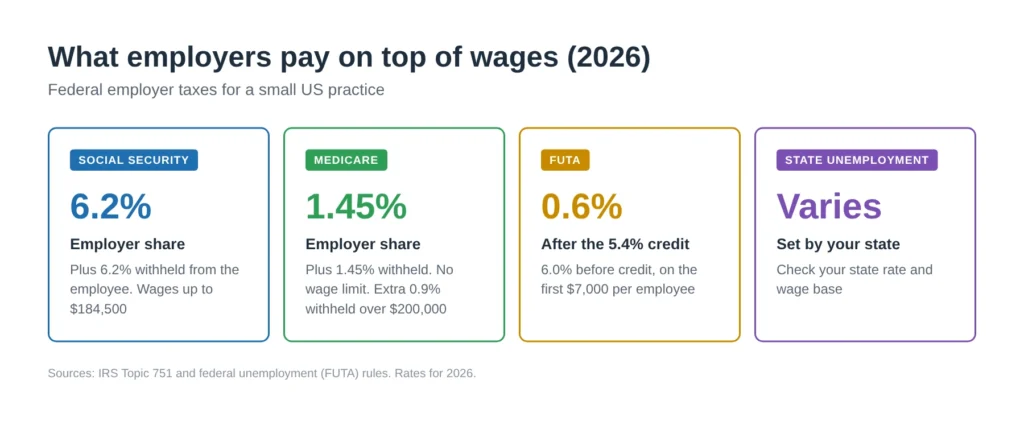
Image file: employer-payroll-taxes-2026.png | Alt text: Employer payroll taxes for 2026: Social Security 6.2%, Medicare 1.45%, FUTA 0.6% after credit, plus state unemployment
| Tax | Employer pays | Employee pays | Limit |
| Social Security | 6.2% | 6.2% | Wages up to $184,500 in 2026 |
| Medicare | 1.45% | 1.45% | No limit |
| Additional Medicare Tax | Nothing | 0.9% | Withheld on wages over $200,000 |
| FUTA | 6.0%, usually 0.6% after the credit | Nothing | First $7,000 per employee |
The FUTA credit of up to 5.4% depends on your state’s unemployment program, so check your state rate as well.
Worked Example: One Biweekly Paycheck
Maria (a fictional front desk coordinator) earns $1,600 gross for the period.
| Item | Calculation | Amount |
| Employer Social Security | $1,600 × 6.2% | $99.20 |
| Employer Medicare | $1,600 × 1.45% | $23.20 |
| Employer FUTA (after credit) | $1,600 × 0.6% | $9.60 |
| Employer cost on top of wages | $132.00 |
The same $99.20 and $23.20 also come out of Maria’s paycheck, plus her federal income tax. Assuming the employer qualifies for the full FUTA credit, the standard 0.6% FUTA rate applies only to the first $7,000 of wages, for a maximum of $42 per employee before any credit-reduction adjustment.
So a $1,600 paycheck really costs the practice $1,732 before state taxes. Budget for that number, not the one on the offer letter.
Overtime in Healthcare Payroll: The 8 and 80 Rule
This is where healthcare payroll parts ways with everyone else.
Under the Fair Labor Standards Act, most employers pay time and a half for hours over 40 in a workweek. But the Department of Labor’s Fact Sheet 54 allows hospitals and residential care establishments to use the 8 and 80 system instead: overtime for hours over 8 in a workday and over 80 in a fixed 14-day period.
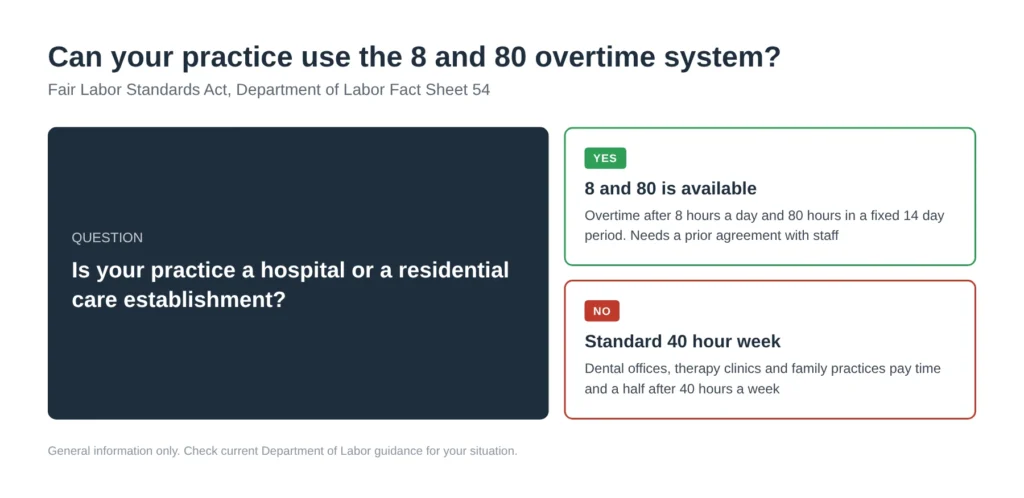
Image file: healthcare-overtime-8-and-80.png | Alt text: Decision chart: only hospitals and residential care establishments can use the 8 and 80 overtime system
Notice who isn’t on that list. A dental office, a physical therapy clinic or a family practice is not a hospital. If that’s you, the 40-hour week applies.
Even eligible employers need an agreement with staff before the work is done, and the 14-day period must be fixed and recurring.
Worked Example: Overtime at an Outpatient Clinic
A medical assistant earns $24 an hour and works 44 hours in one week.
| Hours | Rate | Pay |
| 40 regular | $24 | $960 |
| 4 overtime | $36 | $144 |
| Total | $1,104 |
What Is Petty Cash in a Medical Practice?
Petty cash is a small, fixed amount of cash kept on site for minor expenses not worth a card payment. In a practice, that might be:
- Parking or tolls for a home visit
- Postage or a courier for lab paperwork
- A small office supply run
What it should never pay: wages, tips or bonuses to staff. Pay is pay, whether it comes from direct deposit or the cash box, and it still has to run through payroll.
A good petty cash policy fits on one page:
- One custodian who holds the key and signs off every payment
- A fixed float, set by what you actually spend in two to four weeks
- A receipt or voucher for every dollar out
- A spending cap per transaction
- A count before every top-up
How much should the petty cash fund be? Big enough to last a few weeks, small enough that losing it wouldn’t hurt. For many small practices, a few hundred dollars covers it.
How to Reconcile Petty Cash
Here’s how to reconcile petty cash without guesswork.
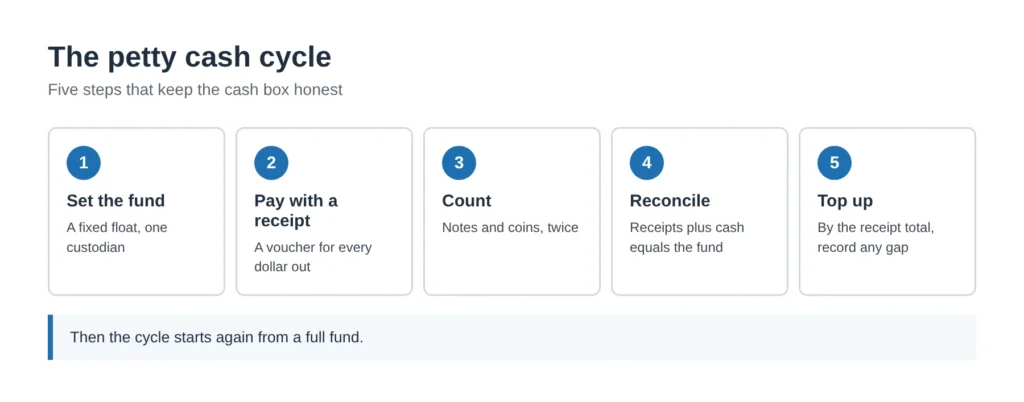
Image file: petty-cash-cycle.png | Alt text: The petty cash cycle: set the fund, pay with a receipt, count, reconcile, top up
1- Add up the receipts. Every voucher since the last top-up.
2- Count the cash. Notes and coins, twice.
3- Compare. Receipts plus cash should equal the original fund.
4- Record any difference. Over or short, it gets written down, not absorbed.
5- Top up by the receipt total. That brings the box back to its fixed amount.
A petty cash tracking template does steps 1 to 4 in one sheet, so the count takes minutes instead of an afternoon.
Worked Example: The Box That Came Up Short
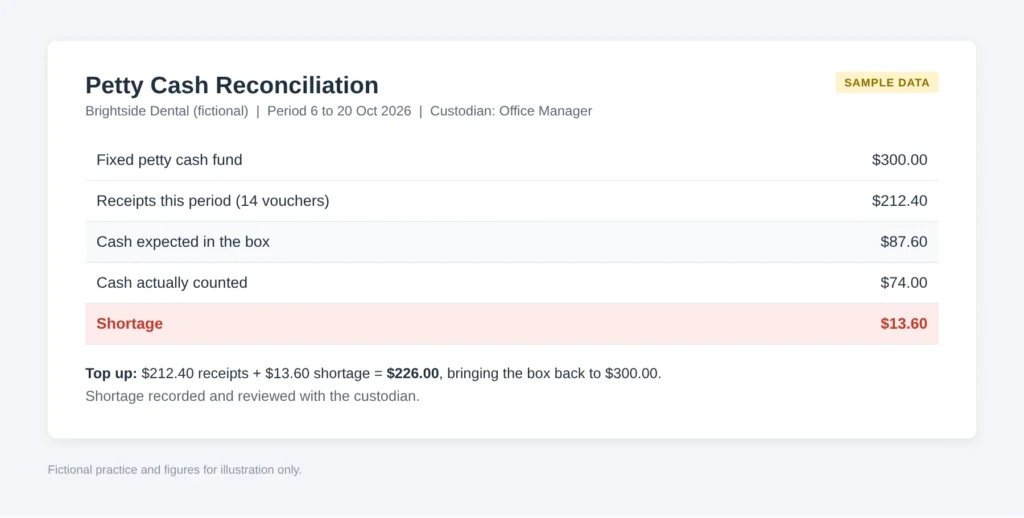
Image file: petty-cash-reconciliation-example.png | Alt text: Sample petty cash reconciliation: $300 fund, $212.40 receipts, $74.00 counted, $13.60 short
| Item | Amount |
| Fixed petty cash fund | $300.00 |
| Receipts this period | $212.40 |
| Cash expected in the box | $87.60 |
| Cash actually counted | $74.00 |
| Shortage | $13.60 |
Small enough to ignore. Big enough to tell you a receipt went missing. Record it as a shortage, top up by $212.40 in receipts plus the $13.60 gap, and ask the custodian what changed.
Common Mistakes
✗ Paying staff from the cash box. It skips withholding. Fix: every dollar of pay goes through payroll.
✗ Using 8 and 80 at a clinic. Only hospitals and residential care qualify. Fix: stick to the 40-hour week.
✗ Missing a Form 941 deadline. They fall on April 30, July 31, October 31 and January 31. Fix: set reminders a week ahead.
✗ No petty cash custodian. Shared keys mean shared blame. Fix: one person, one signature.
Where Software Fits
Medical practice payroll for eight staff and one cash box can run on spreadsheets. A practice with three locations, shift work and staff expenses usually can’t.
As a practice grows, software can help consolidate payroll, attendance, expenses and accounting records that may otherwise be maintained separately. Platforms such as Enerpize combine several of these business functions in one system, while other practices may use separate payroll and accounting tools depending on their needs.
Key Takeaways
- Employers pay 6.2% Social Security and 1.45% Medicare on top of wages, with Social Security capped at $184,500 of wages in 2026.
- FUTA is 6.0% on the first $7,000 per employee, usually 0.6% after the credit, or $42 a year.
- A $1,600 paycheck costs the practice about $1,732 before state taxes.
- Only hospitals and residential care establishments can use the 8 and 80 overtime system.
- Keep employment tax records for at least 4 years after filing the fourth quarter.
- Reconcile petty cash before every top-up, and record every shortage, even $13.60.
Frequently Asked Questions
Can I do my own payroll for my small business?
Yes. If you know how to do payroll for a small business, you can run it for a practice. You need an EIN, a Form W-4 for each employee, a pay schedule, and a reliable way to calculate withholdings and file Form 941 every quarter.
What payroll taxes do employers pay?
Employers pay 6.2% Social Security, 1.45% Medicare and federal unemployment tax (FUTA), plus any state unemployment tax. Employees pay their own matching Social Security and Medicare shares through withholding.
How often should a medical practice run payroll?
There’s no single federal rule. Most small practices pay weekly or biweekly. Check your state, because many states set a minimum pay frequency.
Can a clinic use the 8 and 80 overtime system?
Usually not. The Department of Labor limits it to hospitals and residential care establishments. Outpatient clinics and private practices use the standard 40-hour workweek.
What is petty cash used for in a practice?
Small, occasional costs such as parking for a home visit, postage, couriers or office supplies. Never wages.
How much petty cash can a business have?
There’s no legal limit. Set the fund at what you actually spend in two to four weeks, and keep it small enough that a loss wouldn’t hurt.
Can you pay employees from petty cash?
You shouldn’t. Pay must run through payroll so taxes are withheld and reported, whatever form the money takes.
How long should payroll records be kept?
The IRS says at least four years after filing the fourth quarter for the year. Records for certain credits should be kept for six years.
Back to Friday
Same dental office. Next Friday.
Payroll goes out at ten, with every hour and every tax line where it should be. The petty cash box holds exactly what the sheet says it should.
Nobody had to guess. That’s the whole point of a system.
About the Author
Omar El Bahr is a Senior Digital Growth Specialist at Enerpize, where he leads SEO, content strategy, and organic growth across international markets. He is a Forbes Communications Council contributor and has written for Entrepreneur on business communication and digital strategy.
Disclaimer: This article is general information, not tax, legal or payroll advice. Tax rates and rules change, and state requirements vary. Check current IRS and Department of Labor guidance, or speak with an accountant, before making payroll decisions.
Other Articles You May Find of Interest...
- Prior Authorization Services for Orthopedic Practices: Six Options to Consider
- How to Do Payroll for a Small Medical Practice (and Keep Petty Cash Under Control)
- Digital Process Automation Built Around Forms: What IT Directors Should Evaluate
- How AI and Automation Are Reshaping Revenue Cycle Management
- Pre-Employment Testing Tools for Healthcare Hiring: What to Consider
- How Custom EHR Systems Are Reducing Physician Burnout
- A Beginner’s Guide to Revenue Cycle Management for Oral Surgery Practices